Page 437 of 525
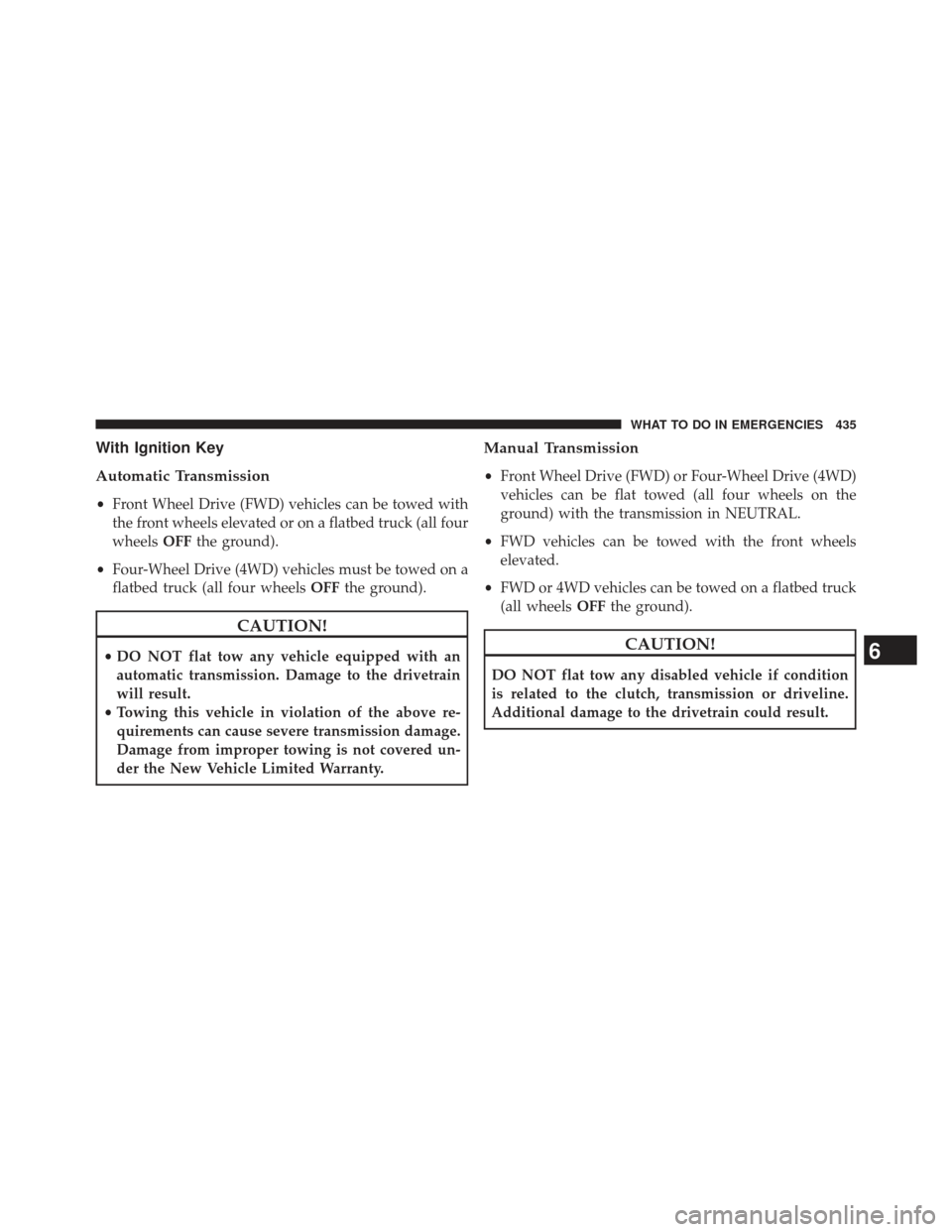
With Ignition Key
Automatic Transmission
•Front Wheel Drive (FWD) vehicles can be towed with
the front wheels elevated or on a flatbed truck (all four
wheels OFFthe ground).
• Four-Wheel Drive (4WD) vehicles must be towed on a
flatbed truck (all four wheels OFFthe ground).
CAUTION!
•DO NOT flat tow any vehicle equipped with an
automatic transmission. Damage to the drivetrain
will result.
• Towing this vehicle in violation of the above re-
quirements can cause severe transmission damage.
Damage from improper towing is not covered un-
der the New Vehicle Limited Warranty.
Manual Transmission
• Front Wheel Drive (FWD) or Four-Wheel Drive (4WD)
vehicles can be flat towed (all four wheels on the
ground) with the transmission in NEUTRAL.
• FWD vehicles can be towed with the front wheels
elevated.
• FWD or 4WD vehicles can be towed on a flatbed truck
(all wheels OFFthe ground).
CAUTION!
DO NOT flat tow any disabled vehicle if condition
is related to the clutch, transmission or driveline.
Additional damage to the drivetrain could result.
6
WHAT TO DO IN EMERGENCIES 435
Page 438 of 525
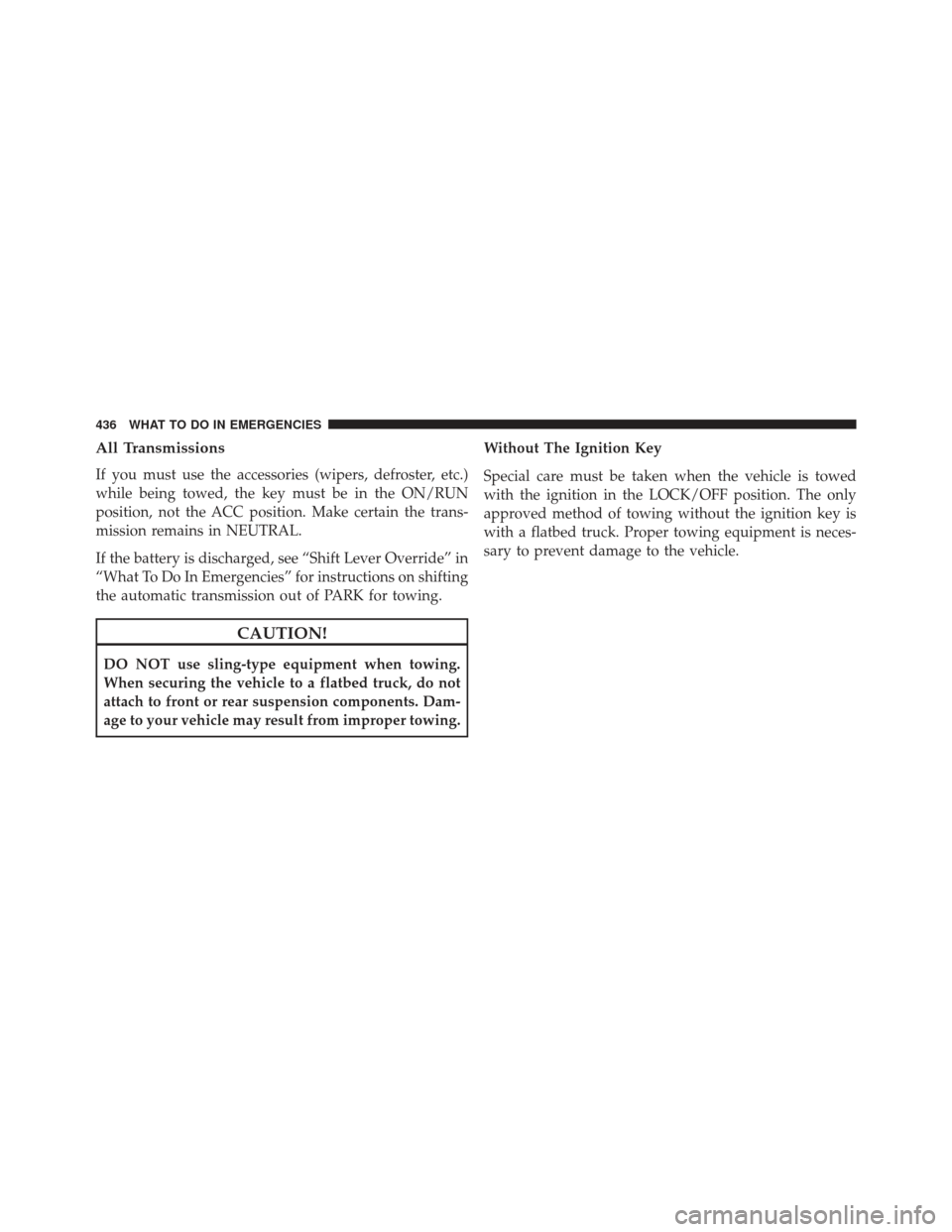
All Transmissions
If you must use the accessories (wipers, defroster, etc.)
while being towed, the key must be in the ON/RUN
position, not the ACC position. Make certain the trans-
mission remains in NEUTRAL.
If the battery is discharged, see “Shift Lever Override” in
“What To Do In Emergencies” for instructions on shifting
the automatic transmission out of PARK for towing.
CAUTION!
DO NOT use sling-type equipment when towing.
When securing the vehicle to a flatbed truck, do not
attach to front or rear suspension components. Dam-
age to your vehicle may result from improper towing.Without The Ignition Key
Special care must be taken when the vehicle is towed
with the ignition in the LOCK/OFF position. The only
approved method of towing without the ignition key is
with a flatbed truck. Proper towing equipment is neces-
sary to prevent damage to the vehicle.
436 WHAT TO DO IN EMERGENCIES
Page 443 of 525
ONBOARD DIAGNOSTIC SYSTEM — OBD II
Your vehicle is equipped with a sophisticated onboard
diagnostic system called OBD II. This system monitors
the performance of the emissions, engine, and automatic
transmission control systems. When these systems are
operating properly, your vehicle will provide excellent
performance and fuel economy, as well as engine emis-
sions well within current government regulations.
If any of these systems require service, the OBD II system
will turn on the “Malfunction Indicator Light” (MIL).
It will also store diagnostic codes and other information
to assist your service technician in making repairs. Al-
though your vehicle will usually be drivable and not
need towing, see your authorized dealer for service as
soon as possible.
CAUTION!
•Prolonged driving with the MIL on could cause
further damage to the emission control system.
It could also affect fuel economy and drivability.
The vehicle must be serviced before any emissions
tests can be performed.
• If the MIL is flashing while the engine is running,
severe catalytic converter damage and power loss
will soon occur. Immediate service is required.
Loose Fuel Filler Cap Message
After fuel is added, the vehicle diagnostic system can
determine if the fuel filler cap is possibly loose or
improperly installed. A “gASCAP” message will be dis-
played in the instrument cluster. Tighten the gas cap until
a �clicking� sound is heard. This is an indication that the7
MAINTAINING YOUR VEHICLE 441
Page 458 of 525
Under normal operating conditions, the catalytic con-
verter will not require maintenance. However, it is im-
portant to keep the engine properly tuned to assure
proper catalyst operation and prevent possible catalyst
damage.
NOTE:Intentional tampering with emissions control
systems can result in civil penalties being assessed
against you.
In unusual situations involving grossly malfunctioning
engine operation, a scorching odor may suggest severe
and abnormal catalyst overheating. If this occurs, stop
the vehicle, turn off the engine and allow it to cool.
Service, including a tune-up to manufacturer’s specifica-
tions, should be obtained immediately. To minimize the possibility of catalytic converter dam-
age:
•
Do not shut off the engine or interrupt the ignition,
when the transmission is in gear and the vehicle is in
motion.
• Do not try to start the engine by pushing or towing the
vehicle.
• Do not idle the engine with any spark plug wires
disconnected or removed, such as when diagnostic
testing, or for prolonged periods during very rough
idle or malfunctioning operating conditions.
456 MAINTAINING YOUR VEHICLE
Page 492 of 525
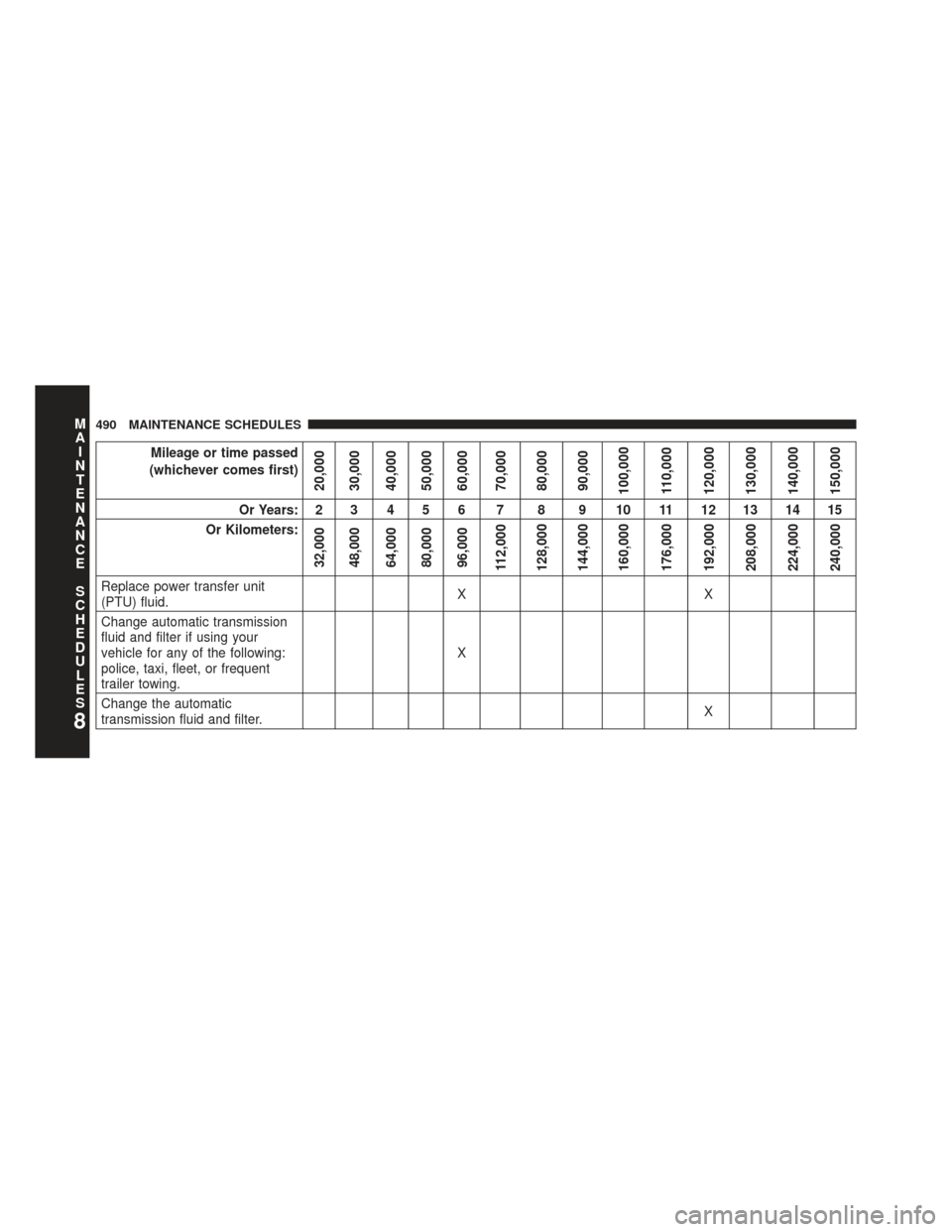
Mileage or time passed
(whichever comes first)
20,000
30,000
40,000
50,000
60,000
70,000
80,000
90,000
100,000
110,000
120,000
130,000
140,000
150,000
Or Years: 2 3 4 5 6 7 8 9 10 11 12 13 14 15
Or Kilometers:
32,000
48,000
64,000
80,000
96,000
112,000
128,000
144,000
160,000
176,000
192,000
208,000
224,000
240,000
Replace power transfer unit
(PTU) fluid. XX
Change automatic transmission
fluid and filter if using your
vehicle for any of the following:
police, taxi, fleet, or frequent
trailer towing. X
Change the automatic
transmission fluid and filter. X
8
M
A I
N T
E
N
A
N
C E
S
C
H E
D
U L
E
S490 MAINTENANCE SCHEDULES
Page 493 of 525
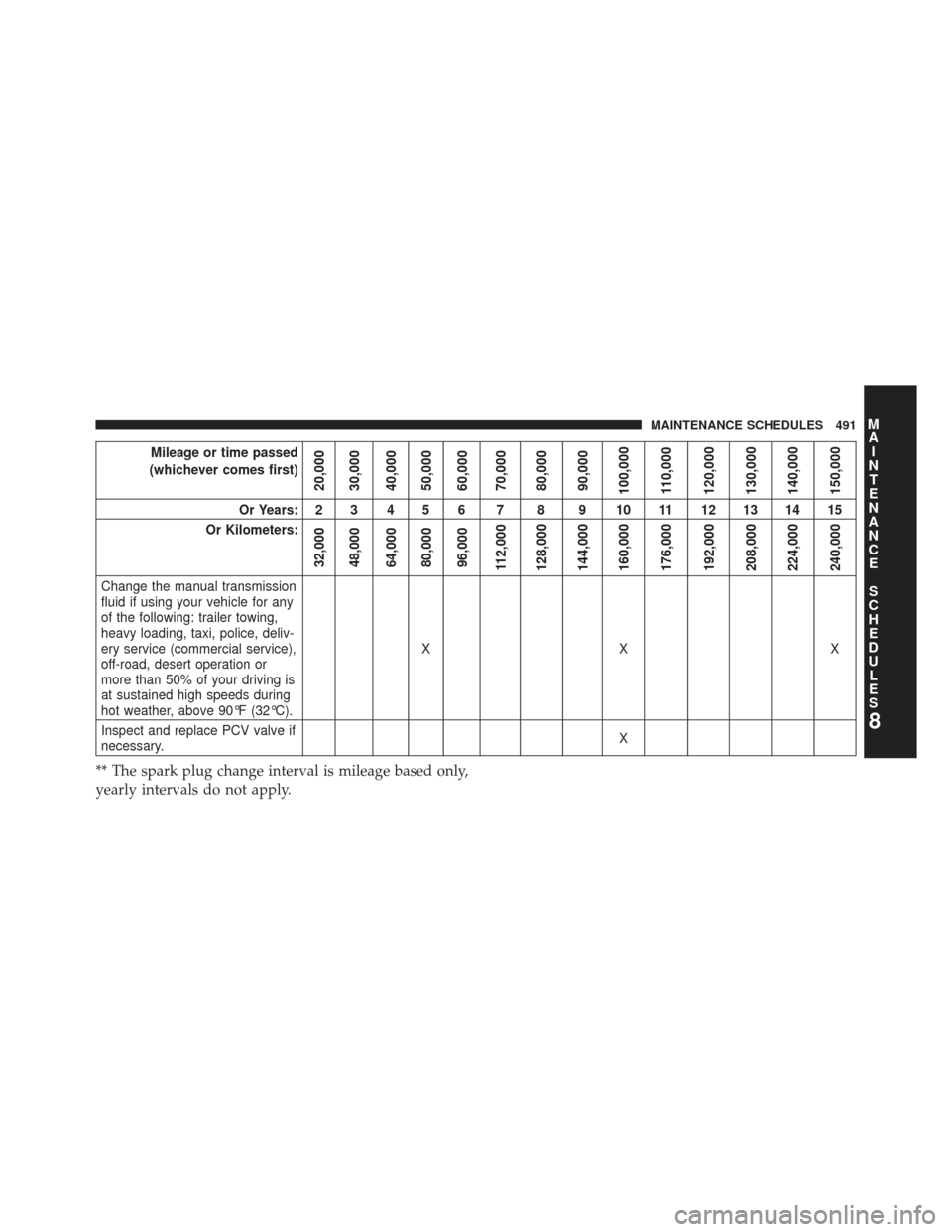
Mileage or time passed
(whichever comes first)
20,000
30,000
40,000
50,000
60,000
70,000
80,000
90,000
100,000
110,000
120,000
130,000
140,000
150,000
Or Years: 2 3 4 5 6 7 8 9 10 11 12 13 14 15
Or Kilometers:
32,000
48,000
64,000
80,000
96,000
112,000
128,000
144,000
160,000
176,000
192,000
208,000
224,000
240,000
Change the manual transmission
fluid if using your vehicle for any
of the following: trailer towing,
heavy loading, taxi, police, deliv-
ery service (commercial service),
off-road, desert operation or
more than 50% of your driving is
at sustained high speeds during
hot weather, above 90°F (32°C). XX X
Inspect and replace PCV valve if
necessary. X
** The spark plug change interval is mileage based only,
yearly intervals do not apply.
8
M
A I
N T
E
N
A
N
C E
S
C
H E
D
U L
E
SMAINTENANCE SCHEDULES 491
Page 506 of 525

ABS (Anti-Lock Brake System)................344
Adding Engine Coolant (Antifreeze) ............458
Adding Fuel ............................ .394
Adding Washer Fluid ..................... .453
Additives, Fuel .......................... .392
Airbag ..................................61
Airbag Deployment ........................71
Airbag Light .............................68
Airbag Maintenance ........................73
Airbag, Side ..............................64
Airbag, Window (Side Curtain) ................65
Air Cleaner, Engine (Engine Air Cleaner Filter) . . . .448
Air Conditioner Maintenance .................450
Air Conditioning ......................... .296
Air Conditioning Controls ...................296
Air Conditioning Filter .....................307
Air Conditioning, Operating Tips ..............308
Air Conditioning Refrigerant .................450
Air Conditioning System ....................296 Air Pressure, Tires
........................ .369
Alarm Light ............................ .217
Alarm System (Security Alarm) ................18
Alterations/Modifications, Vehicle ...............8
Antenna, Satellite Radio .....................256
Antifreeze (Engine Coolant) ..................458
Capacities ........................... .481
Disposal ............................ .460
Anti-Lock Brake System (ABS) ................344
Anti-Lock Warning Light ....................214
Anti-Theft Security Alarm (Theft Alarm) ..........18
Appearance Care ........................ .468
Assistance Towing ........................ .125
Automatic Dimming Mirror ..................108
Automatic Door Locks ......................31
Automatic Temperature Control (ATC) ..........300
Automatic Transaxle ........................12
Automatic Transmission ....................319
Fluid and Filter Changes .................466
504 INDEX
Page 510 of 525
Traction Control System..................346
Electronic Speed Control (Cruise Control) ........172
Electronic Stability Control (ESC) ..............352
Electronic Vehicle Information Center (EVIC) ......228
Emergency, In Case of Jacking ............................. .415
Jump Starting ........................ .427
Towing ............................. .434
Emission Control System Maintenance ..........442
Engine ................................ .439
Air Cleaner .......................... .448
Block Heater ......................... .316
Break-In Recommendations ................96
Checking Oil Level .....................445
Coolant (Antifreeze) .....................457
Cooling ............................. .457
Exhaust Gas Caution .....................97
Fuel Requirements ..................... .389
Jump Starting ........................ .427Oil ................................
.445
Oil Filler Cap ........................ .439
Oil Selection ......................... .446
Oil Synthetic ......................... .447
Overheating ......................... .414
Temperature Gauge .....................218
Enhanced Accident Response Feature ............71
Ethanol ............................... .390
Event Data Recorder ........................74
Exhaust Gas Caution ........................39
Exhaust System ...........................97
Exterior Lights .......................... .100
Filters Air Cleaner .......................... .448
Air Conditioning ...................... .307
Engine Oil ........................... .447
Engine Oil Disposal .....................447
508 INDEX