Page 464 of 525
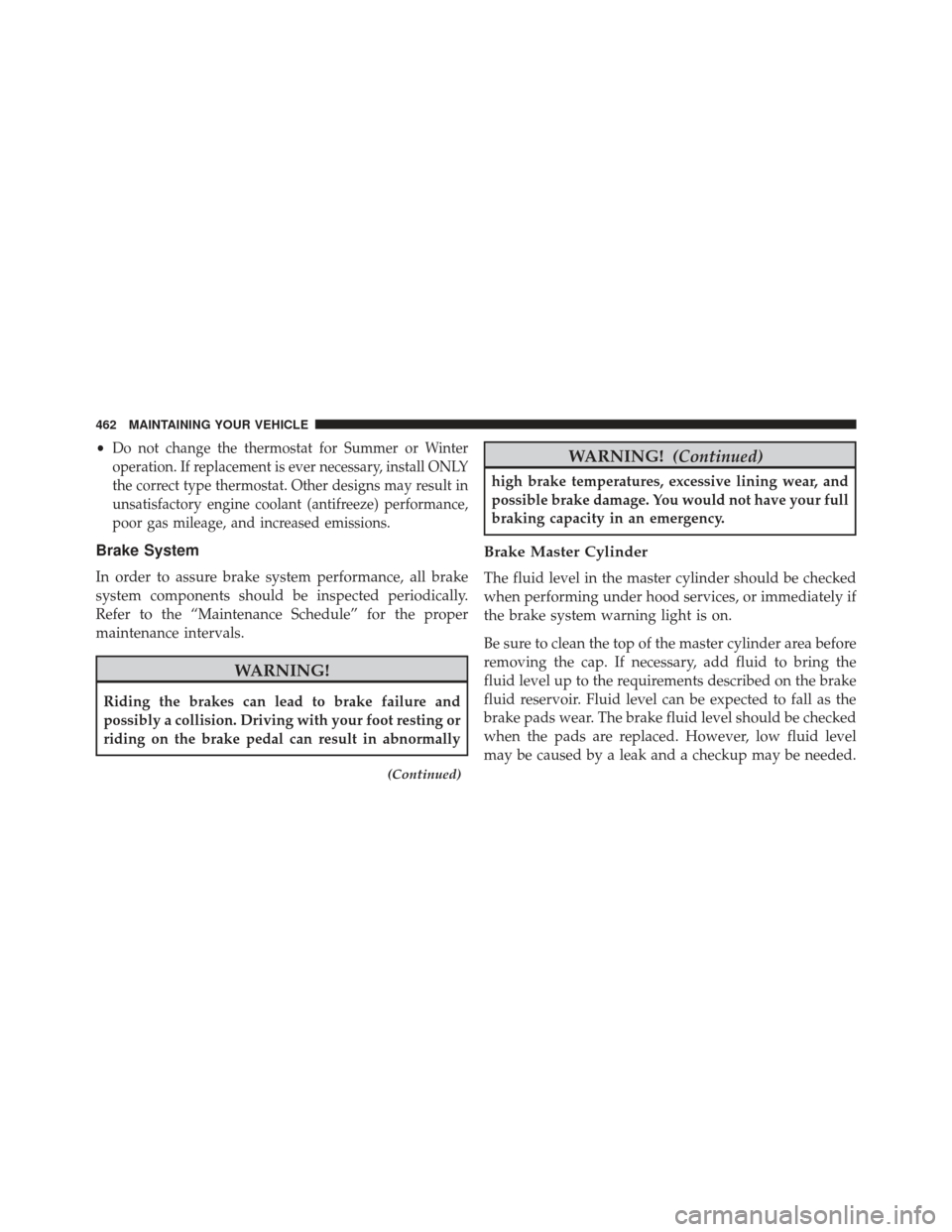
•Do not change the thermostat for Summer or Winter
operation. If replacement is ever necessary, install ONLY
the correct type thermostat. Other designs may result in
unsatisfactory engine coolant (antifreeze) performance,
poor gas mileage, and increased emissions.
Brake System
In order to assure brake system performance, all brake
system components should be inspected periodically.
Refer to the “Maintenance Schedule” for the proper
maintenance intervals.
WARNING!
Riding the brakes can lead to brake failure and
possibly a collision. Driving with your foot resting or
riding on the brake pedal can result in abnormally
(Continued)
WARNING! (Continued)
high brake temperatures, excessive lining wear, and
possible brake damage. You would not have your full
braking capacity in an emergency.
Brake Master Cylinder
The fluid level in the master cylinder should be checked
when performing under hood services, or immediately if
the brake system warning light is on.
Be sure to clean the top of the master cylinder area before
removing the cap. If necessary, add fluid to bring the
fluid level up to the requirements described on the brake
fluid reservoir. Fluid level can be expected to fall as the
brake pads wear. The brake fluid level should be checked
when the pads are replaced. However, low fluid level
may be caused by a leak and a checkup may be needed.
462 MAINTAINING YOUR VEHICLE
Page 466 of 525
WARNING!(Continued)
•To avoid contamination from foreign matter or
moisture, use only new brake fluid or fluid that has
been in a tightly closed container. Keep the master
cylinder reservoir cap secured at all times. Brake
fluid in a open container absorbs moisture from the
air resulting in a lower boiling point. This may
cause it to boil unexpectedly during hard or pro-
longed braking, resulting in sudden brake failure.
This could result in a collision.
• Overfilling the brake fluid reservoir can result in
spilling brake fluid on hot engine parts, causing
the brake fluid to catch fire. Brake fluid can also
damage painted and vinyl surfaces, care should be
taken to avoid its contact with these surfaces.
WARNING! (Continued)
•Do not allow petroleum based fluid to contaminate
the brake fluid. Brake seal components could be
damaged, causing partial or complete brake failure.
This could result in a collision.
CAUTION!
Use of improper brake fluids will affect overall clutch
system performance. Improper brake fluids may dam-
age the clutch system resulting in loss of clutch func-
tion and the ability to shift the transmission.
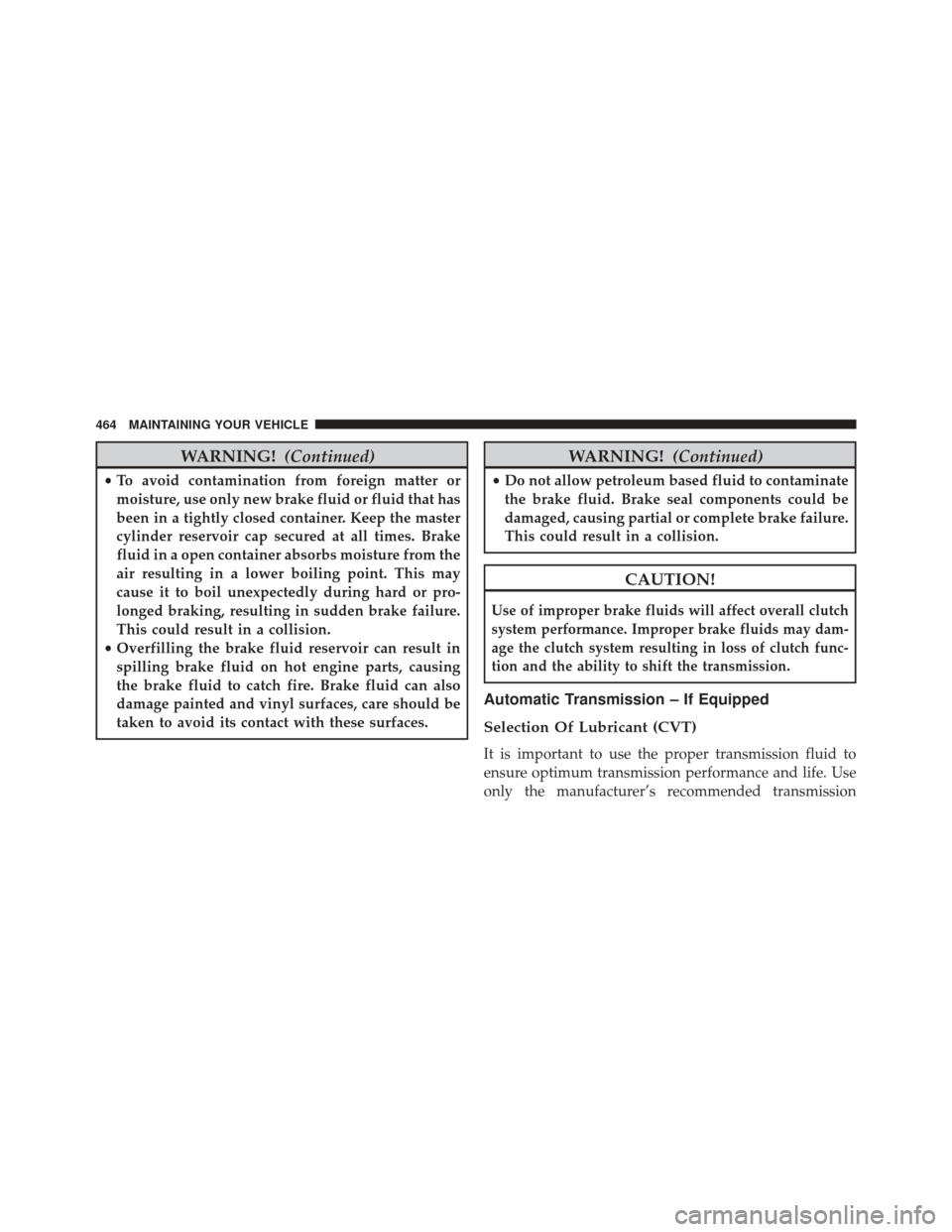
Automatic Transmission – If Equipped
Selection Of Lubricant (CVT)
It is important to use the proper transmission fluid to
ensure optimum transmission performance and life. Use
only the manufacturer’s recommended transmission
464 MAINTAINING YOUR VEHICLE
Page 467 of 525
fluid which has the special friction coefficient additives
necessary for proper steel belt traction on the drive and
driven pulleys. Refer to “Fluids, Lubricants, and Genuine
Parts” in “Maintaining Your Vehicle” for fluid specifica-
tions. It is important to maintain the transmission fluid at
the correct level using the recommended fluid.
No chemical flushes should be used in any transmission;
only the approved lubricant should be used.
CAUTION!
Using a transmission fluid other than the manufac-
turer’s recommended fluid will cause belt slip and
result in a complete transmission failure! Refer to
“Fluids, Lubricants, and Genuine Parts” in “Main-
taining Your Vehicle” for fluid specifications.
Special Additives
The manufacturer strongly recommends against using
any special additives in the transmission.
Automatic transmission fluid is an engineered product
and its performance may be impaired by supplemental
additives. Therefore, do not add any fluid additives to
the transmission. The only exception to this policy is the
use of special dyes for diagnosing fluid leaks. Avoid
using transmission sealers as they may adversely affect
seals.
CAUTION!
Do not use chemical flushes in your transmission as
the chemicals can damage your transmission compo-
nents. Such damage is not covered by the New
Vehicle Limited Warranty.7
MAINTAINING YOUR VEHICLE 465
Page 475 of 525
Instrument Panel Bezels
CAUTION!
When installing hanging air fresheners in your ve-
hicle, read the installation instructions carefully.
Some air fresheners will damage the finish of
painted or decorated parts if allowed to directly
contact any surface.
Cleaning Plastic Instrument Cluster Lenses
The lenses in front of the instruments in this vehicle are
molded in clear plastic. When cleaning the lenses, care
must be taken to avoid scratching the plastic.
1. Clean with a wet soft rag. A mild soap solution may beused, but do not use high alcohol content or abrasive
cleaners. If soap is used, wipe clean with a clean damp
rag.
2. Dry with a soft cloth.
Seat Belt Maintenance
Do not bleach, dye, or clean the belts with chemical
solvents or abrasive cleaners. This will weaken the fabric.
Sun damage can also weaken the fabric.
If the belts need cleaning, use MOPAR� Total Clean, a
mild soap solution, or lukewarm water. Do not remove
the belts from the vehicle to wash them. Dry with a soft
cloth.
Replace the belts if they appear frayed or worn or if the
buckles do not work properly.
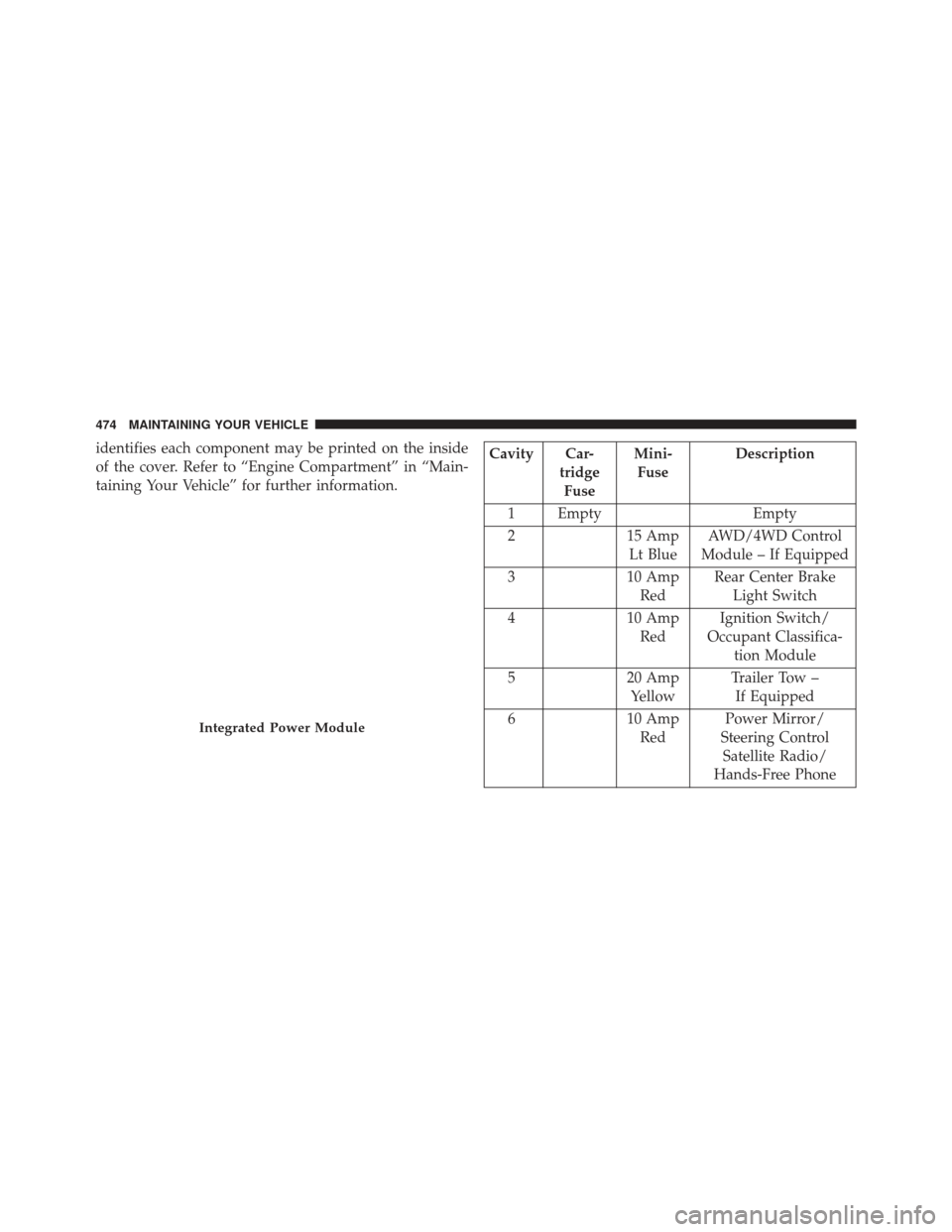
FUSES
Integrated Power Module
The Integrated Power Module is located in the engine
compartment near the air cleaner assembly. This center
contains cartridge fuses and mini-fuses. A label that
7
MAINTAINING YOUR VEHICLE 473
Page 476 of 525
identifies each component may be printed on the inside
of the cover. Refer to “Engine Compartment” in “Main-
taining Your Vehicle” for further information.Cavity Car-tridgeFuse Mini-
Fuse Description
1 Empty Empty
2 15 Amp
Lt Blue AWD/4WD Control
Module – If Equipped
3 10 Amp
Red Rear Center Brake
Light Switch
4 10 Amp
Red Ignition Switch/
Occupant Classifica- tion Module
5 20 Amp
Yellow Trailer Tow –
If Equipped
6 10 Amp
Red Power Mirror/
Steering Control Satellite Radio/
Hands-Free Phone
Integrated Power Module
474 MAINTAINING YOUR VEHICLE
Page 481 of 525
Exterior Bulbs
Bulb Number
Low Beam/High Beam
Headlamp H13
Front Park/Turn Signal/
Side Marker Lamp 3757KA
Front Fog Lamp PSX24W
Center High Mounted
Stop Lamp (CHMSL) LED Assembly (Serviced
At Authorized Dealer)
Rear Tail/Turn/Stop
Lamp 3157
Backup Lamp W16W (921)
License Lamp W5W
BULB REPLACEMENT
Headlamps
1. Raise the hood and locate the connector behind the
headlamp.
2. Reach into engine compartment and pull red lock out at connector.
3. Remove the green connector from the back of the bulb by pulling straight back.
4. Twist the bulb to the left.
5. Pull bulb outward from assembly.
NOTE: These are halogen bulbs. Take care not to touch
the bulb with your fingers. Body oils from your fingers
could cause excessive heat buildup which reduces bulb
life.
7
MAINTAINING YOUR VEHICLE 479
Page 483 of 525
FLUID CAPACITIES
U.S.Metric
Fuel (Approximate) 13.6 Gallons51.5 Liters
Engine Oil with Filter
2.0L and 2.4L Engine
(SAE 5W-20, API Certified) 4.5 Quarts
4.26 Liters
Cooling System *
2.0L and 2.4L Engine
(MOPAR� Antifreeze/Engine
Coolant 10 Year/150,000 Mile
Formula or equivalent) 7.2 Quarts
6.8 Liters
* Includes heater and coolant recovery bottle filled to MAX level.
7
MAINTAINING YOUR VEHICLE 481
Page 484 of 525
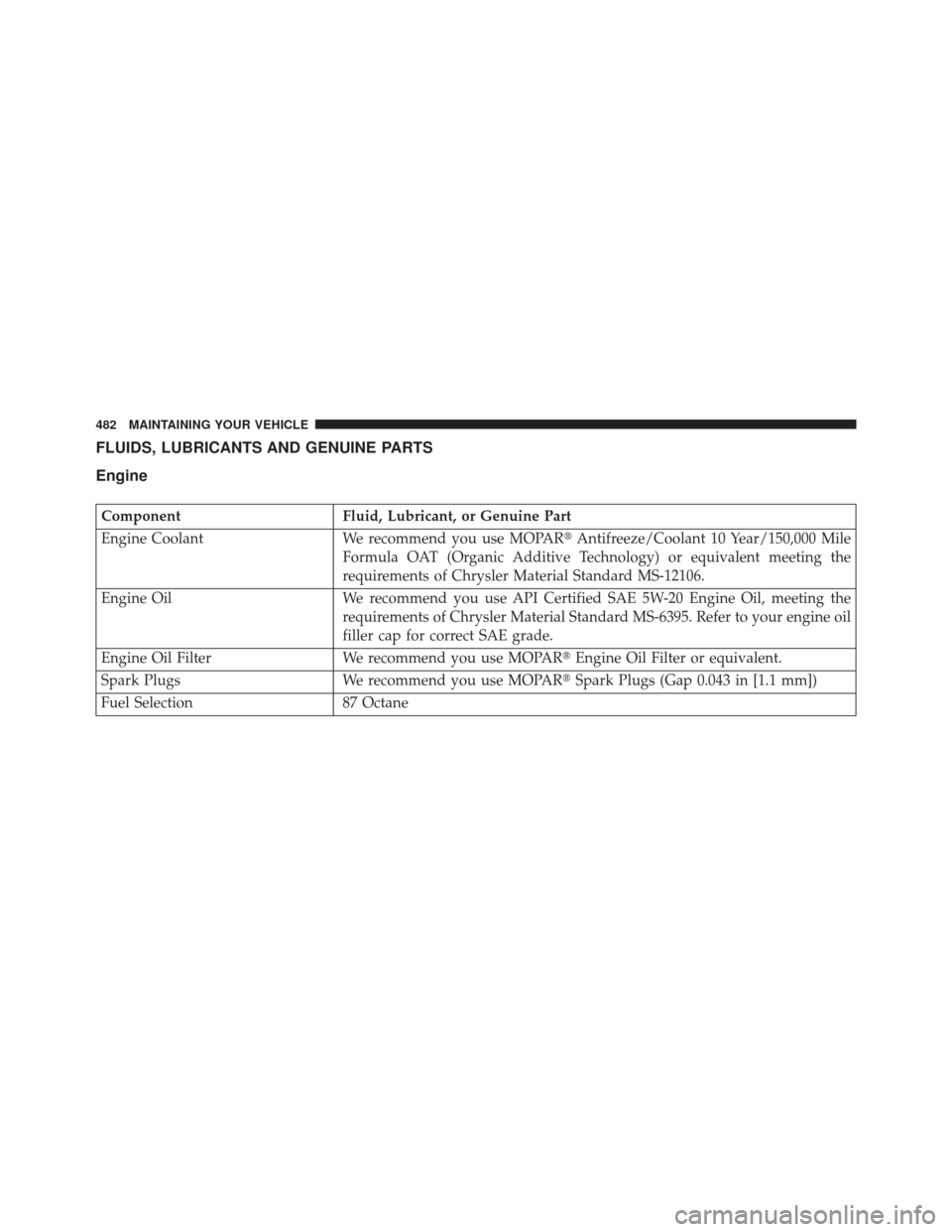
FLUIDS, LUBRICANTS AND GENUINE PARTS
Engine
ComponentFluid, Lubricant, or Genuine Part
Engine Coolant We recommend you use MOPAR�Antifreeze/Coolant 10 Year/150,000 Mile
Formula OAT (Organic Additive Technology) or equivalent meeting the
requirements of Chrysler Material Standard MS-12106.
Engine Oil We recommend you use API Certified SAE 5W-20 Engine Oil, meeting the
requirements of Chrysler Material Standard MS-6395. Refer to your engine oil
filler cap for correct SAE grade.
Engine Oil Filter We recommend you use MOPAR�Engine Oil Filter or equivalent.
Spark Plugs We recommend you use MOPAR�Spark Plugs (Gap 0.043 in [1.1 mm])
Fuel Selection 87 Octane
482 MAINTAINING YOUR VEHICLE