Page 433 of 525
Once the engine is started, remove the jumper cables in
the reverse sequence:
6. Disconnect the negative(-)jumper cable from the
engine ground of the vehicle with the discharged
battery.
7. Disconnect the negative end (-)of the jumper cable
from the negative (-)post of the booster battery.
8. Disconnect the opposite end of the positive (+)jumper
cable from the positive (+)post of the booster battery.
9. Disconnect the positive (+)end of the jumper cable
from the positive (+)post of the discharged vehicle.
10. Reinstall the air intake duct.
If frequent jump-starting is required to start your vehicle
you should have the battery and charging system in-
spected at your authorized dealer.CAUTION!
Accessories that can be plugged into the vehicle
power outlets draw power from the vehicle’s battery,
even when not in use (i.e., cellular phones, etc.).
Eventually, if plugged in long enough, the vehicle’s
battery will discharge sufficiently to degrade battery
life and/or prevent the engine from starting.
FREEING A STUCK VEHICLE
If your vehicle becomes stuck in mud, sand or snow, it
can often be moved using a rocking motion. Turn the
steering wheel right and left to clear the area around
the front wheels. Then shift back and forth between
DRIVE and REVERSE (with automatic transmission) or
2nd gear and REVERSE (with manual transmission),
while gently pressing the accelerator. Use the least
amount of accelerator pedal pressure that will maintain6
WHAT TO DO IN EMERGENCIES 431
Page 434 of 525
the rocking motion, without spinning the wheels, or
racing the engine.
CAUTION!
Racing the engine or spinning the wheels may lead to
transmission overheating and failure. Allow the en-
gine to idle with the transmission in NEUTRAL for at
least one minute after every five rocking-motion
cycles. This will minimize overheating and reduce
the risk of transmission failure during prolonged
efforts to free a stuck vehicle.
NOTE: Press the �ESC Off� switch, to place the Electronic
Stability Control (ESC) system in �Partial Off�mode,
before rocking the vehicle. Refer to “Electronic Brake
Control” in “Starting And Operating” for further infor-
mation. Once the vehicle has been freed, press the �ESC
Off� switch again to restore �ESC On�mode.
CAUTION!
•When “rocking” a stuck vehicle by shifting be-
tween DRIVE/2nd gear and REVERSE, do not spin
the wheels faster than 15 mph (24 km/h), or drive-
train damage may result.
• Revving the engine or spinning the wheels too fast
may lead to transmission overheating and failure.
It can also damage the tires. Do not spin the wheels
above 30 mph (48 km/h) while in gear (no trans-
mission shifting occurring).
WARNING!
Fast spinning tires can be dangerous. Forces gener-
ated by excessive wheel speeds may cause damage, or
even failure, of the axle and tires. A tire could
(Continued)
432 WHAT TO DO IN EMERGENCIES
Page 435 of 525
WARNING!(Continued)
explode and injure someone. Do not spin your vehi-
cle’s wheels faster than 30 mph (48 km/h) or for
longer than 30 seconds continuously without stop-
ping when you are stuck and do not let anyone near
a spinning wheel, no matter what the speed.
SHIFT LEVER OVERRIDE
If a malfunction occurs and the shift lever cannot be
moved out of the PARK position, you can use the
following procedure to temporarily move the shift lever:
1. Turn the engine OFF.
2. Firmly apply the parking brake.
3. Using a small screwdriver or similar tool, remove the
shift lever override access cover (located on the right
side of the shifter housing). 4. Turn the ignition switch to the ACC or ON/RUN
position, but do not start the engine.
5. Press and maintain firm pressure on the brake pedal.
Shift Lever Override Access Cover6
WHAT TO DO IN EMERGENCIES 433
Page 439 of 525
MAINTAINING YOUR VEHICLE
CONTENTS
�ENGINE COMPARTMENT — 2.0L ..........439
� ENGINE COMPARTMENT — 2.4L ..........440
�
ONBOARD DIAGNOSTIC SYSTEM — OBD II . . .441
▫ Loose Fuel Filler Cap Message ............441
� EMISSIONS INSPECTION AND
MAINTENANCE PROGRAMS .............442
� REPLACEMENT PARTS ..................443
� DEALER SERVICE ..................... .443
� MAINTENANCE PROCEDURES ...........444
▫ Engine Oil ......................... .445▫
Engine Oil Filter ..................... .447
▫ Engine Air Cleaner Filter ................448
▫ Maintenance-Free Battery ................448
▫ Air Conditioner Maintenance .............450
▫ Body Lubrication .....................452
▫ Windshield Wiper Blades ...............453
▫ Adding Washer Fluid ..................453
▫ Exhaust System ..................... .454
▫ Cooling System ..................... .457
▫ Brake System ....................... .462
7
Page 440 of 525
▫Automatic Transmission – If Equipped ......464
▫ Manual Transmission – If Equipped ........466
▫ Rear Drive Assembly (RDA) –
AWD/4WD Models Only ...............467
▫ Power Transfer Unit (PTU) –
AWD/4WD Models Only ...............467
▫ Appearance Care And Protection From
Corrosion .......................... .468
� FUSES ............................. .473
▫ Integrated Power Module ...............473
� VEHICLE STORAGE ....................478
� REPLACEMENT BULBS .................478 �
BULB REPLACEMENT ..................479
▫ Headlamps ........................ .479
▫ Fog Lamps ......................... .480
▫ Rear Tail, Turn Signal And Backup Lamps . . .480
▫ License Lamps ...................... .480
▫ Center High-Mounted Stoplamp ..........480
� FLUID CAPACITIES .....................481
�
FLUIDS, LUBRICANTS AND GENUINE PARTS . .482
▫ Engine ............................ .482
▫ Chassis ........................... .483
438 MAINTAINING YOUR VEHICLE
Page 441 of 525
ENGINE COMPARTMENT — 2.0L
1 — Washer Fluid Reservoir6 — Air Cleaner Filter
2 — Power Steering Fluid Reservoir 7 — Coolant Pressure Cap
3 — Engine Oil Fill 8 — Engine Oil Dipstick
4 — Brake Fluid Reservoir 9 — Engine Coolant Reservoir
5 — Integrated Power Module (Fuses)
7
MAINTAINING YOUR VEHICLE 439
Page 442 of 525
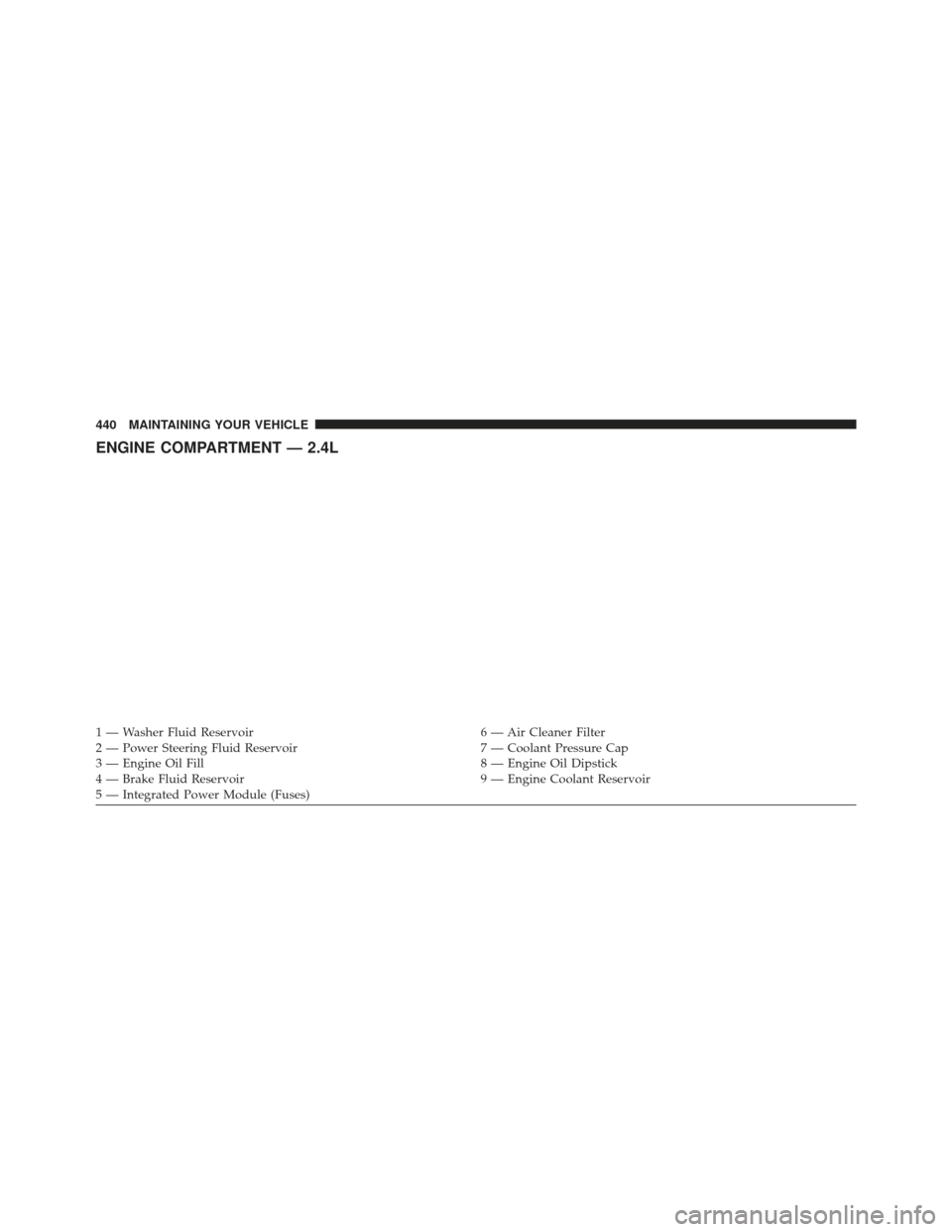
ENGINE COMPARTMENT — 2.4L
1 — Washer Fluid Reservoir6 — Air Cleaner Filter
2 — Power Steering Fluid Reservoir 7 — Coolant Pressure Cap
3 — Engine Oil Fill 8 — Engine Oil Dipstick
4 — Brake Fluid Reservoir 9 — Engine Coolant Reservoir
5 — Integrated Power Module (Fuses) 440 MAINTAINING YOUR VEHICLE
Page 443 of 525
ONBOARD DIAGNOSTIC SYSTEM — OBD II
Your vehicle is equipped with a sophisticated onboard
diagnostic system called OBD II. This system monitors
the performance of the emissions, engine, and automatic
transmission control systems. When these systems are
operating properly, your vehicle will provide excellent
performance and fuel economy, as well as engine emis-
sions well within current government regulations.
If any of these systems require service, the OBD II system
will turn on the “Malfunction Indicator Light” (MIL).
It will also store diagnostic codes and other information
to assist your service technician in making repairs. Al-
though your vehicle will usually be drivable and not
need towing, see your authorized dealer for service as
soon as possible.
CAUTION!
•Prolonged driving with the MIL on could cause
further damage to the emission control system.
It could also affect fuel economy and drivability.
The vehicle must be serviced before any emissions
tests can be performed.
• If the MIL is flashing while the engine is running,
severe catalytic converter damage and power loss
will soon occur. Immediate service is required.
Loose Fuel Filler Cap Message
After fuel is added, the vehicle diagnostic system can
determine if the fuel filler cap is possibly loose or
improperly installed. A “gASCAP” message will be dis-
played in the instrument cluster. Tighten the gas cap until
a �clicking� sound is heard. This is an indication that the7
MAINTAINING YOUR VEHICLE 441