Page 80 of 661

The side air bags will not deploy in all side collisions.
Side air bag deployment will depend on the severity and
type of collision.
Because air bag sensors measure vehicle deceleration
over time, vehicle speed and damage by themselves are
not good indicators of whether or not an air bag should
have deployed.
Seat belts are necessary for your protection in all colli-
sions, and also are needed to help keep you in position,
away from an inflating air bag.
The ORC monitors the readiness of the electronic parts of
the air bag system whenever the ignition switch is in the
START or ON/RUN position. If the key is in the OFF
position, in the ACC position, or not in the ignition, the
air bag system is not on and the air bags will not inflate.The ORC contains a backup power supply system that
may deploy the air bags even if the battery loses power or
it becomes disconnected prior to deployment.
Also, the ORC turns on the Air Bag Warning
Light in the instrument panel for approxi-
mately four to eight seconds for a self-check
when the ignition is first turned on. After the
self-check, the Air Bag Warning Light will turn off. If the
ORC detects a malfunction in any part of the system, it
turns on the Air Bag Warning Light, either momentarily
or continuously. A single chime will sound if the light
comes on again after initial startup.
It also includes diagnostics that will illuminate the instru-
ment cluster Air Bag Warning Light if a malfunction is
noted that could affect the air bag system. The diagnos-
tics also record the nature of the malfunction.
78 THINGS TO KNOW BEFORE STARTING YOUR VEHICLE
Page 85 of 661

Maintaining Your Air Bag System
WARNING!
•Modifications to any part of the air bag system
could cause it to fail when you need it. You could
be injured if the air bag system is not there to
protect you. Do not modify the components or
wiring, including adding any kind of badges or
stickers to the steering wheel hub trim cover or the
upper right side of the instrument panel. Do not
modify the front bumper, vehicle body structure, or
add aftermarket side steps or running boards.
• It is dangerous to try to repair any part of the air
bag system yourself. Be sure to tell anyone who
works on your vehicle that it has an air bag system.
(Continued)
WARNING! (Continued)
•Do not attempt to modify any part of your air bag
system. The air bag may inflate accidentally or may
not function properly if modifications are made.
Take your vehicle to an authorized dealer for any
air bag system service. If your seat, including your
trim cover and cushion, needs to be serviced in any
way (including removal or loosening/tightening of
seat attachment bolts), take the vehicle to your
authorized dealer. Only manufacturer approved
seat accessories may be used. If it is necessary to
modify the air bag system for persons with dis-
abilities, contact your authorized dealer.
2
THINGS TO KNOW BEFORE STARTING YOUR VEHICLE 83
Page 86 of 661

Air Bag Warning Light
You will want to have the air bags ready to
inflate for your protection in a collision. The
Air Bag Warning Light monitors the internal
circuits and interconnecting wiring associated
with air bag system electrical components. While the air
bag system is designed to be maintenance free. If any of
the following occurs, have an authorized dealer service
the air bag system immediately.
• The Air Bag Warning Light does not come on during
the four to eight seconds when the ignition is first
cycled to the ON/RUN.
• The Air Bag Warning Light remains on after the four to
eight-second interval.
• The Air Bag Warning Light comes on intermittently or
remains on while driving. NOTE:
If the speedometer, tachometer, or any engine
related gauges are not working, the Occupant Restraint
Controller (ORC) may also be disabled. The air bags may
not be ready to inflate for your protection. Promptly
check the fuse block for blown fuses. Refer to the label
located on the inside of the fuse block cover for the
proper air bag fuses. See your authorized dealer if the
fuse is good.
Event Data Recorder (EDR)
This vehicle is equipped with an event data recorder
(EDR). The main purpose of an EDR is to record, in
certain crash or near crash-like situations, such as an air
bag deployment or hitting a road obstacle, data that will
assist in understanding how a vehicle’s systems per-
formed. The EDR is designed to record data related to
84 THINGS TO KNOW BEFORE STARTING YOUR VEHICLE
Page 507 of 661
The suggested rotation method is the “forward-cross”
shown in the following diagram.TIRE PRESSURE MONITOR SYSTEM (TPMS)
NOTE:For vehicles equipped with run flat tires — When
the TPMS indicates a tire pressure of 14 psi (96 kPa) or
lower, always check tire pressure and replace the tire at
the first opportunity. At inflation pressure of/or below 14
psi (96 kPa) the tire is in the run-flat mode of operation.
In this condition, it is recommended a vehicle maximum
speed of 50 mph (80 km/h) for a maximum distance of 50
miles (80 km). Chrysler Group LLC does not recommend
using the run flat feature while driving a vehicle loaded
at full capacity or towing a trailer.
The Tire Pressure Monitoring System (TPMS) will warn
the driver of a low tire pressure based on the vehicle
recommended cold tire pressure.
Tire Rotation
5
STARTING AND OPERATING 505
Page 529 of 661
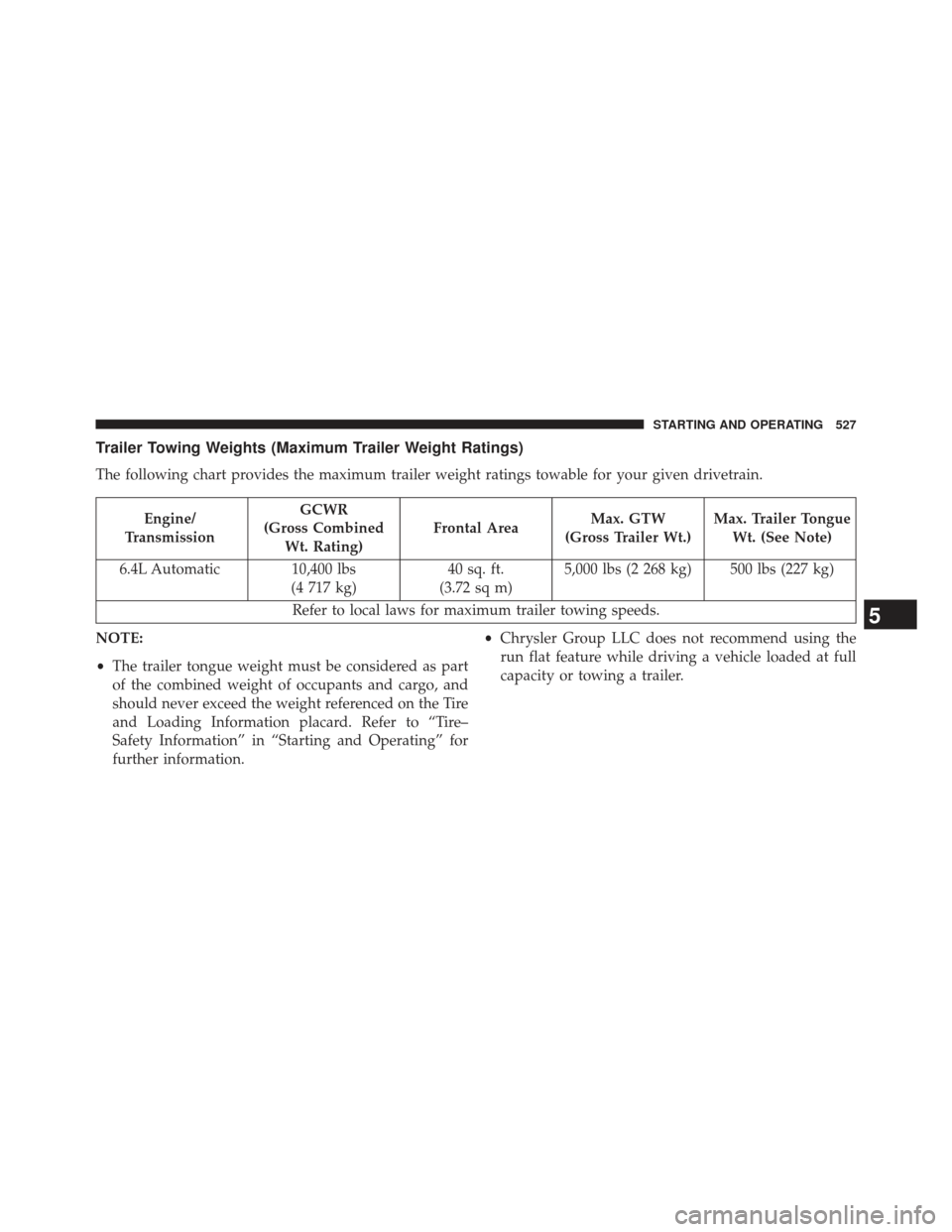
Trailer Towing Weights (Maximum Trailer Weight Ratings)
The following chart provides the maximum trailer weight ratings towable for your given drivetrain.
Engine/
Transmission GCWR
(Gross Combined Wt. Rating) Frontal Area
Max. GTW
(Gross Trailer Wt.) Max. Trailer Tongue
Wt. (See Note)
6.4L Automatic 10,400 lbs (4 717 kg)40 sq. ft.
(3.72 sq m) 5,000 lbs (2 268 kg) 500 lbs (227 kg)
Refer to local laws for maximum trailer towing speeds.
NOTE:
• The trailer tongue weight must be considered as part
of the combined weight of occupants and cargo, and
should never exceed the weight referenced on the Tire
and Loading Information placard. Refer to “Tire–
Safety Information” in “Starting and Operating” for
further information. •
Chrysler Group LLC does not recommend using the
run flat feature while driving a vehicle loaded at full
capacity or towing a trailer.
5
STARTING AND OPERATING 527
Page 537 of 661
WHAT TO DO IN EMERGENCIES
CONTENTS
�HAZARD WARNING FLASHERS ...........536
� IF YOUR ENGINE OVERHEATS ............536
� JACKING AND TIRE CHANGING ..........537
▫ Run Flat Tires ....................... .538
▫ Jack Location ....................... .539
▫ Spare Tire Stowage ....................539
▫ Preparations For Jacking ................539
▫ Jacking Instructions ...................540
▫ Road Tire Installation ...................547 �
JUMP-STARTING ...................... .548
▫ Preparations For Jump-Start ..............548
▫ Jump-Starting Procedure ................550
� FREEING A STUCK VEHICLE .............552
� EMERGENCY TOW HOOKS —
IF EQUIPPED ........................ .553
� SHIFT LEVER OVERRIDE ................554
� TOWING A DISABLED VEHICLE ...........555
6
Page 540 of 661
WARNING!(Continued)
•The jack is designed to be used as a tool for
changing tires only. The jack should not be used to
lift the vehicle for service purposes. The vehicle
should be jacked on a firm level surface only.
Avoid ice or slippery areas.
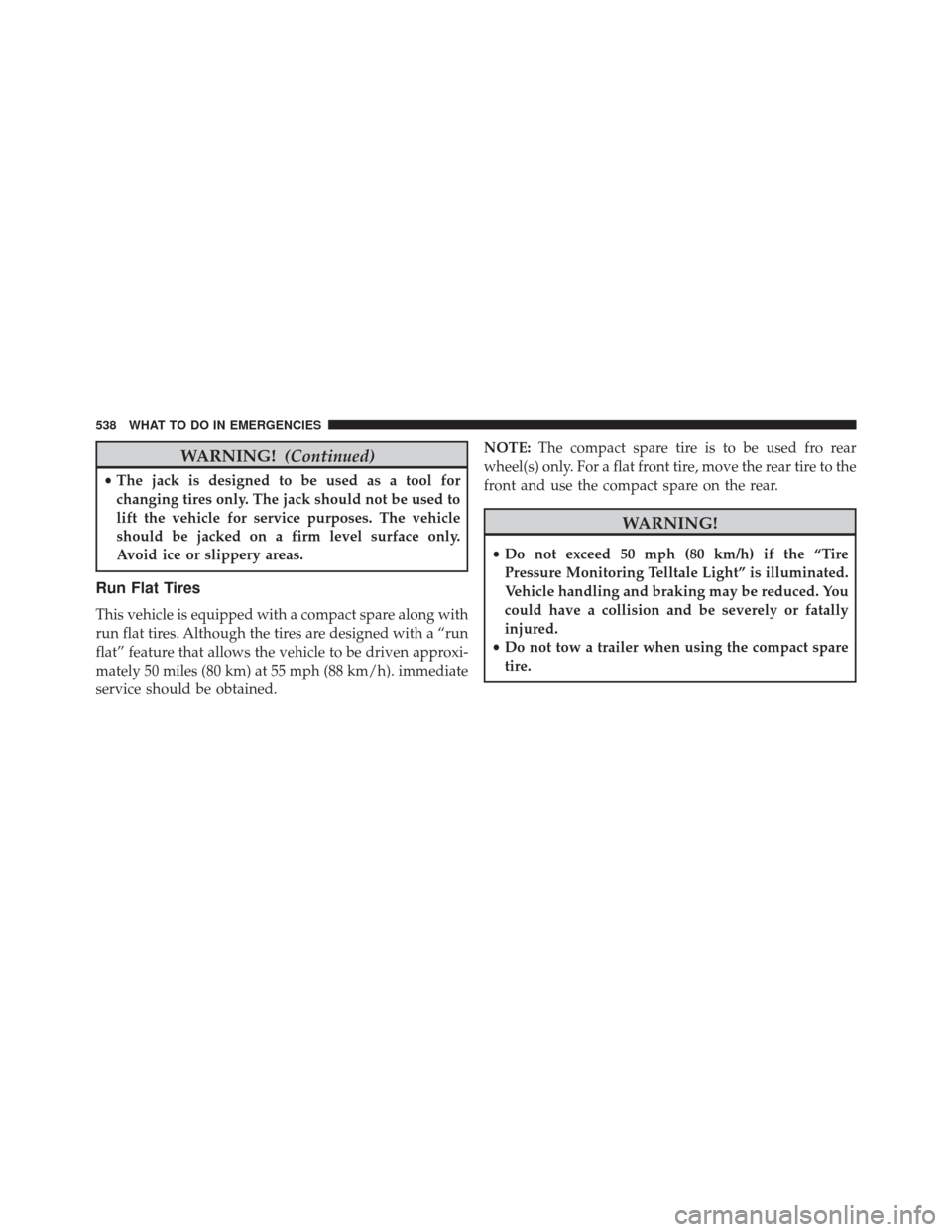
Run Flat Tires
This vehicle is equipped with a compact spare along with
run flat tires. Although the tires are designed with a “run
flat” feature that allows the vehicle to be driven approxi-
mately 50 miles (80 km) at 55 mph (88 km/h). immediate
service should be obtained. NOTE:
The compact spare tire is to be used fro rear
wheel(s) only. For a flat front tire, move the rear tire to the
front and use the compact spare on the rear.
WARNING!
• Do not exceed 50 mph (80 km/h) if the “Tire
Pressure Monitoring Telltale Light” is illuminated.
Vehicle handling and braking may be reduced. You
could have a collision and be severely or fatally
injured.
• Do not tow a trailer when using the compact spare
tire.
538 WHAT TO DO IN EMERGENCIES