2013 HONDA FIT warning
[x] Cancel search: warningPage 245 of 286
uuIf a Tire Goes FlatuChanging a Flat Tire*
244
Handling the Unexpected
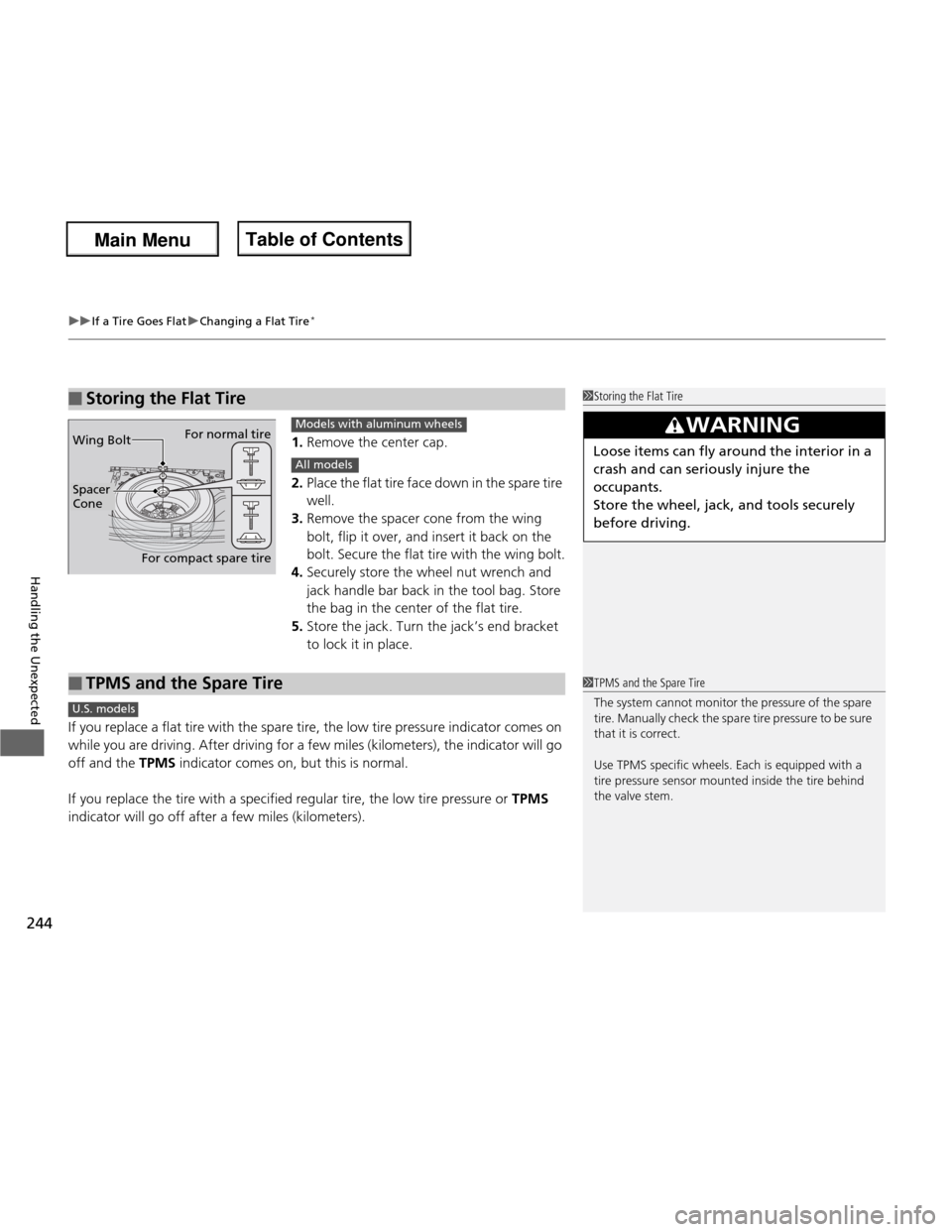
1. Remove the center cap.
2. Place the flat tire face down in the spare tire well.
3. Remove the spacer cone from the wing
bolt, flip it over, and insert it back on the
bolt. Secure the flat tire with the wing bolt.
4. Securely store the wheel nut wrench and
jack handle bar back in the tool bag. Store
the bag in the center of the flat tire.
5. Store the jack. Turn the jack’s end bracket
to lock it in place.
If you replace a flat tire with the spare tire, the low tire pressure indicator comes on
while you are driving. After driving for a few miles (kilometers), the indicator will go off and the TPMS indicator comes on, but this is normal.
If you replace the tire with a specified regular tire, the low tire pressure or TPMS
indicator will go off after a few miles (kilometers).
■Storing the Flat Tire1Storing the Flat Tire
3WARNING
Loose items can fly around the interior in a
crash and can seriously injure the
occupants.
Store the wheel, jack, and tools securely before driving.
For normal tire
For compact spare tire
Wing Bolt
Spacer
Cone
Models with aluminum wheels
All models
■TPMS and the Spare Tire1TPMS and the Spare Tire
The system cannot monitor the pressure of the spare
tire. Manually check
the spare tire pressure to be sure
that it is correct.
Use TPMS specific wheels. Each is equipped with a
tire pressure sensor mounted inside the tire behind
the valve stem.
U.S. models
Main Menu
Main MenuTable of Contents
Page 246 of 286

245
uuIf a Tire Goes FlatuTemporarily Repairing a Flat Tire
Continued
Handling the Unexpected
Temporarily Repairing a Flat Tire
If the tire has a large cut or is otherwise severely damaged, you will need to have the
vehicle towed. If the tire only has a small puncture, from a nail for instance, you can
use the tire repair kit so that you can drive to the nearest service station for a more
permanent repair.
If a tire goes flat while driving, grasp the steering wheel firmly, and brake gradually
to reduce speed. Then stop in a safe place. 1.Park the vehicle on firm, level, and non-slippery ground.
2. Put the shift lever in
(P .
3. Set the parking brake.
4. Turn on the hazard warning lights and turn the ignition switch to LOCK
(0 .
■Getting Ready to Temporarily Repair the Flat Tire
Canadian models with automatic transmission
1Temporarily Repairing a Flat Tire
The kit should not be used in the following situations.
Instead, contact a dealer or a roadside assistant to
have the vehicle towed.
• The tire sealant has expired.
• More than two tires are punctured.
• The puncture is greater than 3/16 inch (4 mm) in diameter.
• The tire side wall is damaged or the puncture is
outside the tire tread.
• Damage has been caused by driving with the tires
extremely under inflated.
• The tire bead is no longer seated.
• A rim is damaged.
Do not remove a nail or screw that punctured the
tire. If you remove it from the tire, you may not be
able to repair the puncture using the kit.
NOTICE
Do not use a puncture-repairing agent other than the
one provided in the ki t that came with your vehicle. If
used, you may permanently damage the tire pressure
sensor.
When the puncture is:
Smaller than 3/16 inch
(4 mm)
Larger than 3/16 inch
(4 mm) Kit Use
YesNo
Contact
Area
Instruction Manual
Air Compressor
Wheel
Label
Sealant Bottle
Expiration Date
Speed Limit Label
Main Menu
Main MenuTable of Contents
Page 248 of 286

Continued247
uuIf a Tire Goes FlatuTemporarily Repairing a Flat Tire
Handling the Unexpected
6.Remove the bottle cap from the bottle
adapter.
7. Attach the air compressor hose onto the
bottle adapter. Screw it until it is tight.
8. Plug in the compressor to the accessory power socket. Be careful not to pinch the
cord in a door or window.
9. Turn the ignition switch to ACCESSORY
(q .
uIn freezing temperatures, start the
engine on and leave it running while
the flat tire is being serviced.
2 Carbon Monoxide Gas P. 61
10. Turn the air compressor on to inflate the tire.
uThe compressor starts injecting sealant
and air into the tire.
11. Inflate the tire.
12. After the air pressure reaches to 33 psi
(230 kPa), turn off the kit.
uCheck the air pressure gauge on the air
compressor.
1Injecting Sealant and Air
NOTICE
Operating the pump for more than 15 minutes may
cause it to overheat and become permanently damaged.
Until the sealant injectio n is complete, the pressure
shown on the pressure gauge will appear higher than
actual. After the sealan t injection is complete the
pressure will drop and then begin to rise again as the
tire is inflated with air. Th is is normal. To accurately
measure the air pressure using the gauge, turn the air
compressor off only after the sealant injection is complete.
3WARNING
Running the engine with the vehicle in an
enclosed or even partly enclosed area can
cause a rapid build-up of toxic carbon
monoxide.
Breathing this colorless, odorless gas can
cause unconsciousness and even death. Only run the engi ne to power the air
compressor with the vehicle outdoors.
Bottle Adapter
Air Compressor Hose Bottle Cap
Air Compressor Switch
OFF
ON
Main Menu
Main MenuTable of Contents
Page 252 of 286
251
Continued
Handling the Unexpected
Jump Starting
Turn off the power to electric devices, such as audio and lights. Turn off the engine,
then open the hood.
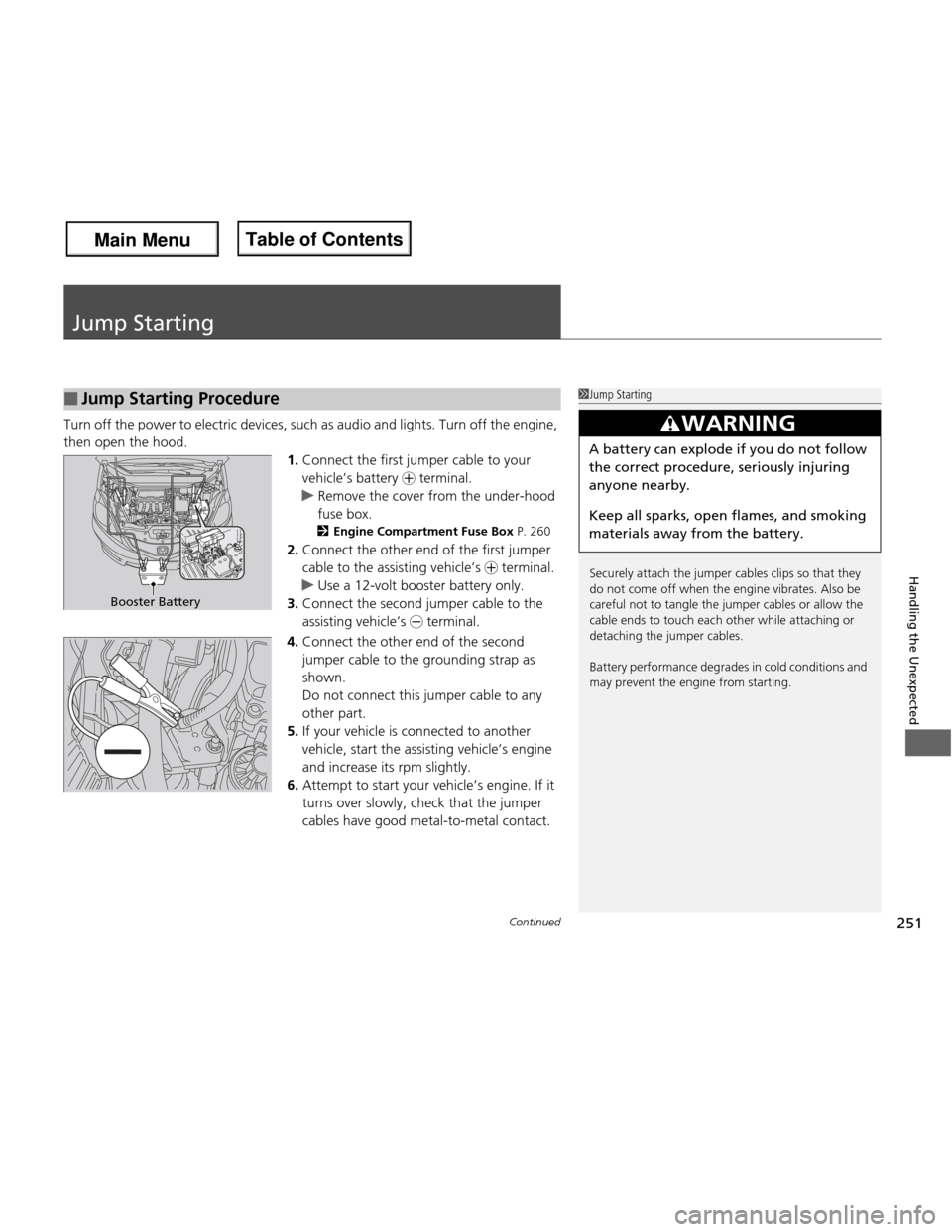
1.Connect the first jumper cable to your vehicle’s battery + terminal.
uRemove the cover from the under-hood fuse box.
2 Engine Compartment Fuse Box P. 260
2. Connect the other end of the first jumper
cable to the assisting vehicle’s + terminal.
uUse a 12-volt booster battery only.
3. Connect the second jumper cable to the
assisting vehicle’s - terminal.
4. Connect the other end of the second
jumper cable to the grounding strap as
shown.
Do not connect this jumper cable to any other part.
5. If your vehicle is co nnected to another
vehicle, start the assisting vehicle’s engine
and increase its rpm slightly.
6. Attempt to start your vehicle’s engine. If it
turns over slowly, check that the jumper cables have good metal-to-metal contact.
■Jump Starting Procedure1Jump Starting
Securely attach the jumper cables clips so that they
do not come off when the engine vibrates. Also be
careful not to tangle the jumper cables or allow the
cable ends to touch each other while attaching or
detaching the jumper cables.
Battery performance degrades in cold conditions and
may prevent the engine from starting.
3WARNING
A battery can explode if you do not follow the correct procedure, seriously injuring anyone nearby.
Keep all sparks, open flames, and smoking
materials away from the battery.
Booster Battery
Main Menu
Main MenuTable of Contents
Page 255 of 286
254
Handling the Unexpected
Overheating
How to Handle Overheating
Overheating symptoms are as follows: •The high temperature indicator comes on or the engine suddenly loses power.
• Steam or spray comes out of the engine compartment.
■ First thing to do
1. Immediately park the vehicle in a safe place.
2. Turn off all accessories and turn on the hazard warning lights.
uNo steam or spray present: Keep the engine running and open the hood.
uSteam or spray is present: Turn off the engine and wait until it subsides.
Then open the hood.
1How to Handle Overheating
NOTICE
Continuing to drive with the high temperature
indicator on may damage the engine.
3WARNING
Steam and spray from an overheated
engine can seriously scald you.
Do not open the ho od if steam is coming
out.
Main Menu
Main MenuTable of Contents
Page 256 of 286

255
uuOverheatinguHow to Handle Overheating
Handling the Unexpected
■Next thing to do
1.Check that the cooling fan is operating and
stop the engine once the high temperature
indicator goes off.
uIf the cooling fan is not operating,
immediately stop the engine.
2. Once the engine has cooled down, inspect
the coolant level and check the cooling
system components for leaks.
uIf the coolant level in the reserve tank is
low, add coolant until it reaches the MAX mark.
uIf there is no coolant in the reserve tank,
check that the radiator is cool. Cover the
radiator cap with a heavy cloth and open
the cap. If necessary, add coolant up to
the base of the filler neck, and put the cap back on.
■ Last thing to do
Once the engine has cooled sufficiently, restart it and check the high temperature indicator.
If the high temperature indicator is off, resume driving. If it stays on, contact a dealer
for repairs.
1How to Handle Overheating
If the coolant is leaking, contact a dealer for repairs.
Use water as an emerge ncy/temporary measure only.
Have a dealer flush the system with proper antifreeze
as soon as possible.
3WARNING
Removing the radiator cap while the
engine is hot can cause the coolant to spray
out, seriously scalding you.
Always let the engine and radiator cool
down before removing the radiator cap.
MAX
Reserve Tank
MIN
Main Menu
Main MenuTable of Contents
Page 257 of 286
256
Handling the Unexpected
Indicator, Coming On/Blinking
If the Low Oil Pressure Indicator Comes On■Reasons for the indicator to come on
Comes on when the engine oil pressure is low. ■ What to do as soon as the indicator comes on
1. Immediately park the vehicle in a safe place.
2. If necessary, turn the hazard warning lights on.
■ What to do after parking the vehicle
1. Stop the engine and let it sit for about one minute.
2. Open the hood and check the oil level.
uAdd oil as necessary.
3. Start the engine and check the low oil pressure indicator.
uThe light goes out: Start driving again.
uThe light does not go out within 10 seconds: Stop the engine and
contact a dealer for repairs immediately.
If the Charging System Indicator Comes On
■Reasons for the indicator to come on
Comes on when the battery is not being charged. ■ What to do when the indicator comes on
Turn off the heating and cooling *
system, rear defogger, and other
electrical systems, and immediately contact a dealer for repairs.
1If the Low Oil Pressure Indicator Comes On
NOTICE
Running the engine with low oil pressure can cause
serious mechanical damage almost immediately.
1If the Charging System Indicator Comes On If you need to stop temporarily, do not turn off the
engine. Restarting the engine may rapidly discharge
the battery.
* Not available on all models
Main Menu
Main MenuTable of Contents
Page 282 of 286

281
Index
High Temperature Indicator ...................... 67
Low Temperature Indicator ....................... 67
Overheating ............................................ 254
Engine Oil ................................................. 201
Adding ................................................... 203
Checking ................................................ 202
Displaying Oil Life ................................... 195
Low Oil Pressure Indicator ................. 64, 256
Recommended Engine Oil ....................... 201
EPS
(Electric Power Steering) System ....... 68, 258
Exhaust Gas Hazard (Carbon Monoxide) .................................. 61
Exterior Care (Cleaning) .......................... 235
Exterior Mirrors ........................................ 102
F
Features .................................................... 121
Filters
Dust and Pollen....................................... 233
Oil .......................................................... 204
Flat Tire ..................................................... 239
Floor Mats ................................................ 234
Fluids Automatic Transmission .......................... 208
Brake/Clutch ........................................... 210
Engine Coolant ....................................... 206
Manual Transmission .............................. 209
Windshield Washer ................................. 211
FM/AM Radio ........................................... 127 Fog Light Indicator
..................................... 70
Folding Down the Rear Seats .................. 108
Foot Brake ................................................. 182
Front Airbags (SRS) ..................................... 37
Front Seats ................................................ 103
Adjusting ................................................. 103
Fuel ...................................................... 14, 186
Economy ................................................. 189
Gauge ....................................................... 72
Low Fuel Indicator ..................................... 66
Recommendation .................................... 186
Refueling ................................................. 186
Fuel Economy ............................................ 189
Fuel Fill Cap ................................................. 14
Message .................................................. 257
Fuel Fill Door ............................................... 14
Fuses .......................................................... 260
Inspecting and Changing ......................... 263
Locations ................................................. 260
G
Gasoline (Fuel) Economy ................................................. 189
Gauge ....................................................... 72
Information ............................................. 186
Low Fuel Indicator ..................................... 66
Refueling ................................................. 186
Gauges ........................................................ 72
Gear Shift Lever Positions
Automatic Transmission ................... 165, 167 Manual Transmission ............................... 172
Glass (care) ................................................ 236
Glove Box .................................................. 113
H Halogen Bulbs .................................. 212, 214
Handling the Unexpected ........................ 237
HandsFreeLink ® (HFL) ............................... 140
Change Language ................................... 151
Help Features .......................................... 141
Making a Call .......................................... 146
Menus..................................................... 142
Muting a Call .......................................... 147
Phone Setup............................................ 144
Phonebook.............................................. 148
Receiving a Call ....................................... 147 Sending Numbers or Names During a
Call ......................................................... 147
Transferring a Call ................................... 147
Hazard Warning Button .............................. 2
Head Restraints ........................................ 105
Headlights ................................................... 95
Aiming .................................................... 212
Dimming ............................................. 95, 96
Operating.................................................. 95
Heated Door Mirrors ................................ 100
Heating and Cooling System ................... 118
Cooling ................................................... 120Defrosting the Windshield and
Windows ............................................... 120
Main Menu
Main Menu