Page 58 of 325
Continued57
uuChild SafetyuSafety of Infants and Small Children
Safe Driving
Since this vehicle does not have a back seat, Honda recommends that you do not
carry a child, age 12 or under, as a passenger.
This is because placing a forward-facing child seat in the passenger’s seat can be
hazardous, even with advanced front airbags that automatically turn the
passenger’s front airbag off.
If you choose to ignore our warnings and transport a small child in this vehicle, be
sure to move the passenger seat as far to the rear as possible, and follow the
instructions and guidelines in the following pages.
■ Important consideration when selecting a child seat
Make sure the child seat meets the following three requirements:• The child seat is the correct type and size for the child.
• The child seat is the correct type for the seating position.
• The child seat is compliant with Federal Motor Vehicle Safety Standard 213 or
Canadian Motor Vehicle Safety Standard 213.
■Protecting Smaller Children
■Selecting a Forward-facing Child Seat
1Protecting Smaller Children
Educate yourself about the laws and regulations
regarding child seat use where you are driving, and
follow the child seat manufacturer's instructions.
All child seats must be secured to the vehicle with the lap part of a lap/shoulder belt. A child whose seat is
not properly secured to the vehicle can be
endangered in a crash.
3WARNING
Placing a forward-facing child seat in the
passenger’s seat can result in serious injury
or death if the front airbag inflates.
If you must place a forward-facing child
seat in the passenger’s seat, move the
vehicle seat as far back as possible, and
properly restrain the child.
Main MenuTable of Contents
Page 61 of 325
60
uuChild SafetyuSafety of Larger Children
Safe Driving
Safety of Larger Children
Since this vehicle does not have a back seat, Honda recommends that you do
not carry a child age 12 or under as a passenger. This is because children
who have outgrown child seats are also at risk of being injured or killed by
an inflating passen ger’s front airbag. If a larger child must ride in this vehicle,
the information in the following pages provides guidelines to help you decide when
a given child may ride in this vehicle, and how to properly protect the child.
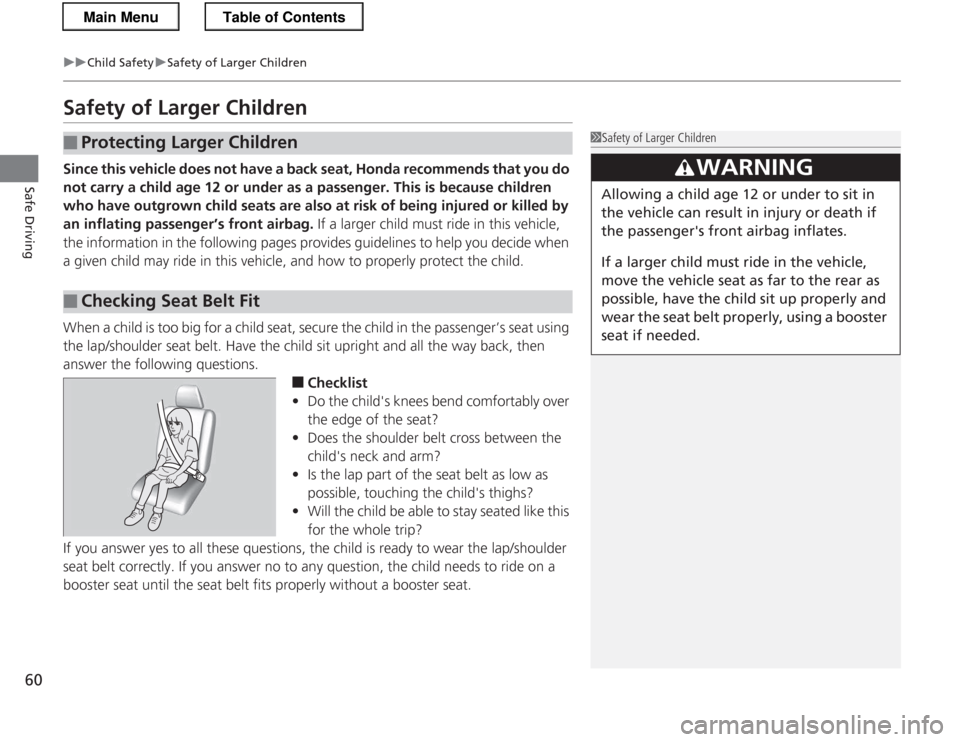
When a child is too big for a child seat, secure the child in the passenger’s seat using
the lap/shoulder seat belt. Have the child sit upright and all the way back, then
answer the following questions.
■Checklist
• Do the child's knees bend comfortably over
the edge of the seat?
• Does the shoulder belt cross between the
child's neck and arm?
• Is the lap part of the seat belt as low as
possible, touching the child's thighs?
• Will the child be able to stay seated like this
for the whole trip?
If you answer yes to all these questions, the child is ready to wear the lap/shoulder
seat belt correctly. If you answer no to any question, the child needs to ride on a
booster seat until the seat belt fits properly without a booster seat.
■Protecting Larger Children
■Checking Seat Belt Fit
1Safety of Larger Children
3WARNING
Allowing a child age 12 or under to sit in
the vehicle can result in injury or death if
the passenger's front airbag inflates.
If a larger child must ride in the vehicle,
move the vehicle seat as far to the rear as
possible, have the child sit up properly and
wear the seat belt properly, using a booster seat if needed.
Main MenuTable of Contents
Page 63 of 325
62
Safe Driving
Exhaust Gas Hazard
Carbon Monoxide Gas
The engine exhaust from this vehicle contains carbon monoxide, a colorless,
odorless, and highly toxic gas. As long as you properly maintain your vehicle, carbon
monoxide gas will not get into the interior. ■ Have the exhaust system inspected for leaks whenever
• The exhaust system is making an unusual noise.
• The exhaust system may have been damaged.
• The vehicle is raised for an oil change.
When you operate a vehicle with the hatch open, airflow can pull exhaust gas into
the interior and create a hazardous condition. If yo u must drive with the hatch open,
open both windows and set the climate control system as shown below. 1. Select the fresh air mode.
2. Select the mode.
3. Set the fan speed to high.
4. Set the temperature control to a comfortable setting.
Adjust the climate control system in the same manner if you sit in your parked
vehicle with the engine running.
1Carbon Monoxide Gas
An enclosed area such as a garage can quickly fill up
with carbon monoxide gas.
Do not run the engine with the garage door closed.
Even when the garage door is open, drive out of the
garage immediately after starting the engine.
3WARNING
Carbon monoxide gas is toxic.
Breathing it can cause unconsciousness and even kill you.
Avoid any enclosed areas or activities that
expose you to carbon monoxide.
Main MenuTable of Contents
Page 70 of 325
69
uuIndicatorsu
Continued
Instrument Panel
IndicatorNameOn/BlinkingExplanationMessage
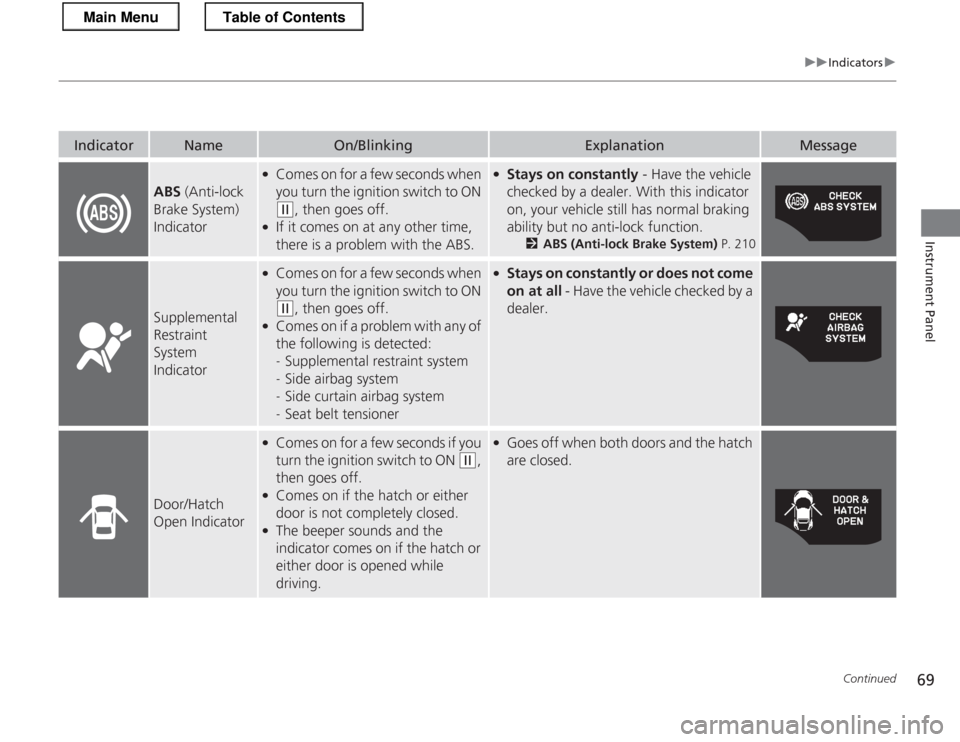
ABS (Anti-lock
Brake System)
Indicator
● Comes on for a few seconds when
you turn the ignition switch to ON
(w , then goes off.
● If it comes on at any other time,
there is a problem with the ABS.
●Stays on constantly - Have the vehicle
checked by a dealer. With this indicator
on, your vehicle still has normal braking
ability but no anti-lock function. 2ABS (Anti-lock Brake System) P. 210
Supplemental
Restraint System
Indicator
●
Comes on for a few seconds when
you turn the ignition switch to ON
(w , then goes off.
● Comes on if a problem with any of
the following is detected: -Supplemental restraint system
- Side airbag system
- Side curtain airbag system
- Seat belt tensioner
●
Stays on constantly or does not come on at all - Have the vehicle checked by a
dealer.
Door/Hatch
Open Indicator
● Comes on for a few seconds if you
turn the ignition switch to ON
(w ,
then goes off.
● Comes on if the hatch or either
door is not completely closed.
● The beeper sounds and the
indicator comes on if the hatch or
either door is opened while
driving.
●Goes off when both doors and the hatch are closed.
Main MenuTable of Contents
Page 72 of 325

71
uuIndicatorsu
Continued
Instrument Panel
IndicatorNameOn/BlinkingExplanationMessage
EPS (Electric
Power Steering) System
Indicator
●Comes on when you turn the ignition switch to ON
(w , and
goes off when the engine starts.
● Comes on if there is a problem
with the EPS (Electric Power Steering) System.
●Stays on constantly or does not come on at all - Have the vehicle checked by a
dealer. 2If the EPS System Indicator Comes On P. 295
Low Tire Pressure/TPMS
Indicator
●
Comes on for a few seconds when
you turn the ignition switch to ON
(w .
● Comes on if the tire pressure of
any of the tires becomes
significantly low.
● Blinks for about one minute, and
then stays on if there is a problem
with the TPMS, or when a
compact spare tire *
is temporarily
installed.
● Comes on while driving - Stop in a
safe place, check tire pressures, and
inflate the tire(s) if necessary.
● Blinks and remains on - Have the
vehicle checked by a dealer. If the vehicle
is fitted with a compact spare, get your
regular tire repaired or replaced and put
back on your vehicle as soon as you can.
U.S.
models only
* Not available on all models
Main MenuTable of Contents
Page 74 of 325
73
uuIndicatorsu
Continued
Instrument Panel
IndicatorNameOn/BlinkingExplanationMessage
Low Temperature
Indicator
●Comes on for a few seconds when
you turn the ignition switch to ON
(w .
● Comes on when the engine coolant temperature is low.
●If the indicator stays on after the engine
has reached normal operating
temperature, there may be a problem
with the temperature sensors. Have the
vehicle inspected by a dealer.
—
Side Airbag Off
Indicator
●
Comes on for a few seconds when
you turn the ignition switch to ON
(w , then goes off.
● Comes on when the passenger
side airbag system is automatically shut off.
●
It does not mean there is a problem with
your side airbags.
● Comes on when nobody is sitting in
the passenger seat - Have the vehicle
checked by a dealer.
● Comes on when someone is sitting in
the seat - Have the passenger sit
properly.
High Beam
Indicator● Comes on when the high beam
headlights are on.
——
U.S.
Canada
U.S.
Canada
Main MenuTable of Contents
Page 122 of 325
121
Continued
Controls
Adjusting the Seats
Adjusting the Seat Positions
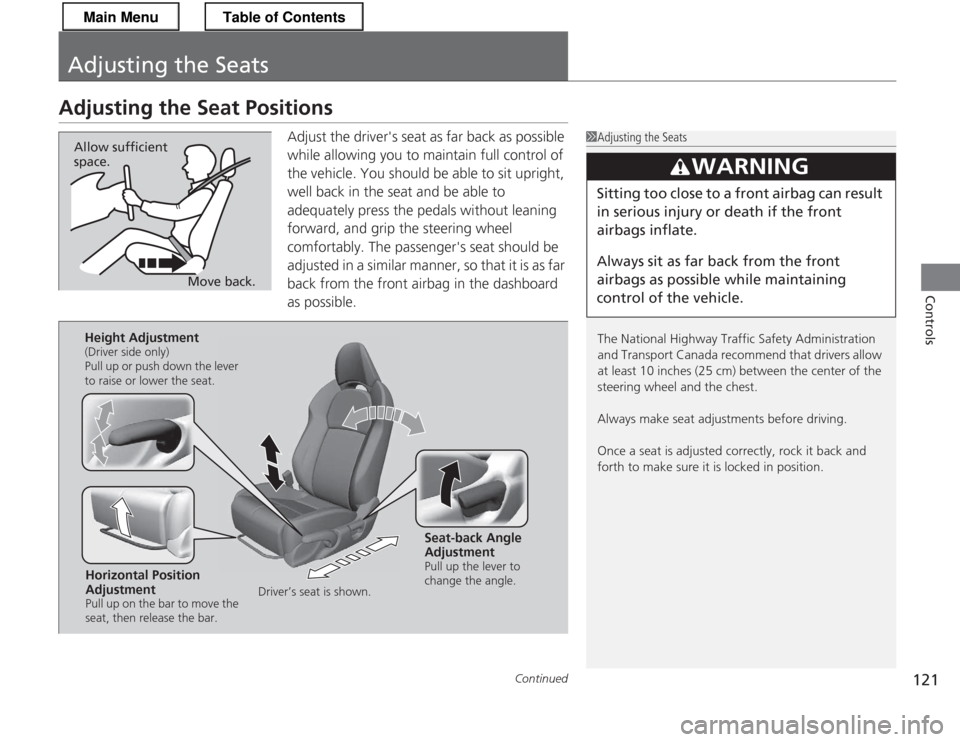
Adjust the driver's seat as far back as possible
while allowing you to maintain full control of
the vehicle. You should be able to sit upright,
well back in the seat and be able to
adequately press the pedals without leaning
forward, and grip the steering wheel
comfortably. The passenger's seat should be
adjusted in a similar manner, so that it is as far
back from the front airbag in the dashboard
as possible.
1Adjusting the Seats
The National Highway Traffic Safety Administration
and Transport Canada recommend that drivers allow
at least 10 inches (25 cm) between the center of the
steering wheel and the chest.
Always make seat adjustments before driving.
Once a seat is adjusted correctly, rock it back and forth to make sure it is locked in position.
3WARNING
Sitting too close to a front airbag can result
in serious injury or death if the front
airbags inflate.
Always sit as far back from the front
airbags as possible while maintaining
control of the vehicle.
Move back.
Allow sufficient space.
Horizontal Position
Adjustment
Pull up on the bar to move the
seat, then release the bar.
Height Adjustment
(Driver side only)
Pull up or push down the lever
to raise or lower the seat.
Seat-back Angle
Adjustment
Pull up the lever to
change the angle.
Driver’s seat is shown.
Main MenuTable of Contents
Page 123 of 325
uuAdjusting the SeatsuAdjusting the Seat Positions
122
Controls
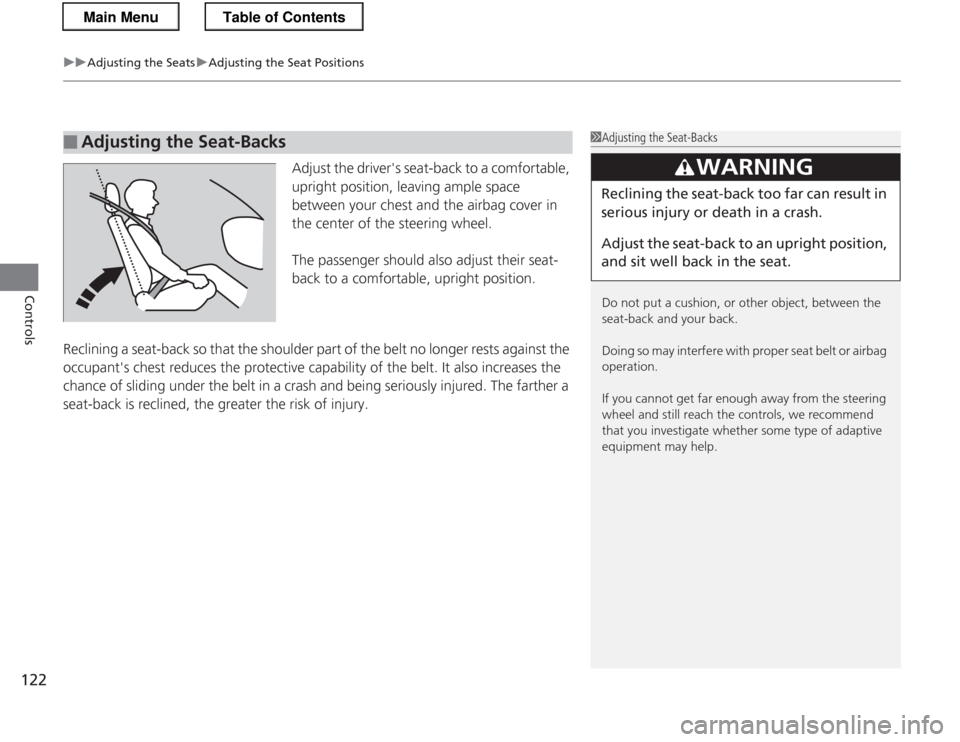
Adjust the driver's seat-back to a comfortable,
upright position, leaving ample space
between your chest and the airbag cover in
the center of the steering wheel.
The passenger should also adjust their seat-
back to a comfortable, upright position.
Reclining a seat-back so that the shoulder part of the belt no longer rests against the
occupant's chest reduces the protective capability of the belt. It also increases the
chance of sliding under the belt in a crash and being seriously injured. The farther a
seat-back is reclined, the greater the risk of injury.
■Adjusting the Seat-Backs1Adjusting the Seat-Backs
Do not put a cushion, or other object, between the
seat-back and your back.
Doing so may interfe re with proper seat belt or airbag
operation.
If you cannot get far enough away from the steering
wheel and still reach the controls, we recommend
that you investigate whether some type of adaptive
equipment may help.
3WARNING
Reclining the seat-back too far can result in
serious injury or death in a crash.
Adjust the seat-back to an upright position,
and sit well back in the seat.
Main MenuTable of Contents
