Page 294 of 563

Fuse or relay
locationFuse amp
ratingProtected circuits
24 15A Steering wheel control module,
Diagnostic connector, Power fold
mirror relay, Remote keyless
entry, Electronic finish panel
25 15A Not used (spare)
26 5A Steering wheel control module
27 20A Not used (spare)
28 15A Ignition switch
29 20A SYNC, GPS module, Radio
faceplate
30 15A Parking lamp relay, Trailer tow
parking lamp relay
31 5A Trailer brake controller (brake
signal), Customer access
32 15A Moonroof motor, Telescoping
mirror switch, Auto dimming
mirrors, Power inverter, Driver
and passenger door lock switch
illumination, Rear heated seat
switch illumination
33 10A Restraint control module
34 10A Heated steering wheel module,
Rear heated seats module
35 5A Select shift switch, Reverse park
aid module, Trailer brake control
module
36 10A Fuel tank select switch
37 10A PTC heater
38 10A AM/FM radio faceplate
39 15A High beam headlamps
40 10A Parking lamps (in mirrors), Roof
marker lamps
Fuses293
2013 F-250/350/450/550(f23)
Owners Guide gf, 1st Printing
USA(fus)
Page 298 of 563
Working with the Engine Off
1. Set the parking brake and shift to P (Park).
2. Turn off the engine and remove the key (if equipped).
3. Block the wheels.
Working with the Engine On
WARNING:To reduce the risk of vehicle damage or personal
burn injuries, do not start your engine with the air cleaner
removed and do not remove it while the engine is running.
1. Set the parking brake and shift to position P.
2. Block the wheels.
OPENING AND CLOSING THE HOOD
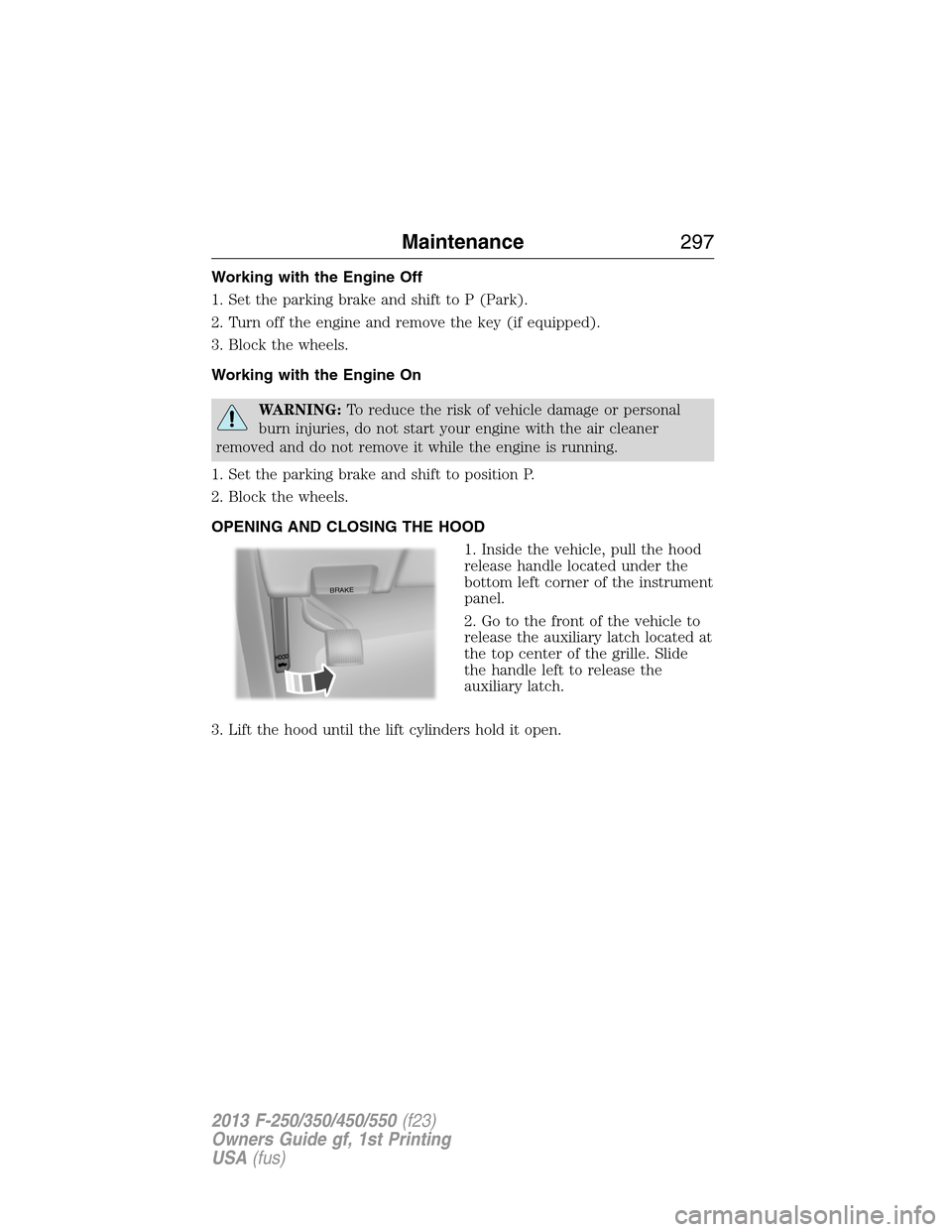
1. Inside the vehicle, pull the hood
release handle located under the
bottom left corner of the instrument
panel.
2. Go to the front of the vehicle to
release the auxiliary latch located at
the top center of the grille. Slide
the handle left to release the
auxiliary latch.
3. Lift the hood until the lift cylinders hold it open.
BRAKE
HOOD
Maintenance297
2013 F-250/350/450/550(f23)
Owners Guide gf, 1st Printing
USA(fus)
Page 299 of 563
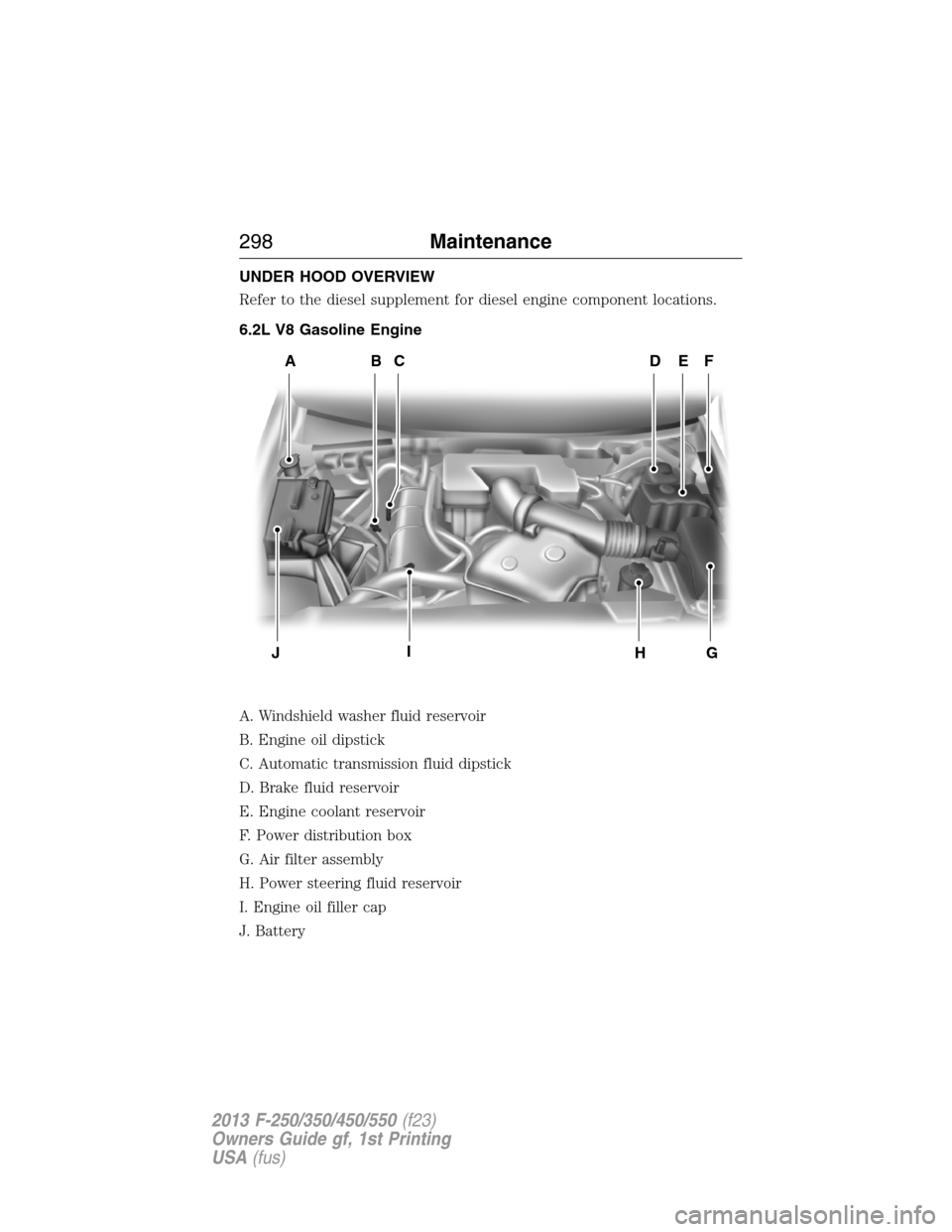
UNDER HOOD OVERVIEW
Refer to the diesel supplement for diesel engine component locations.
6.2L V8 Gasoline Engine
A. Windshield washer fluid reservoir
B. Engine oil dipstick
C. Automatic transmission fluid dipstick
D. Brake fluid reservoir
E. Engine coolant reservoir
F. Power distribution box
G. Air filter assembly
H. Power steering fluid reservoir
I. Engine oil filler cap
J. Battery
ADFEBC
GHIJ
298Maintenance
2013 F-250/350/450/550(f23)
Owners Guide gf, 1st Printing
USA(fus)
Page 300 of 563
6.8L V10 Gasoline Engine
A. Windshield washer fluid reservoir
B. Battery
C. Automatic transmission fluid dipstick
D. Engine oil filler cap
E. Engine oil dipstick
F. Power steering fluid reservoir
G. Brake fluid reservoir
H. Engine coolant reservoir
I. Air filter assembly
J. Power distribution box
ABCEHIJFDG
Maintenance299
2013 F-250/350/450/550(f23)
Owners Guide gf, 1st Printing
USA(fus)
Page 301 of 563
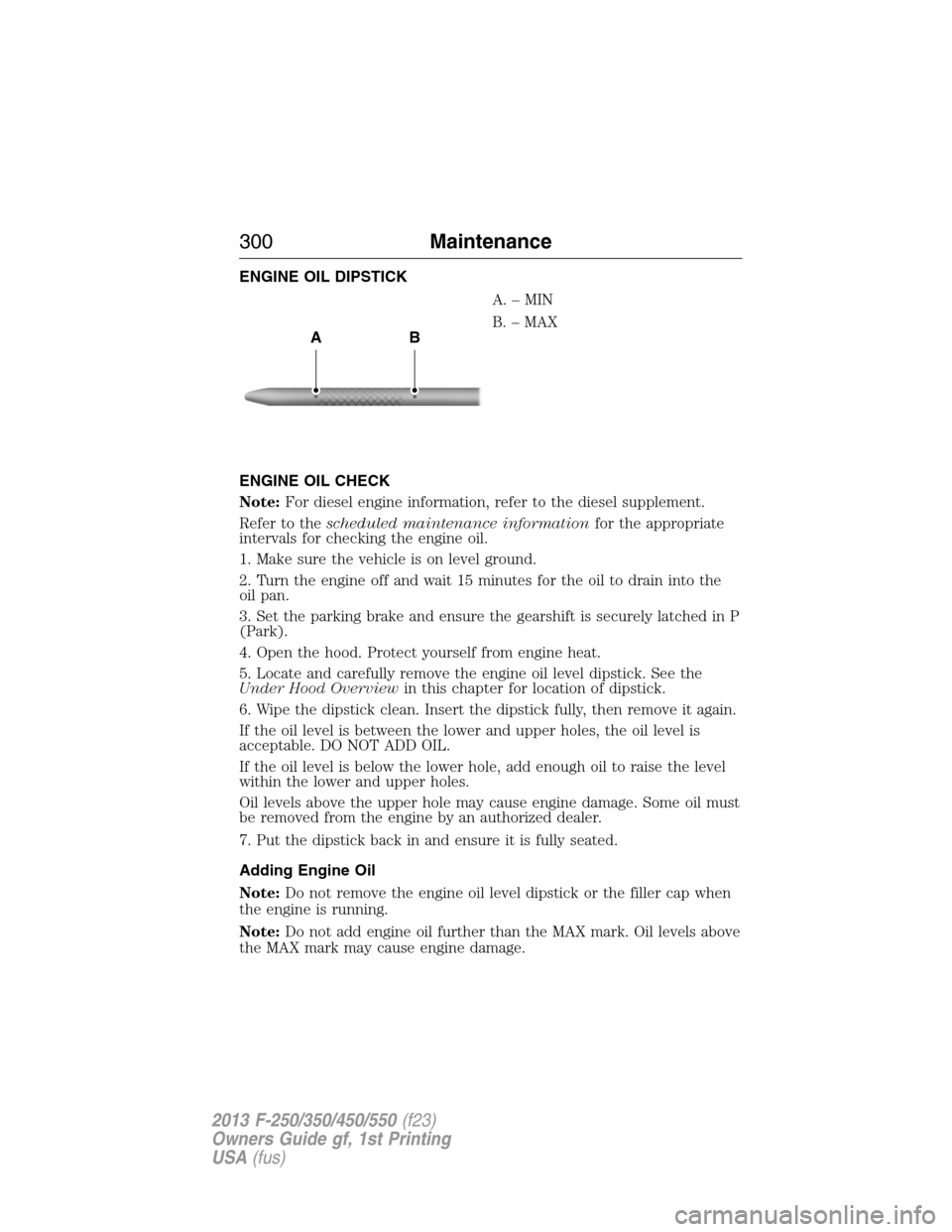
ENGINE OIL DIPSTICK
A.–MIN
B. – MAX
ENGINE OIL CHECK
Note:For diesel engine information, refer to the diesel supplement.
Refer to thescheduled maintenance informationfor the appropriate
intervals for checking the engine oil.
1. Make sure the vehicle is on level ground.
2. Turn the engine off and wait 15 minutes for the oil to drain into the
oil pan.
3. Set the parking brake and ensure the gearshift is securely latched in P
(Park).
4. Open the hood. Protect yourself from engine heat.
5. Locate and carefully remove the engine oil level dipstick. See the
Under Hood Overviewin this chapter for location of dipstick.
6. Wipe the dipstick clean. Insert the dipstick fully, then remove it again.
If the oil level is between the lower and upper holes, the oil level is
acceptable. DO NOT ADD OIL.
If the oil level is below the lower hole, add enough oil to raise the level
within the lower and upper holes.
Oil levels above the upper hole may cause engine damage. Some oil must
be removed from the engine by an authorized dealer.
7. Put the dipstick back in and ensure it is fully seated.
Adding Engine Oil
Note:Do not remove the engine oil level dipstick or the filler cap when
the engine is running.
Note:Do not add engine oil further than the MAX mark. Oil levels above
the MAX mark may cause engine damage.
AB
300Maintenance
2013 F-250/350/450/550(f23)
Owners Guide gf, 1st Printing
USA(fus)
Page 307 of 563
If you notice any of the following:
•the engine coolant temperature gauge moves fully into the red (hot)
area
•the coolant temperature warning light illuminates
•the service engine soon indicator illuminates
1. Pull off the road as soon as safely possible and place the vehicle in P
(Park).
2. Leave the engine running until the coolant temperature gauge needle
moves away from the H range. After several minutes, if this does not
happen, follow the remaining steps.
3. Turn the engine off and wait for it to cool before checking the coolant
level.
WARNING:Never remove the coolant reservoir cap while the
engine is running or hot.
4. If the coolant level is normal, you may restart your engine and
continue on.
5. If the coolant is low, add coolant, restart the engine and take your
vehicle to an authorized dealer. SeeAdding engine coolantin this
chapter for more information.
Refer to fail-safe cooling for additional information.
TRANSMISSION FLUID CHECK
Checking Automatic Transmission Fluid (If Equipped)
Refer to yourScheduled Maintenance Informationfor scheduled
intervals for fluid checks and changes. Your transmission does not
consume fluid. However, the fluid level should be checked if the
transmission is not working properly, i.e., if the transmission slips or
shifts slowly or if you notice some sign of fluid leakage.
Automatic transmission fluid expands when warmed. To obtain an
accurate fluid check, drive the vehicle until it is at normal operating
temperature (approximately 20 miles [30 km]). Verify that the
transmission fluid temperature gauge, located on the instrument cluster,
is within normal range.
1. Drive the vehicle 20 miles (30 km) or until it reaches normal operating
temperature.
2. Park the vehicle on a level surface and engage the parking brake.
306Maintenance
2013 F-250/350/450/550(f23)
Owners Guide gf, 1st Printing
USA(fus)
Page 308 of 563
3. With the engine running, parking brake engaged and your foot on the
brake pedal, move the gearshift lever through all of the gear ranges.
Allow sufficient time for each gear to engage.
4. Latch the gearshift lever in P (Park) and leave the engine running.
5. Remove the dipstick, wiping it clean with a clean, dry lint free rag. If
necessary, refer toUnder Hood Overviewin this chapter for the
location of the dipstick.
6. Install the dipstick making sure it is fully seated in the filler tube.
7. Remove the dipstick and inspect the fluid level. The fluid should be in
the designated area for normal operating temperature or ambient
temperature.
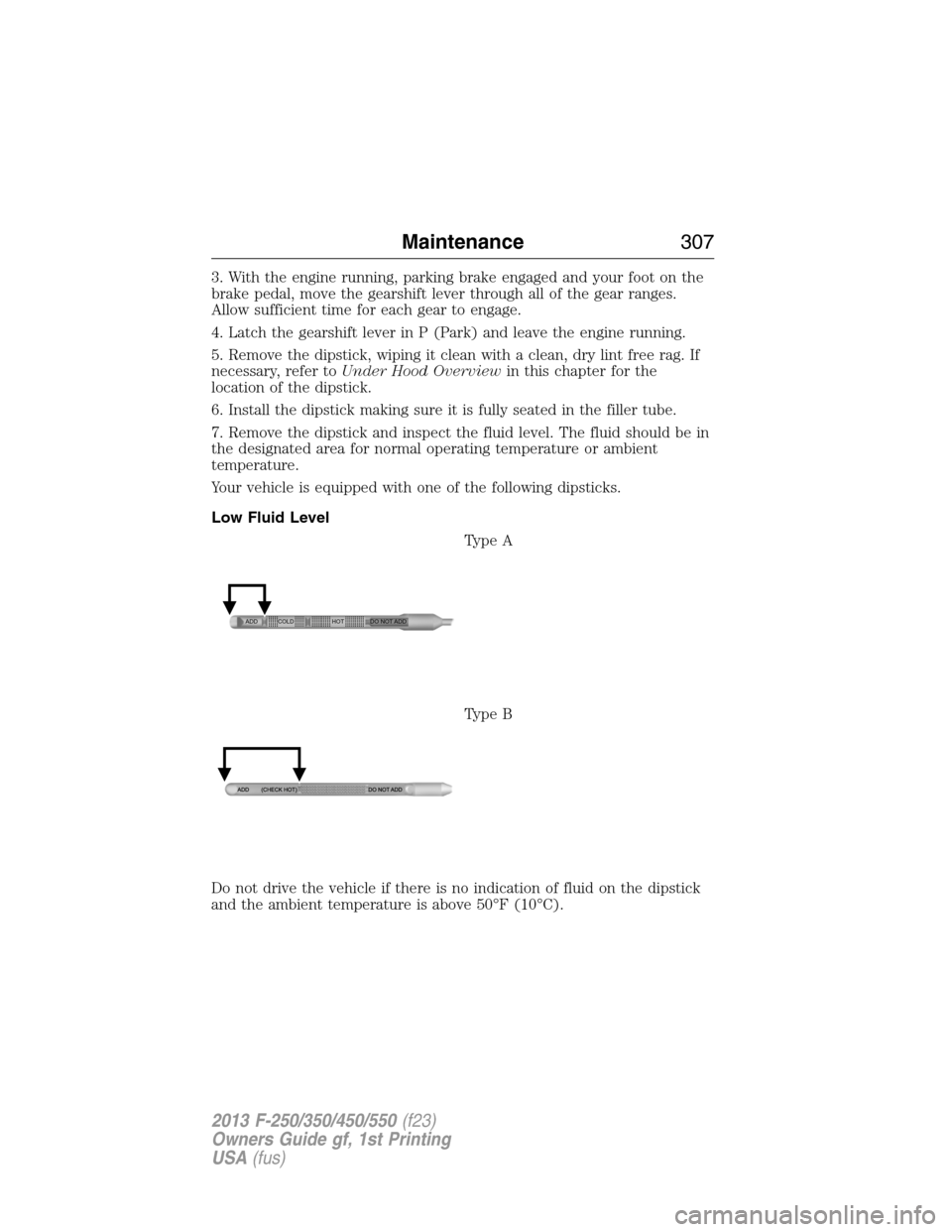
Your vehicle is equipped with one of the following dipsticks.
Low Fluid Level
Type A
Type B
Do not drive the vehicle if there is no indication of fluid on the dipstick
and the ambient temperature is above 50°F (10°C).
ADD COLD HOT DO NOT ADD
Maintenance307
2013 F-250/350/450/550(f23)
Owners Guide gf, 1st Printing
USA(fus)
Page 312 of 563
BRAKE FLUID CHECK
Fluid levels between the MIN and MAX lines are within the normal
operating range; there is no need to add fluid. If the fluid levels are
outside of the normal operating range, the performance of the system
could be compromised; seek service from your authorized dealer
immediately.
POWER STEERING FLUID CHECK
Check the power steering fluid. Refer to yourScheduled Maintenance
Information.If adding fluid is necessary, use only MERCON® V ATF.
Note:This procedure is for vehicles with gasoline engines. Vehicles with
diesel engines are similar. Refer toUnder Hood Overviewin your diesel
supplement.
Check the fluid level when it is at ambient temperature, 20°F–80°F
(-7°C–25°C):
1. Check the fluid level in the reservoir. It should be between the MIN
and MAX range. Do not add fluid if the level is within this range.
2. If the fluid level is low. Add fluid to bring fluid level up to be between
the MIN and MAX range.
3. Start the engine.
4. While the engine idles, turn the steering wheel left and right several
times.
5. Turn the engine off.
6. Recheck the fluid level in the reservoir. Do not add fluid if the level is
between the MIN and MAX range.
7. If the fluid is low, add fluid in small amounts, continuously checking
the level until it is between the MIN and MAX range. Refer toCapacities
and Specificationsfor the proper fluid type. Be sure to put the cap
back on the reservoir.
FUEL FILTER
If equipped with a gasoline engine, your vehicle is equipped with a
lifetime fuel filter that is integrated with the fuel tank. Regular
maintenance or replacement is not needed.
If equipped with a diesel engine, refer to the diesel supplement.
Maintenance311
2013 F-250/350/450/550(f23)
Owners Guide gf, 1st Printing
USA(fus)