Page 24 of 563
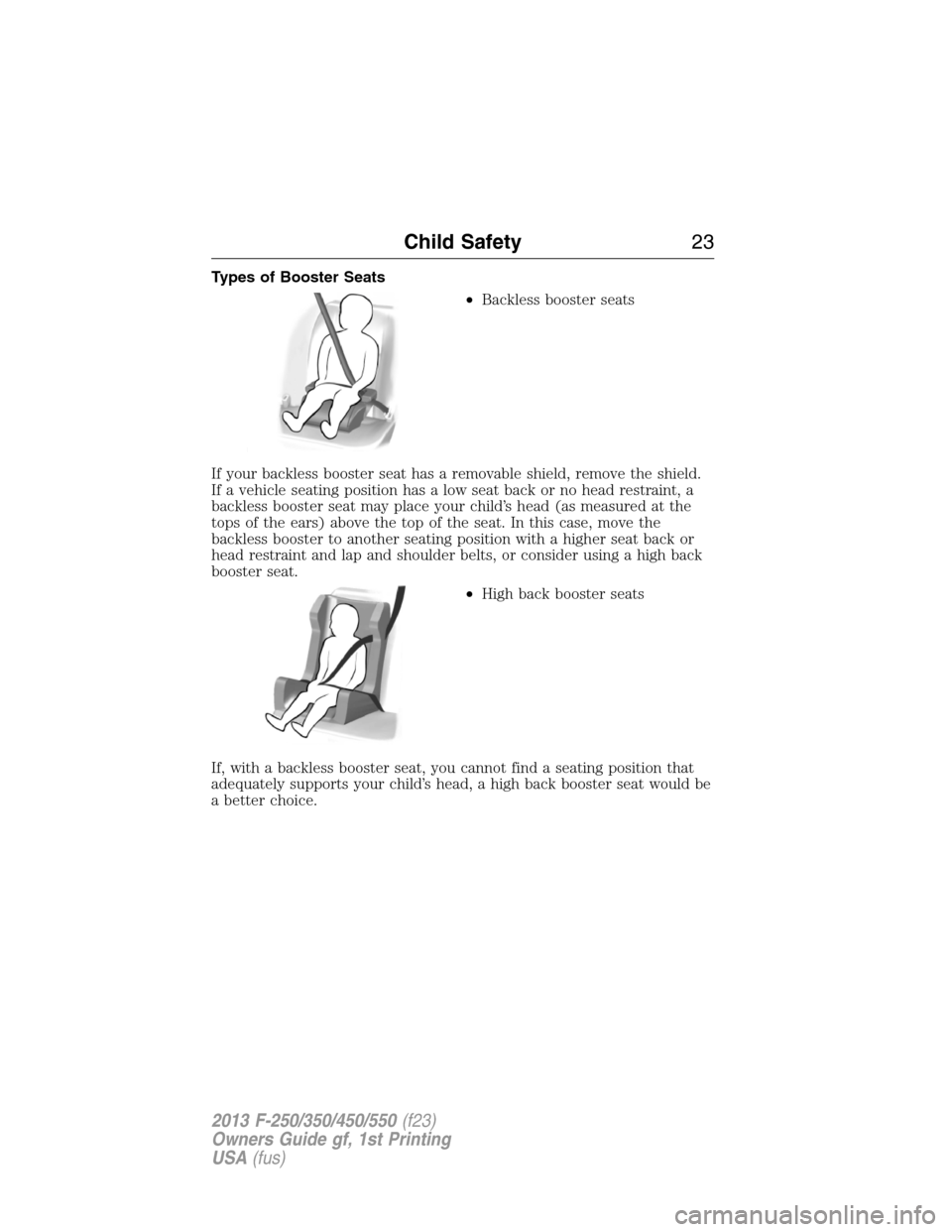
Types of Booster Seats
•Backless booster seats
If your backless booster seat has a removable shield, remove the shield.
If a vehicle seating position has a low seat back or no head restraint, a
backless booster seat may place your child’s head (as measured at the
tops of the ears) above the top of the seat. In this case, move the
backless booster to another seating position with a higher seat back or
head restraint and lap and shoulder belts, or consider using a high back
booster seat.
•High back booster seats
If, with a backless booster seat, you cannot find a seating position that
adequately supports your child’s head, a high back booster seat would be
a better choice.
Child Safety23
2013 F-250/350/450/550(f23)
Owners Guide gf, 1st Printing
USA(fus)
Page 25 of 563
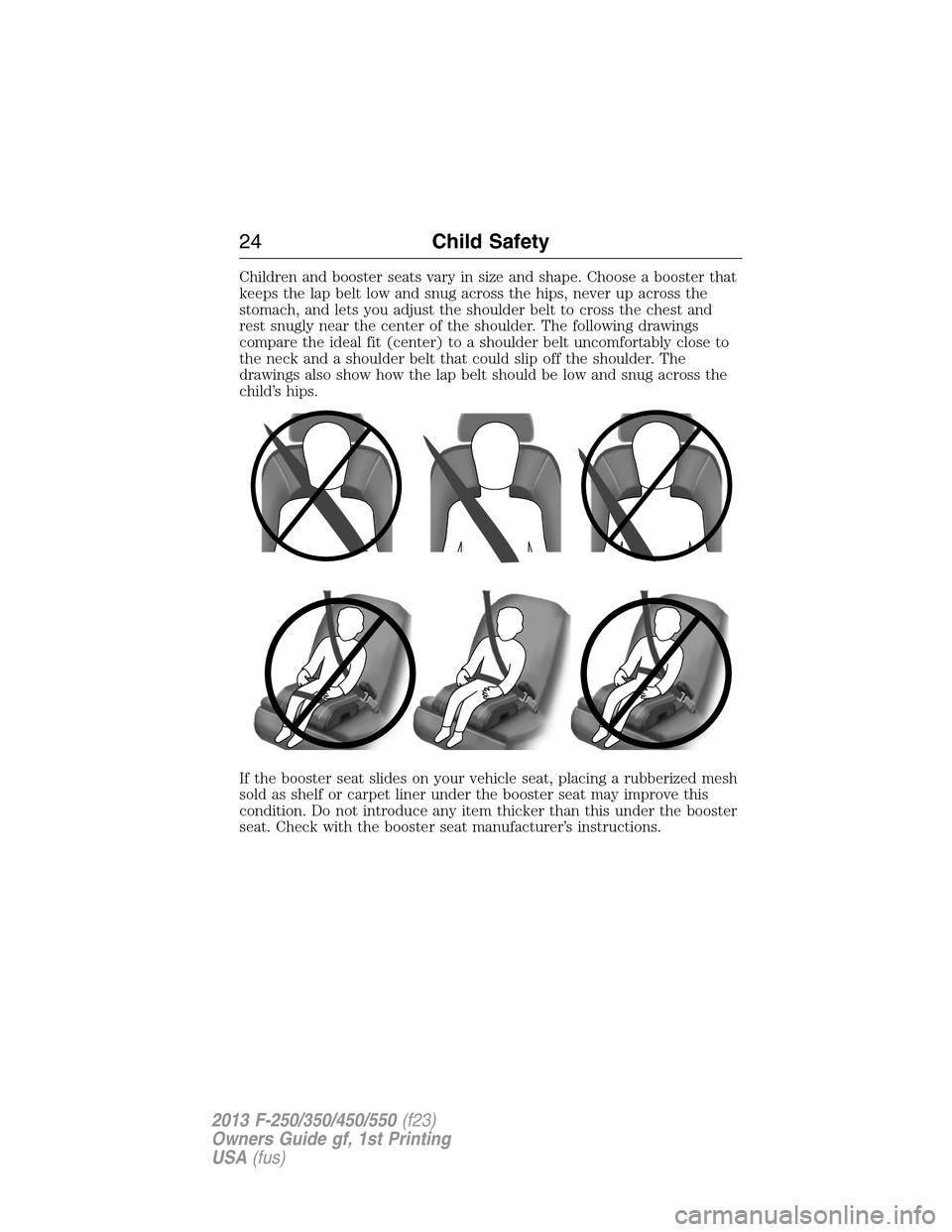
Children and booster seats vary in size and shape. Choose a booster that
keeps the lap belt low and snug across the hips, never up across the
stomach, and lets you adjust the shoulder belt to cross the chest and
rest snugly near the center of the shoulder. The following drawings
compare the ideal fit (center) to a shoulder belt uncomfortably close to
the neck and a shoulder belt that could slip off the shoulder. The
drawings also show how the lap belt should be low and snug across the
child’s hips.
If the booster seat slides on your vehicle seat, placing a rubberized mesh
sold as shelf or carpet liner under the booster seat may improve this
condition. Do not introduce any item thicker than this under the booster
seat. Check with the booster seat manufacturer’s instructions.
24Child Safety
2013 F-250/350/450/550(f23)
Owners Guide gf, 1st Printing
USA(fus)
Page 26 of 563
INSTALLING CHILD SEATS
Using Lap and Shoulder Belts
WARNING:Airbags can kill or injure a child in a child seat.
NEVERplace a rear-facing child seat in front of an active airbag.
If you must use a forward-facing child seat in the front seat, move the
seat all the way back.
WARNING:Children 12 and under should be properly restrained
in the rear seat whenever possible.
WARNING:Depending on where you secure a child restraint,
and depending on the child restraint design, you may block
access to certain safety belt buckle assemblies or LATCH lower
anchors, rendering those features potentially unusable. To avoid risk of
injury, occupants should only use seating positions where they are able
to be properly restrained.
When installing a child safety seat with combination lap/shoulder belts:
•Use the correct safety belt buckle for that seating position.
•Insert the belt tongue into the proper buckle until you hear a snap
and feel it latch. Make sure the tongue is securely fastened in the
buckle.
•Keep the buckle release button pointing up and away from the safety
seat, with the tongue between the child seat and the release button,
to prevent accidental unbuckling.
•Place your vehicle seat back in the upright position.
•This vehicle does not require the use of a locking clip.
Child Safety25
2013 F-250/350/450/550(f23)
Owners Guide gf, 1st Printing
USA(fus)
Page 29 of 563
This is necessary to remove the remaining slack that will exist once the
extra weight of the child is added to the child restraint. It also helps to
achieve the proper snugness of the child seat to your vehicle.
Sometimes, a slight lean toward the buckle will additionally help to
remove remaining slack from the belt.
9. Attach the tether strap (if the child seat is equipped). SeeUsing
Tether Strapsin this chapter.
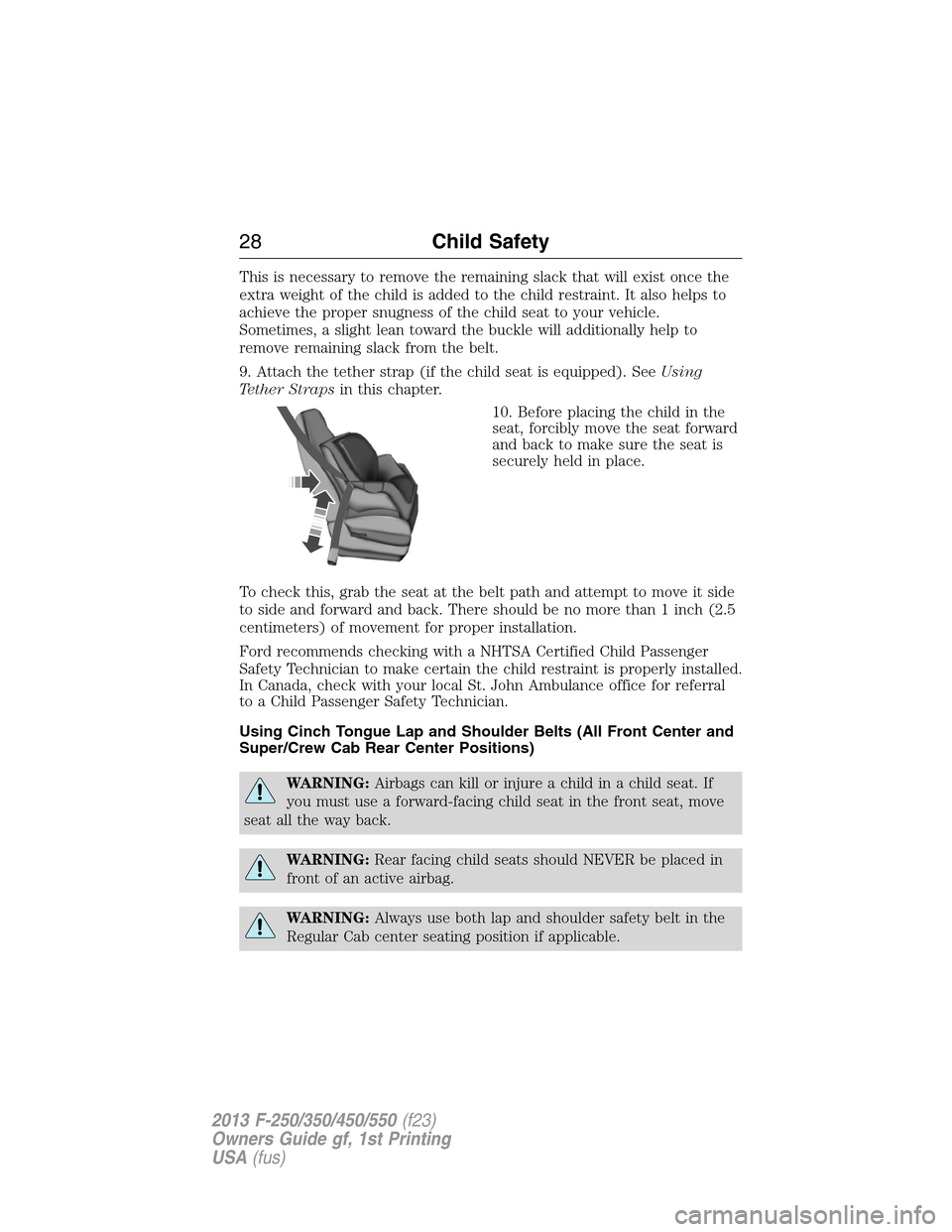
10. Before placing the child in the
seat, forcibly move the seat forward
and back to make sure the seat is
securely held in place.
To check this, grab the seat at the belt path and attempt to move it side
to side and forward and back. There should be no more than 1 inch (2.5
centimeters) of movement for proper installation.
Ford recommends checking with a NHTSA Certified Child Passenger
Safety Technician to make certain the child restraint is properly installed.
In Canada, check with your local St. John Ambulance office for referral
to a Child Passenger Safety Technician.
Using Cinch Tongue Lap and Shoulder Belts (All Front Center and
Super/Crew Cab Rear Center Positions)
WARNING:Airbags can kill or injure a child in a child seat. If
you must use a forward-facing child seat in the front seat, move
seat all the way back.
WARNING:Rear facing child seats should NEVER be placed in
front of an active airbag.
WARNING:Always use both lap and shoulder safety belt in the
Regular Cab center seating position if applicable.
28Child Safety
2013 F-250/350/450/550(f23)
Owners Guide gf, 1st Printing
USA(fus)
Page 32 of 563
9. Check from time to time to be sure that there is no slack in the lap
and shoulder belt. The shoulder belt must be snug to keep the lap belt
tight during a collision.
Ford recommends checking with a NHTSA Certified Child Passenger
Safety Technician to make certain the child restraint is properly installed.
In Canada, check with your local St. John Ambulance office for referral
to a Child Passenger Safety Technician.
Using Lower Anchors and Tethers for CHildren (LATCH)
The LATCH system is composed of three vehicle anchor points: two
lower anchors located where the vehicle seat back and seat cushion meet
(called the seat bight) and one top tether anchor located behind that
seating position. Your vehicle is not equipped with the lower anchor
points in the seat bight. For this vehicle, use the vehicle safety belt and
upper tether to secure a child seat. SeeUsing Tether Strapsand
Recommendations for Safety Restraints for Childrenin this chapter
for more information.
Using Tether Straps
Many forward-facing child safety seats include a tether strap which
extends from the back of the child safety seat and hooks to an anchoring
point called the top tether anchor. Tether straps are available as an
accessory for many older safety seats. Contact the manufacturer of your
child seat for information about ordering a tether strap, or to obtain a
longer tether strap if the tether strap on your safety seat does not reach
the appropriate top tether anchor in the vehicle.
The passenger seats of your vehicle may be equipped with built-in tether
strap anchors located behind the seats as described below.
The tether anchors in your vehicle may be straps on the seat back or an
anchor bracket mounted to the body shell on the back panel.
The SuperCab rear seat has three straps behind the top of the seat back
that function as both routing loops for the tether straps and anchor
loops.
Child Safety31
2013 F-250/350/450/550(f23)
Owners Guide gf, 1st Printing
USA(fus)
Page 34 of 563
Tether Strap Attachment
1. Route the child safety seat tether strap over the back of the seat.
For vehicles with adjustable head restraints, route the tether strap under
the head restraint and between the head restraint posts, otherwise route
the tether strap over the top of the seat back. If the top of the safety
seat hits the head restraint, raise the head restraint to let the child seat
fit further rearward.
2. Locate the correct anchor for the selected seating position.
3. You may need to pull the seatback forward to access the tether
anchors. Make sure the seat is locked in the upright position before
installing the child seat.
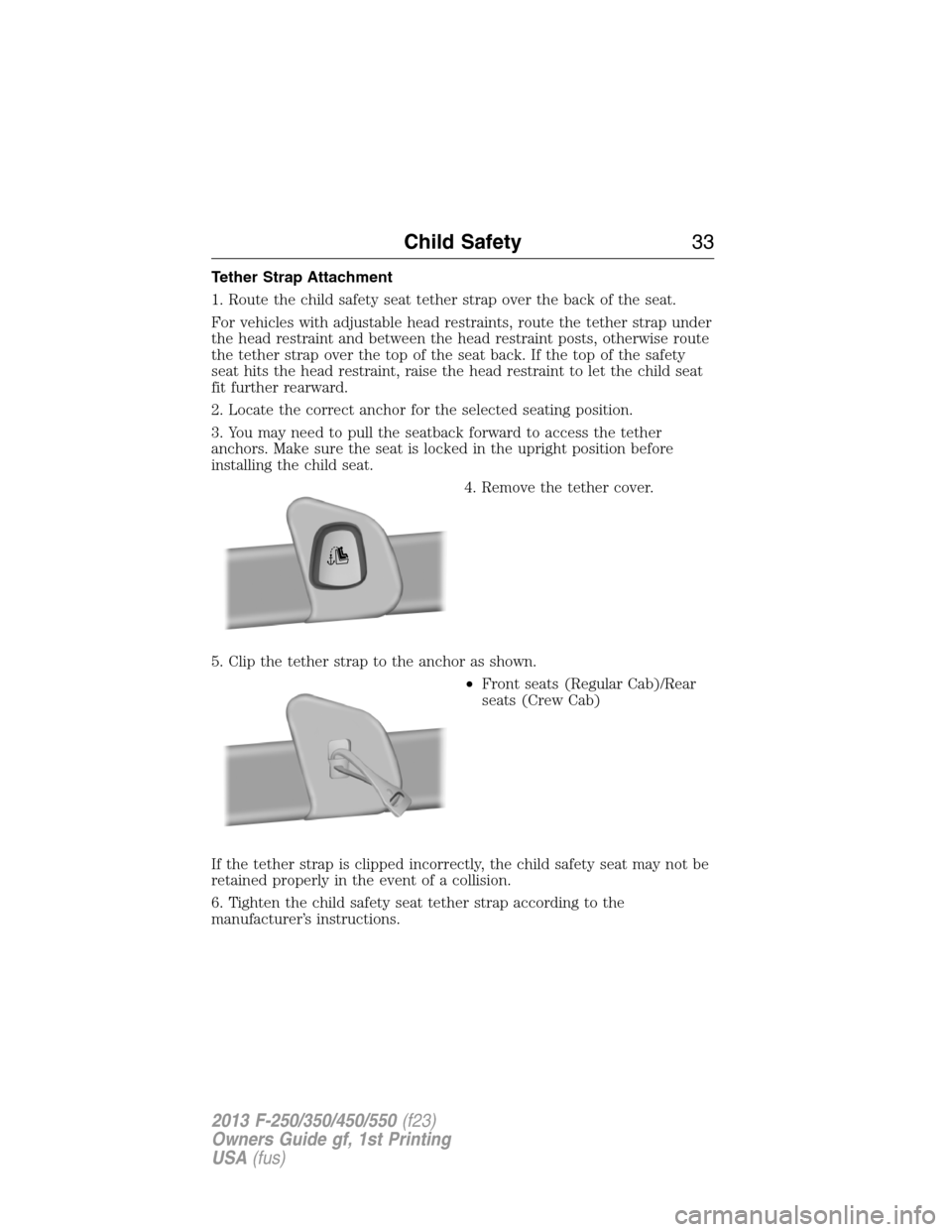
4. Remove the tether cover.
5. Clip the tether strap to the anchor as shown.
•Front seats (Regular Cab)/Rear
seats (Crew Cab)
If the tether strap is clipped incorrectly, the child safety seat may not be
retained properly in the event of a collision.
6. Tighten the child safety seat tether strap according to the
manufacturer’s instructions.
Child Safety33
2013 F-250/350/450/550(f23)
Owners Guide gf, 1st Printing
USA(fus)
Page 36 of 563
3. Install the child safety seat tightly
using the vehicle belts. Follow the
instructions in this chapter.
4. Tighten the tether strap
according to the child seat
manufacturer’s instructions.
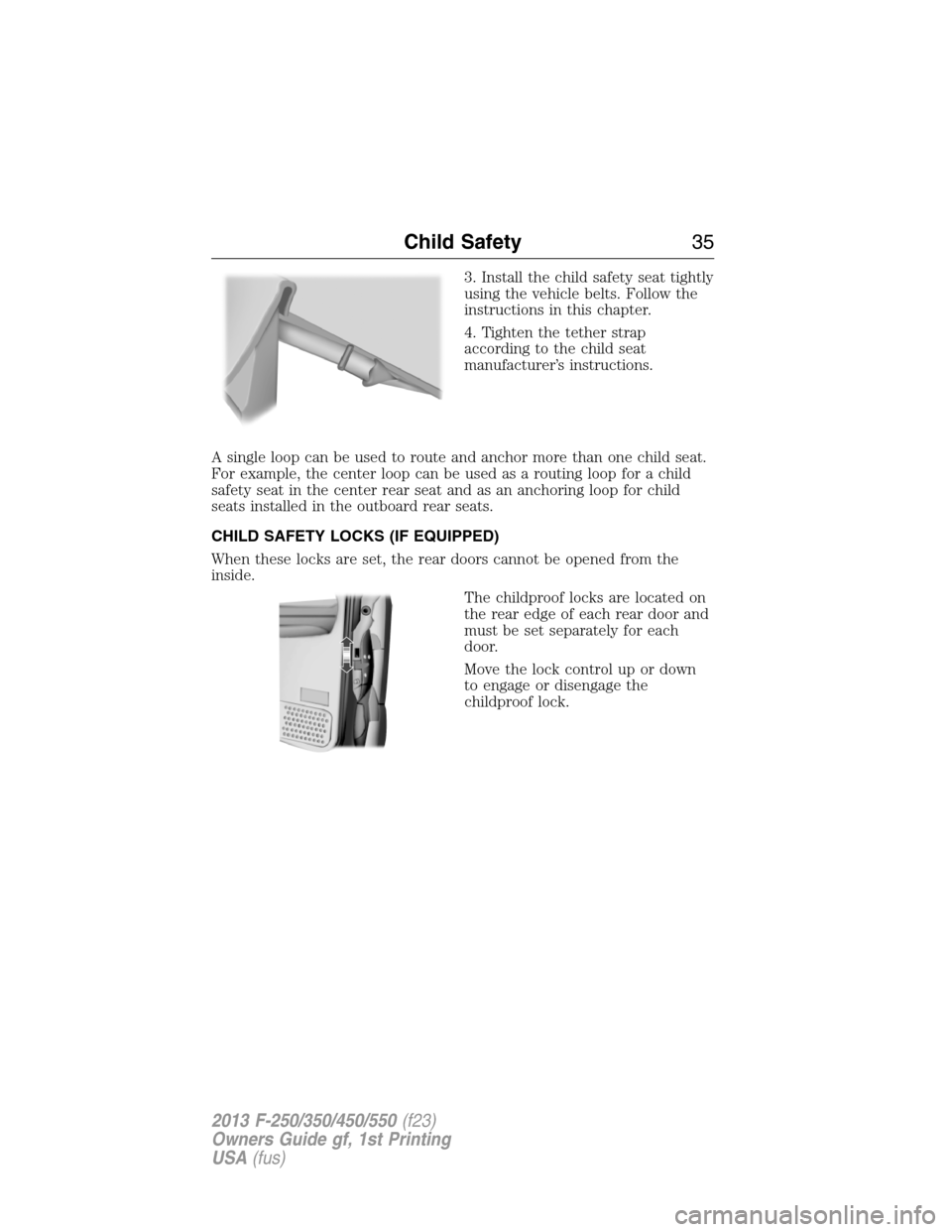
A single loop can be used to route and anchor more than one child seat.
For example, the center loop can be used as a routing loop for a child
safety seat in the center rear seat and as an anchoring loop for child
seats installed in the outboard rear seats.
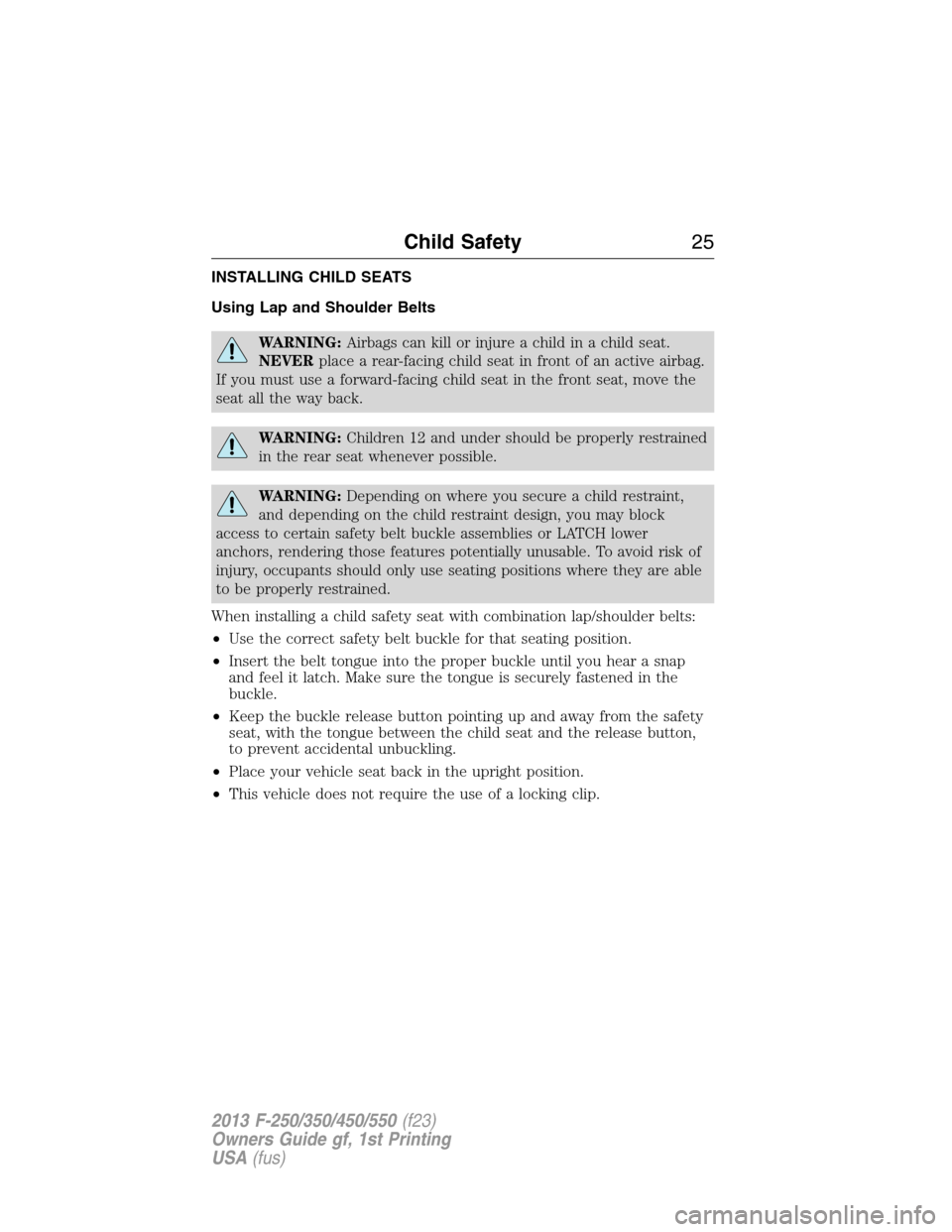
CHILD SAFETY LOCKS (IF EQUIPPED)
When these locks are set, the rear doors cannot be opened from the
inside.
The childproof locks are located on
the rear edge of each rear door and
must be set separately for each
door.
Move the lock control up or down
to engage or disengage the
childproof lock.
Child Safety35
2013 F-250/350/450/550(f23)
Owners Guide gf, 1st Printing
USA(fus)
Page 37 of 563
PRINCIPLES OF OPERATION
WARNING:Always drive and ride with your seat back upright
and the lap belt snug and low across the hips.
WARNING:To reduce the risk of injury, make sure children sit
where they can be properly restrained.
WARNING:Never let a passenger hold a child on his or her lap
while the vehicle is moving. The passenger cannot protect the
child from injury in a crash.
WARNING:All occupants of the vehicle, including the driver,
should always properly wear their safety belts, even when an
airbag supplemental restraint system is provided.
WARNING:It is extremely dangerous to ride in a cargo area,
inside or outside of a vehicle. In a crash, people riding in these
areas are more likely to be seriously injured or killed. Do not allow
people to ride in any area of your vehicle that is not equipped with
seats and safety belts. Be sure everyone in your vehicle is in a seat and
using a safety belt properly.
WARNING:In a rollover crash, an unbelted person is
significantly more likely to die than a person wearing a safety
belt.
WARNING:Each seating position in your vehicle has a specific
safety belt assembly which is made up of one buckle and one
tongue that are designed to be used as a pair. 1) Use the shoulder belt
on the outside shoulder only. Never wear the shoulder belt under the
arm. 2) Never swing the safety belt around your neck over the inside
shoulder. 3) Never use a single belt for more than one person.
WARNING:When possible, all children 12 years old and under
should be properly restrained in a rear seating position.
36Safety Belts
2013 F-250/350/450/550(f23)
Owners Guide gf, 1st Printing
USA(fus)