2013 FORD SUPER DUTY engine coolant
[x] Cancel search: engine coolantPage 54 of 95
Adding engine coolant
WARNING:Do not add coolant when the engine is hot. Steam and
scalding liquids released from a hot cooling system can burn you
badly. Also, you can be burned if you spill coolant on hot engine parts.
WARNING:Do not put coolant in the windshield washer fluid
container. If sprayed on the windshield, coolant could make it
difficult to see through the windshield.
WARNING:To reduce the risk of personal injury, make sure the
engine is cool before unscrewing the coolant pressure relief cap.
The cooling system(s) are under pressure; steam and hot liquid can
come out forcefully when the cap is loosened slightly.
WARNING:Do not add coolant further than the MAX mark.
Note:Do not use stop leak pellets, cooling system sealants or unapproved
additives as they can cause damage to the engine cooling and/or heating
systems. This damage would not be covered under your vehicle’s warranty.
Note:During normal vehicle operation, the engine coolant may change
color from orange to pink or light red. If the engine coolant is clear and
uncontaminated, this color change does not indicate the engine coolant
has degraded nor does it require the engine coolant to be drained, the
system to be flushed, or the engine coolant to be replaced.
•DO NOT MIX different colors or types of coolant in your vehicle. Only
use prediluted engine coolant that meets Ford specification . Mixing of
engine coolants may harm your engine’s cooling system. The use of an
improper coolant may harm engine and cooling system components
and may void the warranty.
•In case of emergency, a large amount of water without engine coolant
may be added in order to reach a vehicle service location. In this
instance, the cooling system must be drained, chemically cleaned, and
refilled with engine coolant as soon as possible per the instructions in
the Workshop Manual. Water alone (without engine coolant) can cause
engine damage from corrosion, overheating or freezing.DO NOTuse
this method for the secondary cooling system. The secondary cooling
system operates close to ambient temperature, and is susceptible to
freezing in any subfreezing environment, in the absence of coolant.
Maintenance
53
2013 Diesel(67l)
Supplement, 1st Printing
USA(fus)
Page 55 of 95
•Do not use alcohol, methanol or brine or any engine coolants mixed
with alcohol or methanol antifreeze (coolant). Alcohol and other
liquids can cause engine damage from overheating or freezing.
•Do not add extra inhibitors or unapproved additives to the coolant.
These can be harmful and compromise the corrosion protection of the
engine coolant.
Add prediluted engine coolant meeting the Ford specification
(Motorcraft® Orange Antifreeze/Coolant Prediluted). SeeCapacities
and Specificationsfor more information. Note: Generic coolants for all
makes and models may not meet the Ford specification and may cause
damage to the cooling system. This damage may void the warranty.
For vehicles with overflow coolant systems with a non-pressurized cap
on the coolant recovery system, add coolant to the coolant recovery
reservoir when the engine is cool. Add prediluted engine coolant
(Motorcraft® Orange Antifreeze/Coolant Prediluted) to the FULL COLD
level. For all other vehicles which have a coolant degas system with a
pressurized cap, or if it is necessary to remove the coolant pressure
relief cap on the radiator of a vehicle with an overflow system, follow
these steps to add engine coolant.
1. Turn the engine off and let it cool.
2. When the engine is cool, wrap a thick cloth around the coolant
pressure relief cap on the coolant reservoir (a translucent plastic bottle).
Slowly turn cap counterclockwise until pressure begins to release.
3. When you are sure that all the pressure has been released, use the
cloth to turn it counterclockwise and remove the cap.
4. Fill the coolant reservoir slowly with prediluted engine coolant to
within the FULL COLD level, or between the MIN and MAX marks
(within the COLD FILL RANGE), as listed on the engine coolant
reservoir. If you removed the radiator cap in an overflow system, fill the
radiator until the coolant is visible and radiator is almost full. If coolant is
added to bring the level within the COLD FILL RANGE when the engine
is not cold, the system may remain under filled.
5. Replace the cap. Turn until tightly installed. Cap must be tightly
installed to prevent coolant loss.
Whenever coolant has been added, the coolant level in the coolant
reservoir should be checked the next few times you drive the vehicle. If
necessary, add enough prediluted engine coolant to bring the coolant
level to the proper level.
Maintenance
54
2013 Diesel(67l)
Supplement, 1st Printing
USA(fus)
Page 56 of 95
If you have to add more than 1.0 quart (1.0 liter) of engine coolant per
month, have your authorized dealer check the engine cooling system.
Your cooling system may have a leak. Operating an engine with a low level
of coolant can result in engine overheating and possible engine damage.
Engine and secondary cooling system refill procedure
The following procedure should be used when refilling the engine or
secondary cooling systems after it has been drained or become extremely
low.
1. Before you remove the cap, turn the engine off and let it cool.
2. When the engine is cool, wrap a thick cloth around the cap. Slowly
turn cap counterclockwise until pressure begins to release.
3. Step back while the pressure releases.
4. When you are sure that all the pressure has been released, use the
cloth to turn it counterclockwise and remove the cap.
5. Slowly add prediluted engine coolant to the coolant reservoir until the
coolant level is within the COLD FILL RANGE as listed on the reservoir.
6. Reinstall the pressure relief cap.
7. Start and run the engine at 2,000 rpm for 2 minutes.
8. Shut engine off, and remove the pressure relief cap as previously
outlined.
9. If required, add prediluted engine coolant to the coolant reservoir until
the coolant level is within the COLD FILL RANGE as listed on the
reservoir.
10. Engine cooling system: Repeat Step 5 until the coolant level has
stabilized (is no longer dropping after each step) AND the upper radiator
hose at the radiator is warm to the touch (indicating that the engine
thermostat is open and coolant is flowing through the radiator).
Secondary cooling system: Repeat Step 5 until the coolant level has
stabilized (is no longer dropping after each step) AND the lower
passenger side of the secondary radiator is warm to the touch
(indicating secondary thermostat is open and coolant is flowing
through the entire system).
11. Reinstall the pressure relief cap. Shut the engine off and let it cool.
12. Check the coolant level in the reservoir before you drive your vehicle
the next few times (with the engine cool).
Maintenance
55
2013 Diesel(67l)
Supplement, 1st Printing
USA(fus)
Page 57 of 95
13. If necessary, add prediluted engine coolant to the coolant reservoir
until the coolant level is within the COLD FILL RANGE as listed on the
reservoir. After any coolant has been added, check the coolant
concentration. SeeEngine and secondary cooling system coolant
earlier in the chapter for more information.
Whenever coolant has been added, the coolant level in the reservoir
should be checked the next few times you drive the vehicle. If needed,
add prediluted engine coolant to bring the coolant to the proper level.
Recycled engine coolant
Ford Motor Company does not recommend the use of recycled engine
coolant since a Ford-approved recycling process is not yet available.
Always dispose of used automotive fluids in a responsible manner. Follow
your community’s regulations and standards for recycling and disposing
of automotive fluids.
Coolant refill capacity
To find out how much fluid your vehicle’s cooling system can hold, refer
to theCapacities and Specificationschapter.
Severe climates
If you drive in extremely cold climates:
•It may be necessary to have a Ford authorized dealer increase the
coolant concentration above 50%.
•A coolant concentration of 60% will provide improved freeze point
protection. Engine coolant concentrations above 60% will decrease the
overheat protection characteristics of the engine coolant and may
cause engine damage.
If you drive in extremely hot climates:
•It may be necessary to have a Ford authorized dealer decrease the
coolant concentration to 40%.
•A coolant concentration of 40% will provide improved overheat
protection. Engine coolant concentrations below 40% will decrease the
corrosion/freeze protection characteristics of the engine coolant and
may cause engine damage.
Vehicles driven year-round in non-extreme climates should use
prediluted engine coolant for optimum cooling system and engine
protection.
Maintenance
56
2013 Diesel(67l)
Supplement, 1st Printing
USA(fus)
Page 58 of 95
Checking coolant corrosion inhibitor additive strength
At specific mileage intervals of 15,000 miles (24,000 km), as listed in the
scheduled maintenance informationchapter, the coolant corrosion
inhibitor additive should be checked. The optional information display, if
equipped, will also display the messageCHECK COOLANT ADDITIVE
at this time. The purpose of checking is to verify the correct engine
coolant concentration (freeze point protection) and corrosion inhibitor
additive level (strength) of the coolant for maximum engine performance
and protection. Three products are available for ensuring the life and
health of the coolant: one tool, a test kit and a coolant inhibitor additive:
•Rotunda tool 300–ROB75240 available from your dealer –
recommended refractometer to test coolant concentration.
•
Rotunda 328-R071–ELC (Antifreeze Coolant ELC Contamination Kit) –
Evaluates the corrosion inhibitor additive strength. Note the first step is
to verify the vehicle’s coolant concentration is in the correct range of 40
– 60%. Coolant concentrations outside this range will not provide valid
test results. If the report results in a pass (i.e., the cooling system does
not show excessive contamination/the corrosion inhibitor additive
strength is sufficient), no action is required. If the report results as
insufficient (does not pass), the corrosion inhibitor additive strength of
the coolant is too low. If the ENGINE COOLING SYSTEM corrosion
inhibitor additive strength is low, add 48 fluid oz. of Motorcraft®
Specialty Orange Engine Coolant Revitalizer. If the SECONDARY
COOLING SYSTEM corrosion inhibitor additive strength is low, add 16
fluid oz. of Motorcraft® Specialty Orange Engine Coolant Revitalizer.
•Motorcraft® Specialty Orange Engine Coolant Revitalizer – Additive to
boost the corrosion inhibitor level based upon the test results of the
Antifreeze Coolant ELC Contamination Kit. The Revitalizer may be
added two times over the life of the coolant. If additional dosages are
required, the cooling system must be flushed and refilled per the
instructions in the Workshop Manual.
Refer to theCapacities and Specificationschapter for the proper
coolant and additive specifications.
Coolant change
At specific mileage intervals, as listed in thescheduled maintenance
information,the coolant should be changed. The optional information
display, if equipped, will also display the messageCOOLANT CHANGE
REQUIREDat this time.
Refer to theCapacities and Specificationschapter for the proper coolant.
Maintenance
57
2013 Diesel(67l)
Supplement, 1st Printing
USA(fus)
Page 64 of 95
If the engine runs hot
The following could cause the engine to overheat:
•Lack of coolant.
•Dirty cooling system.
•Plugged radiator fins, A/C condenser and/or oil cooler.
•Malfunctioning fan drive.
•Driving with frozen coolant.
•Sticking thermostat.
•Overloading or pulling heavy trailers during hot weather.
•Grill or radiator air blockage.
•Slipping or missing drive belt.
•Plugged or very dirty air filter.
If fuses burn out
WARNING:Replacement fuses and circuit breakers must always
be the same rating as the original equipment shown. Never
replace a fuse or circuit breaker with one of a higher rating. Higher
rated fuses or circuit breakers could allow circuit overloading in the
event of a circuit malfunction, resulting in severe vehicle damage or
personal injury due to fire.
Burned-out or blown fuses usually indicate an electrical short-circuit,
although a fuse may occasionally burn out from vibration. Insert a second
fuse. If this fuse immediately burns out and you cannot locate the cause,
return your vehicle to your dealer for a circuit check.
Refer to theOwner’s Manualfor replacement of fuses.
Selective catalytic reduction (SCR) system speed limit and
Idle-only modes
If the vehicle’s speed is limited or in an idle-only mode, the SCR system
may be limiting the vehicle’s functions due to low or contaminated diesel
exhaust fluid (DEF). Check the DEF. SeeSelective catalytic reduction
(SCR) systemin theFuel and Refuelingchapter for more information.
Maintenance
63
2013 Diesel(67l)
Supplement, 1st Printing
USA(fus)
Page 68 of 95
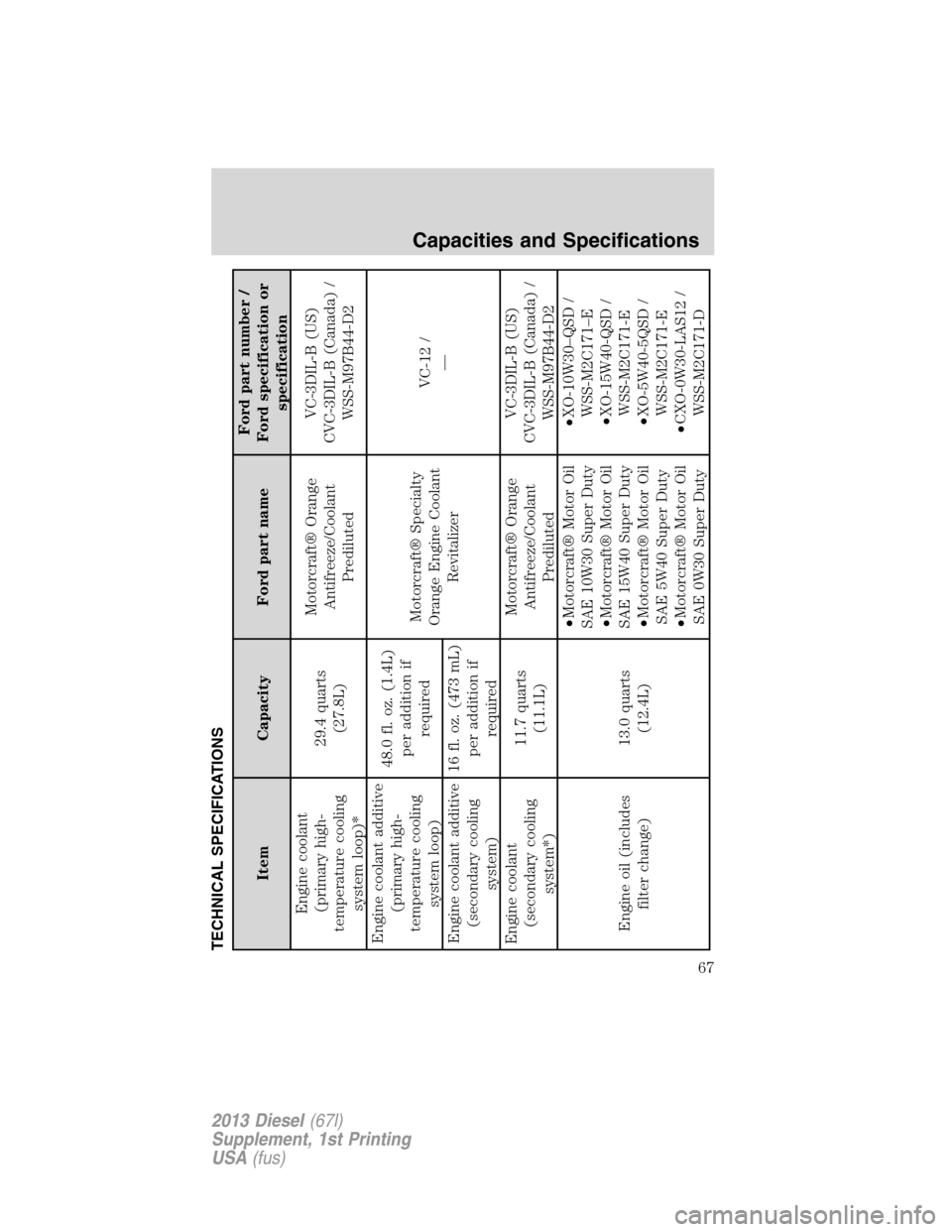
TECHNICAL SPECIFICATIONS
Item Capacity Ford part nameFord part number /
Ford specification or
specification
Engine coolant
(primary high-
temperature cooling
system loop)*29.4 quarts
(27.8L)Motorcraft® Orange
Antifreeze/Coolant
PredilutedVC-3DIL-B (US)
CVC-3DIL-B (Canada) /
WSS-M97B44-D2
Engine coolant additive
(primary high-
temperature cooling
system loop)48.0 fl. oz. (1.4L)
per addition if
requiredMotorcraft® Specialty
Orange Engine Coolant
RevitalizerVC-12 /
—
Engine coolant additive
(secondary cooling
system)16 fl. oz. (473 mL)
per addition if
required
Engine coolant
(secondary cooling
system*)11.7 quarts
(11.1L)Motorcraft® Orange
Antifreeze/Coolant
PredilutedVC-3DIL-B (US)
CVC-3DIL-B (Canada) /
WSS-M97B44-D2
Engine oil (includes
filter change)13.0 quarts
(12.4L)•Motorcraft® Motor Oil
SAE 10W30 Super Duty
•Motorcraft® Motor Oil
SAE 15W40 Super Duty
•Motorcraft® Motor Oil
SAE 5W40 Super Duty
•Motorcraft® Motor Oil
SAE 0W30 Super Duty•XO-10W30–QSD /
WSS-M2C171–E
•XO-15W40-QSD /
WSS-M2C171-E
•XO-5W40-5QSD /
WSS-M2C171-E
•CXO-0W30-LAS12 /
WSS-M2C171-D
Capacities and Specifications
67
2013 Diesel(67l)
Supplement, 1st Printing
USA(fus)
Page 74 of 95
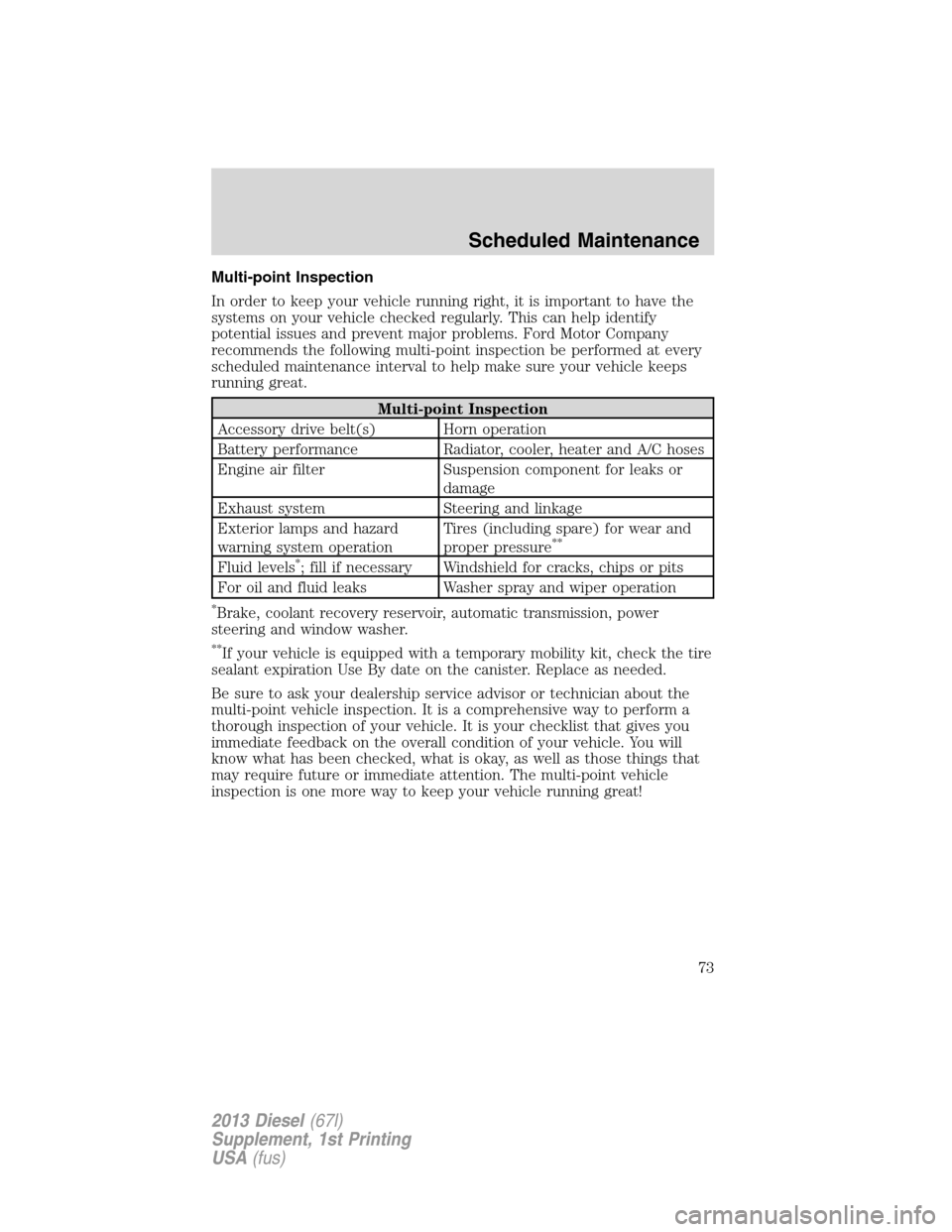
Multi-point Inspection
In order to keep your vehicle running right, it is important to have the
systems on your vehicle checked regularly. This can help identify
potential issues and prevent major problems. Ford Motor Company
recommends the following multi-point inspection be performed at every
scheduled maintenance interval to help make sure your vehicle keeps
running great.
Multi-point Inspection
Accessory drive belt(s) Horn operation
Battery performance Radiator, cooler, heater and A/C hoses
Engine air filter Suspension component for leaks or
damage
Exhaust system Steering and linkage
Exterior lamps and hazard
warning system operationTires (including spare) for wear and
proper pressure
**
Fluid levels*; fill if necessary Windshield for cracks, chips or pits
For oil and fluid leaks Washer spray and wiper operation
*Brake, coolant recovery reservoir, automatic transmission, power
steering and window washer.
**If your vehicle is equipped with a temporary mobility kit, check the tire
sealant expiration Use By date on the canister. Replace as needed.
Be sure to ask your dealership service advisor or technician about the
multi-point vehicle inspection. It is a comprehensive way to perform a
thorough inspection of your vehicle. It is your checklist that gives you
immediate feedback on the overall condition of your vehicle. You will
know what has been checked, what is okay, as well as those things that
may require future or immediate attention. The multi-point vehicle
inspection is one more way to keep your vehicle running great!
Scheduled Maintenance
73
2013 Diesel(67l)
Supplement, 1st Printing
USA(fus)