Page 220 of 475
![FORD FOCUS 2013 3.G Owners Manual •Carry unnecessary weight (approximately 1 mpg [0.4 km/L] is lost for
every 400 lb [180 kg] of weight carried).
•Add particular accessories to your vehicle (e.g. bug deflectors,
rollbars/light bar](/manual-img/11/5144/w960_5144-219.png "FORD FOCUS 2013 3.G Owners Manual •Carry unnecessary weight (approximately 1 mpg [0.4 km/L] is lost for
every 400 lb [180 kg] of weight carried).
•Add particular accessories to your vehicle (e.g. bug deflectors,
rollbars/light bar")
•Carry unnecessary weight (approximately 1 mpg [0.4 km/L] is lost for
every 400 lb [180 kg] of weight carried).
•Add particular accessories to your vehicle (e.g. bug deflectors,
rollbars/light bars, running boards, ski racks).
•Drive with the wheels out of alignment.
DRIVING THROUGH WATER
If driving through deep or standing
water is unavoidable, proceed very
slowly. Never drive through water
that is higher than the bottom of
the wheel rims (for cars) or the
bottom of the hubs (for trucks).
When driving through water, traction or brake capability may be limited.
Also, water may enter your engine’s air intake and severely damage your
engine or your vehicle may stall.
Note:Driving through deep water where the transmission vent tube is
submerged may allow water into the transmission and cause internal
transmission damage.
Note:Once through the water, always dry the brakes by moving your
vehicle slowly while applying light pressure on the brake pedal. Wet
brakes do not stop the vehicle as quickly as dry brakes.
220Driving Hints
2013 Focus(foc)
Owners Guide gf, 1st Printing
USA(fus)
Page 238 of 475
Fuse/Relay
NumberFuse Amp
RatingProtected Components
F3 — Not used
F4 — Not used
F5 — Not used
F6 — Not used
F7 40A** Anti-lock brake system/Electronic
stability program pump
F8 30A** Electronic stability program valve
F9 30A** Heated rear window
F10 40A** Heater blower motor
F11 — Not used
F12 30A** Engine control relay Fuse
F13 30A** Starter relay
F14 25A** Rear power window (without door
control unit)
F15 25A** Automatic transmission
F16 — Not used
F17 — Not used
F18 20A** Front wiper motor
F19 5A* Anti-lock brake system/Electronic
stability program 15 feed
F20 15A* Horn
F21 5A* Stop light switch
F22 15A* Battery monitor system
F23 5A* Relay coils, Light switch module
F24 — Not used
F25 10A* Power exterior mirror (without door
control unit)
F26 15A* Transmission control module 30 feed
automatic transmission
F27 15A* Air conditioning clutch
F28 5A* Mass air flow fuel relay feed
F29 20A* Not used (spare)
238Fuses
2013 Focus(foc)
Owners Guide gf, 1st Printing
USA(fus)
Page 241 of 475

The fuses are coded as follows:
Fuse/Relay
NumberFuse Amp
RatingProtected Components
56 20A Fuel pump supply, Mass air flow
sensor
57 — Not used
58 — Not used
59 5A Passive anti-theft transceiver
60 10A Interior light, Driver door switch
pack, Glove box illumination,
Overhead console switch bank
61 20A Cigar lighter, Power point
62 5A Rain sensor module, Humidity sensor,
Auto-dimming rear view mirror
63 — Not used
64 — Not used
65 10A Luggage compartment release
66 20A Driver door unlock supply, double
lock
67 7.5A SYNC�, Multifunction display, Global
positioning system module, Compass
68 — Not used
69 5A Instrument cluster
70 20A Central lock and unlock supply
71 10A Heating control head (manual air
conditioning), Duel electronic
automatic temperature control
72 7.5A Steering wheel module
73 5A Data link connector
74 15A Low beam headlamp supply
75 15A Fog lamp supply
76 10A Reversing lamp supply
77 20A Windshield washer supply
78 5A Ignition switch, Start button
Fuses241
2013 Focus(foc)
Owners Guide gf, 1st Printing
USA(fus)
Page 242 of 475
Fuse/Relay
NumberFuse Amp
RatingProtected Components
79 15A Radio, Navigation DVD player, Touch
screen, Hazard light switch, Door lock
switch
80 20A Moonroof supply
81 5A Radio frequency receiver
82 20A Windshield washer relay
83 20A Central locking
84 20A Driver door unlock supply, double
lock
85 7.5A Passenger air bag deactivation
indicator, Front seat heater switch,
Heating module (manual air
conditioning), Air quality sensor,
Radio, In-car temperature and
humidity sensor
86 10A Air bag module, Occupant
classification system, Passenger air
bag deactivation indicator
87 — Not used
88 — Not used
89 — Not used
242Fuses
2013 Focus(foc)
Owners Guide gf, 1st Printing
USA(fus)
Page 251 of 475
Note:Automotive fluids are not interchangeable; do not use engine
coolant/antifreeze or windshield washer fluid outside of its specified
function and vehicle location.
Adding Engine Coolant
WARNING:Do not add engine coolant when the engine is hot.
Steam and scalding liquids released from a hot cooling system
can burn you badly. Also, you can be burned if you spill coolant on hot
engine parts.
WARNING:Do not put engine coolant in the windshield washer
fluid container. If sprayed on the windshield, engine coolant
could make it difficult to see through the windshield.
WARNING:To reduce the risk of personal injury, make sure the
engine is cool before unscrewing the coolant pressure relief cap.
The cooling system is under pressure; steam and hot liquid can come
out forcefully when the cap is loosened slightly.
WARNING:Do not add coolant further than the MAX mark.
Note:Do not use stop leak pellets or cooling system sealants/additives
as they can cause damage to the engine cooling and/or heating systems.
This damage would not be covered under your vehicle’s warranty.
Note:During normal vehicle operation, the engine coolant may change
color from orange to pink or light red. As long as the engine coolant is
clear and uncontaminated, this color change does not indicate the engine
coolant has degraded nor does it require the engine coolant to be
drained, the system to be flushed, or the engine coolant to be replaced.
•DO NOT MIX different colors or types of coolant in your vehicle. Make
sure the correct coolant is used. Mixing of engine coolants may harm
your engine’s cooling system. The use of an improper coolant may
harm engine and cooling system components and may void the
warranty.
Maintenance251
2013 Focus(foc)
Owners Guide gf, 1st Printing
USA(fus)
Page 255 of 475

WASHER FLUID CHECK
WARNING:If you operate your vehicle in temperatures below
40°F (5°C), use washer fluid with antifreeze protection. Failure
to use washer fluid with antifreeze protection in cold weather could
result in impaired windshield vision and increase the risk of injury or
accident.
Add fluid to fill the reservoir if the level is low. Only use a washer fluid
that meets Ford specifications. See the technical specifications chart in
theCapacities and Specificationschapter.
Note:The front and rear washer systems are supplied from the same
reservoir.
State or local regulations on volatile organic compounds may restrict the
use of methanol, a common windshield washer antifreeze additive.
Washer fluids containing non-methanol antifreeze agents should be used
only if they provide cold weather protection without damaging the
vehicle’s paint finish, wiper blades or washer system.
CHANGING THE VEHICLE BATTERY
WARNING:Batteries normally produce explosive gases which
can cause personal injury. Therefore, do not allow flames, sparks
or lighted substances to come near the battery. When working near the
battery, always shield your face and protect your eyes. Always provide
proper ventilation.
WARNING:When lifting a plastic-cased battery, excessive
pressure on the end walls could cause acid to flow through the
vent caps, resulting in personal injury and/or damage to the vehicle or
battery. Lift the battery with a battery carrier or with your hands on
opposite corners.
WARNING:Keep batteries out of reach of children. Batteries
contain sulfuric acid. Avoid contact with skin, eyes or clothing.
Shield your eyes when working near the battery to protect against
possible splashing of acid solution. In case of acid contact with skin or
eyes, flush immediately with water for a minimum of 15 minutes and
get prompt medical attention. If acid is swallowed, call a physician
immediately.
Maintenance255
2013 Focus(foc)
Owners Guide gf, 1st Printing
USA(fus)
Page 260 of 475
ADJUSTING THE HEADLAMPS
The headlamps on your vehicle are properly aimed at the assembly plant.
If your vehicle has been in an accident, the alignment of your headlamps
should be checked by your authorized dealer.
Vertical Aim Adjustment
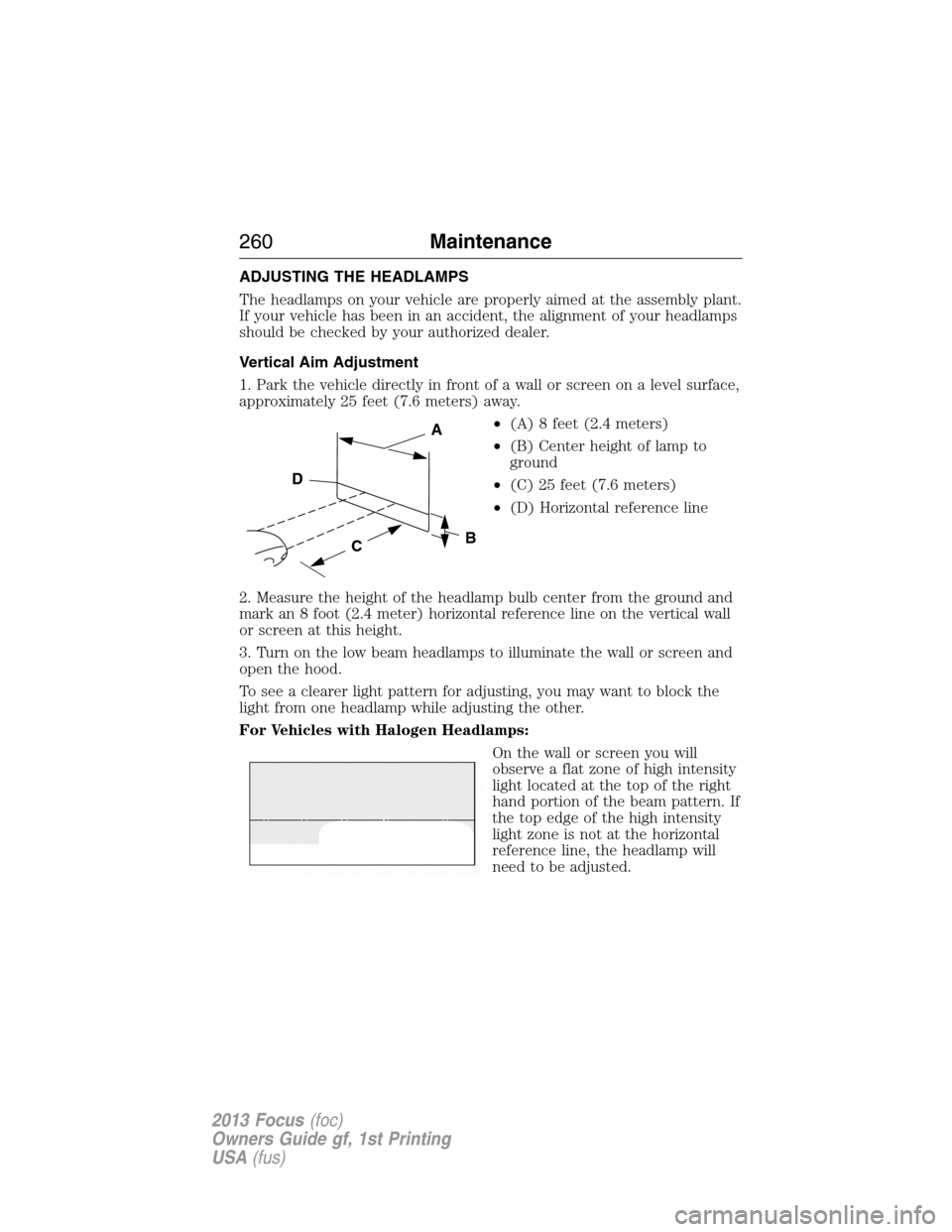
1. Park the vehicle directly in front of a wall or screen on a level surface,
approximately 25 feet (7.6 meters) away.
•(A) 8 feet (2.4 meters)
•(B) Center height of lamp to
ground
•(C) 25 feet (7.6 meters)
•(D) Horizontal reference line
2. Measure the height of the headlamp bulb center from the ground and
mark an 8 foot (2.4 meter) horizontal reference line on the vertical wall
or screen at this height.
3. Turn on the low beam headlamps to illuminate the wall or screen and
open the hood.
To see a clearer light pattern for adjusting, you may want to block the
light from one headlamp while adjusting the other.
For Vehicles with Halogen Headlamps:
On the wall or screen you will
observe a flat zone of high intensity
light located at the top of the right
hand portion of the beam pattern. If
the top edge of the high intensity
light zone is not at the horizontal
reference line, the headlamp will
need to be adjusted.
C
A
B
D
260Maintenance
2013 Focus(foc)
Owners Guide gf, 1st Printing
USA(fus)
Page 261 of 475
For Vehicles with HID Headlamps:
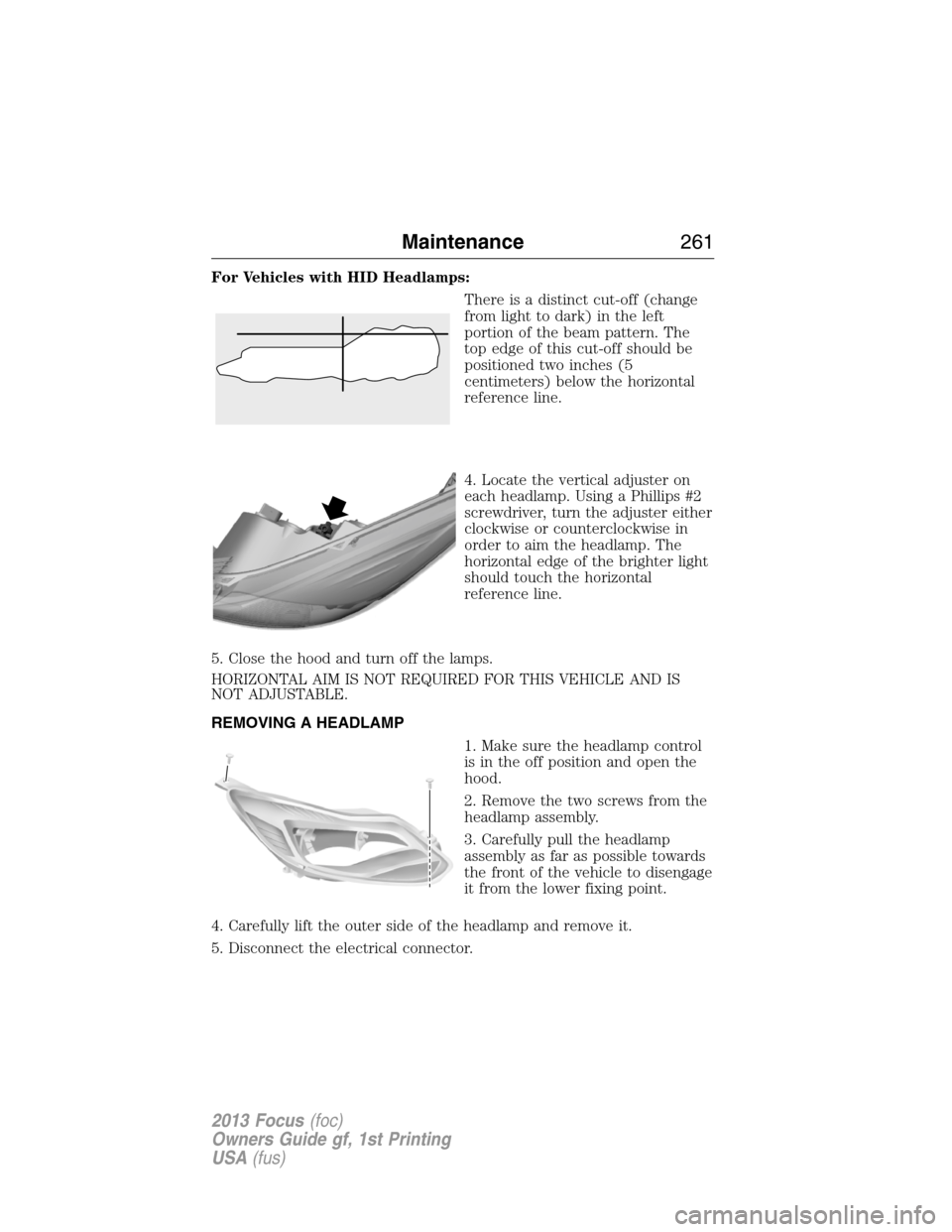
There is a distinct cut-off (change
from light to dark) in the left
portion of the beam pattern. The
top edge of this cut-off should be
positioned two inches (5
centimeters) below the horizontal
reference line.
4. Locate the vertical adjuster on
each headlamp. Using a Phillips #2
screwdriver, turn the adjuster either
clockwise or counterclockwise in
order to aim the headlamp. The
horizontal edge of the brighter light
should touch the horizontal
reference line.
5. Close the hood and turn off the lamps.
HORIZONTAL AIM IS NOT REQUIRED FOR THIS VEHICLE AND IS
NOT ADJUSTABLE.
REMOVING A HEADLAMP
1. Make sure the headlamp control
is in the off position and open the
hood.
2. Remove the two screws from the
headlamp assembly.
3. Carefully pull the headlamp
assembly as far as possible towards
the front of the vehicle to disengage
it from the lower fixing point.
4. Carefully lift the outer side of the headlamp and remove it.
5. Disconnect the electrical connector.
Maintenance261
2013 Focus(foc)
Owners Guide gf, 1st Printing
USA(fus)

