Seats 163
Sitting in the correct position............................163
Head restraints.......................................164
Manual seats.........................................167
Power seats.........................................168
Memory function......................................169
Heated seats.........................................170
Heated and cooled seats................................172
Rear seats..........................................174
Universal Garage Door Opener 184
HomeLink�wireless control system........................184
Auxiliary Power Points 189
Storage Compartments 192
Center console.......................................192
Overhead console.....................................194
Starting and Stopping the Engine 195
Ignition switch.......................................196
Keyless starting......................................196
Engine block heater...................................199
Fuel and Refueling 201
Fuel quality.........................................202
Running out of fuel....................................203
Refueling ...........................................204
Fuel consumption.....................................206
Transmission 210
Automatic transmission.................................210
All-Wheel Drive 216
All wheel drive.......................................216
4Table of Contents
2013 Flex(471)
Owners Guide gf, 1st Printing
USA(fus)
Fuel Used
Shows the amount of fuel used for a given trip.
Distance to E
Indicates the approximate distance the vehicle will travel on the fuel
remaining in the tank. Changes in driving pattern may cause the value to
vary.
Inst Fuel Econ
Shows instantaneous fuel usage.
Average Fuel
Indicates the average fuel consumption since the function was last reset.
Compass (If Equipped)
Displays the vehicle’s heading direction.
To calibrate the compass: Enter the compass menu and select Calibrate.
Follow the prompts.
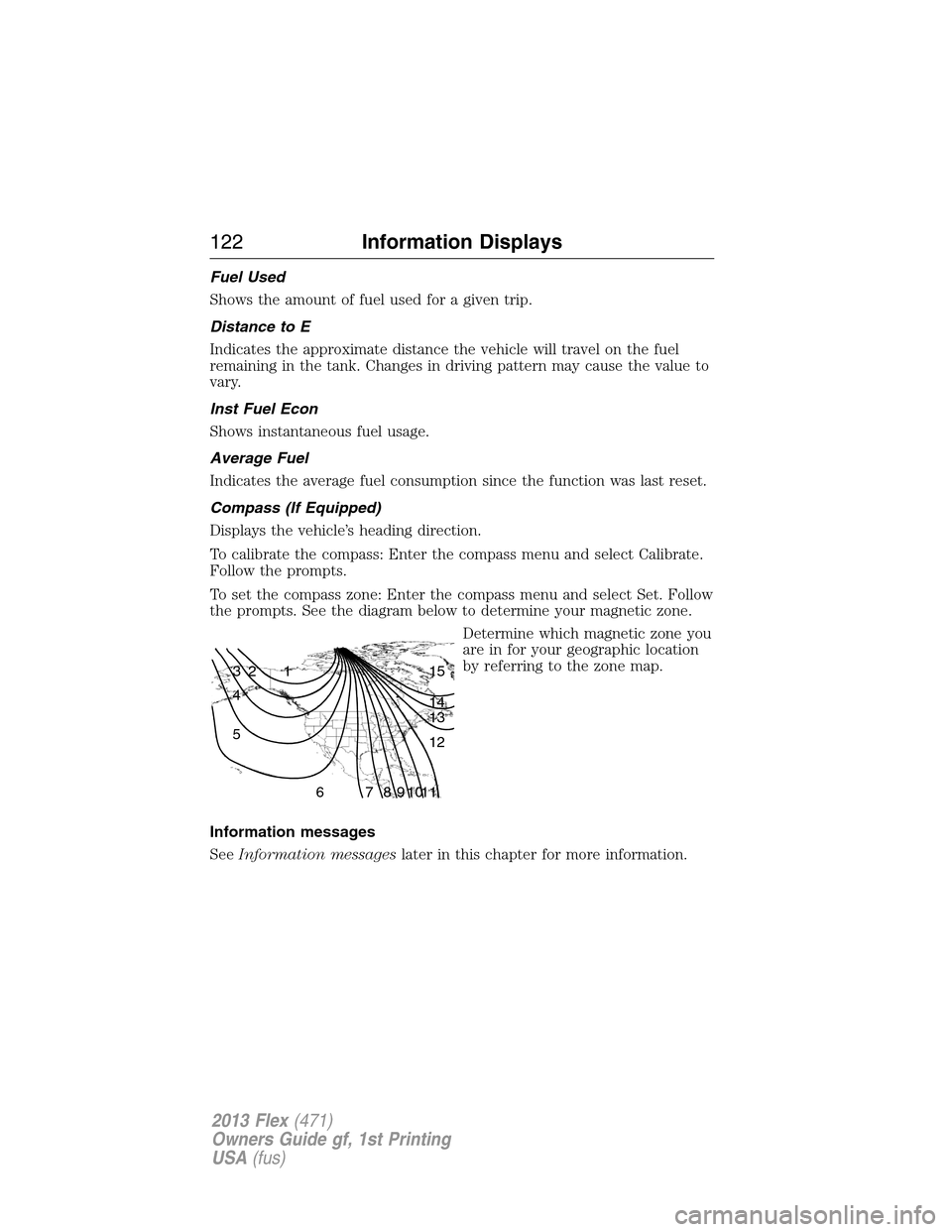
To set the compass zone: Enter the compass menu and select Set. Follow
the prompts. See the diagram below to determine your magnetic zone.
Determine which magnetic zone you
are in for your geographic location
by referring to the zone map.
Information messages
SeeInformation messageslater in this chapter for more information.
1 2 3
4
5
6 7 8 9 101112 13 14 15
122Information Displays
2013 Flex(471)
Owners Guide gf, 1st Printing
USA(fus)
FUEL CONSUMPTION
Filling the tank
The advertised capacity is the indicated capacity and the empty reserve
combined. Indicated capacity is the difference in the amount of fuel in a
full tank and a tank when the fuel gauge indicates empty. Empty reserve
is the amount of fuel in the tank after the fuel gauge indicates empty.
Note:The amount of usable fuel in the empty reserve varies and should
not be relied upon to increase driving range. When refueling your vehicle
after the fuel gauge indicates empty, you might not be able to refuel the
full amount of the advertised capacity of the fuel tank due to the empty
reserve still present in the tank.
For consistent results when filling the fuel tank:
•Turn the ignition off before fueling; an inaccurate reading results if the
engine is left running.
•Use the same fill rate (low–medium–high) each time the tank is filled.
•Allow no more than two automatic click–offs when filling.
Results are most accurate when the filling method is consistent.
Calculating fuel economy
Do not measure fuel economy during the first 1,000 miles (1,600 km) of
driving (this is your engine’s break-in period); a more accurate
measurement is obtained after 2,000 miles–3,000 miles (3,200 km–4,800
km). Also, fuel expense, frequency of fill-ups or fuel gauge readings are
not accurate ways to measure fuel economy.
1. Fill the fuel tank completely and record the initial odometer reading.
2. Each time you fill the tank, record the amount of fuel added.
3. After at least three to five tank fill-ups, fill the fuel tank and record
the current odometer reading.
4. Subtract your initial odometer reading from the current odometer reading.
5. Calculate fuel economy as follows:
Standard: Divide miles traveled by gallons used.
Metric: Multiply liters used by 100, then divide by kilometers traveled.
Keep a record for at least one month and record the type of driving (city
or highway). This provides an accurate estimate of the vehicle’s fuel
economy under current driving conditions. Additionally, keeping records
during summer and winter show how temperature impacts fuel economy.
In general, lower temperatures mean lower fuel economy.
206Fuel and Refueling
2013 Flex(471)
Owners Guide gf, 1st Printing
USA(fus)