Page 158 of 341
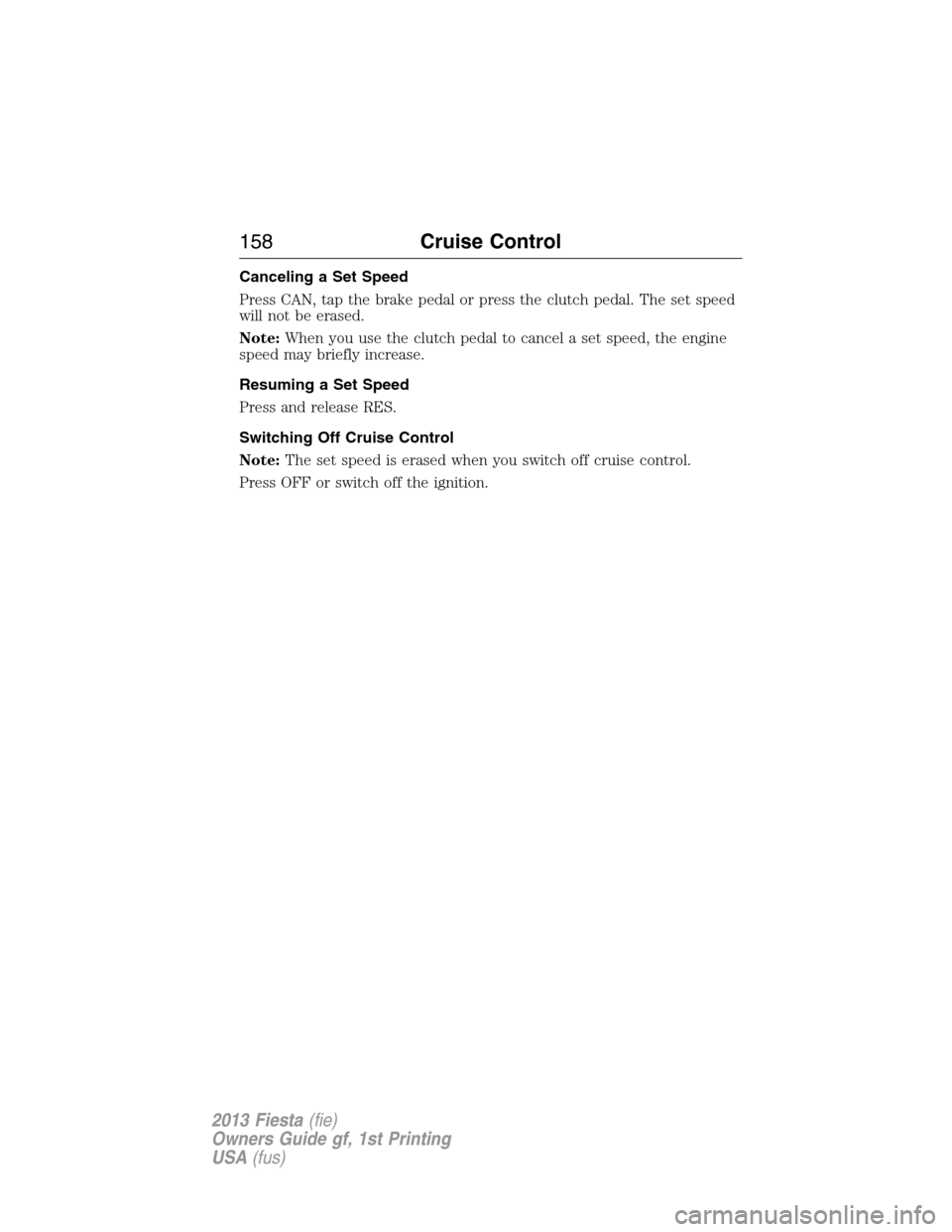
Canceling a Set Speed
Press CAN, tap the brake pedal or press the clutch pedal. The set speed
will not be erased.
Note:When you use the clutch pedal to cancel a set speed, the engine
speed may briefly increase.
Resuming a Set Speed
Press and release RES.
Switching Off Cruise Control
Note:The set speed is erased when you switch off cruise control.
Press OFF or switch off the ignition.
158Cruise Control
2013 Fiesta(fie)
Owners Guide gf, 1st Printing
USA(fus)
Page 159 of 341
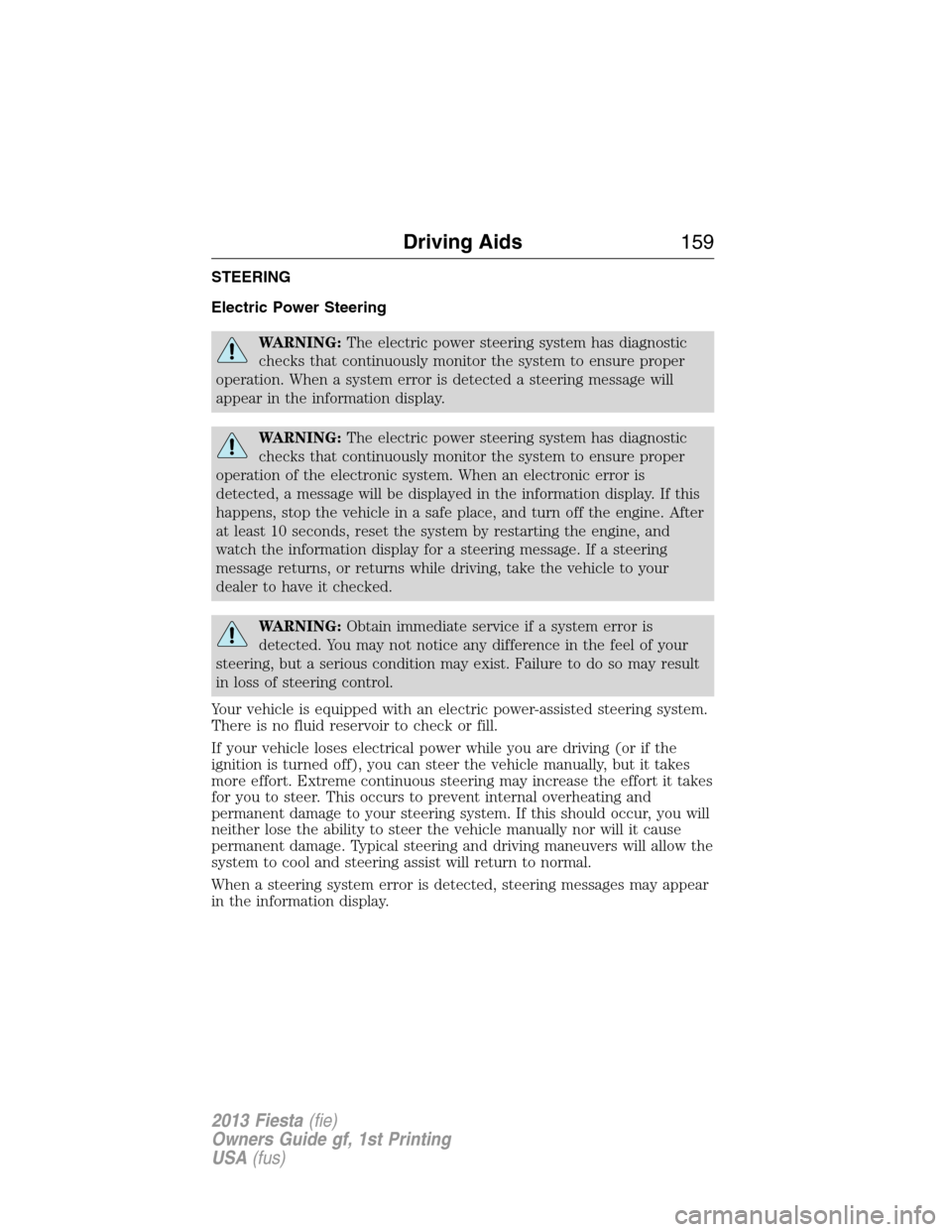
STEERING
Electric Power Steering
WARNING:The electric power steering system has diagnostic
checks that continuously monitor the system to ensure proper
operation. When a system error is detected a steering message will
appear in the information display.
WARNING:The electric power steering system has diagnostic
checks that continuously monitor the system to ensure proper
operation of the electronic system. When an electronic error is
detected, a message will be displayed in the information display. If this
happens, stop the vehicle in a safe place, and turn off the engine. After
at least 10 seconds, reset the system by restarting the engine, and
watch the information display for a steering message. If a steering
message returns, or returns while driving, take the vehicle to your
dealer to have it checked.
WARNING:Obtain immediate service if a system error is
detected. You may not notice any difference in the feel of your
steering, but a serious condition may exist. Failure to do so may result
in loss of steering control.
Your vehicle is equipped with an electric power-assisted steering system.
There is no fluid reservoir to check or fill.
If your vehicle loses electrical power while you are driving (or if the
ignition is turned off), you can steer the vehicle manually, but it takes
more effort. Extreme continuous steering may increase the effort it takes
for you to steer. This occurs to prevent internal overheating and
permanent damage to your steering system. If this should occur, you will
neither lose the ability to steer the vehicle manually nor will it cause
permanent damage. Typical steering and driving maneuvers will allow the
system to cool and steering assist will return to normal.
When a steering system error is detected, steering messages may appear
in the information display.
Driving Aids159
2013 Fiesta(fie)
Owners Guide gf, 1st Printing
USA(fus)
Page 169 of 341

Vehicles with an Automatic Transmission but No Push Button Start
System
Note:Theremustbe battery power to properly move the transmission’s
internal components to N (Neutral) in Step 3. Also, moving the gearshift
to the N (Neutral) position without first turning the ignition to the on
(II) position limits the towing capability to 35 mph (56 km/h) and
50 miles (80 kilometers).
1. Release the parking brake.
2. Turn the ignition to the on (II) position.
3. Press the brake pedal, then move the gearshift to the N (Neutral)
position.
4. Wait for TRANSMISSION READY to appear in the multi-function
display, then turn the ignition to the off (0) position and release the
brake pedal.
5. Disconnect the negative (black) cable from the battery. (The
anti-theft system is disabled until the battery cable is reconnected.)
Refer toBatteryin theMaintenancechapter when disconnecting
and reconnecting the battery cable.
•The maximum towing speed is 70 mph (113 km/h).
•There is no limitation on towing distance.
When done towing, start the engine within 15 minutes of reconnecting
the battery cable. When reconnecting that cable, tighten it until it’s snug
against the terminal; be careful not to overtighten.
Vehicles with an Automatic Transmission and Push Button Start
System
Note:Theremustbe battery power to properly move the transmission’s
internal components to N (Neutral) in Step 3. Also, moving the gearshift
to the N (Neutral) position without first turning the ignition to the on
(II) position limits the towing capability to 35 mph (56 km/h) and
50 miles (80 kilometers).
1. Release the parking brake.
2. Activate the ignition by pressing the START/STOP button, butnot
applying the brake pedal.
3. Press the brake pedal, then move the gearshift to the N (Neutral)
position. Release the brake pedal.
4. Wait for TRANSMISSION READY to appear in the multi-function
display, then deactivate the ignition by pressing the START/STOP
button.
Towing169
2013 Fiesta(fie)
Owners Guide gf, 1st Printing
USA(fus)
Page 177 of 341

Should your vehicle shut off after a collision, you may restart your
vehicle by doing the following:
1. Turn the ignition off.
2. Turn the ignition on.
3. Repeat steps 1 and 2 to re-enable fuel pump.
Note:If your vehicle has the push button start system, press the
stop/start button twice to reactivate the fuel system.
JUMP-STARTING THE VEHICLE
WARNING:The gases around the battery can explode if exposed
to flames, sparks, or lit cigarettes. An explosion could result in
injury or vehicle damage.
WARNING:Batteries contain sulfuric acid which can burn skin,
eyes and clothing, if contacted.
Do not attempt to push-start your automatic transmission vehicle.
Automatic transmissions do not have push-start capability. Attempting to
push-start a vehicle with an automatic transmission may cause
transmission damage.
When the battery is disconnected or a new battery is installed, the
automatic transmission must relearn its shift strategy. As a result, the
transmission may have firm soft shifts, firm shifts or both. This operation
is considered normal and will not affect function or durability of the
transmission. Over time, the adaptive learning process will fully update
transmission operation.
Preparing Your Vehicle
Note:Use only a 12 volt supply to start your vehicle.
Note:Do not disconnect the battery of the disabled vehicle as this could
damage the vehicle’s electrical system
1. Park the booster vehicle close to the hood of the disabled vehicle making
sure the two vehicles do not touch. Set the parking brake on both vehicles
and stay clear of the engine cooling fan and other moving parts.
2. Check all battery terminals and remove any excessive corrosion before
you attach the battery cables. Ensure that vent caps are tight and level.
3. Turn the heater fan on in both vehicles to protect from any electrical
surges. Turn all other accessories off.
Roadside Emergencies177
2013 Fiesta(fie)
Owners Guide gf, 1st Printing
USA(fus)
Page 190 of 341
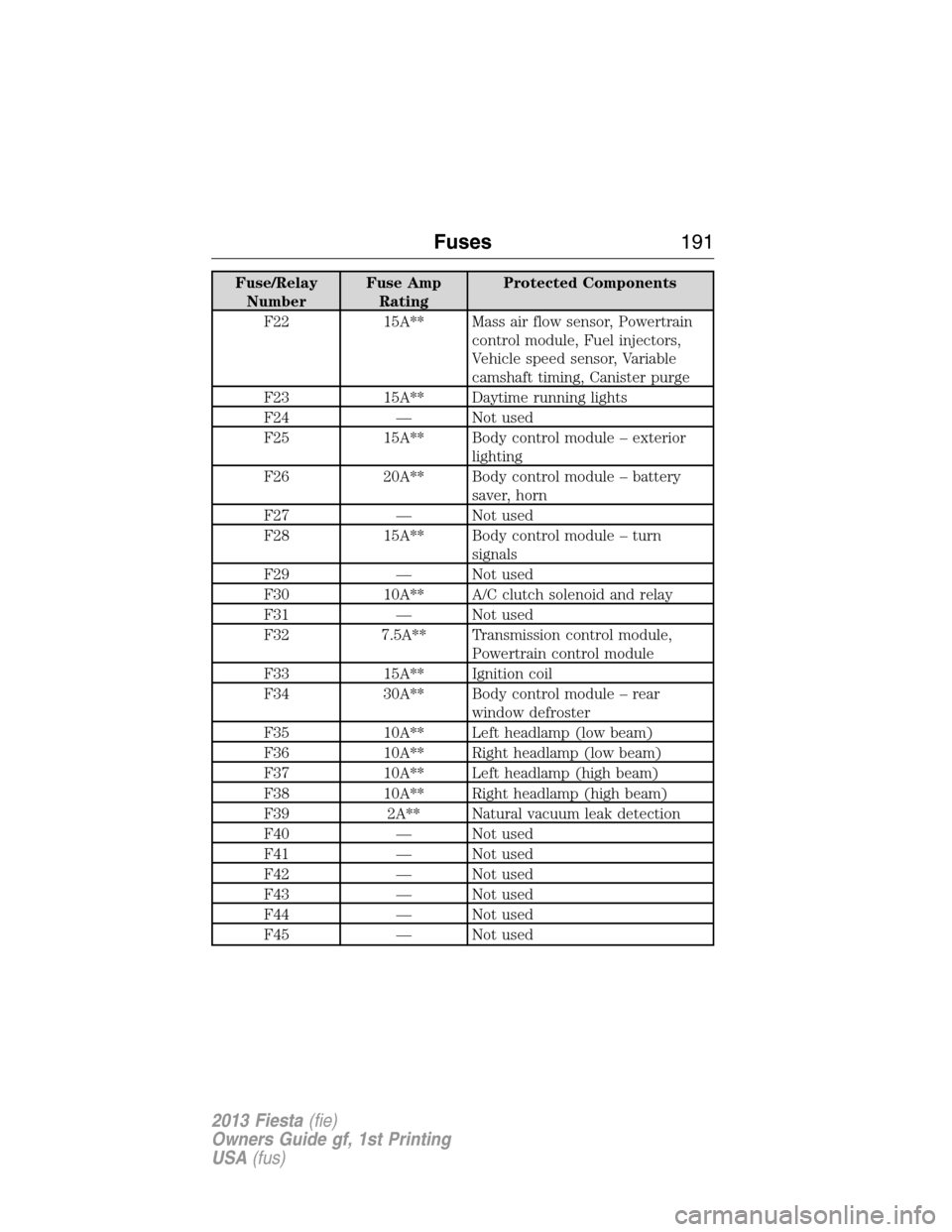
The high-current fuses are coded as follows:
Fuse/Relay
NumberFuse Amp
RatingProtected Components
F1 40A* Anti-lock brake system pump
F2 50A* Transmission control module
F3 40A* Engine cooling fan relay and
motor
F4 40A* Heater blower relay and motor
F5 60A* Passenger compartment fuse
panel
F6 30A* Body control module – door locks
F7 60A* Passenger compartment fuse
panel (ignition relay)
F8 40A* Powertrain control module, Power
distribution box
F9 20A* Anti-lock brake system module
valve
F10 30A* Starter inhibit relay, Starter motor
F11 30A* Electronic fuel pump relay, Fuel
tank, Ignition coil
F12 — Not used
F13 — Not used
F14 — Not used
F15 — Not used
F16 — Not used
F17 20A** High beam relay
F18 — Not used
F19 20A** Low beam relay
F20 15A** Heated exhaust gas oxygen
sensor, Catalyst module sensor
F21 7.5A** Low and High beams coil relay
control
190Fuses
2013 Fiesta(fie)
Owners Guide gf, 1st Printing
USA(fus)
Page 191 of 341
Fuse/Relay
NumberFuse Amp
RatingProtected Components
F22 15A** Mass air flow sensor, Powertrain
control module, Fuel injectors,
Vehicle speed sensor, Variable
camshaft timing, Canister purge
F23 15A** Daytime running lights
F24 — Not used
F25 15A** Body control module – exterior
lighting
F26 20A** Body control module – battery
saver, horn
F27 — Not used
F28 15A** Body control module – turn
signals
F29 — Not used
F30 10A** A/C clutch solenoid and relay
F31 — Not used
F32 7.5A** Transmission control module,
Powertrain control module
F33 15A** Ignition coil
F34 30A** Body control module – rear
window defroster
F35 10A** Left headlamp (low beam)
F36 10A** Right headlamp (low beam)
F37 10A** Left headlamp (high beam)
F38 10A** Right headlamp (high beam)
F39 2A** Natural vacuum leak detection
F40 — Not used
F41 — Not used
F42 — Not used
F43 — Not used
F44 — Not used
F45 — Not used
Fuses191
2013 Fiesta(fie)
Owners Guide gf, 1st Printing
USA(fus)
Page 193 of 341
Passenger Compartment Fuse Panel
The fuse panel is located behind the glove box. Open the glove box,
press the sides inward and swing the glove box down.
The fuses are coded as follows:
Fuse/Relay
NumberFuse Amp
RatingProtected Components
F1 15A Ignition switch, Keyless entry
ignition and accessory relays
F2 10A Electronic mirror, Air conditioning
clutch, Engine compartment fuse
panel
F3 7.5A Instrument cluster
F4 7.5A Passenger airbag deactivation
indicator, Occupant classification
system
F5 15A Diagnostic connector
F6 10A Backup lamp
F25 F19
F10 F1
F11
F13
F15
F17F2
F4
F6
F8 F12
F14
F16
F18
F34
F35
F36F31
F32
F33F3
F5
F7
F9 F20
F21
F22
F23
F24 F26
F27
F28
F29
F30
R1
R7 R4
R3 R2
R5
R6 R8
R9
Fuses193
2013 Fiesta(fie)
Owners Guide gf, 1st Printing
USA(fus)
Page 194 of 341

Fuse/Relay
NumberFuse Amp
RatingProtected Components
F7 7.5A Instrument panel display,
Intelligent access antenna, Manual
climate controls
F8 7.5A Front dome lamp, Moonroof
F9 20A Keyless vehicle module
F10 15A Radio, SYNC�module, Global
positioning system module
F11 20A Body control module – front
wipers
F12 20A Tire pressure monitoring system
F13 15A Body control module – rear wiper
F14 20A Intelligent access module
F15 15A Wiper switch
F16 7.5A Power mirror switch, Driver
window switch
F17 15A Heated seats
F18 10A Stop lamps, Turn signals
F19 7.5A Instrument cluster
F20 10A Airbag module
F21 10A Body control module – ignition
switch, Climate control, Passive
anti-theft system transceiver,
Electronic power steering module,
Instrument cluster, Engine
compartment fuse panel
F22 7.5A Accelerator pedal position sensor,
Powertrain control module, Gear
shifter, Anti-lock brake system
ignition feed
F23 10A Transmission control unit ignition
feed, Tire pressure monitoring
system ignition feed
194Fuses
2013 Fiesta(fie)
Owners Guide gf, 1st Printing
USA(fus)