2013 FORD F750 steering
[x] Cancel search: steeringPage 232 of 378

POWER STEERING FLUID CHECK
Note:To avoid damage to the power steering system, do not operate the
vehicle with a low power steering fluid level.
Note:If adding fluid is necessary, use only the appropriate fluid. See the
Capacities and Specificationschapter. A low fluid level may indicate a
leak in the power steering system. Inspect the power steering system
and repair the leak or see your dealer or a qualified technician for
service. See theScheduled Maintenancechapter for the recommended
service intervals.
Check the fluid level when it is at ambient temperature, 20°F–80°F
(-7°C–25°C):
1. Set the parking brake, then start the engine.
2. Shift into positionNorP(if equipped) (automatic transmission) or
first gear (manual transmission) and turn the engine off.
3. Open the hood.
4. Clean the top of the power steering fluid reservoir.
5. Remove the dipstick from the reservoir and wipe the dipstick clean.
6. Reinstall the dipstick. Remove it again and check the fluid level.
Check the MAX. COLD side of the
dipstick if the fluid is cool or warm to
the touch (approximately 68°F-120°F
[20°C-49°C]). The fluid level should
be within the FULL range. If
necessary, add fluid in small amounts,
continuously checking the level, until
it reaches the proper level.
Check the MAX. HOT side of the
dipstick if the fluid is too hot to
touch (approximately 176°F–230°F
[80°C-110°C]). The fluid level
should be within the FULL range.
If necessary, add fluid in small
amounts, continuously checking the
level, until it reaches the proper
level.
Whenever the dipstick is installed, make sure it is properly seated and
tightened securely.
The fluid level can also be checked by looking at the see-through plastic
reservoir. Make sure that the fluid is within the minimum and maximum
fluid range as marked on the reservoir.
ADD MAX. COLD
FULL
ADD MAX. HOT
FULL
Maintenance231
2013 F-650/750(f67)
Owners Guide gf, 2nd Printing, March 2013
USA(fus)
Page 248 of 378

CLEANING THE INSTRUMENT PANEL AND INSTRUMENT
CLUSTER LENS
WARNING:Do not use chemical solvents or strong detergents
when cleaning the steering wheel or instrument panel to avoid
contamination of the airbag system.
Clean the instrument panel and cluster lens with a clean, damp, white,
cotton cloth, then use a clean and dry, white, cotton cloth to dry these
areas.
•Avoid cleaners or polishes that increase the gloss of the upper portion
of the instrument panel. The dull finish in this area helps protect the
driver from undesirable windshield reflection.
•Be certain to wash or wipe your hands clean if you have been in
contact with certain products such as insect repellent and suntan
lotion in order to avoid possible damage to the interior painted
surfaces.
•Do not use household or glass cleaners as these may damage the
finish of the instrument panel, interior trim and cluster lens.
•Do not allow air fresheners and hand sanitizers to spill on interior
surfaces. If a spill occurs, wipe off immediately. Damage may not be
covered by your warranty.
If a staining liquid, like coffee or juice, has been spilled on the
instrument panel or on interior trim surfaces, clean as follows:
1. Wipe up spilled liquid using a clean, white, cotton cloth.
2. Wipe the surface with a damp, clean, white, cotton cloth. For more
thorough cleaning, use a mild soap and water solution. If the spot
cannot be completely cleaned by this method, the area may be
cleaned using a commercially available cleaning product designed for
automotive interiors.
3. If necessary, apply more soap and water solution or cleaning product
to a clean, white, cotton cloth and press the cloth onto the soiled
area. Allow this to set at room temperature for 30 minutes.
4. Remove the soaked cloth, and if it is not soiled badly, use this cloth
to clean the area by using a rubbing motion for 60 seconds.
5. Following this, wipe area dry with a clean, white, cotton cloth.
Vehicle Care247
2013 F-650/750(f67)
Owners Guide gf, 2nd Printing, March 2013
USA(fus)
Page 257 of 378

Proper tire inflation, toe-in adjustment, loads, and road speeds are
important factors governing tire mileage, steering ease and
maneuverability.
Tire Loading
WARNING:Loading tires beyond their rated capacity decreases
tire life requiring more frequent replacement of tires. Overloading
creates an unsafe condition that may result in sudden air loss from a
tire failure resulting in an accident that could cause property damage,
personal injury or death.
Note:Your GAW/GVW rating is correct at the time of your vehicle
production, and reflects the exact rating of the tires specified. When
replacing tires, make sure that the replacement tire load rating (listed in
pounds and kilograms on the tire sidewall) is the same or higher than
the tire that is removed. Failure to do so adversely affects maximum load
carrying capacity. Tires with the same size specification do not always
have the same load specification.
Matching Tires
Dual Tires:Dual tires should be matched using tires of equivalent size.
Tires which differ more than
14inch (6 millimeters) in diameter or34inch (19 millimeters) in circumference should not be mounted on the
same dual wheel assembly.
Mixing:Never mix bias and radial tires on this vehicle. Never mix
different tire sizes or constructions on the same axle.
Rotation:
Rotation is always advisable:
•If front (steering) axle tires become irregularly worn, move to rear
position.
•In a dual assembly, reverse the position of the tires if one tire wears
much faster than its mate.
•On the drive axle, if heel and toe wear or alternate lug wear occurs,
rotating the tires from one end of the axle to the other end of the
axle may help even out this wear.
Rotation may not advisable:
•Front (Steering) Axle:Tires must be removed when tread is worn
to 4/32 inch (3 millimeters) or less. Retread or rotate worn tires to
drive position. Retreaded tires are not recommended to be used on
steering axles.
•Rear Axles:Tires must be removed when tread is worn to 2/32 inch
(2 millimeters).
256Wheels and Tires
2013 F-650/750(f67)
Owners Guide gf, 2nd Printing, March 2013
USA(fus)
Page 258 of 378
If rib tire is used on front axle and lug or off-road type on rear axle
positions:
•Front (Steering) Axle:Replace tires at front wheels when tread is
worn to 4/32 inch (3 millimeters) or less.
•Rear Axles:Tires must be removed when the tread is worn to
2/32 inch (2 millimeters) or less. Tires identified with the word
re-groovable molded on the sidewall can be re-grooved. A minimum
of 3/32 inch (2.5 millimeters) of under-tread must be left at the
bottom of the grooves.
Wheel and Tire Balancing
Out-of-round or out-of-balance wheels or tires can cause vehicle
vibration, bounce and shimmy. Replace damaged or out-of-round wheels.
Out-of-round tires and wheel assemblies can be corrected by re-clocking
the tire relative to the wheel.
The tire and wheel assembly should then be dynamically balanced.
Tire Wear
Radial tires can exhibit three types of normal wear patterns:
•Even
•Erosion
•Chamfer
Even wear:A sign that the tire is being properly used and maintained.
Erosion wear:Also called rolling wear, channel or river wear. Erosion
wear is found more often on free-rolling tires. This is an indication that
the tire is being used in a slow wearing operation. What happens is that
the belt plies are held very rigid and the tread is not allowed to distort
as it passes through the contact area. Wear only occurs at the edge of
the tread. No corrective action required. If erosion gets to be 1/16 inch
(2 millimeters) or more, the tire may be rotated to a drive axle.
Chamfer or shoulder wear:With tires inflated properly, this is a
normal tendency of most radial tire designs. If both inside and outside
shoulders are wearing evenly around the tire, no further action is
required. Over-inflation is not effective in correcting this effect.
Irregular Wear:If irregular wear is present, check the axle alignment,
tire pressure, wheel balancing, shock and suspension component
condition, and wheel bearing end play.
This condition not only shortens tire life, but adversely affects the
handling of your vehicle, which is dangerous.
Wheels and Tires257
2013 F-650/750(f67)
Owners Guide gf, 2nd Printing, March 2013
USA(fus)
Page 267 of 378
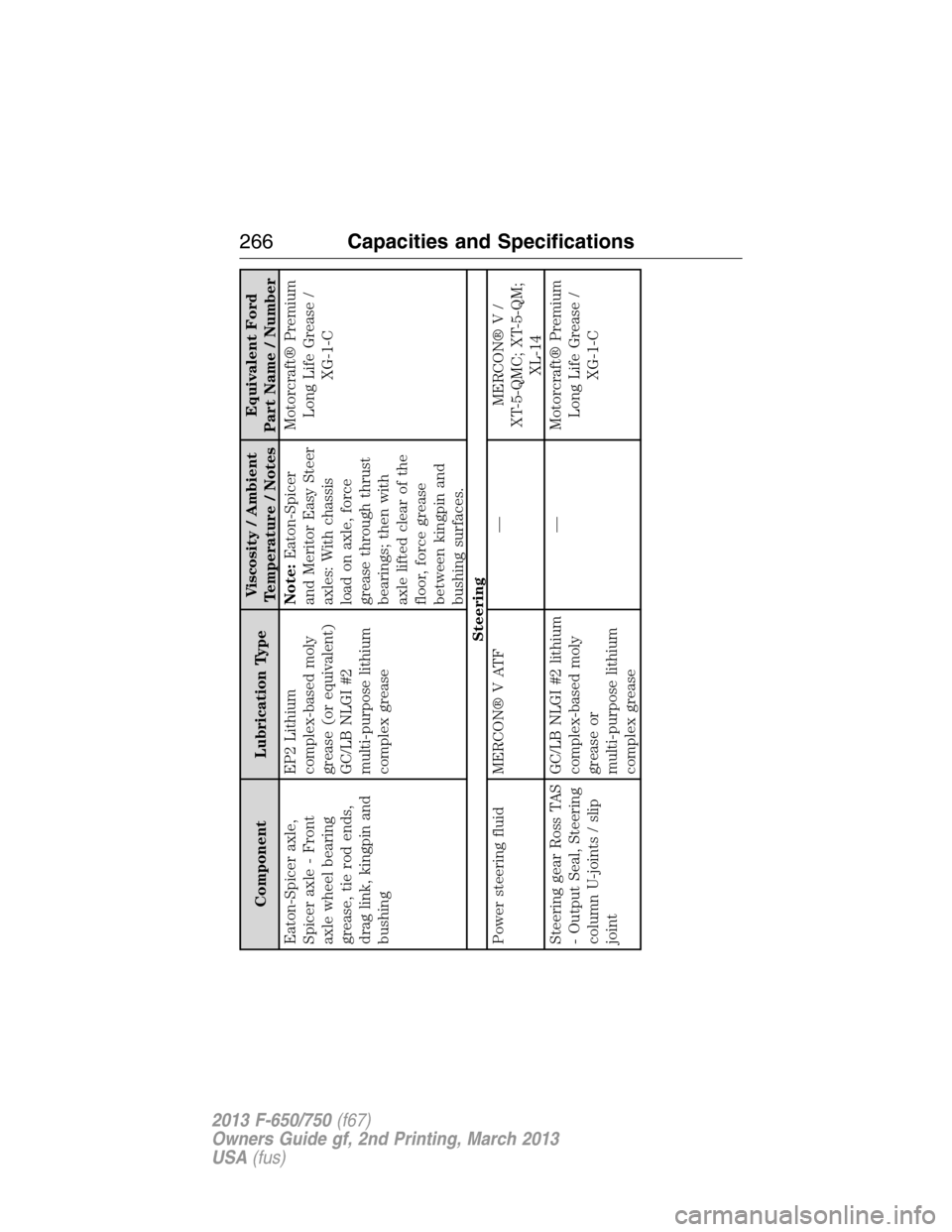
Component Lubrication TypeViscosity / Ambient
Temperature / NotesEquivalent Ford
Part Name / Number
Eaton-Spicer axle,
Spicer axle - Front
axle wheel bearing
grease, tie rod ends,
drag link, kingpin and
bushingEP2 Lithium
complex-based moly
grease (or equivalent)
GC/LB NLGI #2
multi-purpose lithium
complex greaseNote:Eaton-Spicer
and Meritor Easy Steer
axles: With chassis
load on axle, force
grease through thrust
bearings; then with
axle lifted clear of the
floor, force grease
between kingpin and
bushing surfaces.Motorcraft® Premium
Long Life Grease /
XG-1-C
Steering
Power steering fluid MERCON® V ATF — MERCON® V /
XT-5-QMC; XT-5-QM;
XL-14
Steering gear Ross TAS
- Output Seal, Steering
column U-joints / slip
jointGC/LB NLGI #2 lithium
complex-based moly
grease or
multi-purpose lithium
complex grease— Motorcraft® Premium
Long Life Grease /
XG-1-C
266Capacities and Specifications
2013 F-650/750(f67)
Owners Guide gf, 2nd Printing, March 2013
USA(fus)
Page 280 of 378

Meritor
Axle Model Capacity - Pints (Liters)*
RS-23–180/186 47.3 (22.4)
RS-23–240 37.4 (17.7)
RS-23–380 63.6 (30.1)
*Oil capacities are for standard track axles that have been measured at
various common drive pinion angles. The quantities listed include enough
oil for both wheel ends. These capacities change if the track or the drive
pinion angle is different.
Power Steering
Note:Capacities may be increased if the vehicle is equipped with a
cooler. Always check to make sure the fluid level is in the acceptable
range.
Steering Gear Capacity - Pints (Liters)
TAS40 17.6 (8.3)
TAS66 18.4 (8.7)
Air Conditioner Refrigerant
Note:This system uses mineral-based refrigerant oil to lubricate o-rings
and fittings.
This system uses r134a refrigerant and PAG-type refrigerant oil.
Torque the captured washer nut to 170–190 inch-pounds
(19–21 Newton-meters) after servicing.
Fuel Tanks
Standard tanks are listed as such. All other tanks available for your
vehicle are optional equipment.
Gasoline engine
Tank Type Capacity - Gallons (Liters)
Single, steel rectangular 42 (159)
60 (227)
Capacities and Specifications279
2013 F-650/750(f67)
Owners Guide gf, 2nd Printing, March 2013
USA(fus)
Page 285 of 378

Additives and Chemicals
This owner’s manual and the Ford Workshop Manual list the
recommended additives and chemicals for your vehicle. We do not
recommend using chemicals or additives not approved by us as part of
your vehicle’s normal maintenance. Please consult your warranty
information.
Oils, Fluids and Flushing
In many cases, fluid discoloration is a normal operating characteristic
and, by itself, does not necessarily indicate a concern or that the fluid
needs to be changed. However, a qualified expert, such as the
factory-trained technicians at your dealership, should inspect discolored
fluids that also show signs of overheating or foreign material
contamination immediately.
Make sure to change your vehicle’s oils and fluids at the specified
intervals or in conjunction with a repair. Flushing is a viable way to
change fluid for many vehicle sub-systems during scheduled
maintenance. It is critical that systems are flushed only with new fluid
that is the same as that required to fill and operate the system or using a
Ford-approved flushing chemical.
Owner Checks and Services
Certain basic maintenance checks and inspections should be performed
monthly or at six month intervals.
Daily Owner Checks
EngineAir filter restriction gauge.
Engine oil level.
Engine coolant level.
Brake SystemAir brake reservoir automatic drain valve
operation.
Drain the air brake reservoir (manual valve).
TransmissionVisually check for fluid leakage.
Steering SystemPower steering fluid level.
System for evidence of fluid leaks.
284Scheduled Maintenance
2013 F-650/750(f67)
Owners Guide gf, 2nd Printing, March 2013
USA(fus)
Page 286 of 378

Daily Owner Checks
U.S. Department
of Transportation,
Federal Highway
Administration
Requirements
(Make sure the
entire system is
functioning
properly.)Service brakes and parking brake.
Steering mechanism.
Lighting devices and reflectors.
Tires.
Horn.
Windshield wipers.
Rear vision mirrors.
Wheels and rims.
Emergency equipment.
Every Oil Change
EngineInspect engine cooling system hoses, clamps and
protection.
*
Inspect drive belt(s).
Exhaust SystemInspect entire exhaust system (including the inlet
pipe(s), muffler(s), outlet pipe(s), clamps and
fasteners) for holes, leakage, breakage, corrosive
damage and separation from other components.
Adjust, service or replace with the same or the
equivalent part. (Also a noise emission control
service.)
SuspensionTighten the front and rear spring U-bolts to the
specified torque.
Driveline and
Rear AxleLubricate the U-joints and the slip yoke.
BrakesLubricate the air brake foot control valve, hinge
and roller.
Inspect the drum brake linings through the
inspection holes.
Lubricate the rear caliper slide rails.
Lubricate the brake camshafts and slack adjuster
(air brakes only).
Inspect the disc brake pads and the piston boots
(hydraulic brakes only).
Scheduled Maintenance285
2013 F-650/750(f67)
Owners Guide gf, 2nd Printing, March 2013
USA(fus)