Page 15 of 39
HILL DECENT CONTROL
WARNING:Hill descent control does not provide hill hold at
zero mph (0 km/h). When stopped, the parking brake must be
applied and/or the vehicle must be placed inP(Park) or it may roll
away.
Hill descent allows the driver to set and maintain vehicle speed while
descending steep grades regardless of surface conditions.
Hill descent control can maintain vehicle speeds on downhill grades
between 2 and 20 mph (3 and 32 km/h). Between 20 and 40 mph (32
and 64 km/h), the system remains enabled, but descent speed cannot be
set or maintained. If vehicle speed is above 40 mph (64 km/h), the
system is disabled. After this point, vehicle speed must drop below
40 mph (64 km/h), and the hill descent control button must be pressed
again to engage the feature.
Hill descent control requires a cooling down interval after a period of
sustained use. The amount of time that the feature can remain active
before cooling varies with conditions. The system will provide a warning
in the information display screen and a chime will sound when the
system is about to disengage for cooling. At this time, manually apply the
brakes as needed to maintain descent speed.
Enabling Hill Descent Control and Setting the Descent Speed
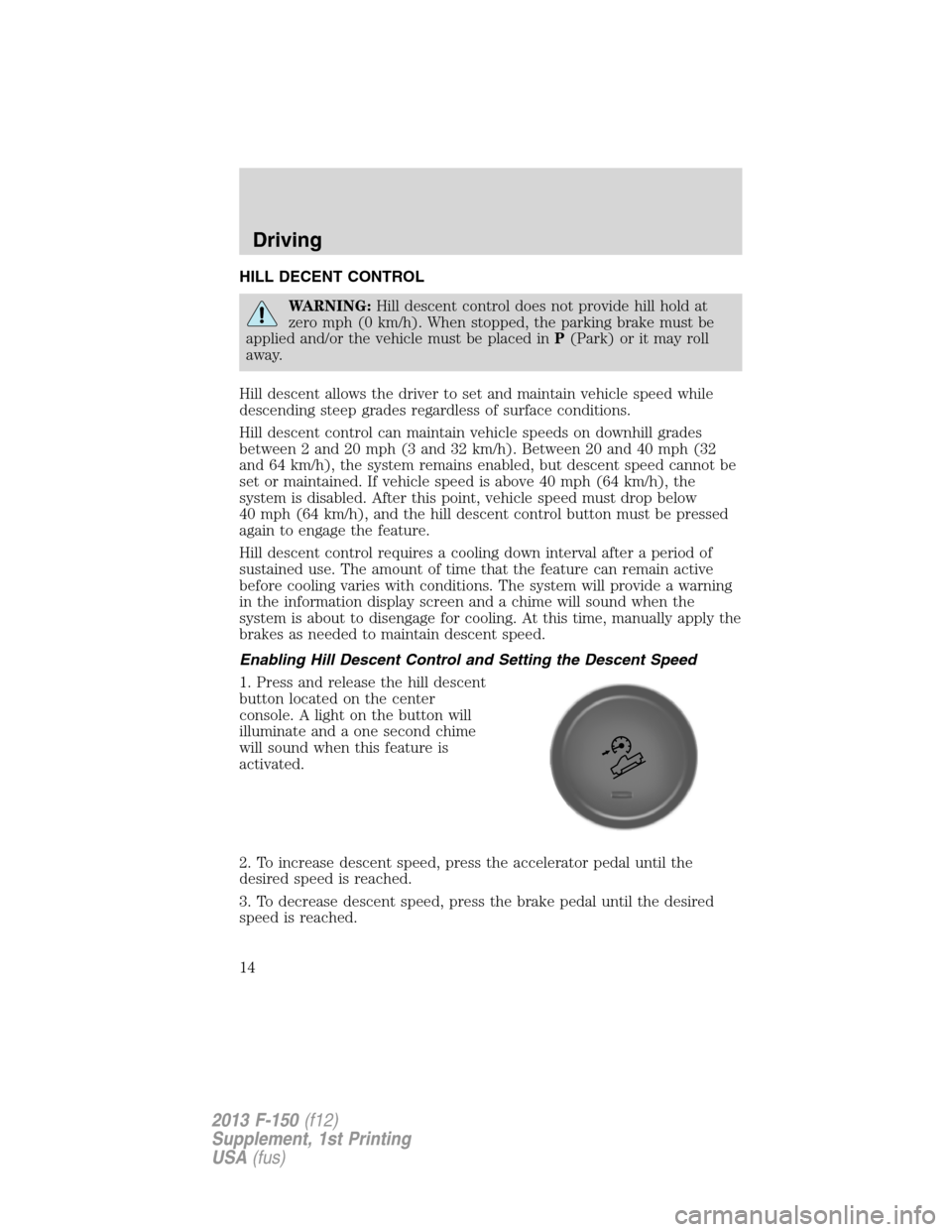
1. Press and release the hill descent
button located on the center
console. A light on the button will
illuminate and a one second chime
will sound when this feature is
activated.
2. To increase descent speed, press the accelerator pedal until the
desired speed is reached.
3. To decrease descent speed, press the brake pedal until the desired
speed is reached.
Driving
14
2013 F-150(f12)
Supplement, 1st Printing
USA(fus)
Page 21 of 39
Front camera washer control
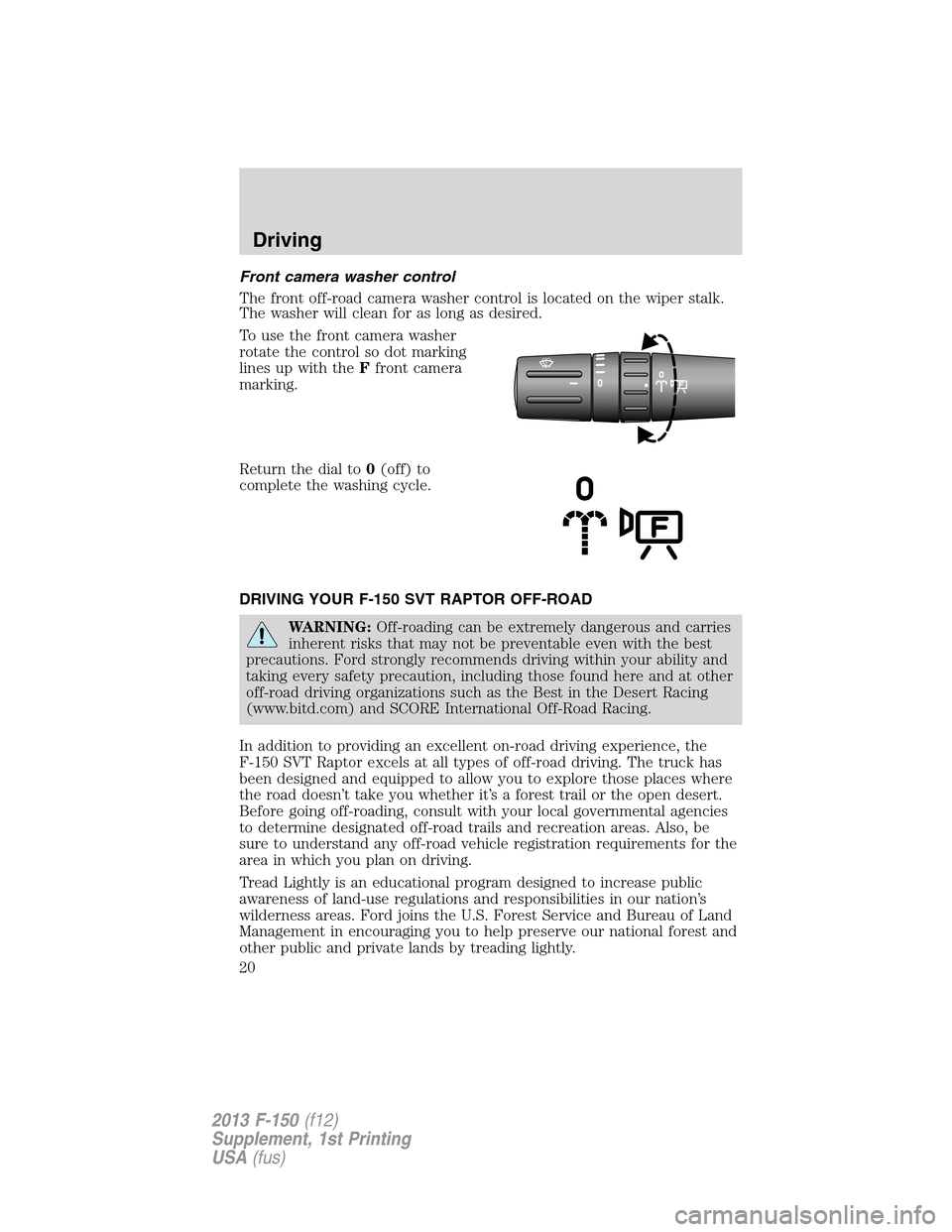
The front off-road camera washer control is located on the wiper stalk.
The washer will clean for as long as desired.
To use the front camera washer
rotate the control so dot marking
lines up with theFfront camera
marking.
Return the dial to0(off) to
complete the washing cycle.
DRIVING YOUR F-150 SVT RAPTOR OFF-ROAD
WARNING:Off-roading can be extremely dangerous and carries
inherent risks that may not be preventable even with the best
precautions. Ford strongly recommends driving within your ability and
taking every safety precaution, including those found here and at other
off-road driving organizations such as the Best in the Desert Racing
(www.bitd.com) and SCORE International Off-Road Racing.
In addition to providing an excellent on-road driving experience, the
F-150 SVT Raptor excels at all types of off-road driving. The truck has
been designed and equipped to allow you to explore those places where
the road doesn’t take you whether it’s a forest trail or the open desert.
Before going off-roading, consult with your local governmental agencies
to determine designated off-road trails and recreation areas. Also, be
sure to understand any off-road vehicle registration requirements for the
area in which you plan on driving.
Tread Lightly is an educational program designed to increase public
awareness of land-use regulations and responsibilities in our nation’s
wilderness areas. Ford joins the U.S. Forest Service and Bureau of Land
Management in encouraging you to help preserve our national forest and
other public and private lands by treading lightly.
Driving
20
2013 F-150(f12)
Supplement, 1st Printing
USA(fus)
Page 24 of 39
DRIVING IN SAND
WARNING:Tires must be returned to normal recommended tire
pressures before driving on pavement or hard surfaces. Failure
to properly maintain your tire pressure could increase the risk of tire
failure, loss of control, vehicle rollover and personal injury.
Soft sand and dunes present a very unique driving challenge. Before
going on such a drive, some research is advised regarding proven
techniques and pitfalls inherent in driving in deep sand. Some general
points to consider:
•It is very difficult and in many cases impossible to navigate deep sand
with tire pressures which are appropriate for on-road driving. If you
decide to air down your tires, be advised that the tire pressure
monitoring light will illuminate. The tires must be returned to normal
recommended tire pressures before driving on pavement or hard
surfaces.
•Lower tire pressures are more likely to cause a debeading of the tire
during cornering. Avoid sharp or abrupt turns when you have
extremely low tire pressures.
•To help prevent becoming stuck in deep sand, avoid spinning the tires
or making abrupt maneuvers. Proceed in a controlled manner while
maintaining vehicle momentum.
•Avoid stopping or parking on inclines as this makes it more difficult to
resume driving.
DRIVING IN DEEP SNOW
•Maintain vehicle momentum.
•Apply the throttle very gently to avoid spinning the tires. Spinning the
tires will potentially dig the vehicle deeper into the snow.
•Drive in a controlled manner, avoiding aggressive steering wheel
movements, and keep braking to a minimum.
•Extremely deep snow may cause the vehicle to high center causing
the vehicle to become stuck. Test the depth of the snow before trying
to drive through it.
Driving
23
2013 F-150(f12)
Supplement, 1st Printing
USA(fus)
Page 35 of 39
IMPORTANT TIRE INFORMATION
Your SVT vehicle is equipped with unique wheels and tires designed to
enhance performance and appearance. To continue providing this
performance, extra care must be taken when operating and maintaining
your vehicle.
TIRES
WARNING:Always re-inflate tires to recommended tire
pressures before the vehicle is operated on-road. The
recommended pressure is located on the tire placard label or safety
certification label, located on the B-pillar, inside the driver’s door.
WARNING:Always check tires and wheels for damage before
returning to the road. Off-road use may cause damage to your
tires and wheels that could result in tire failure.
Note:If tire pressure has been reduced for off-road use, the tire
pressure monitoring system (TPMS) warning light will then activate in
the instrument panel as a reminder to reinflate the tires before returning
to the road.
Your SVT vehicle is equipped with high performance, all-terrain tires that
are designed to optimize handling, steering and braking to provide the
performance you expect in an SVT vehicle. These tires are optimized for
both on and off-road performance, and their ride, noise and wear
characteristics are different than other tires. Also, because of their
aggressive tread profile, it is important that you maintain your tires
properly.
•Always maintain your tire pressures according to the tire information
placard located on the driver’s door B-pillar, using an accurate gauge.
Remember to be prepared to re-inflate your tires before returning to
the road. If a tire filling station is not available, remember to prepare a
supplemental means to inflate the tires, such as a portable
compressor.
•Tire pressures are specified cold and should be checked after the
vehicle has been parked for at least three hours. Do not reduce
pressure of warm tires.
•Check your tire pressure often to maintain it properly. Tire pressure
can diminish over time and fluctuate with temperature.
Tire Information
34
2013 F-150(f12)
Supplement, 1st Printing
USA(fus)