Page 124 of 157
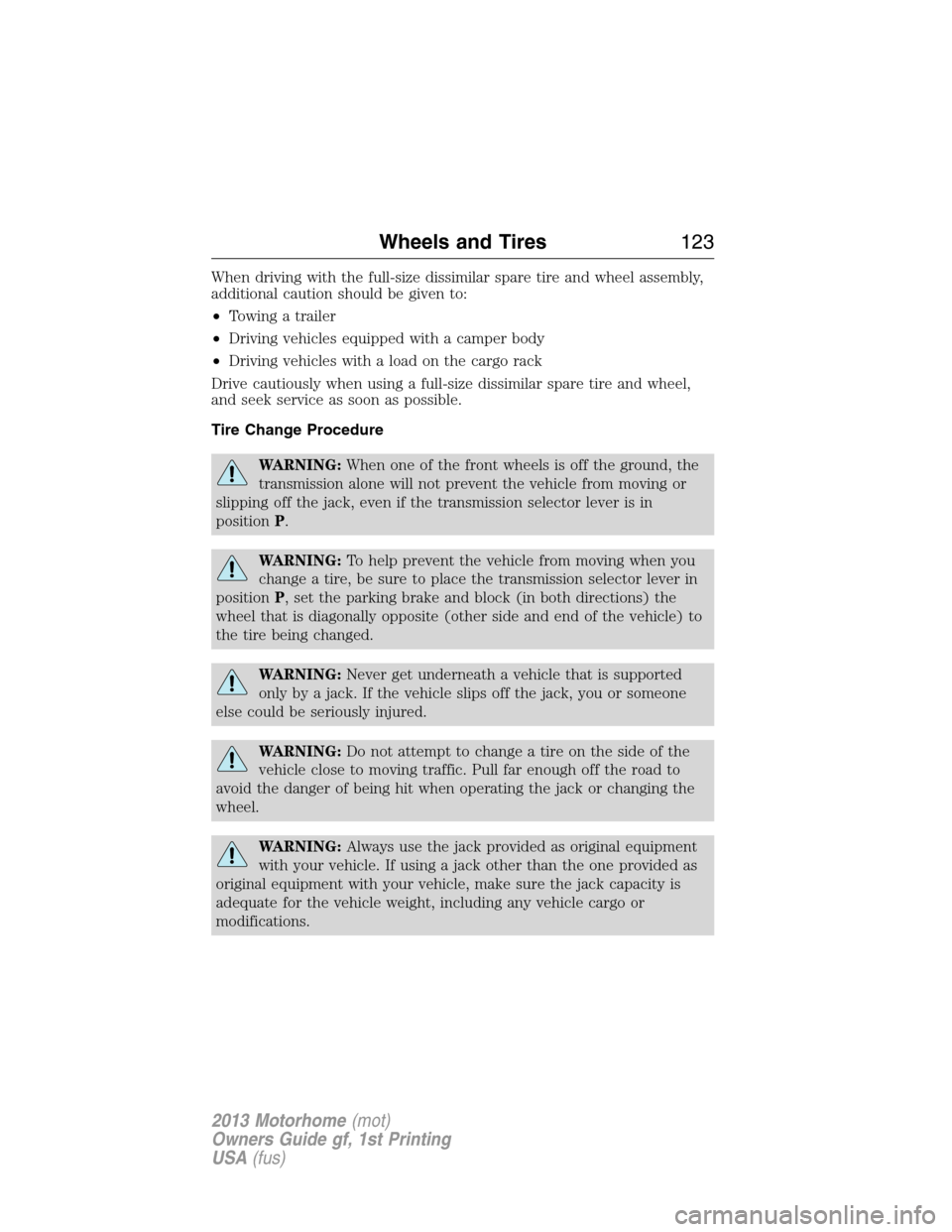
When driving with the full-size dissimilar spare tire and wheel assembly,
additional caution should be given to:
•Towing a trailer
•Driving vehicles equipped with a camper body
•Driving vehicles with a load on the cargo rack
Drive cautiously when using a full-size dissimilar spare tire and wheel,
and seek service as soon as possible.
Tire Change Procedure
WARNING:When one of the front wheels is off the ground, the
transmission alone will not prevent the vehicle from moving or
slipping off the jack, even if the transmission selector lever is in
positionP.
WARNING:To help prevent the vehicle from moving when you
change a tire, be sure to place the transmission selector lever in
positionP, set the parking brake and block (in both directions) the
wheel that is diagonally opposite (other side and end of the vehicle) to
the tire being changed.
WARNING:Never get underneath a vehicle that is supported
only by a jack. If the vehicle slips off the jack, you or someone
else could be seriously injured.
WARNING:Do not attempt to change a tire on the side of the
vehicle close to moving traffic. Pull far enough off the road to
avoid the danger of being hit when operating the jack or changing the
wheel.
WARNING:Always use the jack provided as original equipment
with your vehicle. If using a jack other than the one provided as
original equipment with your vehicle, make sure the jack capacity is
adequate for the vehicle weight, including any vehicle cargo or
modifications.
Wheels and Tires123
2013 Motorhome(mot)
Owners Guide gf, 1st Printing
USA(fus)
Page 125 of 157
1. Park on a level surface.
2. Activate the warning flashers.
3. Place the transmission selector lever in positionP.
4. Apply the parking brake and turn engine off.
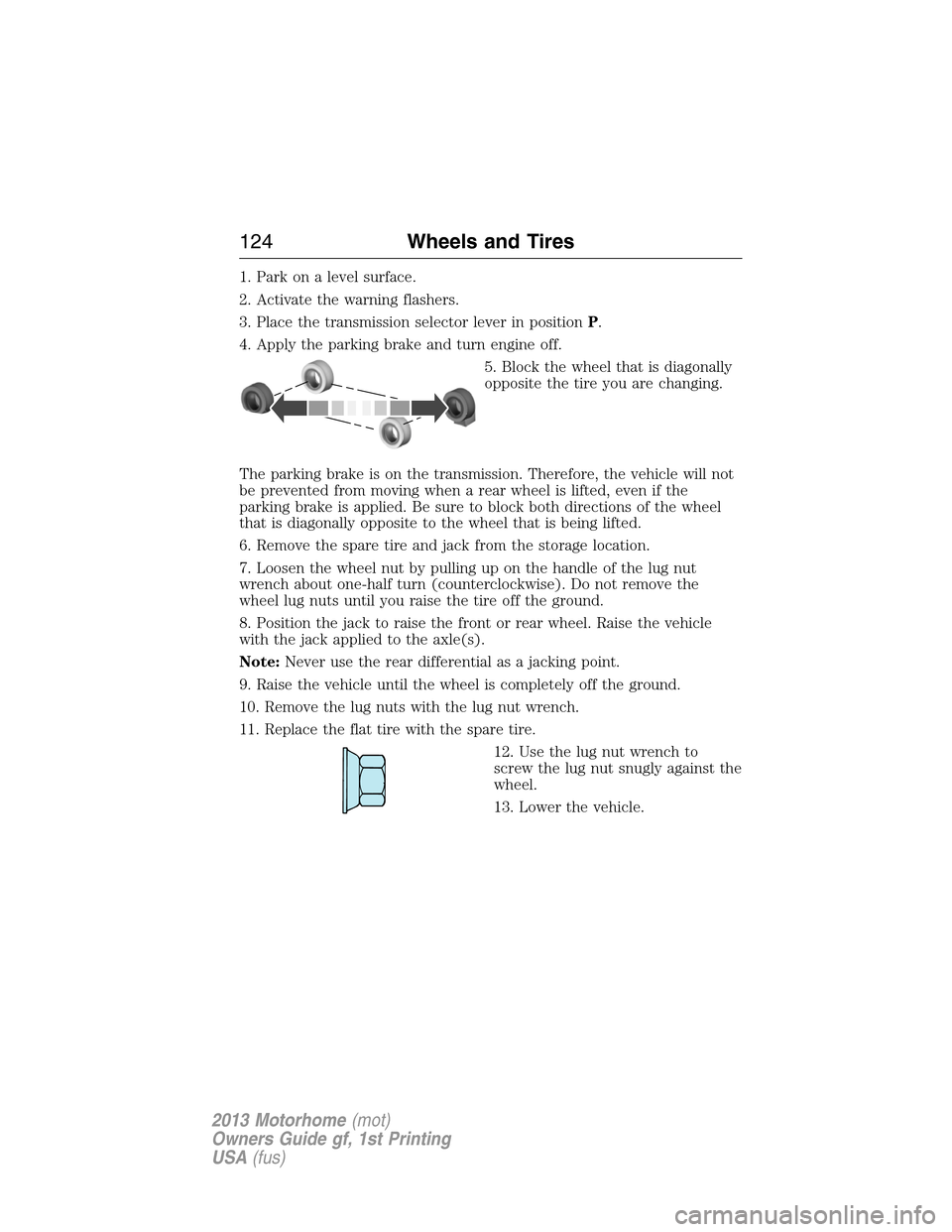
5. Block the wheel that is diagonally
opposite the tire you are changing.
The parking brake is on the transmission. Therefore, the vehicle will not
be prevented from moving when a rear wheel is lifted, even if the
parking brake is applied. Be sure to block both directions of the wheel
that is diagonally opposite to the wheel that is being lifted.
6. Remove the spare tire and jack from the storage location.
7. Loosen the wheel nut by pulling up on the handle of the lug nut
wrench about one-half turn (counterclockwise). Do not remove the
wheel lug nuts until you raise the tire off the ground.
8. Position the jack to raise the front or rear wheel. Raise the vehicle
with the jack applied to the axle(s).
Note:Never use the rear differential as a jacking point.
9. Raise the vehicle until the wheel is completely off the ground.
10. Remove the lug nuts with the lug nut wrench.
11. Replace the flat tire with the spare tire.
12. Use the lug nut wrench to
screw the lug nut snugly against the
wheel.
13. Lower the vehicle.
124Wheels and Tires
2013 Motorhome(mot)
Owners Guide gf, 1st Printing
USA(fus)
Page 140 of 157

Oils, Fluids and Flushing
In many cases, fluid discoloration is a normal operating characteristic
and, by itself, does not necessarily indicate a concern or that the fluid
needs to be changed. However, discolored fluids that also show signs of
overheating and/or foreign material contamination should be inspected
immediately by a qualified expert such as the factory-trained technicians
at your dealership. Your vehicle’s oils and fluids should be changed at the
specified intervals or in conjunction with a repair. Flushing is a viable
way to change fluid for many vehicle sub-systems during scheduled
maintenance. It is critical that systems are flushed only with new fluid
that is the same as that required to fill and operate the system, or using
a Ford-approved flushing chemical.
Owner Checks and Services
Certain basic maintenance checks and inspections should be performed
every month or at six months intervals.
Check Every Month
Engine oil level.
Function of all interior and exterior lights.
Tires (including spare) for wear and proper pressure.
Windshield washer fluid level.
Check Every Six Months
Battery connections. Clean if necessary.
Body and door drain holes for obstructions. Clean if necessary.
Cooling system fluid level and coolant strength.
Door weatherstrips for wear. Lubricate if necessary.
Hinges, latches and outside locks for proper operation. Lubricate if
necessary.
Parking brake for proper operation.
Safety belts and seat latches for wear and function.
Safety warning lamps (brake, ABS, airbag, safety belt) for operation.
Washer spray and wiper operation. Clean or replace blades as
necessary.
Scheduled Maintenance139
2013 Motorhome(mot)
Owners Guide gf, 1st Printing
USA(fus)
Page 141 of 157
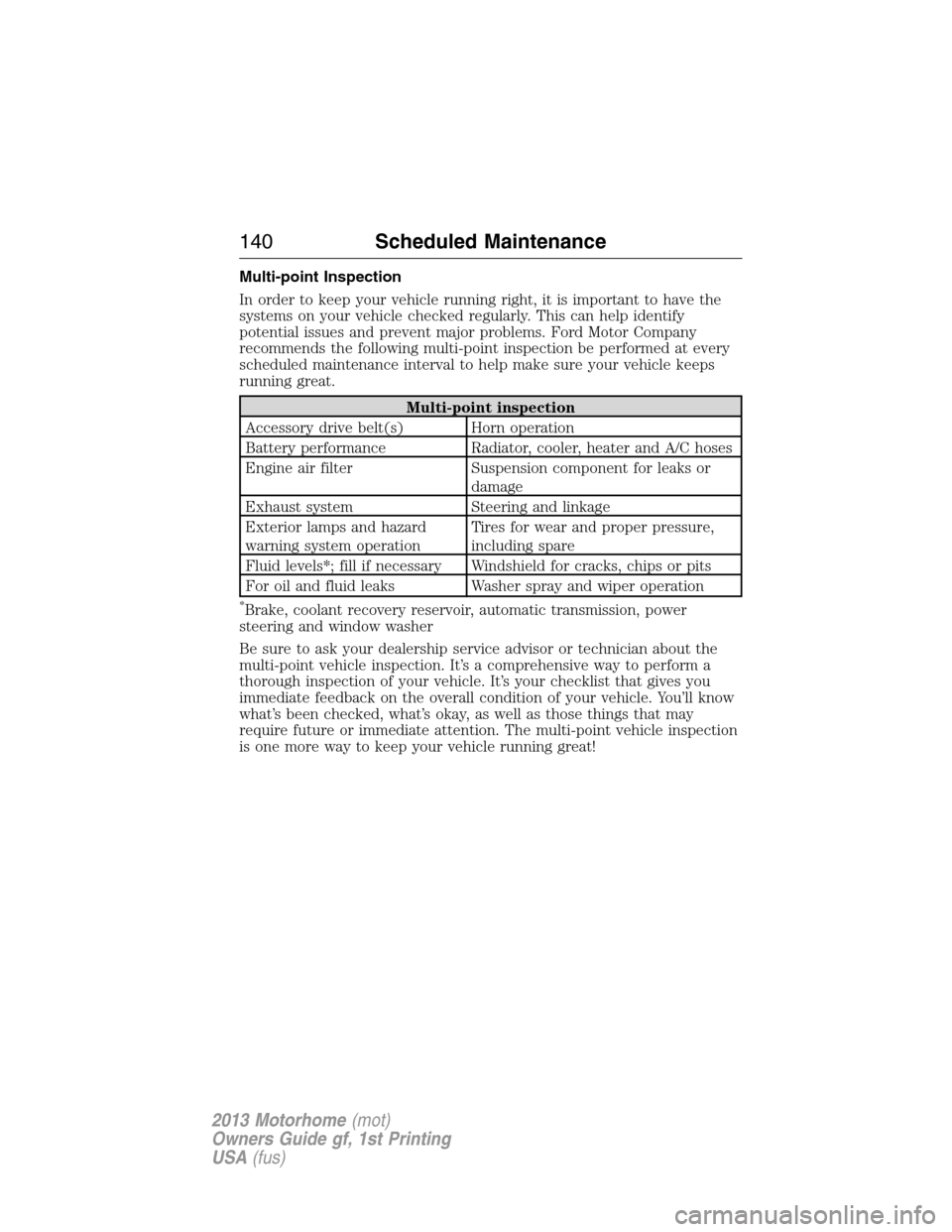
Multi-point Inspection
In order to keep your vehicle running right, it is important to have the
systems on your vehicle checked regularly. This can help identify
potential issues and prevent major problems. Ford Motor Company
recommends the following multi-point inspection be performed at every
scheduled maintenance interval to help make sure your vehicle keeps
running great.
Multi-point inspection
Accessory drive belt(s) Horn operation
Battery performance Radiator, cooler, heater and A/C hoses
Engine air filter Suspension component for leaks or
damage
Exhaust system Steering and linkage
Exterior lamps and hazard
warning system operationTires for wear and proper pressure,
including spare
Fluid levels*; fill if necessary Windshield for cracks, chips or pits
For oil and fluid leaks Washer spray and wiper operation
*Brake, coolant recovery reservoir, automatic transmission, power
steering and window washer
Be sure to ask your dealership service advisor or technician about the
multi-point vehicle inspection. It’s a comprehensive way to perform a
thorough inspection of your vehicle. It’s your checklist that gives you
immediate feedback on the overall condition of your vehicle. You’ll know
what’s been checked, what’s okay, as well as those things that may
require future or immediate attention. The multi-point vehicle inspection
is one more way to keep your vehicle running great!
140Scheduled Maintenance
2013 Motorhome(mot)
Owners Guide gf, 1st Printing
USA(fus)
Page 156 of 157
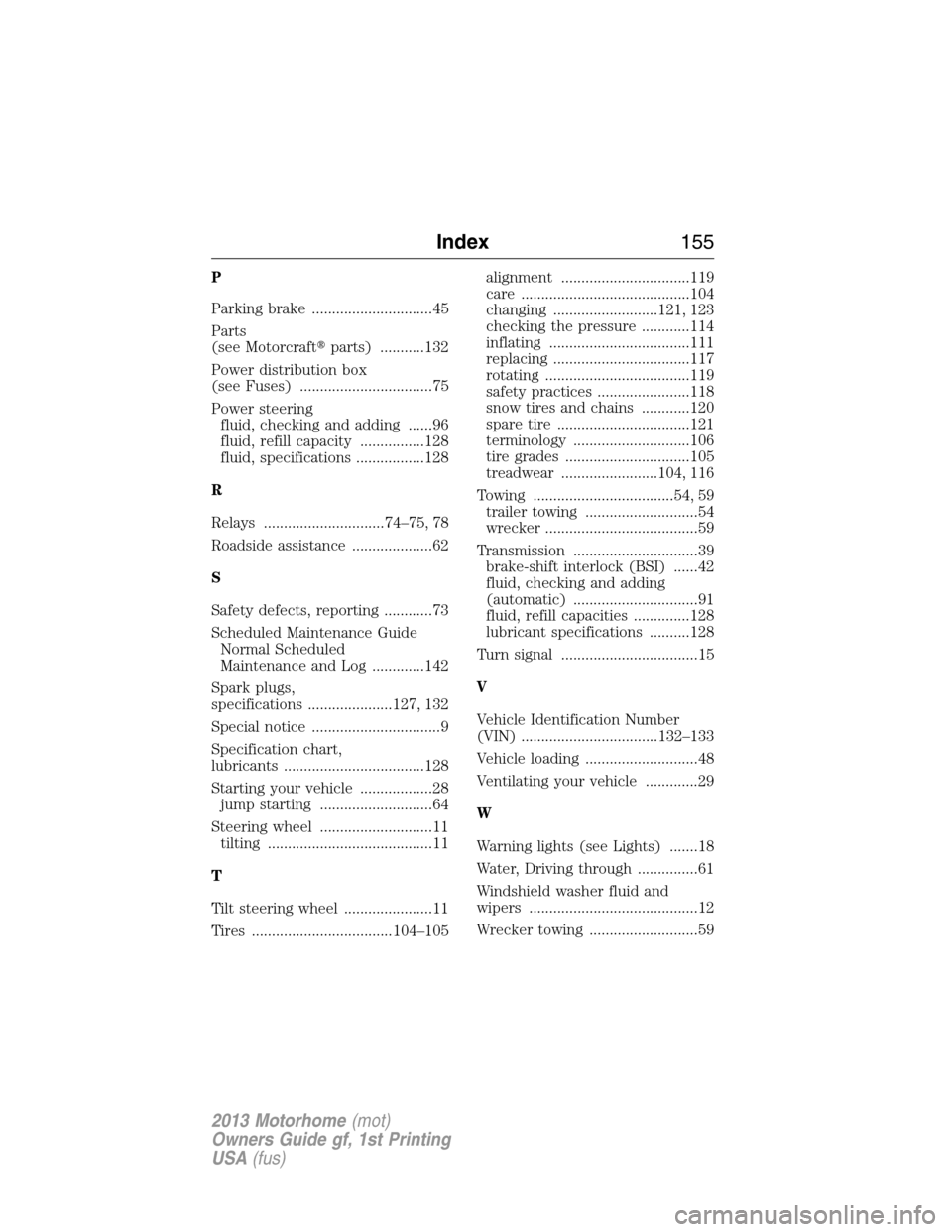
P
Parking brake ..............................45
Parts
(see Motorcraft�parts) ...........132
Power distribution box
(see Fuses) .................................75
Power steering
fluid, checking and adding ......96
fluid, refill capacity ................128
fluid, specifications .................128
R
Relays ..............................74–75, 78
Roadside assistance ....................62
S
Safety defects, reporting ............73
Scheduled Maintenance Guide
Normal Scheduled
Maintenance and Log .............142
Spark plugs,
specifications .....................127, 132
Special notice ................................9
Specification chart,
lubricants ...................................128
Starting your vehicle ..................28
jump starting ............................64
Steering wheel ............................11
tilting .........................................11
T
Tilt steering wheel ......................11
Tires ...................................104–105alignment ................................119
care ..........................................104
changing ..........................121, 123
checking the pressure ............114
inflating ...................................111
replacing ..................................117
rotating ....................................119
safety practices .......................118
snow tires and chains ............120
spare tire .................................121
terminology .............................106
tire grades ...............................105
treadwear ........................104, 116
Towing ...................................54, 59
trailer towing ............................54
wrecker ......................................59
Transmission ...............................39
brake-shift interlock (BSI) ......42
fluid, checking and adding
(automatic) ...............................91
fluid, refill capacities ..............128
lubricant specifications ..........128
Turn signal ..................................15
V
Vehicle Identification Number
(VIN) ..................................132–133
Vehicle loading ............................48
Ventilating your vehicle .............29
W
Warning lights (see Lights) .......18
Water, Driving through ...............61
Windshield washer fluid and
wipers ..........................................12
Wrecker towing ...........................59
Index155
2013 Motorhome(mot)
Owners Guide gf, 1st Printing
USA(fus)