2013 FORD EXPLORER service indicator
[x] Cancel search: service indicatorPage 332 of 576
What you should know about fail-safe cooling
If the engine coolant supply is depleted, this feature allows the vehicle to
be driven temporarily before incremental component damage is incurred.
The “fail-safe” distance depends on ambient temperatures, vehicle load
and terrain.
How fail-safe cooling works
If the engine begins to overheat, the engine coolant temperature gauge
will move to the red (hot) area and:
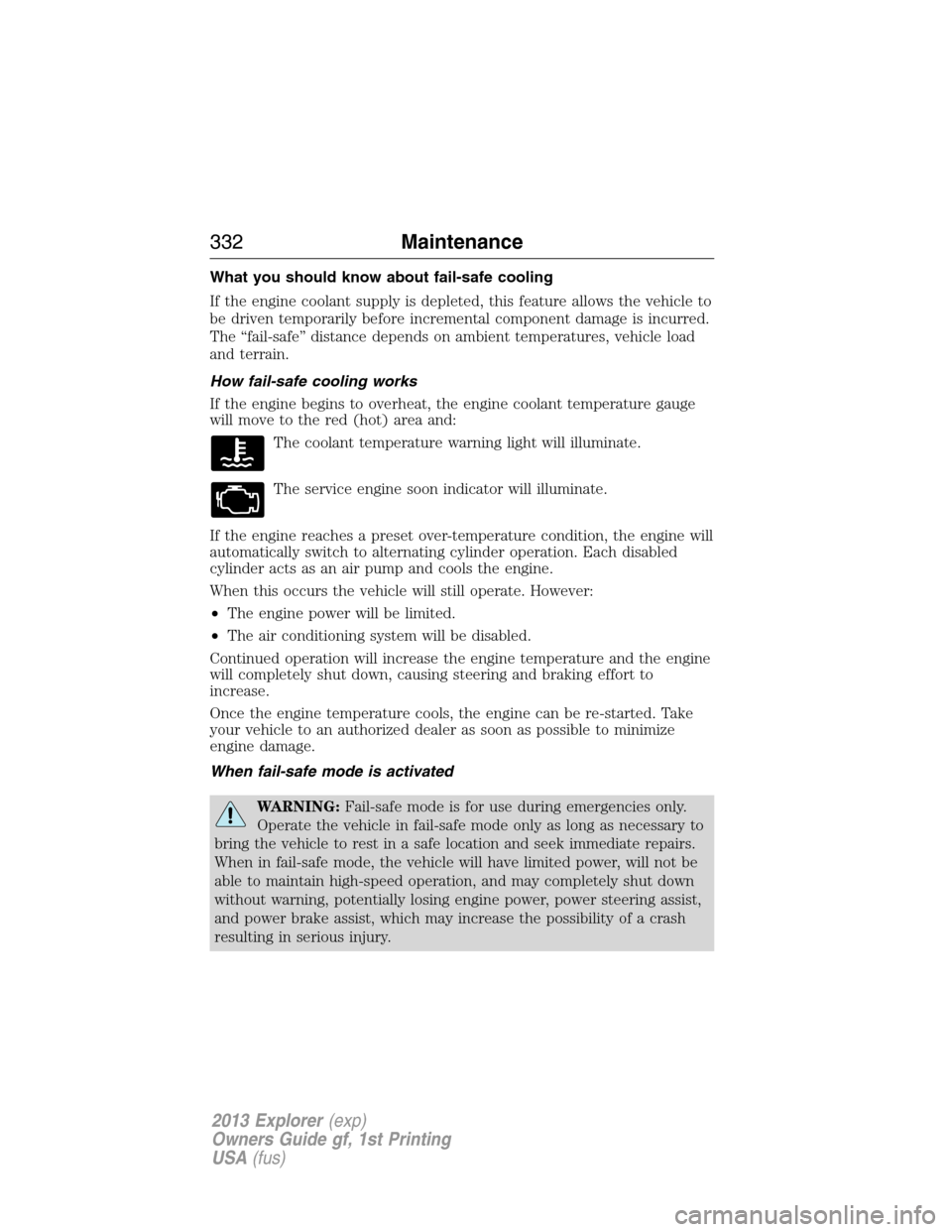
The coolant temperature warning light will illuminate.
The service engine soon indicator will illuminate.
If the engine reaches a preset over-temperature condition, the engine will
automatically switch to alternating cylinder operation. Each disabled
cylinder acts as an air pump and cools the engine.
When this occurs the vehicle will still operate. However:
•The engine power will be limited.
•The air conditioning system will be disabled.
Continued operation will increase the engine temperature and the engine
will completely shut down, causing steering and braking effort to
increase.
Once the engine temperature cools, the engine can be re-started. Take
your vehicle to an authorized dealer as soon as possible to minimize
engine damage.
When fail-safe mode is activated
WARNING:Fail-safe mode is for use during emergencies only.
Operate the vehicle in fail-safe mode only as long as necessary to
bring the vehicle to rest in a safe location and seek immediate repairs.
When in fail-safe mode, the vehicle will have limited power, will not be
able to maintain high-speed operation, and may completely shut down
without warning, potentially losing engine power, power steering assist,
and power brake assist, which may increase the possibility of a crash
resulting in serious injury.
332Maintenance
2013 Explorer(exp)
Owners Guide gf, 1st Printing
USA(fus)
Page 375 of 576
WARNING:When mounting replacement tires and wheels, you
should not exceed the maximum pressure indicated on the
sidewall of the tire to set the beads without additional precautions
listed below. If the beads do not seat at the maximum pressure
indicated, re-lubricate and try again.
When inflating the tire for mounting pressures up to 20 psi (1.38 bar)
greater than the maximum pressure on the tire sidewall, the following
precautions must be taken to protect the person mounting the tire:
1. Make sure that you have the correct tire and wheel size.
2. Lubricate the tire bead and wheel bead seat area again.
3. Stand at a minimum of 12 ft (3.66 m) away from the tire wheel
assembly.
4. Use both eye and ear protection.
For a mounting pressure more than 20 psi (1.38 bar) greater than the
maximum pressure, a Ford dealer or other tire service professional
should do the mounting.
Always inflate steel carcass tires with a remote air fill with the person
inflating standing at a minimum of 12 ft (3.66 m) away from the tire
wheel assembly.
Important:Remember to replace the wheel valve stems when the road
tires are replaced on your vehicle.
It is recommended that the two front tires or two rear tires generally be
replaced as a pair.
The tire pressure sensors mounted in the wheels (originally installed on
your vehicle) are not designed to be used in aftermarket wheels.
The use of wheels or tires not recommended by Ford Motor Company
may affect the operation of your tire pressure monitoring system.
If the TPMS indicator is flashing, your TPMS is malfunctioning. Your
replacement tire might be incompatible with your TPMS, or some
component of the TPMS may be damaged.
Wheels and Tires375
2013 Explorer(exp)
Owners Guide gf, 1st Printing
USA(fus)
Page 379 of 576
When the malfunction indicator is illuminated, the system may not be
able to detect or signal low tire pressure as intended. TPMS malfunctions
may occur for a variety of reasons, including the installation of
replacement or alternate tires or wheels on the vehicle that prevent the
TPMS from functioning properly. Always check the TPMS malfunction
telltale after replacing one or more tires or wheels on your vehicle to
ensure that the replacement or alternate tires and wheels allow the
TPMS to continue to function properly.
The tire pressure monitoring system complies with part 15 of the FCC
rules and with RSS-210 of Industry Canada. Operation is subject to the
following two conditions: (1) This device may not cause harmful
interference, and (2) This device must accept any interference received,
including interference that may cause undesired operation.
WARNING:The tire pressure monitoring system is NOT a
substitute for manually checking tire pressure. The tire pressure
should be checked periodically (at least monthly) using a tire gauge,
seeInflating your tiresin this chapter. Failure to properly maintain
your tire pressure could increase the risk of tire failure, loss of control,
vehicle rollover and personal injury.
Changing Tires with a TPMS
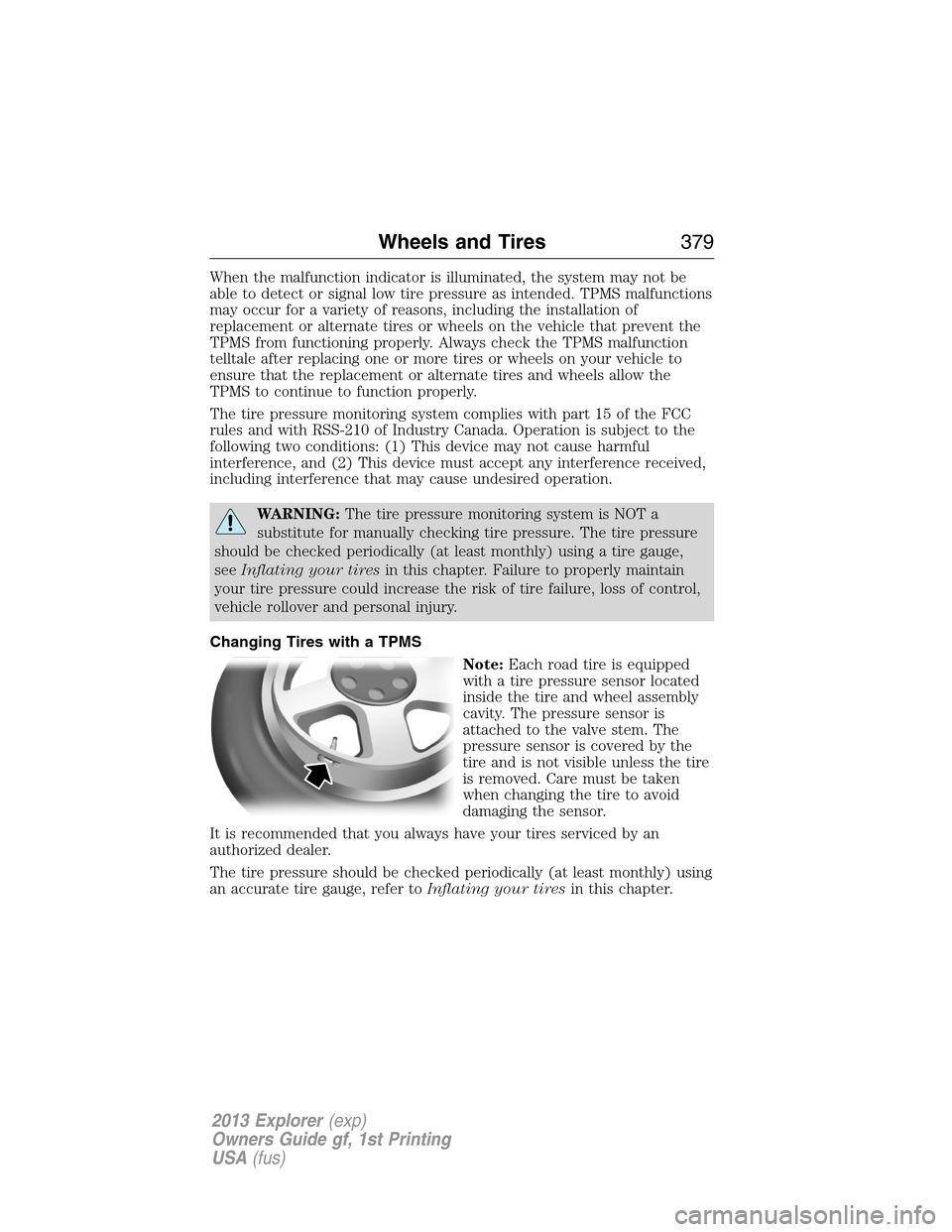
Note:Each road tire is equipped
with a tire pressure sensor located
inside the tire and wheel assembly
cavity. The pressure sensor is
attached to the valve stem. The
pressure sensor is covered by the
tire and is not visible unless the tire
is removed. Care must be taken
when changing the tire to avoid
damaging the sensor.
It is recommended that you always have your tires serviced by an
authorized dealer.
The tire pressure should be checked periodically (at least monthly) using
an accurate tire gauge, refer toInflating your tiresin this chapter.
Wheels and Tires379
2013 Explorer(exp)
Owners Guide gf, 1st Printing
USA(fus)
Page 383 of 576
CHANGING A ROAD WHEEL
WARNING:The use of tire sealants may damage your tire
pressure monitoring system (TPMS) and should not be used.
However, if you must use a sealant, the TPMS sensor and valve stem on
the wheel must be replaced by an authorized Ford dealer.
WARNING:Refer toTire pressure monitoring system (TPMS)
in this chapter for important information. If the tire pressure
monitor sensor becomes damaged, it will no longer function.
Note:The tire pressure monitoring system (TPMS) indicator light will
illuminate when the spare tire is in use. To restore the full functionality
of the monitoring system, all road wheels equipped with tire pressure
monitoring sensors must be mounted on the vehicle.
If you get a flat tire while driving, do not apply the brake heavily.
Instead, gradually decrease your speed. Hold the steering wheel firmly
and slowly move to a safe place on the side of the road.
Have a flat serviced by an authorized dealer in order to prevent damage
to the TPMS sensors, refer toTire pressure monitoring system (TPMS)
earlier in the chapter. Replace the spare tire with a road tire as soon as
possible. During repairing or replacing of the flat tire, have the
authorized dealer inspect the TPMS sensor for damage.
Dissimilar Spare Tire and Wheel Assembly Information
WARNING:Failure to follow these guidelines could result in an
increased risk of loss of vehicle control, injury or death.
If you have a dissimilar spare tire and wheel assembly , then it is
intended for temporary use only. This means that if you need to use it,
you should replace it as soon as possible with a road tire and wheel
assembly that is the same size and type as the road tires and wheels that
were originally provided by Ford. If the dissimilar spare tire or wheel is
damaged, it should be replaced rather than repaired.
A dissimilar spare tire and wheel assembly is defined as a spare tire or
wheel that is different in brand, size or appearance from the road tires
and wheels and can be one of three types:
1.T-type mini-spare:This spare tire begins with the letter “T” for tire
size and may have “Temporary Use Only” molded in the sidewall
Wheels and Tires383
2013 Explorer(exp)
Owners Guide gf, 1st Printing
USA(fus)
Page 571 of 576

D
Defrost ....................... 158, 160, 162
rear window ............................ 166
Dipstick
automatic transmission
fluid .................................. 333–334
engine oil ................................. 327
Display settings ......................... 527
Driver alert ................................ 262
Driving under special
conditions .................. 225, 229, 231
sand ......................................... 230
snow and ice ........................... 232
through water ................. 231, 297
Dual automatic temperature
control (DATC) ................. 160, 162
E
Electronic message center ....... 122
Electronic stability control ...... 238
Emergencies, roadside
jump-starting .......................... 302
running out of fuel ................. 213
Emergency brake
(see Parking brake) .................. 235
Emission control system .......... 217
End user license agreement .... 551
Engine ........................................ 392
cleaning ................................... 352
fail-safe cooling ....................... 332
idle speed control ................... 337
lubrication specifications ....... 393
refill capacities ........................ 393
service points .................. 325–326
Engine block heater ................. 208Engine oil
checking and adding .............. 327
dipstick .................................... 327
filter, specifications ................ 397
refill capacities ........................ 393
specifications .......................... 393
Event data recording .................. 12
Exhaust fumes .......................... 208
F
Fail safe cooling ........................ 332
Fleet MyKey programming ........ 69
Flexible Fuel Vehicle
(FFV) ......................................... 210
Floor mats ................................. 298
Fluid capacities ......................... 393
Fuel
cap ........................................... 215
capacity ................................... 393
choosing the right fuel ........... 211
filler funnel ............................. 213
filling your vehicle with fuel .. 215
filter, specifications ........ 336, 397
fuel pump shut-off .................. 302
octane rating ........................... 392
running out of fuel ................. 213
safety information relating to
automotive fuels ..................... 210
Fuel and distance computer .... 125
outside temperature
indicator .................................. 125
to empty indicator .................. 125
trip distance ............................ 125
trip/reset button ..................... 125
Fuel - flex fuel vehicle
(FFV) ................................. 210–211
Fuses .......................... 313–314, 319
Index571
2013 Explorer(exp)
Owners Guide gf, 1st Printing
USA(fus)