Page 388 of 576
4. Small arrow-shaped marks on the sills show the location of the jacking
points.
5. Remove the lug nuts with the lug wrench.
6. Replace the flat tire with the spare tire, making sure the valve stem is
facing outward. Reinstall the lug nuts until the wheel is snug against the
hub. Do not fully tighten the lug nuts until the wheel has been lowered.
7. Lower the wheel by turning the jack handle counterclockwise.
8. Remove the jack and fully tighten the lug
nuts in the order shown. Refer toWheel lug
nut torque specificationslater in this
chapter for the proper lug nut torque
specification.
388Wheels and Tires
2013 Explorer(exp)
Owners Guide gf, 1st Printing
USA(fus)
Page 389 of 576
Stowing the mini-spare and jack
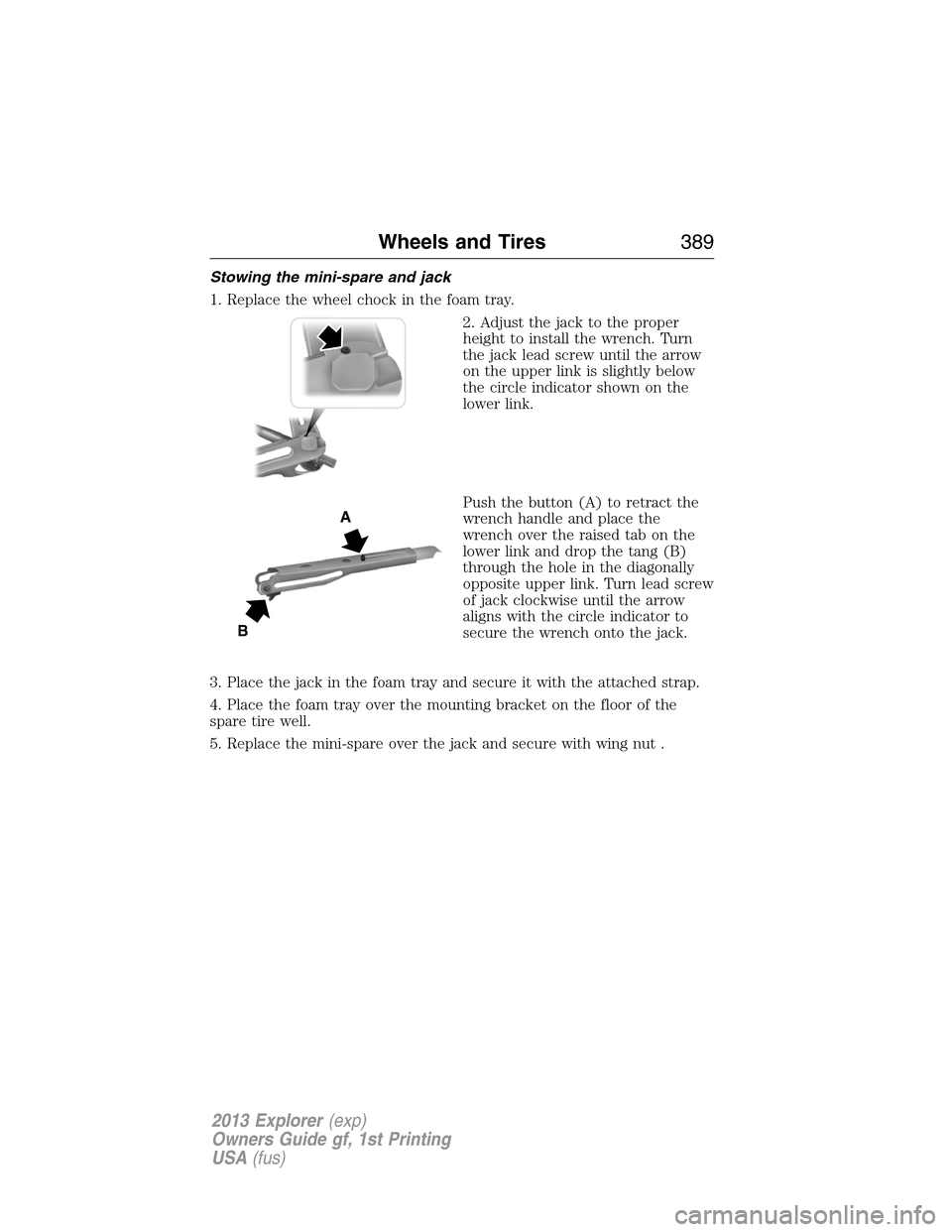
1. Replace the wheel chock in the foam tray.
2. Adjust the jack to the proper
height to install the wrench. Turn
the jack lead screw until the arrow
on the upper link is slightly below
the circle indicator shown on the
lower link.
Push the button (A) to retract the
wrench handle and place the
wrench over the raised tab on the
lower link and drop the tang (B)
through the hole in the diagonally
opposite upper link. Turn lead screw
of jack clockwise until the arrow
aligns with the circle indicator to
secure the wrench onto the jack.
3. Place the jack in the foam tray and secure it with the attached strap.
4. Place the foam tray over the mounting bracket on the floor of the
spare tire well.
5. Replace the mini-spare over the jack and secure with wing nut .
A
B
Wheels and Tires389
2013 Explorer(exp)
Owners Guide gf, 1st Printing
USA(fus)
Page 390 of 576
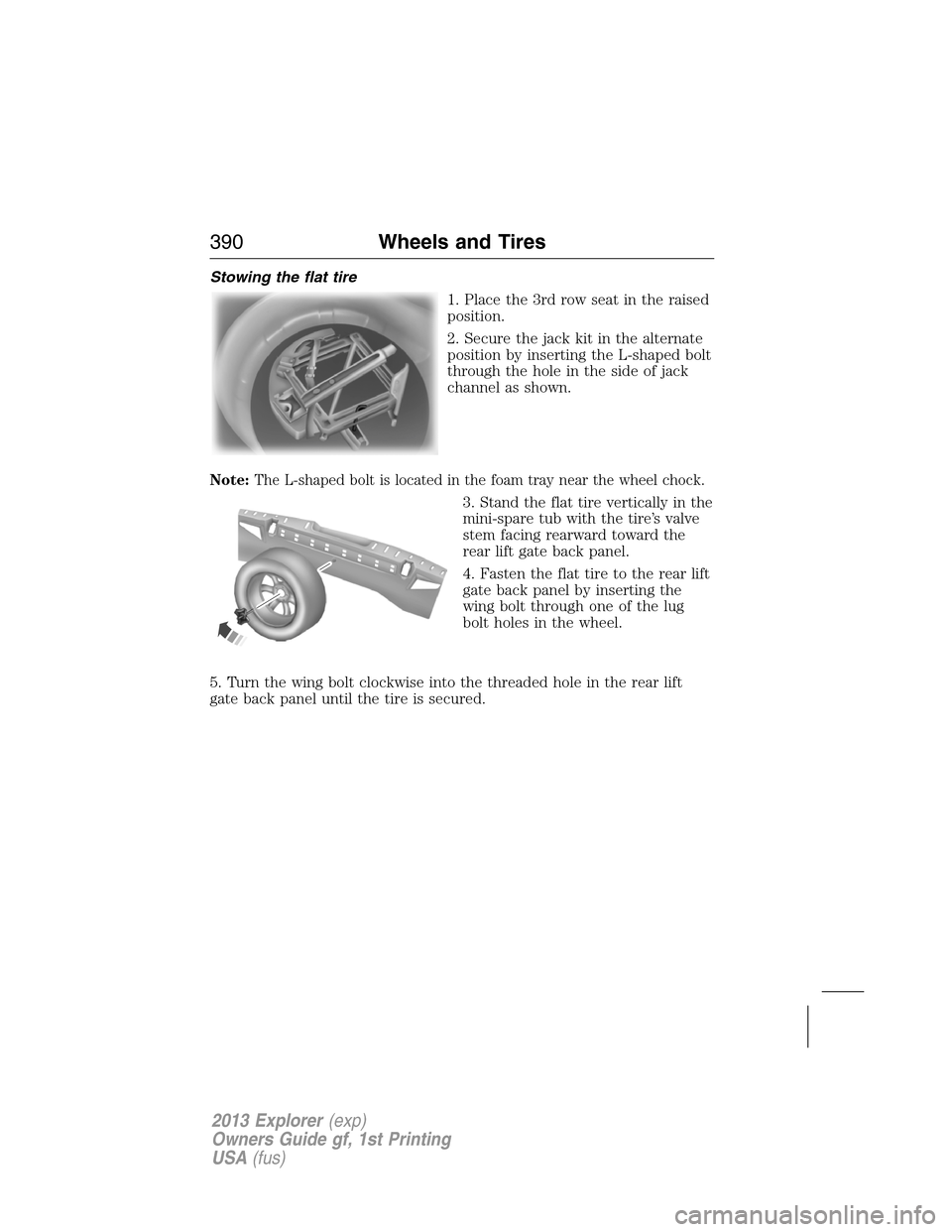
Stowing the flat tire
1. Place the 3rd row seat in the raised
position.
2. Secure the jack kit in the alternate
position by inserting the L-shaped bolt
through the hole in the side of jack
channel as shown.
Note:The L-shaped bolt is located in the foam tray near the wheel chock.
3. Stand the flat tire vertically in the
mini-spare tub with the tire’s valve
stem facing rearward toward the
rear lift gate back panel.
4. Fasten the flat tire to the rear lift
gate back panel by inserting the
wing bolt through one of the lug
bolt holes in the wheel.
5. Turn the wing bolt clockwise into the threaded hole in the rear lift
gate back panel until the tire is secured.
390Wheels and Tires
2013 Explorer(exp)
Owners Guide gf, 1st Printing
USA(fus)
Page 391 of 576

TECHNICAL SPECIFICATIONS
Wheel Lug Nut Torque Specifications
Retighten the lug nuts to the specified torque within 100 miles (160 km)
after any wheel disturbance (rotation, flat tire, wheel removal, etc.).
Lug nut socket
size/Bolt sizeWheel lug nut torque*
ft-lb N•m
12x 20 100 135
* Torque specifications are for nut and bolt threads free of dirt and
rust. Use only Ford recommended replacement fasteners.
WARNING:When a wheel is installed, always remove any
corrosion, dirt or foreign materials present on the mounting
surfaces of the wheel or the surface of the wheel hub, brake drum or
brake disc that contacts the wheel. Ensure that any fasteners that
attach the rotor to the hub are secured so they do not interfere with
the mounting surfaces of the wheel. Installing wheels without correct
metal-to-metal contact at the wheel mounting surfaces can cause the
wheel nuts to loosen and the wheel to come off while the vehicle is in
motion, resulting in loss of control.
Note:Inspect the wheel pilot hole (1) and
mounting surface prior to installation.
Remove any visible corrosion or loose
particles.
Wheels and Tires391
2013 Explorer(exp)
Owners Guide gf, 1st Printing
USA(fus)
Page 401 of 576
Peace of mind
•Keyless entry keypad
•Cargo shade
•Vehicle security systems
•Locking gas plug for capless fuel system
•Wheel locks
•Remote start
•Parking sensors*
*Ford Licensed Accessories (FLA) are warranted by the accessory
manufacturer’s warranty. Ford Licensed Accessories are fully designed
and developed by the accessory manufacturer and have not been
designed or tested to Ford Motor Company engineering requirements.
Contact your Ford dealer for details regarding the manufacturer’s limited
warranty and/or a copy of the FLA product limited warranty offered by
the accessory manufacturer.
For maximum vehicle performance, keep the following information in
mind when adding accessories or equipment to your vehicle:
•When adding accessories, equipment, passengers and luggage to your
vehicle, do not exceed the total weight capacity of the vehicle or of
the front or rear axle (GVWR or GAWR as indicated on the Safety
Compliance Certification label). Consult your authorized dealer for
specific weight information.
•The Federal Communications Commission (FCC) and Canadian Radio
Telecommunications Commission (CRTC) regulate the use of mobile
communications systems — such as two-way radios, telephones and
theft alarms - that are equipped with radio transmitters. Any such
equipment installed in your vehicle should comply with FCC or CRTC
regulations and should be installed only by a qualified service
technician.
•Mobile communications systems may harm the operation of your
vehicle, particularly if they are not properly designed for automotive
use.
Accessories401
2013 Explorer(exp)
Owners Guide gf, 1st Printing
USA(fus)
Page 413 of 576

Normal Scheduled Maintenance - At every oil change interval as
indicated by the message center
Change engine oil and filter
Rotate tires, inspect tire wear and measure tread depth
Perform multi-point inspection (recommended)
Inspect automatic transmission fluid level (if equipped with dipstick);
consult dealer for requirements
Inspect brake pads, shoes, rotors, drums, brake linings, hoses and
parking brake
Inspect cabin air filter (if equipped)
Inspect engine cooling system strength and hoses
Inspect exhaust system and heat shields
Inspect rear axle and U-joints; lubricate if equipped with grease fittings
(AWD vehicles)
Inspect half-shaft boots (if equipped)
Inspect steering linkage, ball joints, suspension, tie-rod ends, driveshaft
and U-joints; lubricate if equipped with grease fittings
Inspect wheels and related components for abnormal noise, wear,
looseness or drag
Reset your Intelligent Oil Life Monitor™ after each engine oil and filter
change; refer to theInstrument Clusterchapter
Do not exceed one year or 10,000 miles (16,000 km) between
service intervals
Scheduled Maintenance413
2013 Explorer(exp)
Owners Guide gf, 1st Printing
USA(fus)
Page 419 of 576

Extensive idling and/or low-speed driving for long distances as
in heavy commercial use (i.e. delivery, taxi, patrol car or livery)
As required Change engine oil and filter as indicated by
message center and perform services listed in the
Normal Scheduled Maintenance chart
Inspect frequently,
service as requiredReplace cabin air filter (if equipped)
Replace engine air filter
Every 30,000 miles
(48,000 km)Change automatic transmission fluid (except
Focus)
Every 60,000 miles
(96,000 km)Replace spark plugs
Operating in dusty or sandy conditions such as unpaved or dusty
roads
Inspect frequently,
service as requiredReplace cabin air filter (if equipped)
Replace engine air filter
Every 5,000 miles
(8,000 km)Inspect the wheels and related components for
abnormal noise, wear, looseness or drag
Rotate tires, inspect tires for wear and measure
tread depth
Every 5,000 miles
(8,000 km) or
6 monthsChange engine oil and filter
Perform multi-point inspection
Every 30,000 miles
(48,000 km)Change automatic transmission fluid (except
Focus)
Every 50,000 miles
(80,000 km)Change manual transmission fluid
Reset your Intelligent Oil Life Monitor™ after each engine oil and filter
change; refer to theInstrument Clusterchapter
Scheduled Maintenance419
2013 Explorer(exp)
Owners Guide gf, 1st Printing
USA(fus)
Page 425 of 576
Edge/MKX AWD only– vehicles operating off-road in sand during high
ambient temperatures must replace the AWD PTU (All-wheel drive
Power Transfer Unit) lube every 20,000 miles (32,000 km).
Engine air filter & cabin air filter replacement:Engine air filter and
cabin air filter life is dependent on exposure to dusty and dirty
conditions. Vehicles operated in these conditions will require frequent
inspection and replacement of the engine air filter and cabin air filter.
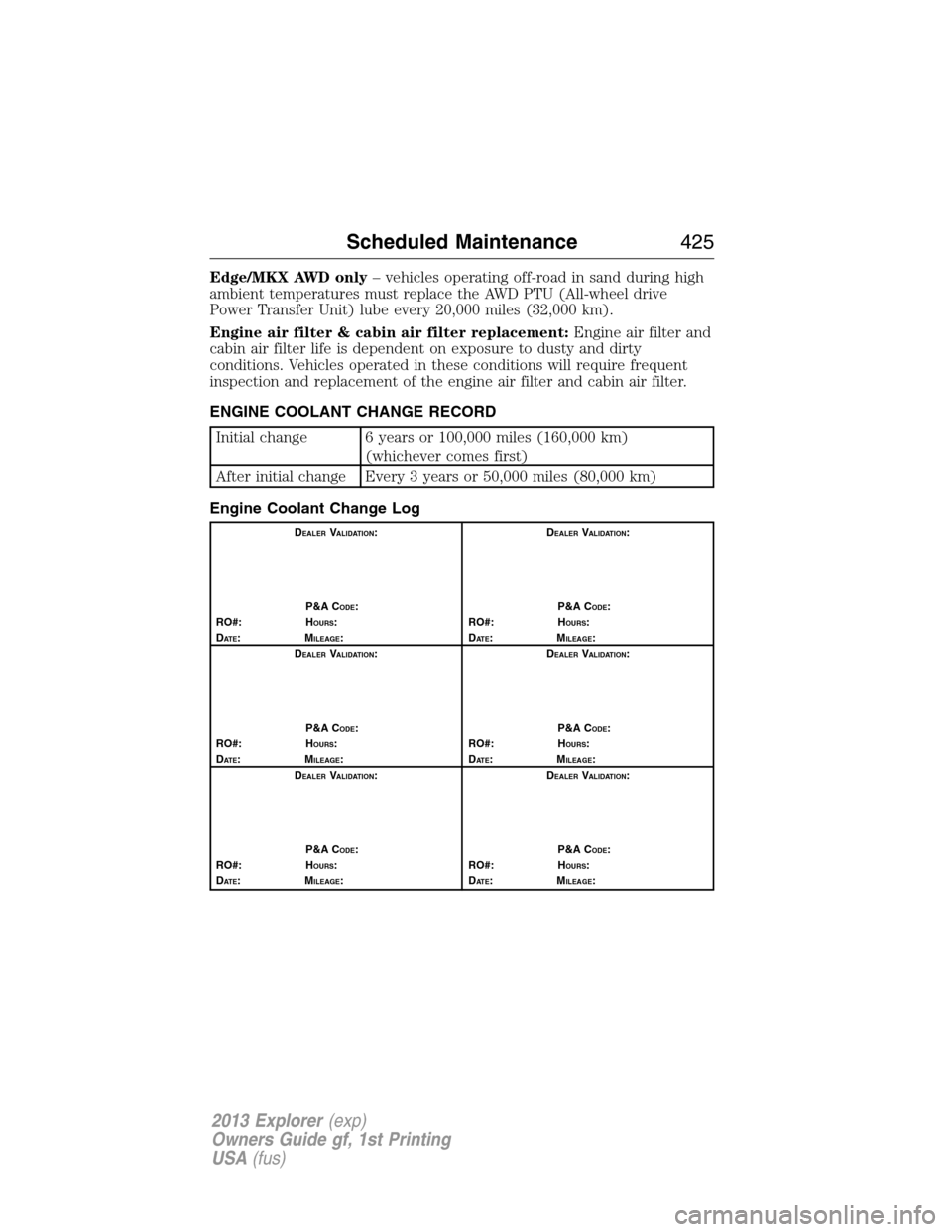
ENGINE COOLANT CHANGE RECORD
Initial change 6 years or 100,000 miles (160,000 km)
(whichever comes first)
After initial change Every 3 years or 50,000 miles (80,000 km)
Engine Coolant Change Log
DEALERVALIDATION:
P&A C
ODE:
RO#: HOURS:
DAT E:MILEAGE:D
EALERVALIDATION:
P&A C
ODE:
RO#: HOURS:
DAT E:MILEAGE:
D
EALERVALIDATION:
P&A C
ODE:
RO#: HOURS:
DAT E:MILEAGE:D
EALERVALIDATION:
P&A C
ODE:
RO#: HOURS:
DAT E:MILEAGE:
D
EALERVALIDATION:
P&A C
ODE:
RO#: HOURS:
DAT E:MILEAGE:D
EALERVALIDATION:
P&A C
ODE:
RO#: HOURS:
DAT E:MILEAGE:
Scheduled Maintenance425
2013 Explorer(exp)
Owners Guide gf, 1st Printing
USA(fus)