2013 FORD E SERIES weight
[x] Cancel search: weightPage 159 of 416

TOWING A TRAILER
WARNING:Do not exceed the GVWR or the GAWR specified on
the certification label.
WARNING:Towing trailers beyond the maximum recommended
gross trailer weight exceeds the limit of the vehicle and could
result in engine damage, transmission damage, structural damage, loss
of vehicle control, vehicle rollover and personal injury.
Note:For information on electrical items such as fuses or relays, see the
Fuseschapter.
Your vehicle’s load capacity is designated by weight, not by volume, so
you cannot necessarily use all available space when loading a vehicle.
Towing a trailer places an additional load on your vehicle’s engine,
transmission, axle, brakes, tires and suspension. Inspect these
components periodically during, and after, any towing operation.
Load Placement
To help minimize how trailer movement affects the vehicle when driving:
•Load the heaviest items closest to the trailer floor.
•Load the heaviest items so they are centered between the left and
right side trailer tires.
•Load the heaviest items above the trailer axles or just slightly forward
toward the trailer tongue. Do not allow the final trailer tongue weight
to go above or below 10–15% of the loaded trailer weight.
•Select a tow bar with the correct rise or drop. When both the loaded
vehicle and trailer are connected, the trailer frame should be level, or
slightly angled down toward the vehicle, when viewed from the side.
When driving with a trailer or payload, a slight takeoff vibration or
shudder may be present due to the increased payload weight. Additional
information regarding proper trailer loading and setting your vehicle up
for towing is noted underLoad limitin theLoad Carryingchapter and
in theRV & Trailer Towing Guide,available at your authorized dealer.
Towing159
2013 Econoline(eco)
Owners Guide gf, 1st Printing
USA(fus)
Page 160 of 416

RECOMMENDED TOWING WEIGHTS
Note:Do not exceed a trailer weight of 5000 pounds (2268 kilograms)
when towing with, or by, bumper only.
Note:Maximum trailer weight for all cutaway vehicles must be
calculated by subtracting the weight of the vehicle (including incomplete
vehicle weight and payload which includes second unit body weight,
cargo and passengers) from the GCW. Otherwise, maximum trailer
weight is 10000 pounds (4536 kilograms).
Note:Do not exceed the trailer weight for your vehicle configuration
listed in the chart below.
Note:Make sure to take into consideration trailer frontal area. Do not
exceed:
•60 feet
2(5.57 meters2) trailer frontal area.
Your vehicle may tow a Class I, II or III trailer provided the maximum
trailer weight is less than or equal to the maximum trailer weight listed
for your vehicle configuration on the following chart.
EngineRear axle
ratioMaximum
GCWR - lb (kg)Maximum Trailer
Weight - lb (kg)
E-150 Regular/Rec/Crew Van
4.6L 3.73 11500 (5216) 6000 (2722)
4.6L 4.10 12000 (5443) 6500 (2948)
5.4L 3.73/4.10 13000 (5897) 7500 (3402)
E-150 Extended Van
4.6L 3.73 11500 (5216) 5900 (2676)
4.6L 4.10 12000 (5443) 6400 (2903)
5.4L 3.73/4.10 13000 (5897) 7300 (3311)
E-150 Regular Wagon (7/8 Passenger)
4.6L 3.73 11500 (5216) 5600 (2540)
4.6L 4.10 12000 (5443) 6100 (2767)
5.4L 3.73/4.10 13000 (5897) 7000 (3175)
E-250 Regular/Rec/Crew Van
4.6L 3.73 11500 (5216) 6000 (2722)
4.6L 4.10 12000 (5443) 6500 (2948)
5.4L 3.73/4.10 13000 (5897) 7400 (3357)
160Towing
2013 Econoline(eco)
Owners Guide gf, 1st Printing
USA(fus)
Page 161 of 416
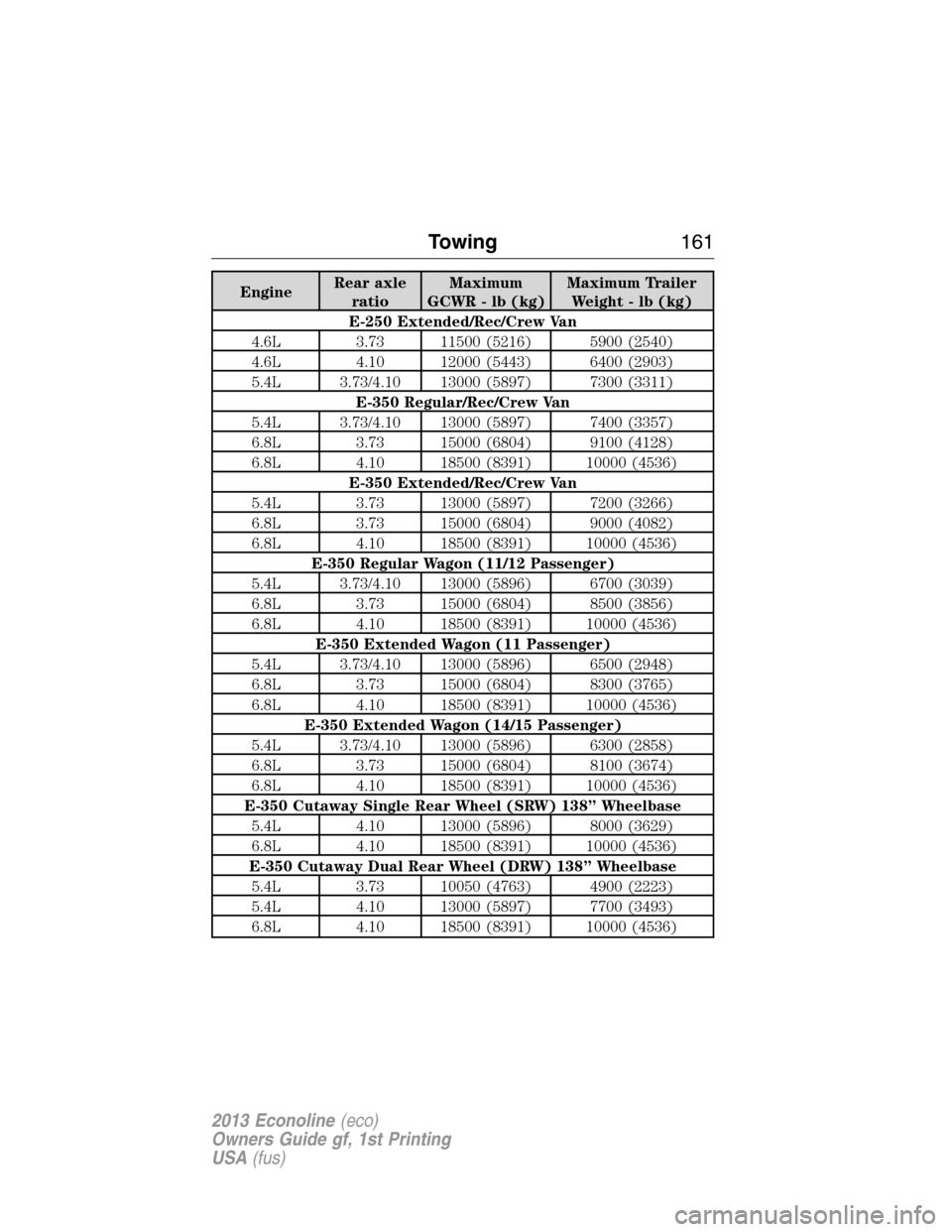
EngineRear axle
ratioMaximum
GCWR - lb (kg)Maximum Trailer
Weight - lb (kg)
E-250 Extended/Rec/Crew Van
4.6L 3.73 11500 (5216) 5900 (2540)
4.6L 4.10 12000 (5443) 6400 (2903)
5.4L 3.73/4.10 13000 (5897) 7300 (3311)
E-350 Regular/Rec/Crew Van
5.4L 3.73/4.10 13000 (5897) 7400 (3357)
6.8L 3.73 15000 (6804) 9100 (4128)
6.8L 4.10 18500 (8391) 10000 (4536)
E-350 Extended/Rec/Crew Van
5.4L 3.73 13000 (5897) 7200 (3266)
6.8L 3.73 15000 (6804) 9000 (4082)
6.8L 4.10 18500 (8391) 10000 (4536)
E-350 Regular Wagon (11/12 Passenger)
5.4L 3.73/4.10 13000 (5896) 6700 (3039)
6.8L 3.73 15000 (6804) 8500 (3856)
6.8L 4.10 18500 (8391) 10000 (4536)
E-350 Extended Wagon (11 Passenger)
5.4L 3.73/4.10 13000 (5896) 6500 (2948)
6.8L 3.73 15000 (6804) 8300 (3765)
6.8L 4.10 18500 (8391) 10000 (4536)
E-350 Extended Wagon (14/15 Passenger)
5.4L 3.73/4.10 13000 (5896) 6300 (2858)
6.8L 3.73 15000 (6804) 8100 (3674)
6.8L 4.10 18500 (8391) 10000 (4536)
E-350 Cutaway Single Rear Wheel (SRW) 138” Wheelbase
5.4L 4.10 13000 (5896) 8000 (3629)
6.8L 4.10 18500 (8391) 10000 (4536)
E-350 Cutaway Dual Rear Wheel (DRW) 138” Wheelbase
5.4L 3.73 10050 (4763) 4900 (2223)
5.4L 4.10 13000 (5897) 7700 (3493)
6.8L 4.10 18500 (8391) 10000 (4536)
Towing161
2013 Econoline(eco)
Owners Guide gf, 1st Printing
USA(fus)
Page 162 of 416

EngineRear axle
ratioMaximum
GCWR - lb (kg)Maximum Trailer
Weight - lb (kg)
E-350 Cutaway Single Rear Wheel (SRW) 158” Wheelbase
5.4L 4.10 13000 (5896) 8000 (3629)
6.8L 4.10 18500 (8391) 10000 (4536)
E-350 Cutaway Dual Rear Wheel (DRW) 158”/176” Wheelbase
5.4L 3.73 10050 (4763) 4800 (2177)
5.4L 4.10 13000 (5897) 7700 (3493)
6.8L 4.10 18500 (8391) 10000 (4536)
E-350 Stripped Chassis Dual Rear Wheel (DRW) 138” Wheelbase
5.4L 4.10 13000 (5897) 8400 (3810)
6.8L 4.10 18500 (8391) 10000 (4536)
E-350 Stripped Chassis Dual Rear Wheel (DRW) 158”/176”
Wheelbase
5.4L 4.10 13000 (5897) 8300 (3765)
6.8L 4.10 18500 (8391) 10000 (4536)
E-450 Cutaway
5.4L 4.56 14050 (6373) 8500 (3856)
6.8L 4.56 22000 (9979) 10000 (4536)
E-450 Stripped Chassis
5.4L 4.56 14050 (6373) 9200 (4173)
6.8L 4.56 22000 (9979) 10000 (4536)
ESSENTIAL TOWING CHECKS
Follow these guidelines for safe towing:
•Do not tow a trailer until your vehicle has been driven at least
1000 miles (1600 kilometers).
•Consult your local motor vehicle laws for towing a trailer.
•See the instructions included with towing accessories for the proper
installation and adjustment specifications.
•Service your vehicle more frequently if you tow a trailer. See your
scheduled maintenance information.
•If you use a rental trailer, follow the instructions the rental agency
gives you.
162Towing
2013 Econoline(eco)
Owners Guide gf, 1st Printing
USA(fus)
Page 163 of 416

For load specification terms found on the tire label and Safety
Compliance label and for instructions on calculating your vehicle’s load,
refer toLoad limitin theLoad Carryingchapter.
Remember to account for the trailer tongue weight as part of the vehicle
load when calculating the total vehicle weight.
Hitches
Do not use a hitch that either clamps onto the bumper or attaches to the
axle.
Distribute the trailer load so 10-15% of the total trailer weight is on the
tongue.
Weight-Distributing Hitches
WARNING:Do not adjust a weight-distributing hitch to any
position where the rear bumper of the vehicle is higher than it
was before attaching the trailer. Doing so will defeat the function of the
weight-distributing hitch, which may cause unpredictable handling, and
could result in serious personal injury.
When hooking-up a trailer using a weight-distributing hitch, always use
the following procedure:
1. Park the loaded vehicle (without the trailer) on a level surface.
2. Measure the height to the top of the vehicle front wheel opening on
the fender, this is H1.
3. Securely attach the loaded trailer to the vehicle without the
weight-distributing bars connected.
4. Measure the height to the top of the vehicle front wheel opening on
the fender a second time, this is H2.
5. Install and adjust the tension in the weight-distributing bars so that
the height of the vehicle’s front wheel opening on the fender is
approximately halfway between H1 and H2.
6. Check that the trailer is level or slightly nose down toward the
vehicle. If not, adjust the ball height accordingly and repeat
Steps 1–6.
7. Lock bar tension adjuster in place.
8. Check that the trailer tongue is securely attached and locked to the
hitch.
9. Install safety chains, lighting, and trailer brake controls as required
by law or the trailer manufacturer.
Towing163
2013 Econoline(eco)
Owners Guide gf, 1st Printing
USA(fus)
Page 168 of 416

•When the vehicle is turned off, the TBC output is disabled and the display
and module are shut down. The TBC module and display turn on when the
ignition is turned from the off position to the on position.
•The TBC is only a factory-installed or dealer-installed item. Ford is not
responsible for warranty or performance of the TBC due to misuse or
customer installation.
Trailer Lamps
Trailer lamps are required on most towed vehicles. Make sure all running
lights, brake lights, turn signals and hazard lights are working. Contact
your authorized dealer or trailer rental agency for proper instructions
and equipment for hooking up the lamps.
Using a Step Bumper (If Equipped)
The rear bumper is equipped with an integral hitch and only requires a
ball with a one inch (25.4 millimeter) shank diameter. The bumper has a
5000 pound (2268 kilogram) trailer weight and 500 pound (227
kilogram) tongue weight capacity.
If it is necessary to relocate the trailer hitch ball position, a
frame-mounted trailer hitch must be installed.
Before Towing a Trailer
Practice turning, stopping and backing up to get the feel of the
vehicle-trailer combination before starting on a trip. When turning, make
wider turns so the trailer wheels will clear curbs and other obstacles.
When Towing a Trailer
•Do not drive faster than 70 mph (113 km/h) during the first 500 miles
(800 kilometers).
•Do not make full-throttle starts.
•Check your hitch, electrical connections and trailer wheel lug nuts
thoroughly after you have traveled 50 miles (80 kilometers).
•When stopped in congested or heavy traffic during hot weather, place
gearshift in positionPto aid engine and transmission cooling and to
help A/C performance.
•Turn off the speed control with heavy loads or in hilly terrain. The
speed control may turn off automatically when you are towing on
long, steep grades.
•Shift to a lower gear when driving down a long or steep hill. Do not
apply the brakes continuously, as they may overheat and become less
effective.
168Towing
2013 Econoline(eco)
Owners Guide gf, 1st Printing
USA(fus)
Page 172 of 416

PREPARING TO DRIVE
WARNING:Utility vehicles have a significantly higher rollover
rate than other types of vehicles.
WARNING:In a rollover crash, an unbelted person is
significantly more likely to die than a person wearing a seat belt.
WARNING:Vehicles with a higher center of gravity such as
utility vehicles and trucks handle differently than vehicles with a
lower center of gravity. Utility vehicles and trucks arenotdesigned for
cornering at speeds as high as passenger cars any more than low-slung
sports cars are designed to perform satisfactorily under off-road
conditions. Avoid sharp turns, excessive speed or abrupt maneuvers in
these vehicles. Failure to drive cautiously could result in an increased
risk of loss of vehicle control, vehicle rollover, personal injury and
death.
WARNING:Loaded vehicles, with a higher center of gravity, may
handle differently than unloaded vehicles. Do not overload your
vehicle and use extra precautions, such as driving at slower speeds,
avoiding abrupt steering changes and allowing for increased stopping
distance, when driving a heavily loaded vehicle. Over-loading or loading
the vehicle improperly can deteriorate handling capability and
contribute to loss of vehicle control and vehicle rollover.
Utility vehicles and trucks have larger tires and increased ground
clearance, giving the vehicle a higher center of gravity than a passenger
car.
Vehicle stability and handling
The risk of a rollover crash increases as the number of people and load
in the vehicle increase. This increased risk occurs because the passenger
weight and load raises the vehicle’s center of gravity and causes it to
shift rearward. As a result, the van has less resistance to rollover and
handles differently from other commonly driven passenger vehicles,
making it more difficult to control in an emergency situation. Placing any
load on the roof also raises the center of gravity and increases the
potential for rollover.
172Driving Hints
2013 Econoline(eco)
Owners Guide gf, 1st Printing
USA(fus)
Page 175 of 416

There are also some things you may not want to do because they may
reduce your fuel economy:
•Sudden or hard accelerations.
•Rev the engine before turning it off.
•Idle for periods longer than one minute.
•Warm up your vehicle on cold mornings.
•Use the air conditioner or front defroster.
•Use the speed control in hilly terrain.
•Rest your foot on the brake pedal while driving.
•Drive a heavily loaded vehicle or tow a trailer.
•Carry unnecessary weight (approximately 1 mpg [0.4 km/L] is lost for
every 400 lb [180 kg] of weight carried).
•Add particular accessories to your vehicle (e.g.; bug deflectors,
rollbars or light bars, running boards, ski racks).
•Drive with the wheels out of alignment.
DRIVING THROUGH WATER
Note:Driving through deep water may allow water into the transmission
and engine causing internal damage. Have the fluid checked and, if water
is found, replace the fluid.
Do not drive quickly through standing water, especially if the depth is
unknown. Traction or brake capability may be limited and if the ignition
system gets wet, your engine may stall. Water may also enter your
engine’s air intake and severely damage your engine.
If driving through deep or standing
water is unavoidable, proceed very
slowly. Never drive through water
that is higher than the bottom of
the hubs (for trucks) or the bottom
of the wheel rims (for cars).
Once through the water, always try the brakes. Wet brakes do not stop the
vehicle as effectively as dry brakes. Drying can be improved by moving
your vehicle slowly while applying light pressure on the brake pedal.
Driving Hints175
2013 Econoline(eco)
Owners Guide gf, 1st Printing
USA(fus)