2013 FORD E SERIES child restraint
[x] Cancel search: child restraintPage 44 of 416

PRINCIPLES OF OPERATION
WARNING:Airbags DO NOT inflate slowly or gently, and the
risk of injury from a deploying airbag is the greatest close to the
trim covering the airbag module.
WARNING:All occupants of your vehicle, including the driver,
should always properly wear their safety belts, even when an
airbag supplemental restraint system is provided.
WARNING:Always transport children 12 years old and under in
the back seat and always properly use appropriate child
restraints.
WARNING:Never place your arm over the airbag module as a
deploying airbag can result in serious arm fractures or other
injuries.
WARNING:Airbags can kill or injure a child in a child seat.
NEVER place a rear-facing child seat in front of an active airbag.
If you must use a forward-facing child seat in the front seat, move the
seat all the way back.
WARNING:Do not attempt to service, repair, or modify the
airbag supplemental restraint systems or its fuses. Contact your
authorized dealer as soon as possible.
WARNING:Several airbag system components get hot after
inflation. Do not touch them after inflation.
WARNING:If the airbag has deployed, the airbag will not
function again and must be replaced immediately. If the airbag is
not replaced, the unrepaired area will increase the risk of injury in a
collision.
44Supplementary Restraints System
2013 Econoline(eco)
Owners Guide gf, 1st Printing
USA(fus)
Page 46 of 416
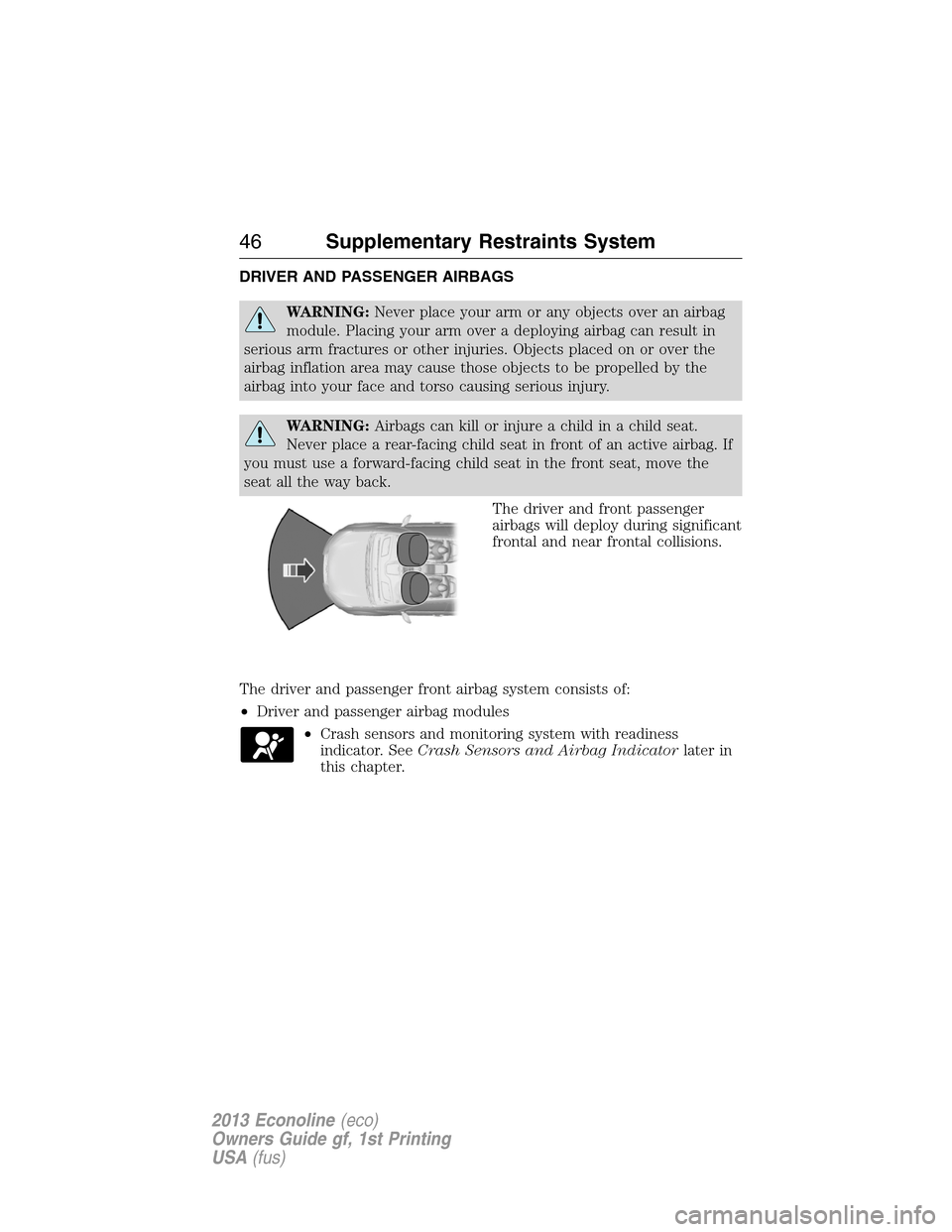
DRIVER AND PASSENGER AIRBAGS
WARNING:Never place your arm or any objects over an airbag
module. Placing your arm over a deploying airbag can result in
serious arm fractures or other injuries. Objects placed on or over the
airbag inflation area may cause those objects to be propelled by the
airbag into your face and torso causing serious injury.
WARNING:Airbags can kill or injure a child in a child seat.
Never place a rear-facing child seat in front of an active airbag. If
you must use a forward-facing child seat in the front seat, move the
seat all the way back.
The driver and front passenger
airbags will deploy during significant
frontal and near frontal collisions.
The driver and passenger front airbag system consists of:
•Driver and passenger airbag modules
•Crash sensors and monitoring system with readiness
indicator. SeeCrash Sensors and Airbag Indicatorlater in
this chapter.
46Supplementary Restraints System
2013 Econoline(eco)
Owners Guide gf, 1st Printing
USA(fus)
Page 47 of 416

Proper Driver and Front Passenger Seating Adjustment
WARNING:National Highway Traffic Safety Administration
(NHTSA) recommends a minimum distance of at least 10 inches (25
centimeters) between an occupant’s chest and the driver airbag module.
To properly position yourself away from the airbag:
•Move your seat to the rear as far as you can while still reaching the
pedals comfortably.
•
Recline the seat slightly (one or two degrees) from the upright position.
After all occupants have adjusted their seats and put on safety belts, it is
very important that they continue to sit properly. A properly seated
occupant sits upright, leaning against the seat back, and centered on the
seat cushion, with their feet comfortably extended on the floor. Sitting
improperly can increase the chance of injury in a crash event. For
example, if an occupant slouches, lies down, turns sideways, sits forward,
leans forward or sideways, or puts one or both feet up, the chance of
injury during a crash is greatly increased.
Children and Airbags
WARNING:Airbags can kill or injure a child in a child seat.
NEVER place a rear-facing child seat in front of an active airbag.
If you must use a forward-facing child seat in the front seat, move the
seat all the way back.
Children must always be properly
restrained. Accident statistics
suggest that children are safer when
properly restrained in the rear
seating positions than in the front
seating position. Failure to follow
these instructions may increase the
risk of injury in a collision.
Supplementary Restraints System47
2013 Econoline(eco)
Owners Guide gf, 1st Printing
USA(fus)
Page 49 of 416

WARNING:An infant in a rear-facing seat faces a high risk of
serious or fatal injuries from a deploying passenger airbag. Rear
facing infant seats should NEVER be placed in the front seats, unless
the passenger airbag is turned off.
1. Insert the ignition key, turn the
switch to off, and hold in the off
position while removing the key.
2. When the ignition is turned to
off, the off light illuminates briefly,
momentarily shuts off and then
turns back on. This indicates that
the passenger airbag is deactivated.
Turning the Passenger Airbag Back On
WARNING:The safety belts for the driver and right front
passenger seating positions have been specifically designed to
function together with the airbags in certain types of crashes. When
you turn OFF your airbag, you not only lose the protection of the
airbag, you also may reduce the effectiveness of your safety belt
system, which was designed to work with the airbag. If you are not a
person who meets the requirements stated in the NHTSA/Transport
Canada deactivation criteria turning OFF the airbag can increase the
risk of serious injury or death in a collision.
WARNING:If your vehicle has rear seats, always transport
children who are 12 and younger in a rear seating position.
Always use safety belts and child restraints properly. DO NOT place a
child in a rear facing infant seat in the front seat unless your vehicle is
equipped with an airbag ON/OFF switch and the passenger airbag is
turned OFF. This is because the back of the infant seat is too close to
the inflating airbag and the risk of a fatal injury to the infant when the
airbag inflates is substantial.
OFF
ON OFFPASSENGER
AIRBAG
Supplementary Restraints System49
2013 Econoline(eco)
Owners Guide gf, 1st Printing
USA(fus)
Page 51 of 416

NHTSA Deactivation Criteria (excluding Canada)
WARNING:This vehicle has special energy management safety
belts for the driver and right front passenger. These particular
belts are specifically designed to work with airbags to help reduce the
risk of injury in a collision. The energy management safety belt is
designed to give or release additional belt webbing in some accidents to
reduce concentration of force on an occupant’s chest and reduce the
risk of certain bone fractures and injuries to underlying organs. In a
crash, if the airbag is turned OFF, this energy management safety belt
might permit the person wearing the belt to move forward enough to
incur a serious or fatal injury. The more severe the crash, and the
heavier the occupant, the greater the risk is. Be sure the airbag is
turned ON for any person who does not qualify under the NHTSA
deactivation criteria.
1.Infant.An infant (less than 1 year old) must ride in the front seat
because:
•the vehicle has no rear seat;
•the vehicle has a rear seat too small to accommodate a rear-facing
infant seat; or
•the infant has a medical condition which, according to the infant’s
physician, makes it necessary for the infant to ride in the front so that
the driver can constantly monitor the child’s condition.
2.Child age 1 to 12.A child age 1 to 12 must ride in the front seat
because:
•the vehicle has no rear seat;
•although children ages 1 to 12 ride in the rear seat(s) whenever
possible, children ages 1 to 12 sometimes must ride in the front
because no space is available in the rear seat(s) of the vehicle; or
•the child has a medical condition which, according to the child’s
physician, makes it necessary for the child to ride in the front seat so
that the driver can constantly monitor the child’s condition.
Supplementary Restraints System51
2013 Econoline(eco)
Owners Guide gf, 1st Printing
USA(fus)
Page 53 of 416

2.Child age 12 or under:A child age 12 or under must ride in the
front seat because:
•my vehicle has no rear seat;
•although children age 12 and under ride in the rear seat whenever
possible, children age 12 and under have no option but to sometimes
ride in the front seat because rear seat space is insufficient; or
•the child has a medical condition that, according to the child’s
physician, makes it necessary for the child to ride in the front seat so
that the driver can monitor the child’s condition.
3.Medical condition:A passenger has a medical condition that,
according to his or her physician:
•poses a special risk for the passenger if the airbag deploys; and
•makes the potential harm from the passenger airbag deployment
greater than the potential harm from turning OFF the airbag and
experiencing a crash without the protection offered by the airbag
CRASH SENSORS AND AIRBAG INDICATOR
WARNING:Modifying or adding equipment to the front end of
your vehicle (including frame, bumper, front end body structure
and tow hooks) may affect the performance of the airbag system,
increasing the risk of injury. Do not modify the front end of your
vehicle.
Your vehicle has a collection of crash and occupant sensors which
provide information to the Restraints Control Module (RCM) which
deploys (activates) the front safety belt pretensioners, driver airbag and
passenger airbag. Based on the type of accident, the restraints control
module will deploy the appropriate safety devices.
The restraints control module also monitors the readiness of the above
safety devices plus the crash and occupant sensors. The readiness of the
safety system is indicated by a warning indicator light in the instrument
cluster or by a backup tone if the warning light is not working. See
Warning lamps and indicatorsin theInstrument Clusterchapter.
Routine maintenance of the airbag is not required.
Supplementary Restraints System53
2013 Econoline(eco)
Owners Guide gf, 1st Printing
USA(fus)
Page 242 of 416

GENERAL INFORMATION
Notice to Utility Vehicle, Van and Truck Owners
WARNING:Utility vehicles have a significantly higher rollover
rate than other types of vehicles. To reduce the risk of serious
injury or death from a rollover or other crash you must:
•Avoid sharp turns and abrupt maneuvers;
•Drive at safe speeds for the conditions;
•Keep tires properly inflated;
•Never overload or improperly load your vehicle; and
•Make sure every passenger is properly restrained.
WARNING:In a rollover crash, an unbelted person is
significantly more likely to die than a person wearing a seat belt.
All occupants must wear seat belts and children/infants must use
appropriate restraints to minimize the risk of injury or ejection.
Utility vehicles, vans and trucks handle
differently than passenger cars in the
various driving conditions that are
encountered on streets, highways and
off-road. Utility vehicles, vans and
trucks are not designed for cornering
at speeds as high as passenger cars
any more than low-slung sports cars
are designed to perform satisfactorily
under off-road conditions.
242Wheels and Tires
2013 Econoline(eco)
Owners Guide gf, 1st Printing
USA(fus)
Page 410 of 416

911 Assist™ ..............................329
A
ABS (see Brakes) .....................137
Accessing call history/phone
book during active call .............319
Accessing the help screen .......388
Accessing the music in your
jukebox ......................................382
Accessing your media menu
features ......................................341
Accessing your phone menu
features ......................................320
Accessory delay ..........................71
Active call menu options .........319
Advanced menu options ...327, 348
Advanced menu options
(prompts, languages, defaults,
master reset, installing
applications) ..............................327
Airbag supplemental restraint
system ..........................................46
and child safety seats ..............47
description ................................46
disposal ......................................54
driver airbag ..............................46
passenger airbag .......................46
passenger deactivation
switch ........................................48
side airbag .................................46
Air cleaner filter .......221–222, 285
Air conditioning ..................99–100
manual heating and air
conditioning system .........99–100
Ambulance packages ..................14
AM/FM .......................................366Antifreeze
(see Engine coolant) ................205
Anti-lock brake system
(see Brakes) ..............................137
Anti-theft system ........................63
arming the system ....................63
AppLink™ .................................336
Audio system
Single CD ............................91–92
Audio system (see Radio) ...91–92
Automatic transmission
driving an automatic
overdrive .........................129, 132
fluid, adding ............................210
fluid, checking ........................210
fluid, refill capacities ..............280
fluid, specification ..................280
Auxiliary input jack (Line in) ....94
Auxiliary powerpoint ................111
Axle
lubricant specifications ..........280
refill capacities ........................280
traction lok ..............................136
B
Battery .......................................218
acid, treating emergencies .....218
jumping a disabled battery ....181
maintenance-free ....................218
replacement, specifications ...285
servicing ..................................218
Booster seats ...............................22
Brakes ........................................137
anti-lock ...................................137
anti-lock brake system (ABS)
warning light ...........................137
brake warning light ................137
410Index
2013 Econoline(eco)
Owners Guide gf, 1st Printing
USA(fus)