2013 FORD B MAX fuel
[x] Cancel search: fuelPage 102 of 298

Downloaded from www.Manualslib.com manuals search engine Refilling With a Portable FuelContainer
WARNINGS
Do not insert the nozzle of portablefuel containers or aftermarketfunnels into the capless fuel system.This could damage the fuel system and itsseal, and may cause fuel to run onto theground instead of filling the tank, whichcould result in serious personal injury.
Do not try to pry open or push openthe capless fuel system with foreignobjects. This could damage the fuelsystem and its seal and cause injury to youor others.
When filling your vehicle's fuel tank froma portable fuel container, use the funnelincluded with your vehicle.
Use the following guidelines to avoidelectrostatic charge build-up when fillingan ungrounded fuel container:
•Place approved fuel container on theground.
•Do not fill a fuel container while it is inthe vehicle (including the cargo area).
•Keep the fuel pump nozzle in contactwith the fuel container while filling.
•Do not use a device that would holdthe fuel pump handle in the fill position.
1.Locate the plastic funnel in the glovebox.
2.Slowly insert the funnel into thecapless fuel system.
3.Fill your vehicle with fuel from theportable fuel container.
4.When done, clean the funnel orproperly dispose of it. Extra funnels canbe purchased from your authorizeddealer if you choose to dispose of thefunnel.
CATALYTIC CONVERTER
WARNING
Do not park or idle your vehicle overdry leaves, dry grass or othercombustible materials. The exhaustwill radiate a considerable amount of heatduring use, and after you have switchedthe engine off. This is a potential firehazard.
Driving with a Catalytic Converter
WARNINGS
Avoid running out of fuel.
Do not crank the engine for longperiods.
Do not run the engine when a sparkplug lead is disconnected.
Do not push-start or tow-start yourvehicle. Use booster cables. SeeJump-Starting the Vehicle (page132).
Do not switch the ignition off whendriving.
100B-MAX (CB2) Vehicles Built From: 25-06-2012, Vehicles Built Up To: 31-12-2013Fuel and Refueling
Page 103 of 298

Downloaded from www.Manualslib.com manuals search engine REFUELING
WARNINGS
Do not attempt to start the engine ifyou have filled the fuel tank with theincorrect fuel. This could damage theengine. Have the system checked by anauthorized dealer immediately.
Do not use any kind of flames or heatnear the fuel system. The fuel systemis under pressure. There is a risk ofinjury if the fuel system is leaking.
If you use a high pressure spray towash your vehicle, only spray the fuelfiller flap briefly from a distance notless than 8 inches (200 millimeters).
We recommend that you wait atleast 10 seconds before removing thefuel pipe nozzle to allow any residualfuel to drain into the fuel tank.
Stop refueling after the fuel nozzlestops the second time. Additionalfuel will fill the expansion space inthe fuel tank which could lead to fueloverflowing. Fuel spillage could behazardous to other road users.
Do not remove the nozzle from itsfully inserted position during theentire refueling process.
Note:It is not possible to fully open thesliding door when the fuel filler flap is open.
Note:Your vehicle does not have a fuel fillercap.
1.Press the flap to open it. Open the flapfully until it engages.
Note:When you insert the correct size fuelnozzle, a spring loaded inhibitor will open.This helps to avoid filling up with the wrongfuel.
2.Insert the fuel nozzle up to andincluding the first notch on the nozzleA. Keep it resting on the cover of thefuel pipe opening.
101B-MAX (CB2) Vehicles Built From: 25-06-2012, Vehicles Built Up To: 31-12-2013Fuel and Refueling
Page 104 of 298

Downloaded from www.Manualslib.com manuals search engine 3.Hold the nozzle in position B duringrefilling. Holding the nozzle in positionA may affect the flow of fuel and shutoff the fuel nozzle before the fuel tankis full.
4.Operate the nozzle within the areashown.
5.Slightly raise the fuel nozzle to removeit.
FUEL CONSUMPTION
Note:The amount of usable fuel in theempty reserve varies and should not berelied upon to increase driving range. Whenrefueling your vehicle after the fuel gaugeindicates empty, you might not be able torefuel the full amount of the advertisedcapacity of the fuel tank due to the emptyreserve still present in the tank.
The CO2 and fuel consumption figures arederived from laboratory tests according toRegulation (EC) 715/2007 and subsequentamendments are carried out by all vehiclemanufacturers.
They are intended as a comparisonbetween makes and models of vehicles.They are not intended to represent the realworld fuel consumption you may get fromyour vehicle. Real world fuel consumptionis governed by many factors including:driving style, high speed driving, stop-startdriving, air conditioning usage, theaccessories fitted, payload, towing, etc.
The advertised capacity is the indicatedcapacity and the empty reserve combined.Indicated capacity is the difference in theamount of fuel in a full tank and a tankwhen the fuel gauge indicates empty.Empty reserve is the amount of fuel in thetank after the fuel gauge indicates empty.
Filling the Tank
For consistent results when refueling:
•Switch the ignition off before refueling.An inaccurate reading results if youleave the engine running.
•Use the same fill rate(low-medium-high) each time the tankis filled.
•Allow no more than two automaticshut-offs when refueling.
Results are most accurate when therefueling method is consistent.
102B-MAX (CB2) Vehicles Built From: 25-06-2012, Vehicles Built Up To: 31-12-2013Fuel and Refueling
Page 105 of 298

Downloaded from www.Manualslib.com manuals search engine Calculating Fuel Economy
Do not measure fuel economy during thefirst 1000 miles (1600 km) of driving (thisis your engine’s break-in period). A moreaccurate measurement is obtained after2000 - 3000 miles (3200 - 4800 km).Also, fuel expense, frequency of fill ups orfuel gauge readings are not accurate waysto measure fuel economy.
1.Fill the fuel tank completely and recordthe initial odometer reading.
2.Each time you fill the tank, record theamount of fuel added.
3.After at least three to five tank fill ups,fill the fuel tank and record the currentodometer reading.
4.Subtract your initial odometer readingfrom the current odometer reading.
5.Calculate fuel economy by dividingmiles traveled by gallons used (ForMetric: Multiply liters used by 100, thendivide by kilometers traveled).
Keep a record for at least one month andrecord the type of driving (city or freeway).This provides an accurate estimate of yourvehicle’s fuel economy under currentdriving conditions. Additionally, keepingrecords during summer and winter showhow temperature impacts fuel economy.In general, lower temperatures mean lowerfuel economy.
TECHNICAL SPECIFICATIONS
Fuel Consumption Figures
CO2 Emis-sionsCombinedExtra-UrbanUrban
Variant
g/kml/100 km(mpg)l/100 km(mpg)l/100 km(mpg)
1195.1 (55.4)4.3 (65.7)6.6 (42.8)1.0L EcoBoost(74kW/100PS) withoutstart-stop
1144.9 (57.6)4.2 (67.3)6 (47.1)1.0L EcoBoost(74kW/100PS) with start-stop
1144.9 (57.6)4.2 (67.3)6 (47.1)1.0L EcoBoost(90kW/120PS)
1396 (47.1)4.9 (57.6)7.9 (35.8)1.4L Duratec-16V
1496.4 (44.1)5.1 (55.4)8.6 (32.8)1.6L Duratec-16V Ti-VCT
1044 (70.6)3.6 (78.4)4.7 (60.1)1.5L Duratorq-TDCi
1094.1 (68.9)3.8 (74.3)4.8 (58.9)1.6L Duratorq-TDCi
103B-MAX (CB2) Vehicles Built From: 25-06-2012, Vehicles Built Up To: 31-12-2013Fuel and Refueling
Page 134 of 298
Downloaded from www.Manualslib.com manuals search engine HAZARD WARNING FLASHERS
The hazard warning button is located onthe instrument panel. Use it when yourvehicle is creating a safety hazard for othermotorists.
Press the button to turn on the hazardwarning function, and the front and reardirection indicators will flash.
Press the button again to turn them off.
Note:If used when the engine is notrunning, the battery will lose charge. Theremay be insufficient power to restart yourengine.
Note:Depending on applicable laws andregulations in the country for which yourvehicle was originally built, the hazardwarning flashers may flash if you brakeheavily.
FIRST AID KIT
Space is provided in the luggagecompartment.
WARNING TRIANGLE
Space is provided in the luggagecompartment.
JUMP-STARTING THE VEHICLE
WARNINGS
Do not use fuel lines, engine rockercovers or the intake manifold asgrounding points.
Connect batteries with only the samenominal voltage.
WARNINGS
Always use booster cables withinsulated clamps and adequate sizecable.
Note:Do not disconnect the battery fromyour vehicle’s electrical system.
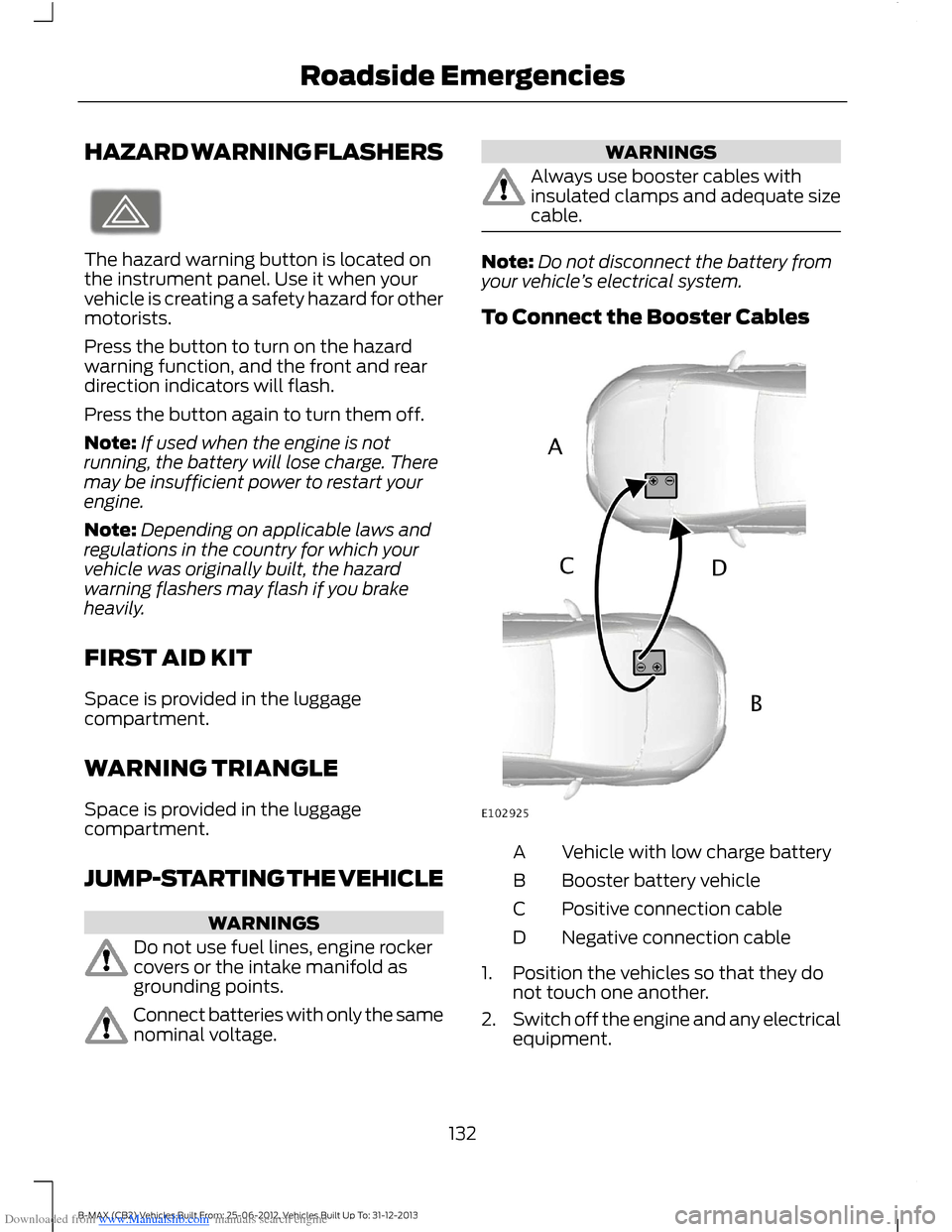
To Connect the Booster Cables
Vehicle with low charge batteryA
Booster battery vehicleB
Positive connection cableC
Negative connection cableD
1.Position the vehicles so that they donot touch one another.
2.Switch off the engine and any electricalequipment.
132B-MAX (CB2) Vehicles Built From: 25-06-2012, Vehicles Built Up To: 31-12-2013Roadside Emergencies
Page 135 of 298

Downloaded from www.Manualslib.com manuals search engine 3.Connect the positive (+) terminal ofvehicle B with the positive (+) terminalof vehicle A (cable C).
4.Connect the negative (-) terminal ofvehicle B to the ground connection ofvehicle A (cable D).
WARNINGS
Do not connect directly to thenegative (–) terminal of the batterywith low charge.
Make sure that the cables are clearof any moving parts and fuel deliverysystem parts.
To Start the Engine
1.Run the engine of vehicle B at amoderately high speed.
2.Start the engine of vehicle A.
3.Run both vehicles for a minimum ofthree minutes before disconnecting thecables.
WARNING
Do not switch on the headlampswhen disconnecting the cables. Thepeak voltage could blow the bulbs.
Disconnect the cables in the reverse order.
133B-MAX (CB2) Vehicles Built From: 25-06-2012, Vehicles Built Up To: 31-12-2013Roadside Emergencies
Page 139 of 298

Downloaded from www.Manualslib.com manuals search engine Circuits protectedFuse ratingFuse
Not used-30
Not used-31
Horn, battery saver, keyless vehicle module20 A32
Heated rear window20 A33
Fuel pump relay, diesel fuel heater20 A34
Cat1 alarm system15 A35
Automatic transmission controller7.5A36
Front door module left-hand side25 A37
Front door module right-hand side25 A38
Rear door module left-hand side25 A39
Rear door module right-hand side25 A40
Circuits switchedRelay
Cooling system fanR1
Not usedR2
Powertrain control moduleR3
High beamR4
Not usedR5
Not usedR6
Engine cooling fanR7
StarterR8
Air conditioning clutchR9
Front fog lampsR10
Fuel pump, diesel fuel heaterR11
Reversing lampR12
Heater blowerR13
137B-MAX (CB2) Vehicles Built From: 25-06-2012, Vehicles Built Up To: 31-12-2013Fuses
Page 141 of 298

Downloaded from www.Manualslib.com manuals search engine Circuits protectedFuse ratingFuse
Ignition, electric powerassisted steering, instrumentcluster, passive anti-theftsystem, anti-lock brakingsystem
10 A13
Powertrain control module,transmission selector lever,fuel pump7.5 A14
Audio system, instrumentcluster7.5 A15
Heated windshield7.5 A16
Not used-17
Not used-18
Data link connector15 A19
Multi function display, clock,internal scanner, heatingvents, air conditioning panel20 A20
Audio system, navigation,bluetooth15 A21
Instrument cluster7.5 A22
Trailer module7.5 A23
Sync module antenna7.5 A24
Not used-25
Front wiper, left-hand side30 A26
Front wiper, right-hand side30 A27
Circuits switchedRelay
IgnitionR1
139B-MAX (CB2) Vehicles Built From: 25-06-2012, Vehicles Built Up To: 31-12-2013Fuses