Page 296 of 350

Disposal Of Used Power Electronics and Battery
Thermal Management Systems Coolant
Used antifreeze is a regulated substance requiring proper
disposal. Check with your local authorities to determine
the disposal rules for your community. To prevent inges-
tion by animals or children, do not store antifreeze in
open containers or allow it to remain in puddles on the
ground. If ingested by a child, contact a physician
immediately. Clean up any ground spills immediately.
Points To Remember
If an examination of your underhood compartment
shows no evidence of cooler or hose leaks, the vehicle
may be safely driven.
•Do not overfill the coolant recovery bottles. •
Check coolant (antifreeze) freeze point in the coolant
recovery bottles. If coolant (antifreeze) needs to be
added, contents of coolant recovery bottles must also
be protected against freezing.
• If frequent coolant (antifreeze) additions are required,
or if the level in the coolant recovery bottles does not
drop when the engine cools, the cooling system should
be pressure tested for leaks.
• Maintain coolant (antifreeze) concentration at 50%
OAT coolant (antifreeze) (minimum) and distilled/
deionized water for proper corrosion protection of
your engine which contains aluminum components.
• Make sure that the coolant control systems recovery
bottles overflow hoses are not kinked or obstructed.
• Keep the front of the coolant control systems clean. If
your vehicle is equipped with air conditioning, keep
the front of the condenser clean.
294 MAINTAINING YOUR VEHICLE
Page 320 of 350
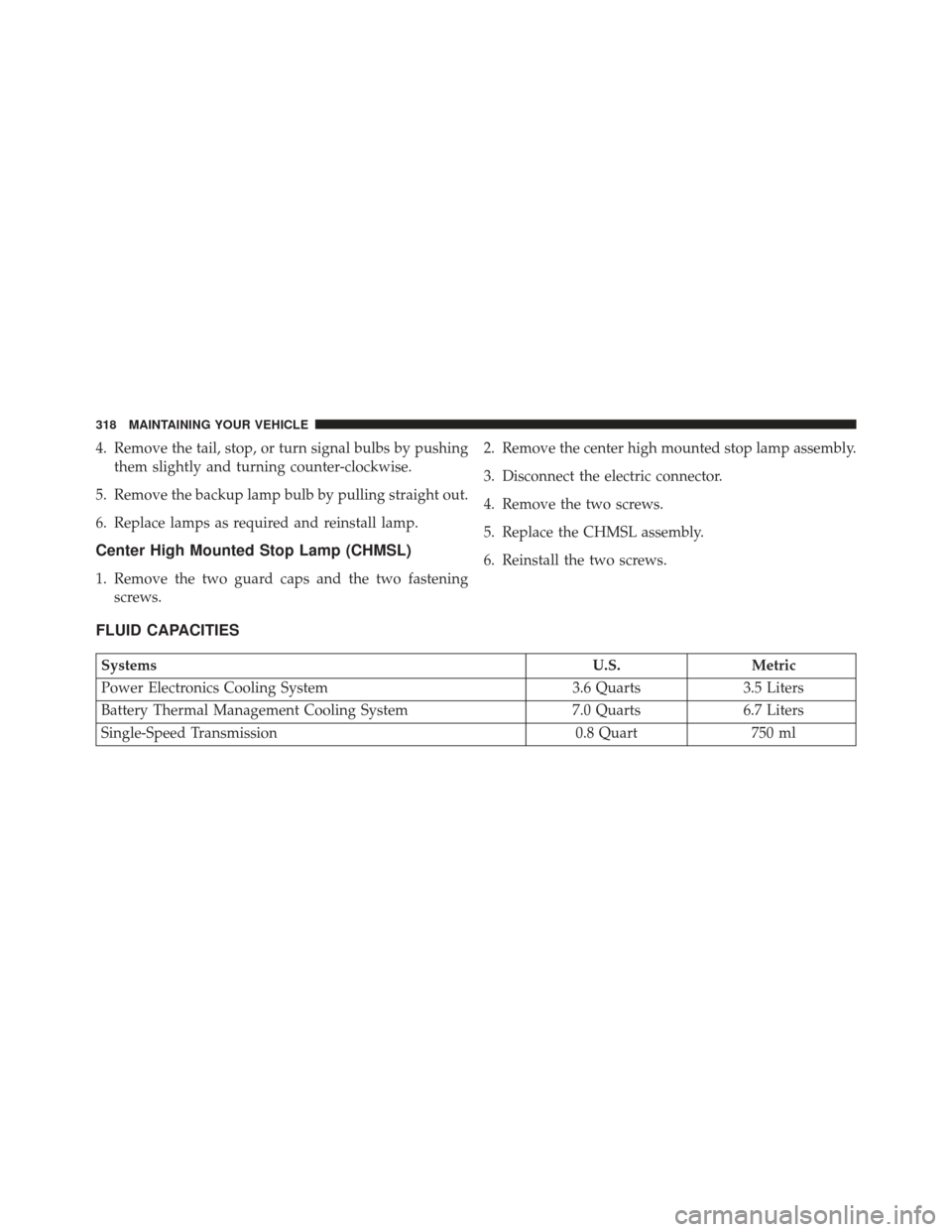
4. Remove the tail, stop, or turn signal bulbs by pushingthem slightly and turning counter-clockwise.
5. Remove the backup lamp bulb by pulling straight out.
6. Replace lamps as required and reinstall lamp.
Center High Mounted Stop Lamp (CHMSL)
1. Remove the two guard caps and the two fastening screws. 2. Remove the center high mounted stop lamp assembly.
3. Disconnect the electric connector.
4. Remove the two screws.
5. Replace the CHMSL assembly.
6. Reinstall the two screws.
FLUID CAPACITIES
Systems
U.S.Metric
Power Electronics Cooling System 3.6 Quarts3.5 Liters
Battery Thermal Management Cooling System 7.0 Quarts6.7 Liters
Single-Speed Transmission 0.8 Quart750 ml
318 MAINTAINING YOUR VEHICLE
Page 324 of 350
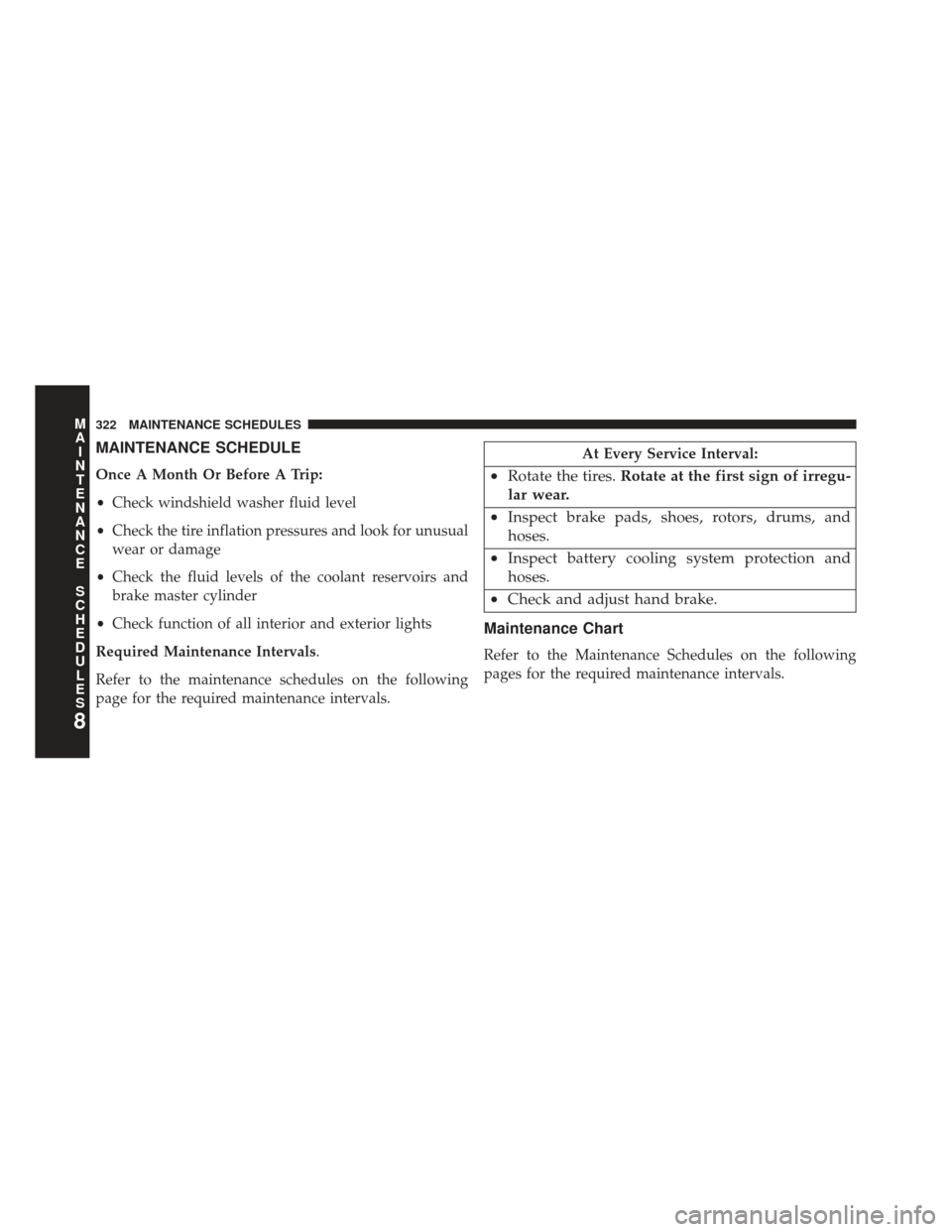
MAINTENANCE SCHEDULE
Once A Month Or Before A Trip:
•Check windshield washer fluid level
• Check the tire inflation pressures and look for unusual
wear or damage
• Check the fluid levels of the coolant reservoirs and
brake master cylinder
• Check function of all interior and exterior lights
Required Maintenance Intervals.
Refer to the maintenance schedules on the following
page for the required maintenance intervals.
At Every Service Interval:
• Rotate the tires. Rotate at the first sign of irregu-
lar wear.
• Inspect brake pads, shoes, rotors, drums, and
hoses.
• Inspect battery cooling system protection and
hoses.
• Check and adjust hand brake.
Maintenance Chart
Refer to the Maintenance Schedules on the following
pages for the required maintenance intervals.
8
M A I
N T
E
N
A
N
C E
S
C
H E
D
U L
E
S322 MAINTENANCE SCHEDULES