Page 373 of 520
•Various TPMS messages, which display in the Elec-
tronic Vehicle Information Center (EVIC), and
• TPM Telltale Light
Tire Pressure Monitoring Low Pressure Warnings
The “TPM Telltale Light” will illuminate in the
instrument cluster and a chime will sound when
tire pressure is low in one or more of the four active road
tires. In addition, the EVIC will display a “LOW TIRE”
message and a graphic showing the pressure values of
each tire with the low tire pressure values flashing. An
�Inflate Tire to XX� message will also be displayed in the
EVIC display. Should this occur, you should stop as soon as possible
and inflate all of the tires with a low pressure condition
(those flashing in the EVIC graphic) to the vehicle’s
recommended cold placard pressure inflation value as
shown in the
�Inflate Tire to XX� message. Once the
system receives the updated tire pressures, the system
will automatically update, the graphic display in the
5
STARTING AND OPERATING 371
Page 375 of 520

If the ignition switch is cycled, this sequence will repeat,
providing the system fault still exists. If the system fault
no longer exists, the “TPM Telltale Light” will no longer
flash, and the�SERVICE TPM SYSTEM� message will no
longer display, and a pressure value will display in place
of the dashes. A system fault can occur due to any of the
following:
1. Signal interference due to electronic devices or driving next to facilities emitting the same radio frequencies as
the TPM sensors.
2. Installing aftermarket window tinting that contains materials that may block radio wave signals.
3. Accumulation of snow or ice around the wheels or wheel housings.
4. Using tire chains on the vehicle.
5. Using wheels/tires not equipped with TPM sensors. The EVIC will also display a
�SERVICE TPM SYSTEM�
message for a minimum of five seconds when a system
fault related to an incorrect sensor location fault is
detected. In this case, the �SERVICE TPM SYSTEM�
message is then followed with a graphic display with
pressure values still shown. This indicates that the pres-
sure values are still being received from the TPM sensors
but they may not be located in the correct vehicle
position. The system still needs to be serviced as long as
the �SERVICE TPM SYSTEM� message is displayed.
Vehicles with Compact Spare
1. The compact spare tire does not have a TPM sensor. Therefore, the TPMS will not monitor the pressure in
the compact spare tire.
2. If you install the compact spare tire in place of a road tire that has a pressure below the low-pressure warn-
ing limit, upon the next ignition switch cycle, the
“TPM Telltale Light” will remain ON and a chime will
5
STARTING AND OPERATING 373
Page 376 of 520
sound. In addition, the graphic in the EVIC will still
display a flashing pressure value and the�Inflate Tire
to XX� message.
3. After driving the vehicle for up to 20 minutes above 15 mph (24 km/h), the “TPM Telltale Light” will flash
on and off for 75 seconds and then remain on solid. In
addition, the EVIC will display a �SERVICE TPM
SYSTEM� message for a minimum of five seconds and
then display dashes (- -) in place of the pressure value.
4. For each subsequent ignition switch cycle, a chime will sound, the “TPM Telltale Light” will flash on and off
for 75 seconds and then remain on solid, and the EVIC
will display a �SERVICE TPM SYSTEM� message for a
minimum of five seconds and then display dashes (- -)
in place of the pressure value.
5. Once you repair or replace the original road tire and reinstall it on the vehicle in place of the compact spare,
the TPMS will update automatically. In addition, the “TPM Telltale Light” will turn OFF and the graphic in
the EVIC will display a new pressure value instead of
dashes (- -), as long as no tire pressure is below the
low-pressure warning limit in any of the four active
road tires. The vehicle may need to be driven for up to
20 minutes above 15 mph (24 km/h) in order for the
TPMS to receive this information.
General Information
This device complies with Part 15 of the FCC rules and
RSS 210 of Industry Canada. Operation is subject to the
following conditions:
•
This device may not cause harmful interference.
• This device must accept any interference received,
including interference that may cause undesired op-
eration.
374 STARTING AND OPERATING
Page 386 of 520
Overloading
The load carrying components (axle, springs, tires,
wheels, etc.) of your vehicle will provide satisfactory
service as long as you do not exceed the GVWR and the
front and rear GAWR.
The best way to figure out the total weight of your
vehicle is to weigh it when it is fully loaded and ready for
operation. Weigh it on a commercial scale to ensure that
it is not over the GVWR.
Figure out the weight on the front and rear of the vehicle
separately. It is important that you distribute the load
evenly over the front and rear axles.
Overloading can cause potential safety hazards and
shorten useful service life. Heavier axles or suspension
components do not necessarily increase the vehicle’s
GVWR.
Loading
To load your vehicle properly, first figure out its empty
weight, axle-by-axle and side-by-side. Store heavier items
down low and be sure you distribute their weight as
evenly as possible. Stow all loose items securely before
driving. If weighing the loaded vehicle shows that you
have exceeded either GAWR, but the total load is within
the specified GVWR, you must redistribute the weight.
Improper weight distribution can have an adverse effect
on the way your vehicle steers and handles and the way
the brakes operate.
NOTE:Refer to the “Vehicle Certification Label” affixed
to the rear of the driver’s door for your vehicle’s GVWR
and GAWRs.
TRAILER TOWING
Trailer towing with this vehicle is not recommended.
384 STARTING AND OPERATING
Page 394 of 520
TIREFIT Usage Precautions
•Replace the TIREFIT Sealant Bottle (1) and Sealant
Hose (6) prior to the expiration date (printed on the
bottle label) to assure optimum operation of the sys-
tem. Refer to “Sealing a Tire with TIREFIT” section (F)
“Sealant Bottle and Hose Replacement”.
• The Sealant Bottle (1) and Sealant Hose (6) are a one
tire application use. After each use, always replace
these components immediately at an authorized
dealer.
• When the TIREFIT sealant is in a liquid form, clean
water, and a damp cloth will remove the material from
the vehicle or tire and wheel components. Once the
sealant dries, it can easily be peeled off and properly
discarded. •
For optimum performance, make sure the valve stem
on the wheel is free of debris before connecting the
TIREFIT kit.
• You can use the TIREFIT air pump to inflate bicycle
tires. The kit also comes with two needles, located in
the Accessory Storage Compartment (on the bottom of
the air pump) for inflating sport balls, rafts, or similar
inflatable items. However, use only the Air Pump Hose
(7) and make sure the Mode Select Knob (5) is in the
Air Mode when inflating such items to avoid injecting
sealant into them. The TIREFIT Sealant is only in-
tended to seal punctures less than ¼ in (6 mm)
diameter in the tread of your vehicle.
• Do not lift or carry the TIREFIT kit by the hoses.
392 WHAT TO DO IN EMERGENCIES
Page 406 of 520

CAUTION!(Continued)
cycles. This will minimize overheating and reduce
the risk of transmission failure during prolonged
efforts to free a stuck vehicle.
NOTE: Press the �ESC Off� switch, to place the Electronic
Stability Control (ESC) system in �Partial Off�mode,
before rocking the vehicle. Refer to “Electronic Brake
Control” in “Starting And Operating” for further infor-
mation. Once the vehicle has been freed, press the �ESC
Off� switch again to restore �ESC On�mode.
CAUTION!
•When “rocking” a stuck vehicle by shifting be-
tween DRIVE/2nd gear and REVERSE, do not spin
the wheels faster than 15 mph (24 km/h), or drive-
train damage may result.
(Continued)
CAUTION! (Continued)
•Revving the engine or spinning the wheels too fast
may lead to transmission overheating and failure.
It can also damage the tires. Do not spin the wheels
above 30 mph (48 km/h) while in gear (no trans-
mission shifting occurring).
WARNING!
Fast spinning tires can be dangerous. Forces gener-
ated by excessive wheel speeds may cause damage, or
even failure, of the axle and tires. A tire could
explode and injure someone. Do not spin your vehi-
cle’s wheels faster than 30 mph (48 km/h) or for
longer than 30 seconds continuously without stop-
ping when you are stuck and do not let anyone near
a spinning wheel, no matter what the speed.
404 WHAT TO DO IN EMERGENCIES
Page 472 of 520
6,000 Miles (10,000 km) or
6 Months Maintenance
Service Schedule
❏Change the engine oil and engine oil
filter.
❏ Rotate tires.
Odometer Reading Date
Repair Order #Dealer Code
Signature, Authorized Service Center
12,000 Miles (20,000 km) or 12 Months Maintenance Service
Schedule
❏Change the engine oil and engine oil filter.
❏ Rotate tires.
❏ If you are using your vehicle in dusty or off-road conditions, inspect the engine air
cleaner filter, and replace if necessary.
❏ Inspect the brake linings, and replace if necessary.
❏ Inspect the CV joints. Perform the first inspection at 12,000 miles (20 000 km) or 12
months.
❏ Inspect the exhaust system. Perform the first inspection at 12,000 miles (20 000 km)
or 12 months.
❏ Inspect the manual transmission fluid (if equipped), add as necessary.
❏ Inspect the front suspension, tie rod ends and boot seals for cracks or leaks and all
parts for damage, wear, improper looseness or end play; replace if necessary.
❏ Replace the air conditioning filter.
Odometer Reading Date
Repair Order #Dealer Code
Signature, Authorized Service Center
470 MAINTENANCE SCHEDULES
Page 473 of 520
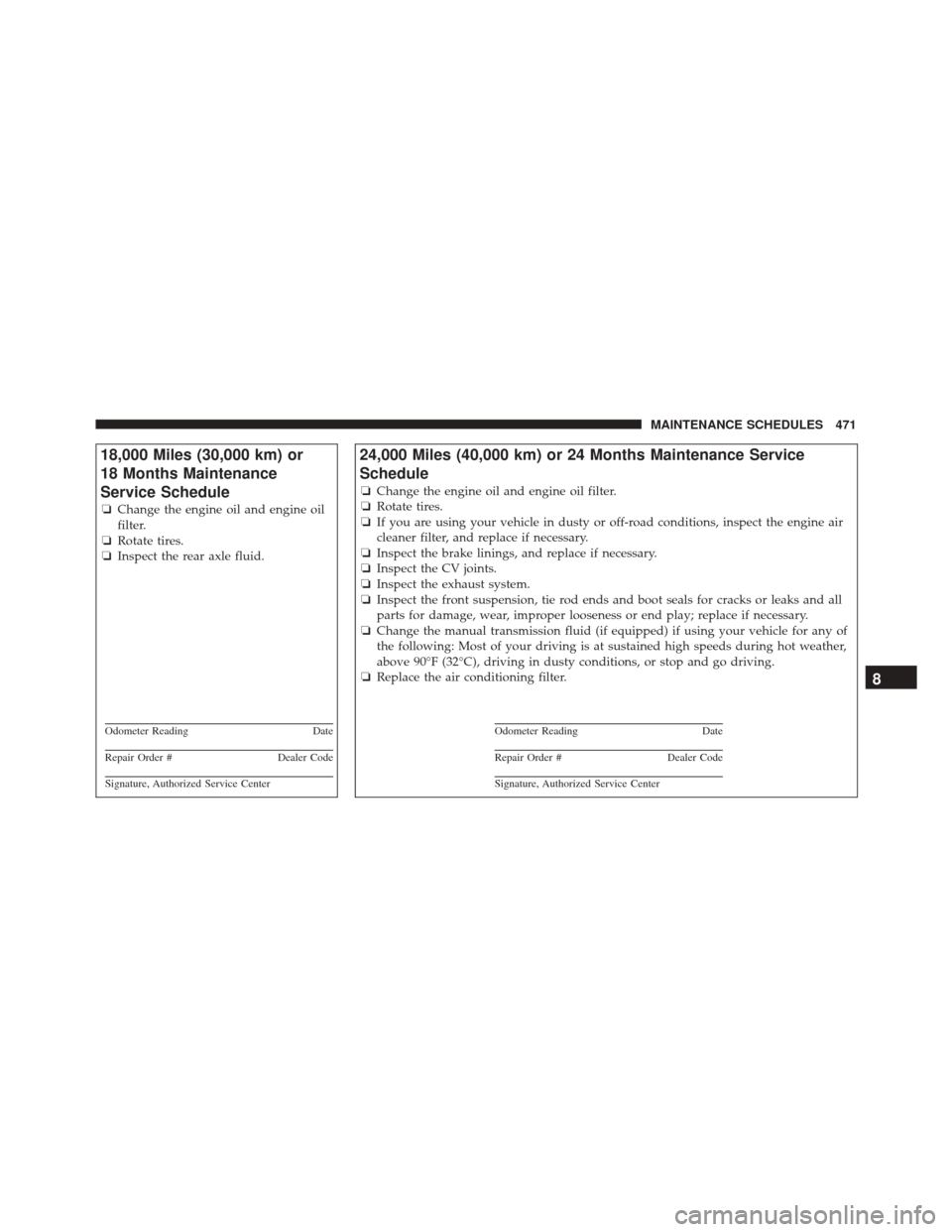
18,000 Miles (30,000 km) or
18 Months Maintenance
Service Schedule
❏Change the engine oil and engine oil
filter.
❏ Rotate tires.
❏ Inspect the rear axle fluid.
Odometer Reading Date
Repair Order #Dealer Code
Signature, Authorized Service Center
24,000 Miles (40,000 km) or 24 Months Maintenance Service
Schedule
❏Change the engine oil and engine oil filter.
❏ Rotate tires.
❏ If you are using your vehicle in dusty or off-road conditions, inspect the engine air
cleaner filter, and replace if necessary.
❏ Inspect the brake linings, and replace if necessary.
❏ Inspect the CV joints.
❏ Inspect the exhaust system.
❏ Inspect the front suspension, tie rod ends and boot seals for cracks or leaks and all
parts for damage, wear, improper looseness or end play; replace if necessary.
❏ Change the manual transmission fluid (if equipped) if using your vehicle for any of
the following: Most of your driving is at sustained high speeds during hot weather,
above 90°F (32°C), driving in dusty conditions, or stop and go driving.
❏ Replace the air conditioning filter.
Odometer Reading Date
Repair Order #Dealer Code
Signature, Authorized Service Center
8
MAINTENANCE SCHEDULES 471
