Page 356 of 543
WARNING!
Overloading of your tires is dangerous. Overloading
can cause tire failure, affect vehicle handling, and
increase your stopping distance. Use tires of the
recommended load capacity for your vehicle. Never
overload them.
TIRES — GENERAL INFORMATION
Tire Pressure
Proper tire inflation pressure is essential to the safe and
satisfactory operation of your vehicle. Three primary
areas are affected by improper tire pressure:
Safety
WARNING!
•Improperly inflated tires are dangerous and can
cause collisions.
• Under-inflation increases tire flexing and can re-
sult in over-heating and tire failure.
• Over-inflation reduces a tire’s ability to cushion
shock. Objects on the road and chuckholes can
cause damage that result in tire failure.
• Over-inflated or under-inflated tires can affect ve-
hicle handling and can fail suddenly, resulting in
loss of vehicle control.
• Unequal tire pressures can cause steering prob-
lems. You could lose control of your vehicle.
(Continued)
354 STARTING AND OPERATING
Page 403 of 543

fluid and filter as specified for “police, taxi, fleet, or
frequent trailer towing.” Refer to the “Maintenance Sched-
ule” for the proper maintenance intervals.
Electronic Speed Control – If Equipped
•Do not use in hilly terrain or with heavy loads.
• When using the speed control, if you experience speed
drops greater than 10 mph (16 km/h), disengage until
you can get back to cruising speed.
• Use speed control in flat terrain and with light loads to
maximize fuel efficiency.
AutoStick®
• When using the AutoStick® shift control, select the
highest gear that allows for adequate performance and
avoids frequent downshifts. For example, choose “4” if
the desired speed can be maintained. Choose “3” or
“2” if needed to maintain the desired speed. •
To prevent excess heat generation, avoid continuous
driving at high RPM. Reduce vehicle speed as neces-
sary to avoid extended driving at high RPM. Return to
a higher gear or vehicle speed when grade and road
conditions allow.
Cooling System
To reduce potential for engine and transmission over-
heating, take the following actions:
City Driving
When stopped for short periods, shift the transmission
into NEUTRAL and increase engine idle speed.
Highway Driving
Reduce speed.
Air Conditioning
Turn off temporarily.
5
STARTING AND OPERATING 401
Page 408 of 543
HAZARD WARNING FLASHERS
The Hazard Warning flasher switch is located in the
switch bank near the bottom center of the instrument
panel.Press the switch to turn on the Hazard Warning
flasher. When the switch is activated, all direc-
tional turn signals will flash on and off to warn oncoming
traffic of an emergency. Press the switch a second time to
turn off the Hazard Warning flashers.
This is an emergency warning system and it should not
be used when the vehicle is in motion. Use it when your
vehicle is disabled and it is creating a safety hazard for
other motorists. When you must leave the vehicle to seek assistance, the
Hazard Warning flashers will continue to operate even
though the ignition is placed in the OFF position.
NOTE:
With extended use the Hazard Warning flashers
may wear down your battery.
IF YOUR ENGINE OVERHEATS
In any of the following situations, you can reduce the
potential for overheating by taking the appropriate ac-
tion.
• On the highways — slow down.
• In city traffic — while stopped, place the transmission
in NEUTRAL, but do not increase engine idle speed.
NOTE: There are steps that you can take to slow down
an impending overheat condition:
406 WHAT TO DO IN EMERGENCIES
Page 434 of 543
FREEING A STUCK VEHICLE
If your vehicle becomes stuck in mud, sand, or snow, it
can often be moved using a rocking motion. Turn the
steering wheel right and left to clear the area around the
front wheels. Then shift back and forth between DRIVE
and REVERSE (with automatic transmission) or 2nd gear
and REVERSE (with manual transmission), while gently
pressing the accelerator. Use the least amount of accel-
erator pedal pressure that will maintain the rocking
motion, without spinning the wheels or racing the en-
gine.
CAUTION!
Racing the engine or spinning the wheels may lead to
transmission overheating and failure. Allow the en-
gine to idle with the transmission in NEUTRAL for at
least one minute after every five rocking-motion
(Continued)
CAUTION!(Continued)
cycles. This will minimize overheating and reduce
the risk of transmission failure during prolonged
efforts to free a stuck vehicle.
NOTE: Press the �ESC Off� switch, to place the Electronic
Stability Control (ESC) system in �Partial Off�mode,
before rocking the vehicle. Refer to “Electronic Brake
Control” in “Starting And Operating” for further infor-
mation. Once the vehicle has been freed, press the �ESC
Off� switch again to restore �ESC On�mode.
CAUTION!
•When “rocking” a stuck vehicle by shifting be-
tween DRIVE/2nd gear and REVERSE, do not spin
the wheels faster than 15 mph (24 km/h), or drive-
train damage may result.
(Continued)
432 WHAT TO DO IN EMERGENCIES
Page 435 of 543
CAUTION!(Continued)
•Revving the engine or spinning the wheels too fast
may lead to transmission overheating and failure.
It can also damage the tires. Do not spin the wheels
above 30 mph (48 km/h) while in gear (no trans-
mission shifting occurring).
WARNING!
Fast spinning tires can be dangerous. Forces gener-
ated by excessive wheel speeds may cause damage, or
even failure, of the axle and tires. A tire could
explode and injure someone. Do not spin your vehi-
cle’s wheels faster than 30 mph (48 km/h) or for
longer than 30 seconds continuously without stop-
ping when you are stuck and do not let anyone near
a spinning wheel, no matter what the speed.
SHIFT LEVER OVERRIDE
If a malfunction occurs and the shift lever cannot be
moved out of the PARK position, you can use the
following procedure to temporarily move the shift lever:
1. Turn the engine OFF.
2. Firmly apply the parking brake.
3. Using a small screwdriver or similar tool, remove the shift lever override access cover (located to the right of
the shift lever).
4. Press and maintain firm pressure on the brake pedal.
5. Insert the screwdriver or similar tool into the access hole, and push and hold the override release lever
down.
6
WHAT TO DO IN EMERGENCIES 433
Page 464 of 543
NOTE:Intentional tampering with emissions control
systems can result in civil penalties being assessed
against you.
In unusual situations involving grossly malfunctioning
engine operation, a scorching odor may suggest severe
and abnormal catalyst overheating. If this occurs, stop
the vehicle, turn off the engine and allow it to cool.
Service, including a tune-up to manufacturer’s specifica-
tions, should be obtained immediately. To minimize the possibility of catalytic converter dam-
age:
•
Do not shut off the engine or interrupt the ignition,
when the transmission is in gear and the vehicle is in
motion.
• Do not try to start the engine by pushing or towing the
vehicle.
• Do not idle the engine with any spark plug wires
disconnected or removed, such as when diagnostic
testing, or for prolonged periods during very rough
idle or malfunctioning operating conditions.
462 MAINTAINING YOUR VEHICLE
Page 526 of 543

Driving to Achieve Maximum Fuel Economy......229
Electrical Power Outlets .....................198
Electric Remote Mirrors .....................110
Electronic Brake Control System ...............332
Electronic Power Distribution Center (Fuses) ......483
Electronic Speed Control (Cruise Control) ........173
Electronic Stability Control (ESC) ..............337
Electronic Throttle Control Warning Light ........213
Electronic Vehicle Information Center (EVIC) ......224
Emergency Deck Lid Release ..................45
Emergency, In Case of Freeing Vehicle When Stuck ................432
Hazard Warning Flasher ..................406
Jacking .............................. .418
Jump Starting ......................... .427
Overheating .......................... .406
Towing ............................. .435
Emergency Trunk Release ....................45 Emission Control System Maintenance
..........445
Engine ................................ .443
Air Cleaner .......................... .453
Block Heater ......................... .303
Break-In Recommendations .................96
Checking Oil Level ..................... .448
Compartment ......................... .442
Compartment Identification ................442
Coolant (Antifreeze) .....................463
Cooling ............................. .463
Exhaust Gas Caution .....................97
Fails to Start .......................... .301
Flooded, Starting ...................... .301
Fuel Requirements ..................... .378
Jump Starting ......................... .427
Oil................................. .448
Oil Filler Cap ......................... .451
Oil Selection .......................... .450
Oil Synthetic ......................... .452
524 INDEX
Page 527 of 543
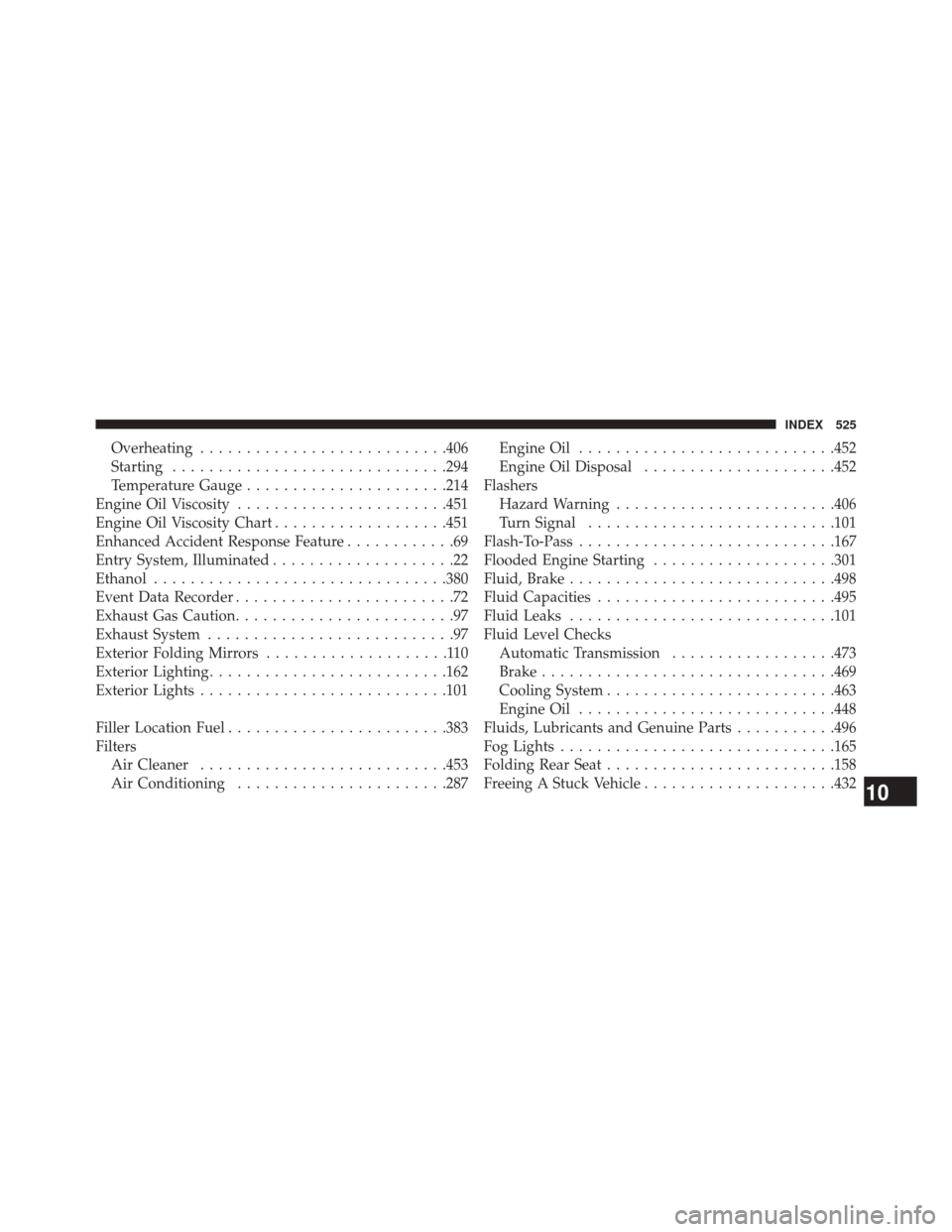
Overheating.......................... .406
Starting ............................. .294
Temperature Gauge ..................... .214
Engine Oil Viscosity ...................... .451
Engine Oil Viscosity Chart ...................451
Enhanced Accident Response Feature ............69
Entry System, Illuminated ....................22
Ethanol ............................... .380
Event Data Recorder ........................72
Exhaust Gas Caution ........................97
Exhaust System ...........................97
Exterior Folding Mirrors ....................110
Exterior Lighting ......................... .162
Exterior Lights .......................... .101
Filler Location Fuel ....................... .383
Filters Air Cleaner .......................... .453
Air Conditioning ...................... .287Engine Oil
........................... .452
Engine Oil Disposal .....................452
Flashers Hazard Warning ....................... .406
Turn Signal .......................... .101
Flash-To-Pass ........................... .167
Flooded Engine Starting ....................301
Fluid, Brake ............................ .498
Fluid Capacities ......................... .495
Fluid Leaks ............................ .101
Fluid Level Checks Automatic Transmission ..................473
Brake ............................... .469
Cooling System ........................ .463
Engine Oil ........................... .448
Fluids, Lubricants and Genuine Parts ...........496
Fog Lights ............................. .165
Folding Rear Seat ........................ .158
Freeing A Stuck Vehicle .....................432
10
INDEX 525
