Page 46 of 519
Here are some simple steps you can take to minimize the
risk of harm from a deploying air bag:
1. Children 12 years old and under should always ridebuckled up in a rear seat.
WARNING!
•Never place a rear facing infant seat in front of an
air bag. A deploying passenger Advanced Front
Air Bag can cause death or serious injury to a child
12 years or younger, including a child in a rearward
facing infant seat.
• Only use a rearward-facing child restraint in a rear
seat.
Children that are not big enough to wear the vehicle seat
belt properly (see section on Child Restraints) should be
secured in the rear seat in child restraints or belt posi-
tioning booster seats. Older children who do not use child restraints or belt-positioning booster seats should
ride properly buckled up in the rear seat. Never allow
children to slide the shoulder belt behind them or under
their arm. If a child from 2 to 12 years old (not in a rear
facing child seat) must ride in the front passenger seat,
move the seat as far back as possible and use the proper
child restraint. (Refer to “Child Restraints”)
You should read the instructions provided with your
child restraint to make sure that you are using it properly.
2. All occupants should always wear their lap and
shoulder belts properly.
3. The driver and front passenger seats should be moved back as far as practical to allow the Advanced Front
Air Bags room to inflate.
44 THINGS TO KNOW BEFORE STARTING YOUR VEHICLE
Page 47 of 519
4. Do not lean against the door or window. If yourvehicle has side air bags, and deployment occurs, the
side air bags will inflate forcefully into the space
between you and the door.
5. If the air bag system in this vehicle needs to be modified to accommodate a disabled person, contact
the Customer Center. Phone numbers are provided
under “If You Need Assistance”.
WARNING!
•Relying on the air bags alone could lead to more
severe injuries in a collision. The air bags work
with your seat belt to restrain you properly. In
some collisions, the air bags won’t deploy at all.
Always wear your seat belts even though you have
air bags.
(Continued)
WARNING! (Continued)
•Being too close to the steering wheel or instrument
panel during Advanced Front Air Bag deployment
could cause serious injury, including death. Air
Bags need room to inflate. Sit back, comfortably
extending your arms to reach the steering wheel or
instrument panel.
• Supplemental Side Air Bag Inflatable Curtain
(SABIC) — if equipped and Seat-Mounted Side Air
Bags (SAB) also need room to inflate. Do not lean
against the door or window. Sit upright in the
center of the seat.
(Continued)
2
THINGS TO KNOW BEFORE STARTING YOUR VEHICLE 45
Page 48 of 519
WARNING!(Continued)
•In a collision, you and your passengers can suffer
much greater injuries if you are not properly buck-
led up. You can strike the interior of your vehicle or
other passengers, or you can be thrown out of the
vehicle. Always be sure you and others in your
vehicle are buckled up properly.
• Being too close to the Supplemental Side Air Bag
Inflatable Curtain (SABIC) — if equipped and/or
Seat-Mounted Side Air Bag (SAB) during deploy-
ment could cause you to be severely injured or
killed.
Buckle up even though you are an excellent driver, even
on short trips. Someone on the road may be a poor driver
and cause a collision that includes you. This can happen
far away from home or on your own street. Research has shown that seat belts save lives, and they
can reduce the seriousness of injuries in a collision. Some
of the worst injuries happen when people are thrown
from the vehicle. Seat belts reduce the possibility of
ejection and the risk of injury caused by striking the
inside of the vehicle. Everyone in a motor vehicle should
be belted at all times.
Lap/Shoulder Belts
All seating positions in your vehicle are equipped with
lap/shoulder belts.
The belt webbing retractor will lock only during very
sudden stops or collisions. This feature allows the shoul-
der part of the belt to move freely with you under normal
conditions. However, in a collision the belt will lock and
reduce your risk of striking the inside of the vehicle or
being thrown out.
46 THINGS TO KNOW BEFORE STARTING YOUR VEHICLE
Page 49 of 519
WARNING!
•Be sure everyone in your vehicle is in a seat and
using a seat belt properly.
• It is dangerous to ride in a cargo area, inside or
outside of a vehicle. In a collision, people riding in
these areas are more likely to be seriously injured
or killed.
• Wearing a seat belt incorrectly is dangerous. Seat
belts are designed to go around the large bones of
your body. These are the strongest parts of your
body and can take the forces of a collision the best.
• Wearing your belt in the wrong place could make
your injuries in a collision much worse. You might
suffer internal injuries, or you could even slide out
of part of the belt. Follow these instructions to wear
your seat belt safely and to keep your passengers
safe, too.
(Continued)
WARNING! (Continued)
•Two people should never be belted into a single
seat belt. People belted together can crash into one
another in a collision, hurting one another badly.
Never use a lap/shoulder belt or a lap belt for more
than one person, no matter what their size.
Lap/Shoulder Belt Operating Instructions
1. Enter the vehicle and close the door. Sit back and adjust the seat.
2. The seat belt latch plate is above the back of the front seat, next to your arm. Grasp the latch plate and pull
out the belt. Slide the latch plate up the webbing as far
as necessary to allow the belt to go around your lap.
2
THINGS TO KNOW BEFORE STARTING YOUR VEHICLE 47
Page 50 of 519
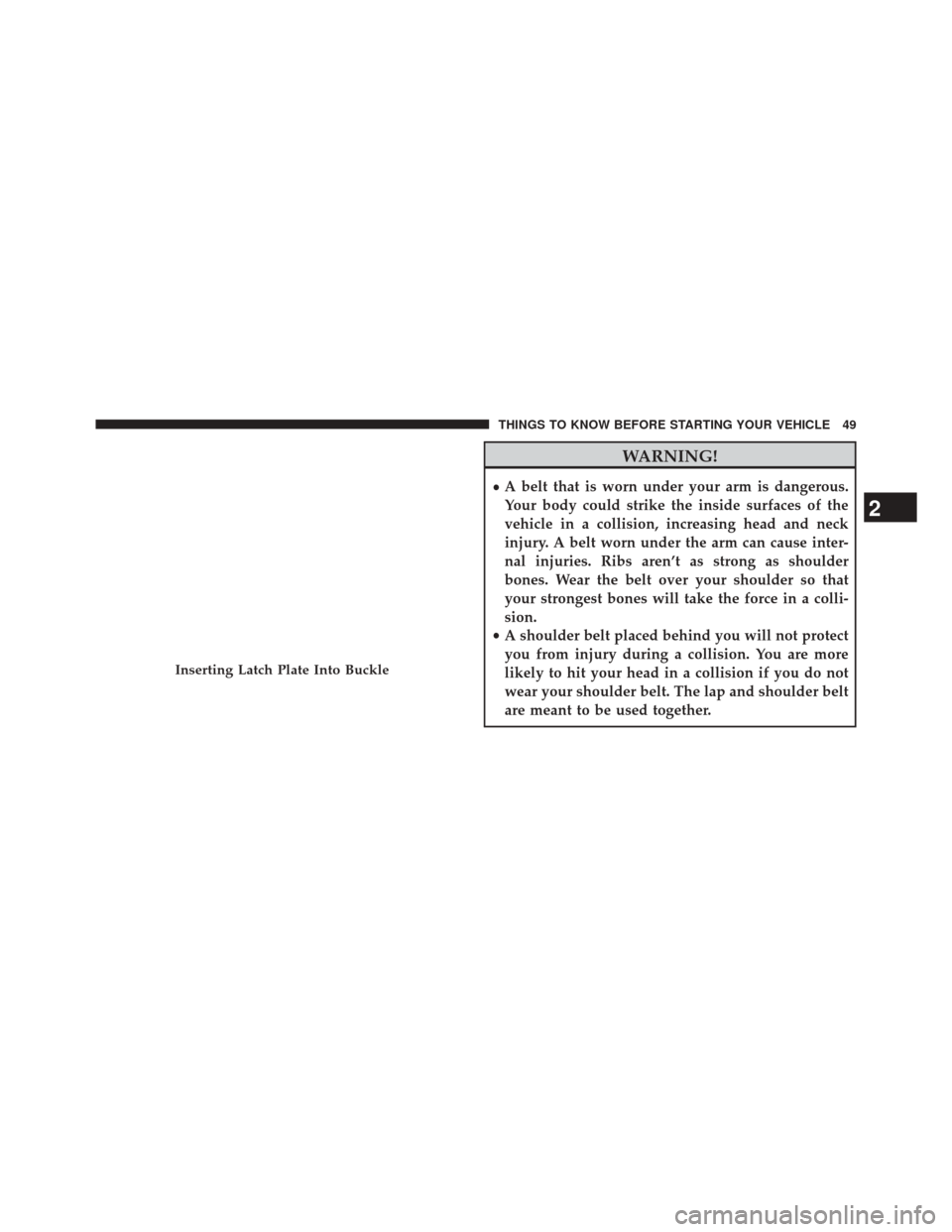
3. When the belt is long enough to fit, insert the latchplate into the buckle until you hear a “click.”
WARNING!
•A belt that is buckled into the wrong buckle will
not protect you properly. The lap portion could ride
too high on your body, possibly causing internal
injuries. Always buckle your belt into the buckle
nearest you.
• A belt that is too loose will not protect you prop-
erly. In a sudden stop, you could move too far
forward, increasing the possibility of injury. Wear
your seat belt snugly.
Pulling Out The Latch Plate
48 THINGS TO KNOW BEFORE STARTING YOUR VEHICLE
Page 51 of 519
WARNING!
•A belt that is worn under your arm is dangerous.
Your body could strike the inside surfaces of the
vehicle in a collision, increasing head and neck
injury. A belt worn under the arm can cause inter-
nal injuries. Ribs aren’t as strong as shoulder
bones. Wear the belt over your shoulder so that
your strongest bones will take the force in a colli-
sion.
• A shoulder belt placed behind you will not protect
you from injury during a collision. You are more
likely to hit your head in a collision if you do not
wear your shoulder belt. The lap and shoulder belt
are meant to be used together.
Inserting Latch Plate Into Buckle
2
THINGS TO KNOW BEFORE STARTING YOUR VEHICLE 49
Page 52 of 519
4. Position the lap belt across your thighs, below yourabdomen. To remove slack in the lap belt portion, pull
up on the shoulder belt. To loosen the lap belt if it is
too tight, tilt the latch plate and pull on the lap belt. A
snug belt reduces the risk of sliding under the belt in
a collision.WARNING!
•A lap belt worn too high can increase the risk of
injury in a collision. The belt forces won’t be at the
strong hip and pelvic bones, but across your abdo-
men. Always wear the lap part of your seat belt as
low as possible and keep it snug.
• A twisted belt may not protect you properly. In a
collision, it could even cut into you. Be sure the belt
is straight. If you can’t straighten a belt in your
vehicle, take it to your authorized dealer immedi-
ately and have it fixed.
5. Position the shoulder belt on your chest so that it is comfortable and not resting on your neck. The retrac-
tor will withdraw any slack in the belt.
Positioning The Lap Belt
50 THINGS TO KNOW BEFORE STARTING YOUR VEHICLE
Page 53 of 519
6. To release the belt, push the red button on the buckle.The belt will automatically retract to its stowed posi-
tion. If necessary, slide the latch plate down the
webbing to allow the belt to retract fully.
WARNING!
A frayed or torn belt could rip apart in a collision and
leave you with no protection. Inspect the belt system
periodically, checking for cuts, frays, or loose parts.
Damaged parts must be replaced immediately.
Do not disassemble or modify the system. Seat belt
assemblies must be replaced after a collision if they
have been damaged (bent retractor, torn webbing,
etc.).
Lap/Shoulder Belt Untwisting Procedure
Use the following procedure to untwist a twisted lap/
shoulder belt.
1. Position the latch plate as close as possible to theanchor point.
2. At about 6 to 12 in (15 to 30 cm) above the latch plate, grasp and twist the belt webbing 180° to create a fold
that begins immediately above the latch plate.
3. Slide the latch plate upward over the folded webbing. The folded webbing must enter the slot at the top of
the latch plate.
4. Continue to slide the latch plate up until it clears the folded webbing.
2
THINGS TO KNOW BEFORE STARTING YOUR VEHICLE 51