Page 416 of 519
3. Remove the protective cover over the remote positive(+) battery post. To remove the cover, press the locking
tab and pull upward on the cover. 4. If using another vehicle to jump-start the battery, park
the vehicle within the jumper cables reach, set the
parking brake and make sure the ignition is OFF.
WARNING!
Do not allow vehicles to touch each other as this
could establish a ground connection and personal
injury could result.
Jump-Starting Procedure
WARNING!
Failure to follow this procedure could result in per-
sonal injury or property damage due to battery ex-
plosion.
Locking Tab
414 WHAT TO DO IN EMERGENCIES
Page 423 of 519
Without The Ignition Key
Special care must be taken when the vehicle is towed
with the ignition in the LOCK/OFF position. Flatbed
towing is the preferred towing method. However, if a
flatbed towing vehicle is not available, wheel lift towing
equipment may be used. Rear towing (with the front
wheels on the ground) is not allowed, as transmission
damage will occur. If rear towing is the only alternative,
the front wheels must be placed on a towing dolly. Proper
towing equipment is necessary to prevent damage to the
vehicle.
CAUTION!
Towing this vehicle in violation of the above require-
ments can cause severe engine and/or transmission
damage. Damage from improper towing is not cov-
ered under the New Vehicle Limited Warranty.
6
WHAT TO DO IN EMERGENCIES 421
Page 442 of 519

7. Install the A/C Air Filter with the arrow on the filterpointing toward the floor. When installing the filter
cover, make sure the retaining tabs fully engage the
cover.
CAUTION!
The A/C air filter is identified with an arrow to
indicate airflow direction through the filter. Failure
to install the filter properly will result in the need to
replace it more often.
8. Reinstall the glove box door dampener and glove box.
Body Lubrication
Locks and all body pivot points, including such items as
seat tracks, door hinge pivot points and rollers, liftgate,
tailgate, sliding doors and hood hinges, should be lubri-
cated periodically with a lithium based grease, such as MOPAR® Spray White Lube to assure quiet, easy opera-
tion and to protect against rust and wear. Prior to the
application of any lubricant, the parts concerned should
be wiped clean to remove dust and grit; after lubricating
excess oil and grease should be removed. Particular
attention should also be given to hood latching compo-
nents to ensure proper function. When performing other
underhood services, the hood latch, release mechanism
and safety catch should be cleaned and lubricated.
The external lock cylinders should be lubricated twice a
year, preferably in the Fall and Spring. Apply a small
amount of a high quality lubricant, such as MOPAR®
Lock Cylinder Lubricant directly into the lock cylinder.Windshield Wiper Blades
Clean the rubber edges of the wiper blades and the
windshield periodically with a sponge or soft cloth and a
mild nonabrasive cleaner. This will remove accumula-
tions of salt or road film.
440 MAINTAINING YOUR VEHICLE
Page 446 of 519
To minimize the possibility of catalytic converter dam-
age:
•Do not shut off the engine or interrupt the ignition,
when the transmission is in gear and the vehicle is in
motion.
• Do not try to start the engine by pushing or towing the
vehicle.
• Do not idle the engine with any spark plug wires
disconnected or removed, such as when diagnostic
testing, or for prolonged periods during very rough
idle or malfunctioning operating conditions.Cooling System
WARNING!
• When working near the radiator cooling fan, dis-
connect the fan motor lead or turn the ignition
switch to the LOCK position. The fan is tempera-
ture controlled and can start at anytime the ignition
switch is in the ON position.
• You or others can be badly burned by hot engine
coolant (antifreeze) or steam from your radiator. If
you see or hear steam coming from under the hood,
do not open the hood until the radiator has had
time to cool. Never try to open a cooling system
pressure cap when the radiator is hot.
444 MAINTAINING YOUR VEHICLE
Page 466 of 519
CavityCar-
tridge Fuse Mini
Fuse Description
7 — 30 Amp GreenIgnition Off Draw
(IOD) Sense 1
8 — 30 Amp GreenIgnition Off Draw
(IOD) Sense 2
9 40 Amp Green Battery Feed –
Power Seats –
If Equipped
10 — 20 Amp YellowInstrument Panel/
Power Locks/
Interior Lights
11 — 15 Amp Lt BlueSelectable Power
Outlet (Inside
Center Arm Rest)Cavity Car-
tridge Fuse Mini
Fuse Description
12 — 20 Amp Yellow—
13 — 20 Amp YellowIgnition/Cigar
Lighter
14 — 10 Amp RedInstrument Panel
15 40 Amp Green — Radiator Fan Relay
16 — 15 Amp Lt. BlueSunroof –
If Equipped
17 — 10 Amp Red
Wireless Control
Module (WCM)/
Clock/Steering Con-
trol Module (SCM)
464 MAINTAINING YOUR VEHICLE
Page 468 of 519
CavityCar-
tridge Fuse Mini
Fuse Description
28 — 10 Amp RedIgnition Run —
Occupant
Classification
Module (OCM)/
Occupant Restraint
Controller (ORC)
29 — — Hot Car (No Fuse Required)
30 — 20 Amp YellowIgnition Run –
Heated Seats –
If Equipped
31 — — SpareCavity Car-
tridge Fuse Mini
Fuse Description
32 30 Amp Pink — Auto Shutdown
(ASD) Relay 1
33 — 10 Amp RedSwitch Bank/
Diagnostic Link
Connector/
Powertrain Control
Module (PCM)
34 30 Amp Pink — Anti-Lock Brakes
(ABS) Module – If
Equipped/Electronic
Stability Control
(ESC) Module –
If Equipped
466 MAINTAINING YOUR VEHICLE
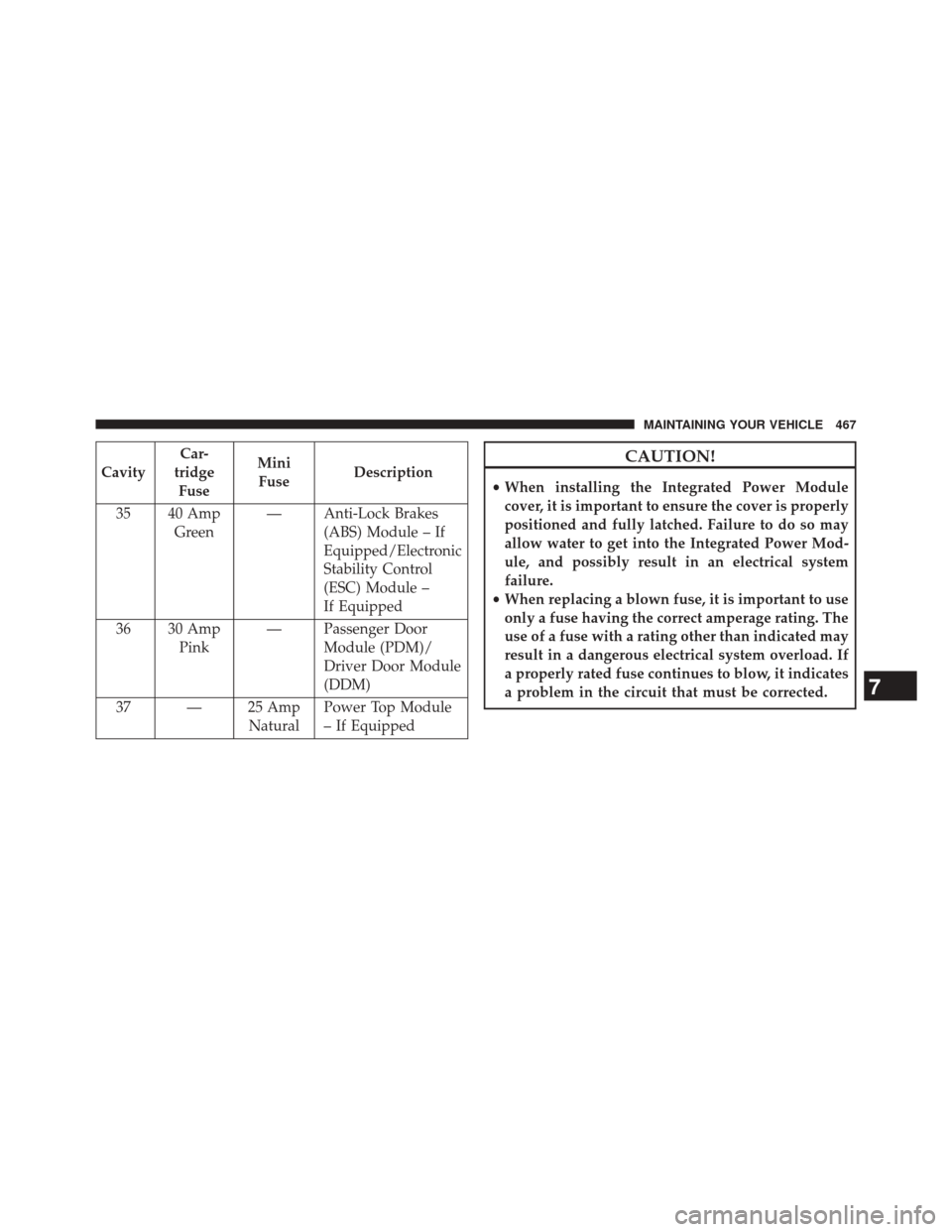
Page 469 of 519
CavityCar-
tridge Fuse Mini
Fuse Description
35 40 Amp Green — Anti-Lock Brakes
(ABS) Module – If
Equipped/Electronic
Stability Control
(ESC) Module –
If Equipped
36 30 Amp Pink — Passenger Door
Module (PDM)/
Driver Door Module
(DDM)
37 — 25 Amp NaturalPower Top Module
– If EquippedCAUTION!
•
When installing the Integrated Power Module
cover, it is important to ensure the cover is properly
positioned and fully latched. Failure to do so may
allow water to get into the Integrated Power Mod-
ule, and possibly result in an electrical system
failure.
• When replacing a blown fuse, it is important to use
only a fuse having the correct amperage rating. The
use of a fuse with a rating other than indicated may
result in a dangerous electrical system overload. If
a properly rated fuse continues to blow, it indicates
a problem in the circuit that must be corrected.
7
MAINTAINING YOUR VEHICLE 467
Page 473 of 519
CAUTION!
Do not touch the new bulb with your fingers. Oil
contamination will severely shorten bulb life.
4. Pull the bulb out of the socket and replace the bulb. 5. If the bulb comes in contact with any oily surface,
clean the bulb with rubbing alcohol.
6. Reinsert the bulb and socket assembly and rotate clockwise ¼ turn to secure.
7
MAINTAINING YOUR VEHICLE 471