2013 DACIA SANDERO immobiliser
[x] Cancel search: immobiliserPage 5 of 146
1.1
ENG_UD8701_2Sommaire 1 (B90 - Dacia)ENG_NU_817-2_NU_Dacia_1
Section 1: Getting to know your vehicle
Keys/Radio frequency remote control . . . . . . . . . . . . . . . . . . . . . . . . . . . . . . . . . . . . \
. . . . . . . . . . . . 1.2
Doors . . . . . . . . . . . . . . . . . . . . . . . . . . . . . . . . . . . . \
. . . . . . . . . . . . . . . . . . . . . . . . . . . . . . . . . . . . \
. 1.4
RAID (Anti-Intruder Device) . . . . . . . . . . . . . . . . . . . . . . . . . . . . . . . . . . . . \
. . . . . . . . . . . . . . . . . . . . 1.6
Engine immobiliser . . . . . . . . . . . . . . . . . . . . . . . . . . . . . . . . . . . .\
. . . . . . . . . . . . . . . . . . . . . . . . . . 1.7
Headrests - Seats . . . . . . . . . . . . . . . . . . . . . . . . . . . . . . . . . . . .\
. . . . . . . . . . . . . . . . . . . . . . . . . . . 1.8
Seat belts. . . . . . . . . . . . . . . . . . . . . . . . . . . . . . . . . . . . \
. . . . . . . . . . . . . . . . . . . . . . . . . . . . . . . . . . 1.11
Methods of restraint in addition to the front seat belts . . . . . . . . . . . . . . . . . . . . . . . . . . . . . . . . . . . . 1.15
Side protection devices . . . . . . . . . . . . . . . . . . . . . . . . . . . . . . . . . . . . \
. . . . . . . . . . . . . . . . . . . . . . . 1.19
Child safety: General information . . . . . . . . . . . . . . . . . . . . . . . . . . . . . . . . . . . .\
. . . . . . . . . . . . . . . 1.21
Choosing a child seat mounting . . . . . . . . . . . . . . . . . . . . . . . . . . . . . . . . . . . . \
. . . . . . . . . . . 1.23
fitting a child seat . . . . . . . . . . . . . . . . . . . . . . . . . . . . . . . . . . . . \
. . . . . . . . . . . . . . . . . . . . . . 1.25
Deactivating/activating the front passenger air bag . . . . . . . . . . . . . . . . . . . . . . . . . . . . . . . . 1.30
Rear view mirrors . . . . . . . . . . . . . . . . . . . . . . . . . . . . . . . . . . . .\
. . . . . . . . . . . . . . . . . . . . . . . . . . . 1.32
Steering wheel . . . . . . . . . . . . . . . . . . . . . . . . . . . . . . . . . . . . \
. . . . . . . . . . . . . . . . . . . . . . . . . . . . . . 1.33
Driving position . . . . . . . . . . . . . . . . . . . . . . . . . . . . . . . . . . . .\
. . . . . . . . . . . . . . . . . . . . . . . . . . . . . 1.34
Control instruments . . . . . . . . . . . . . . . . . . . . . . . . . . . . . . . . . . . . \
. . . . . . . . . . . . . . . . . . . . . . . . . . 1.36
Trip computer and warning system . . . . . . . . . . . . . . . . . . . . . . . . . . . . . . . . . . . . \
. . . . . . . . . . . . . . 1.41
Clock . . . . . . . . . . . . . . . . . . . . . . . . . . . . . . . . . . . .\
. . . . . . . . . . . . . . . . . . . . . . . . . . . . . . . . . . . .\
. 1.45
Exterior lighting and signals. . . . . . . . . . . . . . . . . . . . . . . . . . . . . . . . . . . . \
. . . . . . . . . . . . . . . . . . . . 1.46
Headlight beam adjustment . . . . . . . . . . . . . . . . . . . . . . . . . . . . . . . . . . . . \
. . . . . . . . . . . . . . . . . . . . 1.48
Audible and visual signals . . . . . . . . . . . . . . . . . . . . . . . . . . . . . . . . . . . . \
. . . . . . . . . . . . . . . . . . . . . 1.49
Windscreen wiper/Washer/De-icing . . . . . . . . . . . . . . . . . . . . . . . . . . . . . . . . . . . .\
. . . . . . . . . . . . . 1.50
Fuel tank (filling with fuel) . . . . . . . . . . . . . . . . . . . . . . . . . . . . . . . . . . . .\
. . . . . . . . . . . . . . . . . . . . . 1.52
Page 11 of 146

engine immobiliser................................(up to the end of the DU)engine immobiliser................................(up to the end of the DU)
1.7
ENG_UD5545_1Système antidémarrage (B90 - Dacia)ENG_NU_817-2_NU_Dacia_1
Système antidémarrage
ENGINE IMMOBILISER
This prevents the vehicle being driven by anyone not in possession of the vehicle’s coded ignition key.
Operating principle
The vehicle is automatically protected a few seconds after the ignition is switched off.
If the vehicle does not recognise the
coded ignition key, tell-tale light 1 will flash continuously and the engine cannot be started.
Any unauthorised work carried out on the engine immobiliser (computers, wiring, etc.) could be dan- gerous. Work must be carried out by qualified personnel.
Indicator light
System operating tell-tale light
When the ignition is switched on, tell-
tale 1 lights up continuously for approx- imately three seconds and then goes out. The vehicle has recognised the code. You can then start the engine. v
ehicle protection tell-tale light
A few seconds after the ignition has
been switched off, tell-tale light 1 will flash constantly.
The vehicle will only be protected after the ignition has been switched off.
Operating fault warning light
After the ignition has been switched
on, if warning light 1 continues to flash or remains continuously lit, there is a system operating fault.
In all cases, it is essential to contact an approved dealer as only they are qual- ified to repair the engine immobiliser.
If the coded ignition key is faulty, use the second key (supplied with the vehicle).
1
Page 41 of 146

JauneNoirNoir texte
1.37
ENG_UD5559_1tableau de bord : Témoins lumineux (B90 - Dacia)ENG_NU_817-2_NU_Dacia_1
INSTRUMENT PANEL: warning lights (continued)
êEngine immobiliser system warning light
This light performs several functions.
Refer to the information on the “Engine immobiliser” in Section 1.
6
Electronic fault or preheat- ing warning light
Preheating warning light
This light should come on when the ig- nition key is in position M; it indicates that the heater plugs are in operation.
It goes out when preheating is complete and the engine can be started.
Electronic fault warning light
If it remains lit or comes on when you are driving, it indicates an electrical or electronic fault. Contact an approved Dealer as soon as possible.
ÚBattery charge warning light
It should go out as soon as the engine starts.
If it comes on when you are driving, it indicates that the circuit is overcharging or has discharged. Stop and contact an approved Dealer.
ÄToxic Fume Filter System
w arning Light
On equipped vehicles, the light comes on when the ignition is switched on then goes out.
– If it lights up continuously, consult
your approved Dealer as soon as possible.
– If it flashes, reduce the engine
speed until the light stops flashing. Contact an approved Dealer as soon as possible.
Refer to the information “Advice on antipollution, fuel economy and driving” in Section 2.
The presence and operation of the warning lights DEPEND ON THE EQUIPMENT\
AND COUNTRY.
ÔCoolant temperature warn- ing light
This goes out as soon as the engine starts. If it comes on when driving, it in- dicates an increase in coolant tempera- ture. Stop and let the engine idle for a minute or two; the temperature should fall. Otherwise, stop the engine, let it cool and check the coolant level.
If the level is normal, the indicator light is being lit by something else. Contact an approved Dealer.
ÀOil pressure warning light
It goes out as soon as the engine starts; if it lights up when you are driving, it is essential to stop and switch off the ignition. Check the oil level.
If the level is normal, the indicator light is being lit by something else. Contact an approved Dealer.
Page 60 of 146
running in ...............................................................(current page)ignition switch ........................................................(current page)engine immobiliser (switch) ...................................(current page)driving ....................................................................(current page)starting ...................................................................(current page)
2.2
ENG_UD5481_1Rodage / Contacteur de démarrage (U90 - Dacia)ENG_NU_817-2_NU_Dacia_2
Rodage - Contacteur de démarrage
RUNNING IN
Petrol version
For the first 600 miles (1,000 km), do not exceed 78 mph (130 km/h) in the highest gear, or 3,000 to 3,500 rpm.
After 600 miles (1,000 km), you may use your vehicle normally. However, it is only after 1,800 miles (3,000 km) have been covered that you may rea- sonably expect full performance.
Service intervals: refer to the Mainte- nance Service Booklet for your vehicle.
Diesel version
For the first 900 miles (1,500 km), do not exceed 2,500 rpm. After complet- ing this mileage you may drive faster, although you may only expect top p e r f o r m a n c e a f t e r a p p r o x i m a t e l y 3,600 miles (6,000 km).
During the running in period, do not ac- celerate hard while the engine is still cold and do not let the engine over-rev.
Service intervals: refer to the Mainte- nance Service Booklet for your vehicle.
IGNITION SWITCH
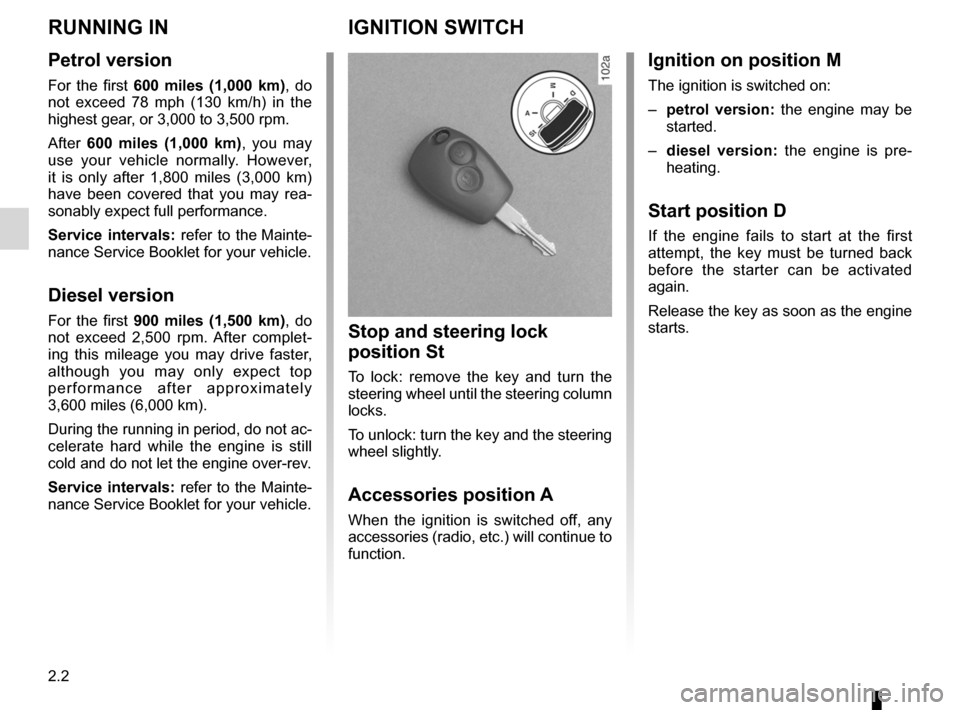
Stop and steering lock
position St
To lock: remove the key and turn the steering wheel until the steering column locks.
To unlock: turn the key and the steering wheel slightly.
Accessories position A
When the ignition is switched off, any accessories (radio, etc.) will continue to function.
Ignition on position M
The ignition is switched on:
–
petrol version: the engine may be started.
–
diesel version: the engine is pre- heating.
Start position D
If the engine fails to start at the first attempt, the key must be turned back before the starter can be activated again.
Release the key as soon as the engine starts.
Page 61 of 146

driving ...................................................(up to the end of the DU)starting ..................................................(up to the end of the DU)starting the engine ................................(up to the end of the DU)
2.3
ENG_UD5482_1Mise en route / Arrêt du moteur (U90 - Dacia)ENG_NU_817-2_NU_Dacia_2
Stopping the engine
With the engine idling, turn the key back to “Stop” position St.
ÉDiesel injection
Turn the ignition key to ignition “On” po- sition M, and hold this position until the preheating warning light goes out.
Turn the key to starter position D with- out depressing the accelerator pedal.
Release the key as soon as the engine starts.
Starting the engine
Special feature on vehicles equipped with an engine immobiliser system
In very cold conditions (temperatures below –20°C): so that it is easier to start the engine, switch on the ignition for several seconds before starting the engine.
Make sure the engine immobiliser is not activated. Refer to the information on the “Engine immobiliser” in Section 1.
Petrol injection
Engine warm or cold
– Turn the key to the start position
without depressing the accelera- tor.
– Release the key as soon as the
engine starts.
Mise en route / Arrêt du moteur
STARTING/STOPPING THE ENGINE
Never leave your vehicle with the keys inside when leaving a child (or \
animal) in the car, even for a short period.
The reason for this is that the child may endanger himself or others by starting the engine, activating equipment such
as the window winders for example, or locking the doors.
Risk of serious injury.
Never switch off the ignition before the vehicle has stopped completely. Once the engine has stopped, the brake servo, power assisted steering and passive safety equipment such as air bags wi\
ll no longer operate.
The steering is locked when the key is removed.
Page 124 of 146
ENG_NU_817-2_NU_Dacia_5
FUSES (continued)
Allocation of fuses(the presence of certain fuses DEPENDS ON THE VEHICLE EQUIPMENT LEVEL)\
SymbolAllocation
qEngine i")
5.24
ENG_UD5610_1Fusibles (B90 - Dacia)ENG_NU_817-2_NU_Dacia_5
FUSES (continued)
Allocation of fuses(the presence of certain fuses DEPENDS ON THE VEHICLE EQUIPMENT LEVEL)\
SymbolAllocation
qEngine immobiliser
ËReversing light
uPower-assisted steering
iAutomatic transmission
Compressed Natural Gas
Some functions are protected by fuses located in the engine compartment.
However, because of their reduced ac- cessibility, you are advised to have these fuses replaced by an approved dealer.
Page 143 of 146

7.1
FRA_UD8707_2Index (B90 - Dacia)ENG_NU_817-2_NU_Dacia_7
children .............................................................. 1.4 – 1.5, 1.14cigar lighter ........................................................................\
3.12clock ........................................................................\
..........1.45control instruments ................................................1.36 → 1.47controls ................................................................... 1.34 – 1.35courtesy light .......................................................................3.9
Ddashboard............................................................... 1.34 – 1.35demistingwindscreen .....................................................................3.6dimensions ........................................................................\
..6.5dipstick.......................................................................4.3 → 4.5doors........................................................................\
... 1.4 – 1.5driver’s position ...................................................... 1.34 – 1.35driving .................................................... 2.2 → 2.9, 2.11 – 2.12
Eelectric door locking .............................................................1.5electric windows ..................................................... 3.10 – 3.11emergency spare wheel ..................................... 5.2, 5.7 → 5.9enginetechnical specifications ..................................................6.4engine coolant .....................................................................4.7engine immobiliser...............................................................1.7engine immobiliser (switch) .................................................2.2
engine oil ...................................................................4.3 → 4.5engine oil grade .......................................................... 4.4 – 4.5engine specifications ...........................................................6.4environment ........................................................................\
.2.9
Ffaultsoperating faults ................................................5.30 → 5.33filterair filter ........................................................................\
...4.8
AABS ........................................................................\
...........2.12accessories........................................................................\
5.29accessories - installation ...................................................5.29adjusting your driving position ......................... 1.9, 1.11 – 1.12advice on antipollution ...........................................5.22 → 5.24air bag....................................................................1.15 → 1.20activating the front passenger air bags ........................1.31deactivating the front passenger air bags ....................1.30air conditioning ..........................................................3.4 → 3.8air vents ...................................................................... 3.2 – 3.3anti-lock braking system: ABS ...........................................2.12antipollutionadvice ..................................................................2.6 → 2.8ashtrays ........................................................................\
.....3.12
Bbattery........................................................................\
..........4.9troubleshooting ................................................. 5.20 – 5.21battery (remote control) .....................................................5.19bodywork (maintenance) ........................................ 4.10 – 4.11bonnet........................................................................\
..........4.2brake fluid ........................................................................\
....4.6bulbschanging ..........................................................5.11 → 5.18
Ccapacity of mechanical components.............................4.3, 4.9catalytic converter................................................................2.4central door locking .............................................................1.5changing a bulb .....................................................5.11 → 5.18changing a wheel.................................................................5.6child booster seat ................................................... 1.21 – 1.22child restraint/seat .................................................1.21 → 1.29child safety...................................................... 1.4, 1.21 → 1.29child seats..............................................................1.21 → 1.29
AlphABEtiCAl inDEx