2013 DACIA SANDERO lock
[x] Cancel search: lockPage 61 of 146

driving ...................................................(up to the end of the DU)starting ..................................................(up to the end of the DU)starting the engine ................................(up to the end of the DU)
2.3
ENG_UD5482_1Mise en route / Arrêt du moteur (U90 - Dacia)ENG_NU_817-2_NU_Dacia_2
Stopping the engine
With the engine idling, turn the key back to “Stop” position St.
ÉDiesel injection
Turn the ignition key to ignition “On” po- sition M, and hold this position until the preheating warning light goes out.
Turn the key to starter position D with- out depressing the accelerator pedal.
Release the key as soon as the engine starts.
Starting the engine
Special feature on vehicles equipped with an engine immobiliser system
In very cold conditions (temperatures below –20°C): so that it is easier to start the engine, switch on the ignition for several seconds before starting the engine.
Make sure the engine immobiliser is not activated. Refer to the information on the “Engine immobiliser” in Section 1.
Petrol injection
Engine warm or cold
– Turn the key to the start position
without depressing the accelera- tor.
– Release the key as soon as the
engine starts.
Mise en route / Arrêt du moteur
STARTING/STOPPING THE ENGINE
Never leave your vehicle with the keys inside when leaving a child (or \
animal) in the car, even for a short period.
The reason for this is that the child may endanger himself or others by starting the engine, activating equipment such
as the window winders for example, or locking the doors.
Risk of serious injury.
Never switch off the ignition before the vehicle has stopped completely. Once the engine has stopped, the brake servo, power assisted steering and passive safety equipment such as air bags wi\
ll no longer operate.
The steering is locked when the key is removed.
Page 69 of 146

power-assisted steering.........................................(current page)driving ....................................................................(current page)power-assisted steering.........................................(current page)handbrake..............................................................(current page)
2.11
ENG_UD6871_1Frein à main / Direction assistée (B90 - Dacia)ENG_NU_817-2_NU_Dacia_2
Handbrake
To release
Gently pull the lever upwards, press
button 1 and move the lever to the floor.
The red warning light on the instrument panel will light up if you are driving with an incorrectly released handbrake.
Levier de vitesses - Frein à mainDirection assistée
HANDBRAKE/POWER-ASSISTED STEERING
1
To apply
Pull upwards, check that the vehicle is properly immobilised.
Depending on the gradient and/or vehicle load, it may be necessary to apply the brake by at least a further two notches and engage a gear (1st or reverse gear).
Never switch off the igni- tion when travelling down- hill, and avoid doing so in normal driving (assistance is not provided).
When driving, ensure that the handbrake has been completely released (red warning light off), risk of overheathing.
Power-assisted steering
If you have power-assisted steer- ing fitted, do not leave the steering wheel at full lock while stationary as this may damage the pump.
Page 70 of 146
driving ...................................................(up to the end of the DU)ABS ......................................................(up to the end of the DU)anti-lock braking system: ABS ..............(up to the end of the DU)
2.12
ENG_UD5488_1Système antiblocage des routes : ABS (U90 - Dacia)ENG_NU_817-2_NU_Dacia_2
Operating faults
Two possible situations may occur:
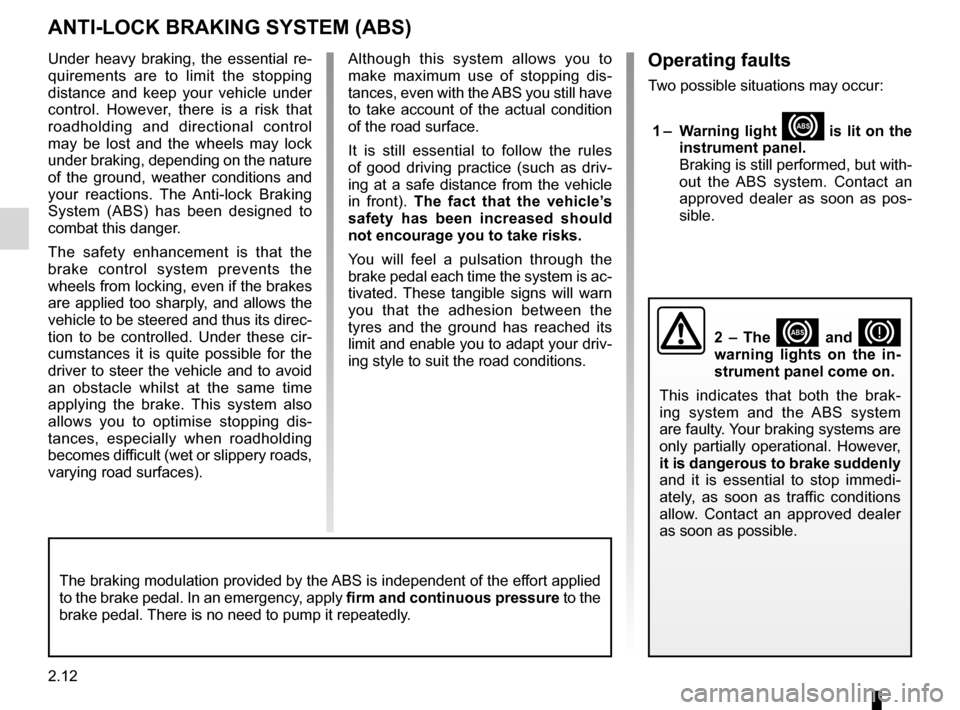
1 – Warning light x is lit on the instrument panel.Braking is still performed, but with- out the ABS system. Contact an approved dealer as soon as pos- sible.
Although this system allows you to make maximum use of stopping dis- tances, even with the ABS you still have to take account of the actual condition of the road surface.
It is still essential to follow the rules of good driving practice (such as driv- ing at a safe distance from the vehicle in front). The fact that the vehicle’s safety has been increased should not encourage you to take risks.
You will feel a pulsation through the brake pedal each time the system is ac- tivated. These tangible signs will warn you that the adhesion between the tyres and the ground has reached its limit and enable you to adapt your driv- ing style to suit the road conditions.
2 – The x and D warning lights on the in- strument panel come on.
This indicates that both the brak- ing system and the ABS system are faulty. Your braking systems are only partially operational. However, it is dangerous to brake suddenly and it is essential to stop immedi- ately, as soon as traffic conditions allow. Contact an approved dealer as soon as possible.
Système antiblocage des roues (ABS)
ANTI-LOCK BRAKING SYSTEM (ABS)
Under heavy braking, the essential re- quirements are to limit the stopping distance and keep your vehicle under control. However, there is a risk that roadholding and directional control may be lost and the wheels may lock under braking, depending on the nature of the ground, weather conditions and your reactions. The Anti-lock Braking System (ABS) has been designed to combat this danger.
The safety enhancement is that the brake control system prevents the wheels from locking, even if the brakes are applied too sharply, and allows the vehicle to be steered and thus its direc- tion to be controlled. Under these cir- cumstances it is quite possible for the driver to steer the vehicle and to avoid an obstacle whilst at the same time applying the brake. This system also allows you to optimise stopping dis- tances, especially when roadholding becomes difficult (wet or slippery roads, varying road surfaces).
The braking modulation provided by the ABS is independent of the effort applied to the brake pedal. In an emergency, apply firm and continuous pressure to the brake pedal. There is no need to pump it repeatedly.
Page 79 of 146
lighting:interior .............................................(up to the end of the DU)courtesy light ........................................(up to the end of the DU)map reading lights ................................(up to the end of the DU)
3.9
ENG_UD5582_1Eclairage intérieur (B90 - Dacia)ENG_NU_817-2_NU_Dacia_3
Éclairage intérieur
INTERIOR LIGHTING
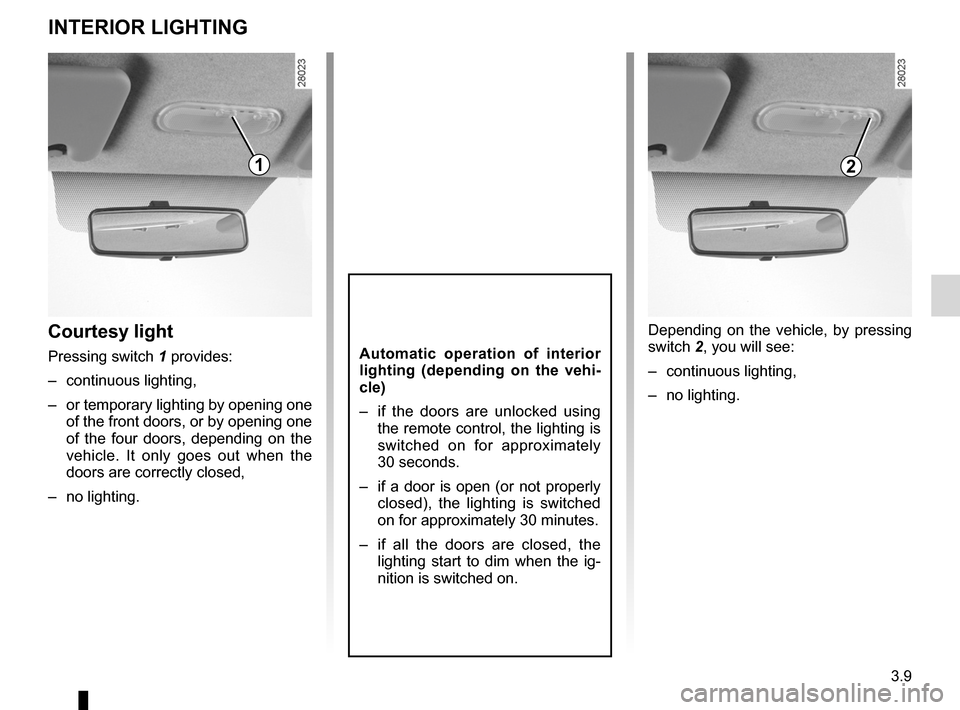
Courtesy light
Pressing switch 1 provides:
– continuous lighting,
– or temporary lighting by opening one
of the front doors, or by opening one of the four doors, depending on the vehicle. It only goes out when the doors are correctly closed,
– no lighting.
Automatic operation of interior lighting (depending on the vehi- cle)
– if the doors are unlocked using
the remote control, the lighting is switched on for approximately
30 seconds.
– if a door is open (or not properly
closed), the lighting is switched on for approximately 30 minutes.
– if all the doors are closed, the
lighting start to dim when the ig- nition is switched on.
Depending on the vehicle, by pressing
switch 2, you will see:
– continuous lighting,
– no lighting.
12
Page 80 of 146
electric windows ...................................(up to the end of the DU)
3.10
ENG_UD5583_1Lève-vitres / pare soleil - poignée de maintien (B90 - Dacia)ENG_NU_817-2_NU_Dacia_3
JauneNoirNoir texte
Lève-vitres
ELECTRIC WINDOWS
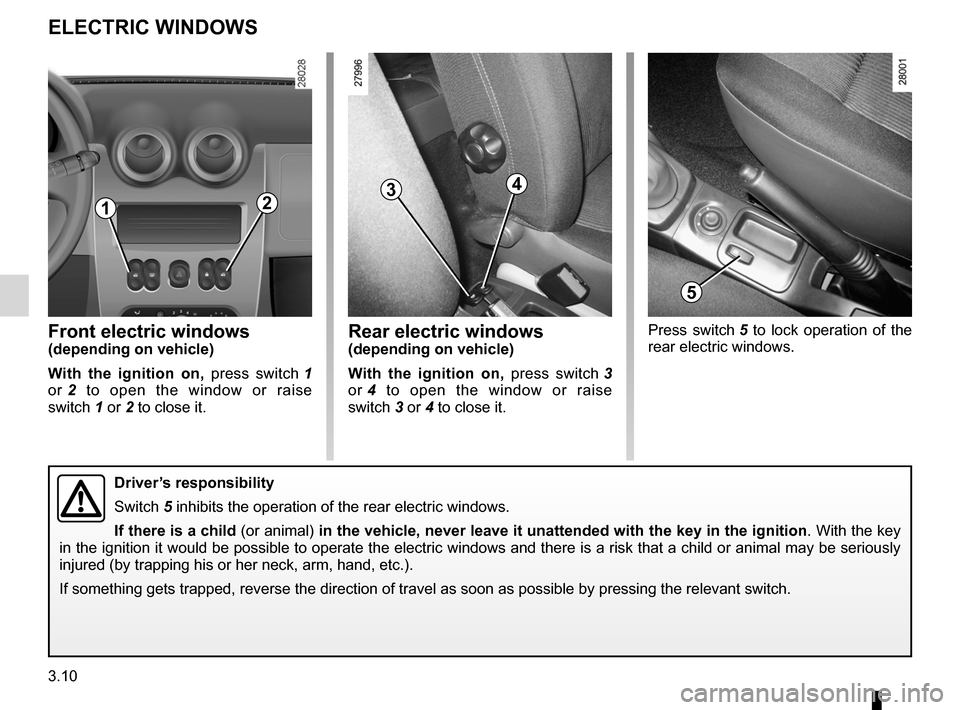
Front electric windows(depending on vehicle)
With the ignition on, press switch 1
or 2 to open the window or raise
switch 1 or 2 to close it.
Rear electric windows(depending on vehicle)
With the ignition on, press switch 3
or 4 to open the window or raise
switch 3 or 4 to close it. Press switch
5 to lock operation of the rear electric windows.
1234
5
Driver’s responsibility
Switch
5 inhibits the operation of the rear electric windows.
If there is a child (or animal) in the vehicle, never leave it unattended with the key in the ignition. With the key in the ignition it would be possible to operate the electric windows and there is a risk that a child or animal may be seriously injured (by trapping his or her neck, arm, hand, etc.).
If something gets trapped, reverse the direction of travel as soon as po\
ssible by pressing the relevant switch.
Page 85 of 146
3.15
ENG_UD8377_2Banquette arrière (fonctionnalité) (B90 - Dacia)ENG_NU_817-2_NU_Dacia_3
REAR BENCH SEAT (functions)
When moving the rear bench seat, make sure the anchorage points are clean (they should be free from grit, cloths, toys etc.).
For safety reasons, carry out any adjustments when the vehicle is not being driven.
Check that the rear seat belts are positioned and operating correctly each time the rear bench seat is moved.
– W h e n r e t u r n i n g t h e seatback to its normal position, make sure that it is properly locked at the top.
– If seat covers are fitted,
make sure these do not prevent the seatback latch from locking in.
– When moving the bench seat,
ensure the seat belt unit buckles do not cross over and ensure they are correctly repositioned before folding down the seat base.
Once the bench seat has been re- turned to its normal position, check that the seat belts are correctly po- sitioned. The seat belts must be on the seatback.
To reposition the seatback
Raise the seatbacks.
Check the seatbacks are correctly locked in position.
3
1
2
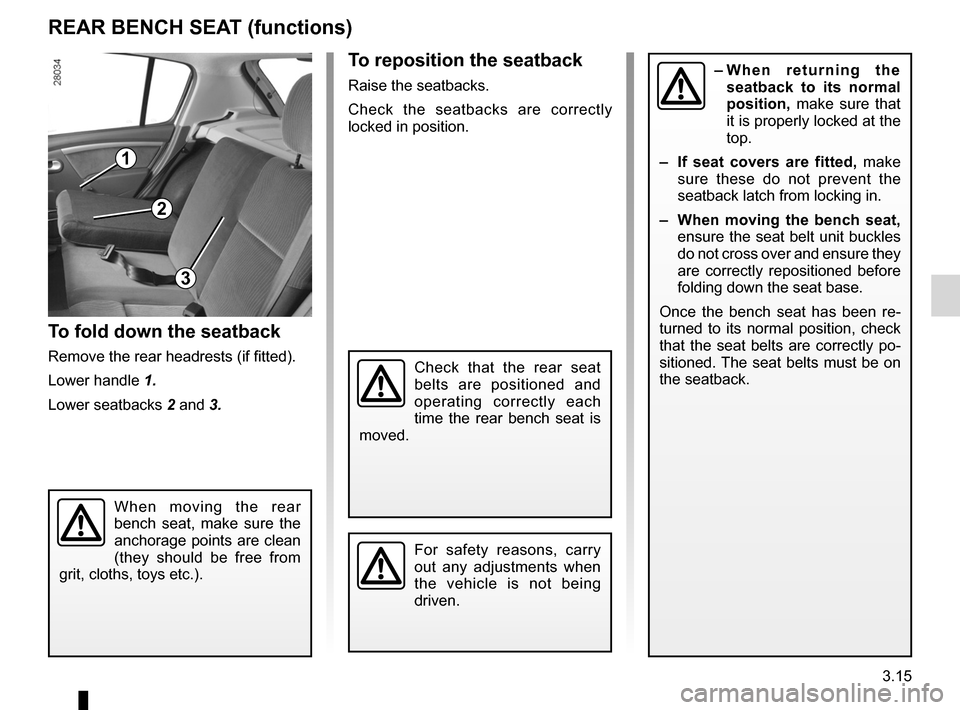
To fold down the seatback
Remove the rear headrests (if fitted).
Lower handle
1.
Lower seatbacks
2 and 3.
Page 86 of 146
tailgate ...................................................................(current page)transporting objectsin the luggage compartment ............................(current page)
3.16
ENG_UD5587_1Coffre à bagage / transport d’objets dans le coffre (B90 - Dacia)ENG_NU_817-2_NU_Dacia_3
Coffre à bagages - Transport d’objets dans le coffre
LUGGAGE COMPARTMENT - TRANSPORTING OBJECTS IN THE LUGGAGE COMPARTMENT
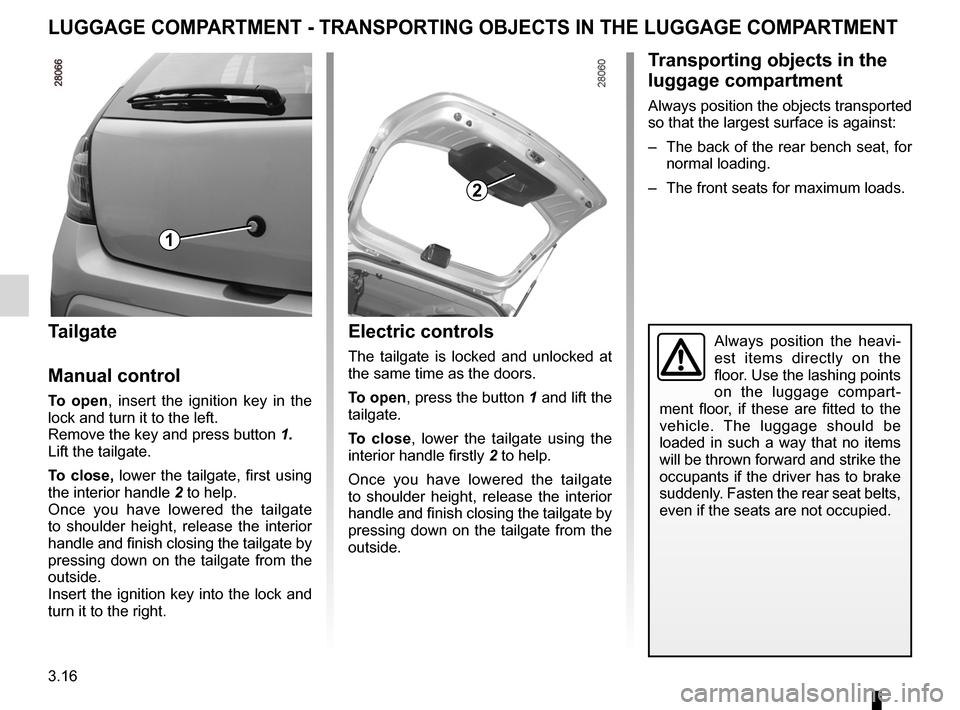
Tailgate
Manual control
To open, insert the ignition key in the lock and turn it to the left.
Remove the key and press button 1.Lift the tailgate.
To close, lower the tailgate, first using
the interior handle 2 to help.Once you have lowered the tailgate to shoulder height, release the interior handle and finish closing the tailgate by pressing down on the tailgate from the outside.Insert the ignition key into the lock and turn it to the right.
Always position the heavi- est items directly on the floor. Use the lashing points on the luggage compart- ment floor, if these are fitted to the vehicle. The luggage should be loaded in such a way that no items will be thrown forward and strike the occupants if the driver has to brake suddenly. Fasten the rear seat belts, even if the seats are not occupied.
Transporting objects in the
luggage compartment
Always position the objects transported so that the largest surface is against:
– The back of the rear bench seat, for
normal loading.
– The front seats for maximum loads.
Electric controls
The tailgate is locked and unlocked at the same time as the doors.
To open , press the button 1 and lift the tailgate.
To close, lower the tailgate using the
interior handle firstly 2 to help.
Once you have lowered the tailgate to shoulder height, release the interior handle and finish closing the tailgate by pressing down on the tailgate from the outside.
1
2
Page 90 of 146
bonnet...................................................(up to the end of the DU)
4.2
ENG_UD5590_1Capot moteur (B90 - Dacia)ENG_NU_817-2_NU_Dacia_4
Capot moteur
BONNET
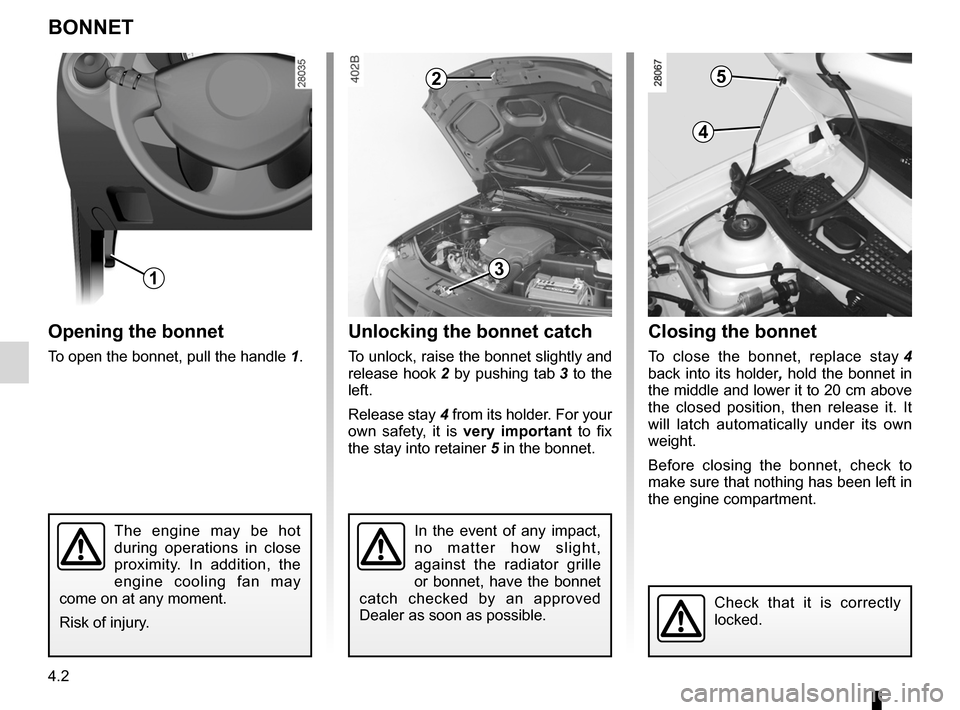
Opening the bonnet
To open the bonnet, pull the handle 1.
Unlocking the bonnet catch
To unlock, raise the bonnet slightly and
release hook 2 by pushing tab 3 to the left.
Release stay
4 from its holder. For your own safety, it is very important to fix
the stay into retainer 5 in the bonnet.
Closing the bonnet
To close the bonnet, replace stay 4 back into its holder, hold the bonnet in the middle and lower it to 20 cm above the closed position, then release it. It will latch automatically under its own weight.
Before closing the bonnet, check to make sure that nothing has been left in
the engine compartment.
The engine may be hot during operations in close proximity. In addition, the engine cooling fan may come on at any moment.
Risk of injury.
In the event of any impact, n o m a t t e r h o w s l i g h t , against the radiator grille or bonnet, have the bonnet catch checked by an approved Dealer as soon as possible.Check that it is correctly locked.
1
2
3
4
5