2013 DACIA SANDERO start the engine
[x] Cancel search: start the enginePage 91 of 146
capacity of mechanical components......................(current page)engine oil ..............................................(up to the end of the DU)dipstick..................................................(up to the end of the DU)levels ....................................................(up to the end of the DU)maintenance:mechanical ......................................(up to the end of the DU)
4.3
ENG_UD5591_1Niveau huile moteur/Vidange moteur (B90 - Dacia)ENG_NU_817-2_NU_Dacia_4
It is normal for an engine to use oil for lubrication and cooling of moving parts and it is sometimes necessary to top up the level between oil changes.
However, contact your approved dealer if more than 0.5 litres is being con- sumed every 600 miles (1,000 km) after the running in period.
Oil change frequency: check the oil level from time to time and certainly before any long journey to avoid the risk of damaging your engine.
Niveau huile moteur
ENGINE OIL LEVEL
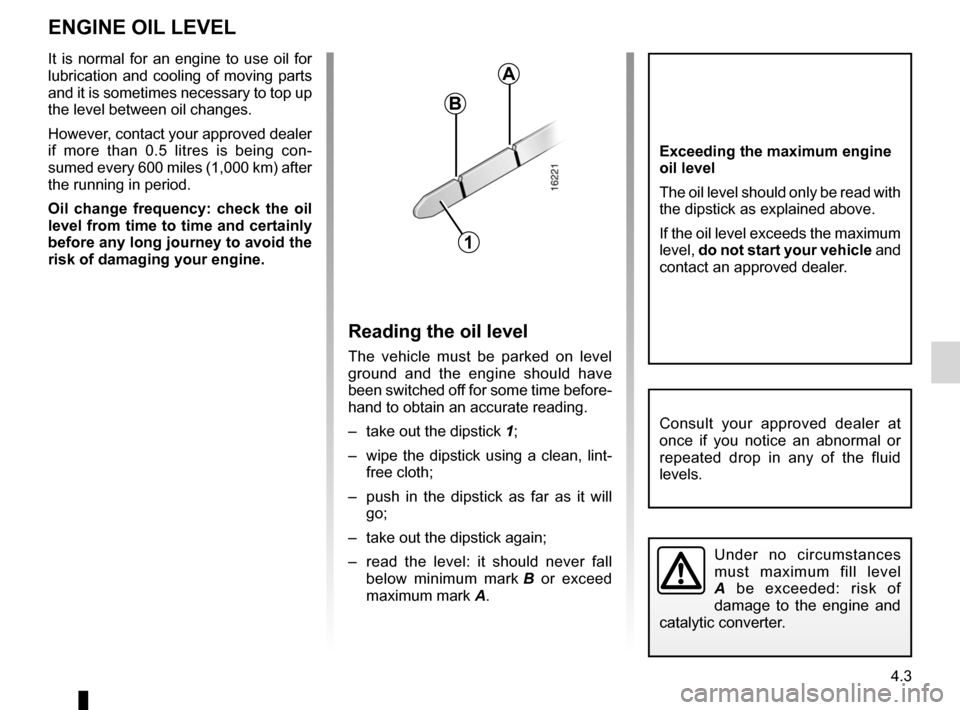
Reading the oil level
The vehicle must be parked on level ground and the engine should have been switched off for some time before- hand to obtain an accurate reading.
– take out the dipstick
1;
– wipe the dipstick using a clean, lint
- free cloth;
– push in the dipstick as far as it will
go;
– take out the dipstick again;
– read the level: it should never fall
below minimum mark B or exceed
maximum mark A.
A
B
1
Exceeding the maximum engine oil level
The oil level should only be read with the dipstick as explained above.
If the oil level exceeds the maximum level, do not start your vehicle and contact an approved dealer.
Under no circumstances must maximum fill level A be exceeded: risk of damage to the engine and catalytic converter.
Consult your approved dealer at once if you notice an abnormal or repeated drop in any of the fluid levels.
Page 92 of 146
engine oil grade ....................................(up to the end of the DU)
4.4
ENG_UD5591_1Niveau huile moteur/Vidange moteur (B90 - Dacia)ENG_NU_817-2_NU_Dacia_4
JauneNoirNoir texte
ENGINE OIL LEVEL (continued)
Topping up/filling
The vehicle must be parked on level ground and the engine should be cold (for instance, before the engine is started up for the first time in the day).
Engine oil grade
Refer to the Maintenance Service Booklet for your vehicle for information regarding which grade of oil to use. –
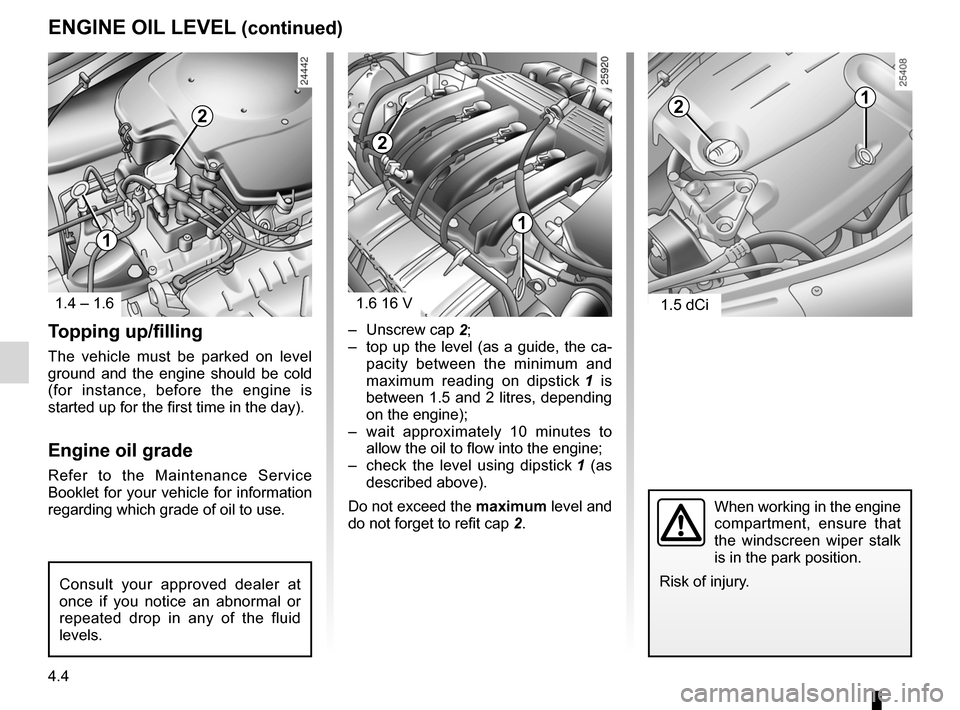
Unscrew cap
2;
– top up the level (as a guide, the ca- pacity between the minimum and
maximum reading on dipstick 1 is between 1.5 and 2 litres, depending on the engine);
– wait approximately 10 minutes to allow the oil to flow into the engine;
– check the level using dipstick 1 (as described above).
Do not exceed the maximum level and
do not forget to refit cap 2.When working in the engine compartment, ensure that the windscreen wiper stalk is in the park position.
Risk of injury.
2
1
12
1
2
1.4 – 1.6 1.6 16 V 1.5 dCi
Consult your approved dealer at once if you notice an abnormal or repeated drop in any of the fluid levels.
Page 121 of 146
JauneNoirNoir texte
5.21
ENG_UD5609_1Batterie : dépannage (B90 - Dacia)ENG_NU_817-2_NU_Dacia_5
BATTERY: troubleshooting (continued)
2
3
1
2
3
4
A
B
Connecting a battery charger
The battery charger must be com- patible with a battery with nominal voltage of 12 volts.
Switch the engine off and then discon- nect both battery leads starting with the negative terminal.
Do not disconnect the battery when the engine is running. Follow the instruc- tions given by the manufacturer of the battery charger you are using.
Starting the vehicle using the
battery from another vehicle
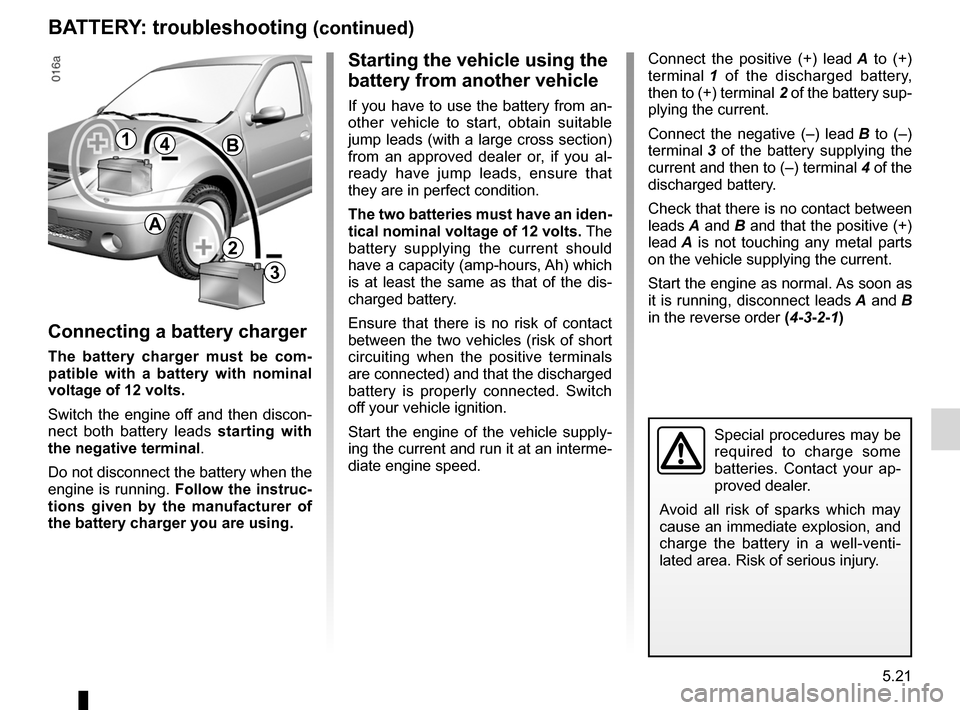
If you have to use the battery from an- other vehicle to start, obtain suitable jump leads (with a large cross section) from an approved dealer or, if you al- ready have jump leads, ensure that they are in perfect condition.
The two batteries must have an iden- tical nominal voltage of 12 volts. The battery supplying the current should have a capacity (amp-hours, Ah) which is at least the same as that of the dis- charged battery.
Ensure that there is no risk of contact between the two vehicles (risk of short circuiting when the positive terminals are connected) and that the discharged battery is properly connected. Switch off your vehicle ignition.
Start the engine of the vehicle supply- ing the current and run it at an interme- diate engine speed.Connect the positive (+) lead
A to (+)
terminal 1 of the discharged battery,
then to (+) terminal 2 of the battery sup- plying the current.
Connect the negative (–) lead
B to (–)
terminal 3 of the battery supplying the
current and then to (–) terminal 4 of the discharged battery.
Check that there is no contact between
leads A and B and that the positive (+)
lead A is not touching any metal parts on the vehicle supplying the current.
Start the engine as normal. As soon as
it is running, disconnect leads A and B in the reverse order (4-3-2-1)
Special procedures may be required to charge some batteries. Contact your ap- proved dealer.
Avoid all risk of sparks which may cause an immediate explosion, and charge the battery in a well-venti- lated area. Risk of serious injury.
Page 127 of 146
practical advice .....................................(up to the end of the DU)filterdiesel filter .......................................(up to the end of the DU)
5.27
ENG_UD5525_1Filtre à gazole (U90 - Dacia)ENG_NU_817-2_NU_Dacia_5
Filtre à gazole
DIESEL FILTER
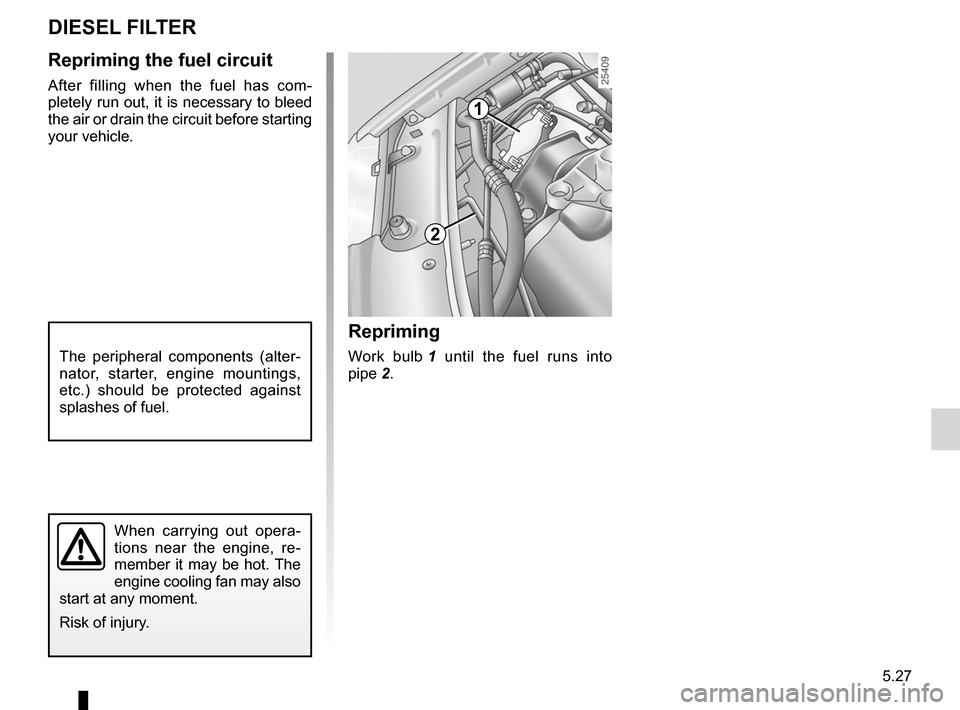
Repriming the fuel circuit
After filling when the fuel has com- pletely run out, it is necessary to bleed the air or drain the circuit before starting your vehicle.
The peripheral components (alter- nator, starter, engine mountings, etc.) should be protected against splashes of fuel.
When carrying out opera- tions near the engine, re- member it may be hot. The engine cooling fan may also start at any moment.
Risk of injury.
Repriming
Work bulb 1 until the fuel runs into
pipe 2.
1
2
Page 130 of 146
operating faults .....................................(up to the end of the DU)practical advice .....................................(up to the end of the DU)faultsoperating faults ...............................(up to the end of the DU)
5.30
ENG_UD5616_1Anomalies de fonctionnement (B90 - Dacia)ENG_NU_817-2_NU_Dacia_5
JauneNoirNoir texte
Anomalies de fonctionnement
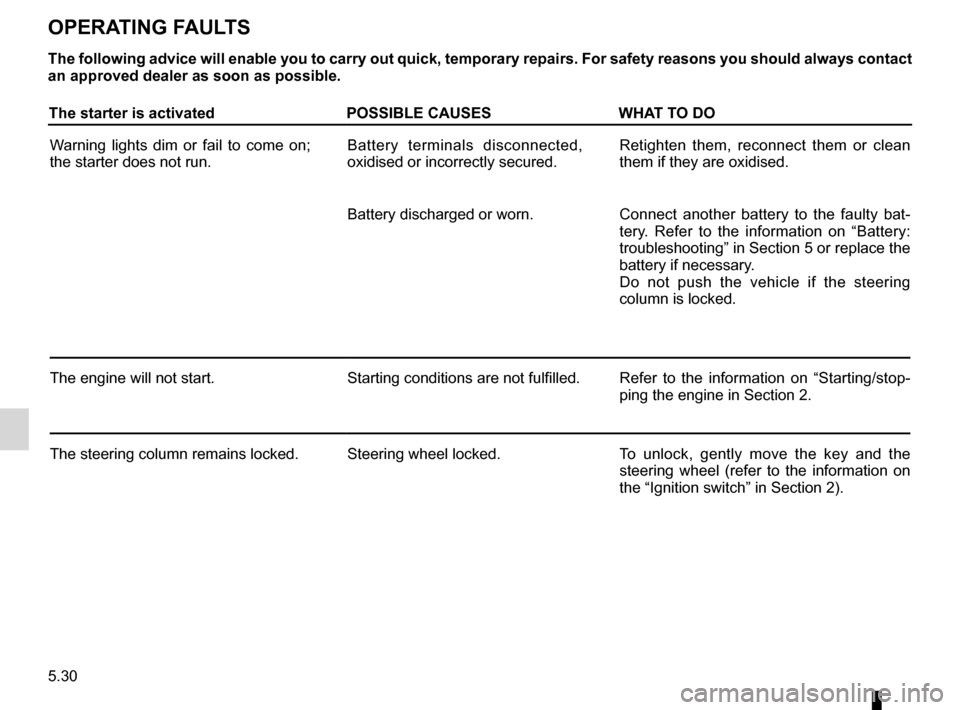
OPERATING FAULTS
The following advice will enable you to carry out quick, temporary repairs. For safety reasons you should always contact an approved dealer as soon as possible.
The starter is activatedPOSSIBLE CAUSESWHAT TO DO
Warning lights dim or fail to come on; the starter does not run.Battery terminals disconnected, oxidised or incorrectly secured.Retighten them, reconnect them or clean them if they are oxidised.
Battery discharged or worn.Connect another battery to the faulty bat- tery. Refer to the information on “Battery: troubleshooting” in Section 5 or replace the battery if necessary.Do not push the vehicle if the steering column is locked.
The engine will not start.Starting conditions are not fulfilled.Refer to the information on “Starting/stop- ping the engine in Section 2.
The steering column remains locked.Steering wheel locked.To unlock, gently move the key and the steering wheel (refer to the information on the “Ignition switch” in Section 2).
Page 145 of 146

JauneNoirNoir texte
7.3
FRA_UD8707_2Index (B90 - Dacia)ENG_NU_817-2_NU_Dacia_7
reverse gearselecting .......................................................................2.10running in ........................................................................\
.....2.2
Sseat belts ...............................................................1.11 → 1.20signals and lights .................................................... 1.46 – 1.47speakerslocation ........................................................................\
5.28special features of diesel versions.......................................2.5special features of petrol vehicles .......................................2.4starting ........................................................................\
2.2 – 2.3starting the engine ...............................................................2.3steering wheeladjustment ...................................................................1.33storage compartment.............................................. 3.13 – 3.14storage compartments ............................................ 3.13 – 3.14sun visor ........................................................................\
....3.11
ttailgate .................................................................... 3.16 – 3.17tanks and reservoirsbrake fluid ......................................................................4.6coolant ........................................................................\
...4.7tanks and reservoirs:windscreen washer ........................................................4.8
technical specifications ..............................................6.2 → 6.7towing ........................................................................\
..........6.6breakdown ...................................................................5.25towing equipment .........................................................5.26towing a caravan .................................................................6.6towing hitch.................................................................5.3, 5.25towing weights .....................................................................6.6transporting children ..............................................1.21 → 1.29transporting objectsin the luggage compartment ........................................3.16
side lights ............................................................1.46, 5.11
Mmaintenance:bodywork .......................................................... 4.10 – 4.11interior trim ...................................................................4.12mechanical ...........................................................4.3 → 4.9map reading lights ...............................................................3.9methods of restraint in addition to the front seat belts ..............
1.15 → 1.18, 1.20
mirrors ........................................................................\
.......3.11
Ooil change ........................................................................\
....4.5operating faults ......................................................5.30 → 5.33overspeed buzzer ..............................................................1.39
ppaintworkmaintenance ................................................................4.10reference ........................................................................\
6.2power-assisted steering..............................................2.11, 4.8power-assisted steering pump.............................................4.8practical advice ........................................................5.2 → 5.33puncture........................................................................\
5.2, 5.6
Rradiofitting a radio ................................................................5.28rear parcel shelf .................................................................3.17rear screendemisting ...................................................1.35, 1.38, 1.51rear view mirrors ................................................................1.32remote control door locking unit ..........................................1.2replacement parts ................................................................6.7
AlphABEtiCAl inDEx (continued)