2013 DACIA SANDERO Fuel
[x] Cancel search: FuelPage 66 of 146
ENG_NU_817-2_NU_Dacia_2
ADVICE ON ANTIPOLLUTION, FUEL ECONOMY AND DRIVING (continued)
– In vehicles fitted")
2.8
ENG_UD5485_1Conseils antipollution, économies de carburant, conduite (U90 - Daci\
a)ENG_NU_817-2_NU_Dacia_2
ADVICE ON ANTIPOLLUTION, FUEL ECONOMY AND DRIVING (continued)
– In vehicles fitted with air condi- tioning, it is normal to observe an increase in fuel consumption (es- pecially in city conditions) when it is used. For vehicles fitted with manual air conditioning, switch off the system when it is not required.
Some advice for reducing fuel consumption and therefore help- ing to protect the environment:
– It is advisable to drive with the air
vents open and the windows closed.
– If the vehicle has been parked in the
sun, open the doors for a few mo- ments to let the hot air escape before starting the engine.
– Never fill the fuel tank to the brim to
avoid overflow.
– Do not leave an empty roof rack
fitted to the vehicle.
– It is better to fit a trailer for bulky ob
- jects.
– When towing a caravan, fit a wind
deflector and adjust it carefully.
Advice on use
– Electricity is fuel; switch off all the electrical components which are not really needed.
However (safety first), keep your lights on when the visibility is bad (“see and be seen”).
– Use the air vents. Driving with the
windows open will increase fuel consumption by 4% at a speed of 60 mph (100 km/h). –
Avoid using the vehicle for door-to
- door journeys (short journeys, with long stops in-between) because in these conditions, the engine never reaches its ideal temperature.
Tyres
Increased fuel consumption could be the result of:
– insufficient pressure,
– using non-recommended tyres.
Page 67 of 146

driving ...................................................(up to the end of the DU)environment ..........................................(up to the end of the DU)
2.9
ENG_UD5486_1Environnement (U90 - Dacia)ENG_NU_817-2_NU_Dacia_2
Environnement
ENVIRONMENT
Your vehicle has been designed with the aim of caring for the environment.
– Most versions are equipped with a
particle filter system including a cat- alytic converter, an oxygen sensor and an active carbon filter (the latter prevents vapour from the fuel tank being released into the open air.)
–
These vehicles operate with un- leaded fuel only.
– 87% of the parts in your vehicle
can
be recycled and it already contains parts made using recycled materi- als.
– 95% of the plastic components
in your vehicle are marked with a symbol which allows the principal component material to be identified. These markings mean that parts re- moved can be sorted more easily, making it easier to recycle them.
In addition to this, your vehicle meets the requirements laid down in European legislation relating to environmental protection.
Make your contribution towards pro- tection of the environment too.
Do not dispose of parts replaced in the course of routine vehicle maintenance (battery, oil filter, air filter, etc.) and oil containers (empty or full of used oil) with household waste.
Dispose of them through specialist or- ganisations. In all cases, comply with local legislation.
Page 77 of 146

JauneNoirNoir texte
3.7
ENG_UD5580_1Chauffage - Ventilation - Air conditionné (B90 - Dacia)ENG_NU_817-2_NU_Dacia_3
HEATING - VENTILATION - AIR CONDITIONING (continued)
Air conditioning controls(depending on vehicle)
Control
E switches the air conditioning on or off.
The system cannot be switched on if
control A is set to 0.
Using the air conditioning system enables you to:
– lower the temperature inside the
passenger compartment;
– e l i m i n a t e c o n d e n s a t i o n m o r e
quickly.
Fuel consumption increases when the air conditioning system is being used. (Switch it off when it is not required.)
Note: The air conditioning may be used in all conditions but does not operate when the external temperature is low.
– Button
E not activated (indicator light off)
The air conditioning is not operating.
The heating and ventilation controls are the same as a vehicle without air
conditioning.
– Button
E activated (indicator light on)
The air conditioning is activated.
D
EA
B
C
Page 78 of 146
air conditioning .....................................(up to the end of the DU)heating system .....................................(up to the end of the DU)heating and air conditioning system .....(up to the end of the DU)ventilationheating and air conditioning system (up to the end of the DU)air conditioning ......................................................(current page)
3.8
ENG_UD5493_1Air conditionné : informations et conseils utilisation (U90 - Dacia)\
ENG_NU_817-2_NU_Dacia_3
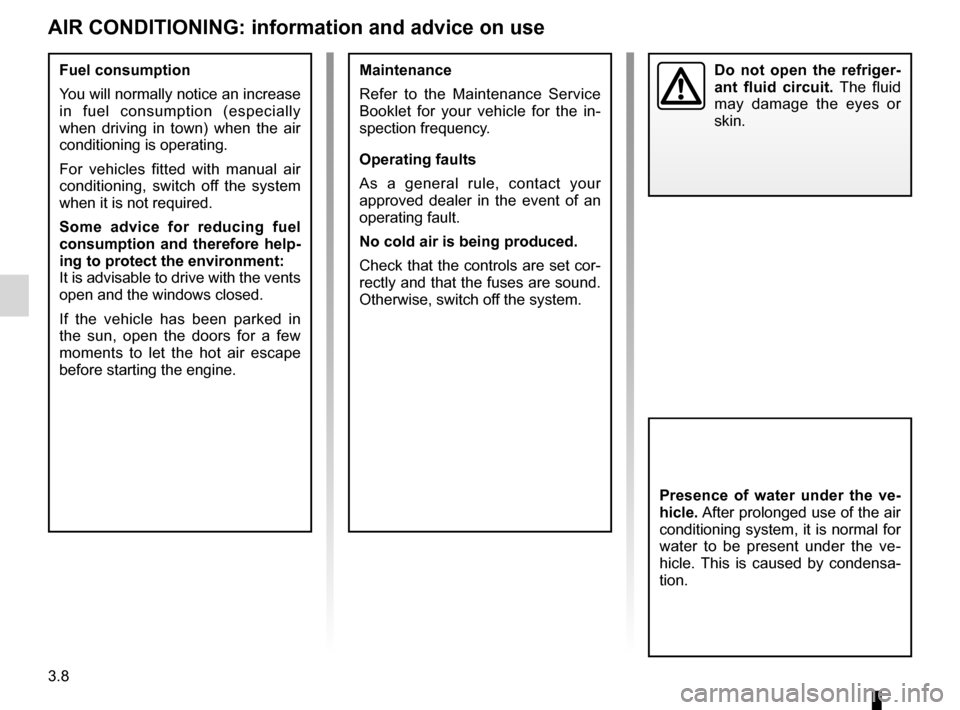
AIR CONDITIONING: information and advice on use
Fuel consumption
You will normally notice an increase in fuel consumption (especially when driving in town) when the air conditioning is operating.
For vehicles fitted with manual air conditioning, switch off the system when it is not required.
Some advice for reducing fuel consumption and therefore help- ing to protect the environment:It is advisable to drive with the vents open and the windows closed.
If the vehicle has been parked in the sun, open the doors for a few moments to let the hot air escape before starting the engine.
Maintenance
Refer to the Maintenance Service Booklet for your vehicle for the in- spection frequency.
Operating faults
As a general rule, contact your approved dealer in the event of an operating fault.
No cold air is being produced.
Check that the controls are set cor- rectly and that the fuses are sound. Otherwise, switch off the system.
Do not open the refriger- ant fluid circuit. The fluid may damage the eyes or skin.
Presence of water under the ve- hicle. After prolonged use of the air conditioning system, it is normal for water to be present under the ve- hicle. This is caused by condensa- tion.
Page 98 of 146
bodywork (maintenance) ......................(up to the end of the DU)maintenance:bodywork ........................................(up to the end of the DU)washing ................................................(up to the end of the DU)paintworkmaintenance ....................................................(current page)
4.10
ENG_UD5594_1Entretien de la carrosserie (B90 - Dacia)ENG_NU_817-2_NU_Dacia_4
JauneNoirNoir texte
Entretien de la carrosserie
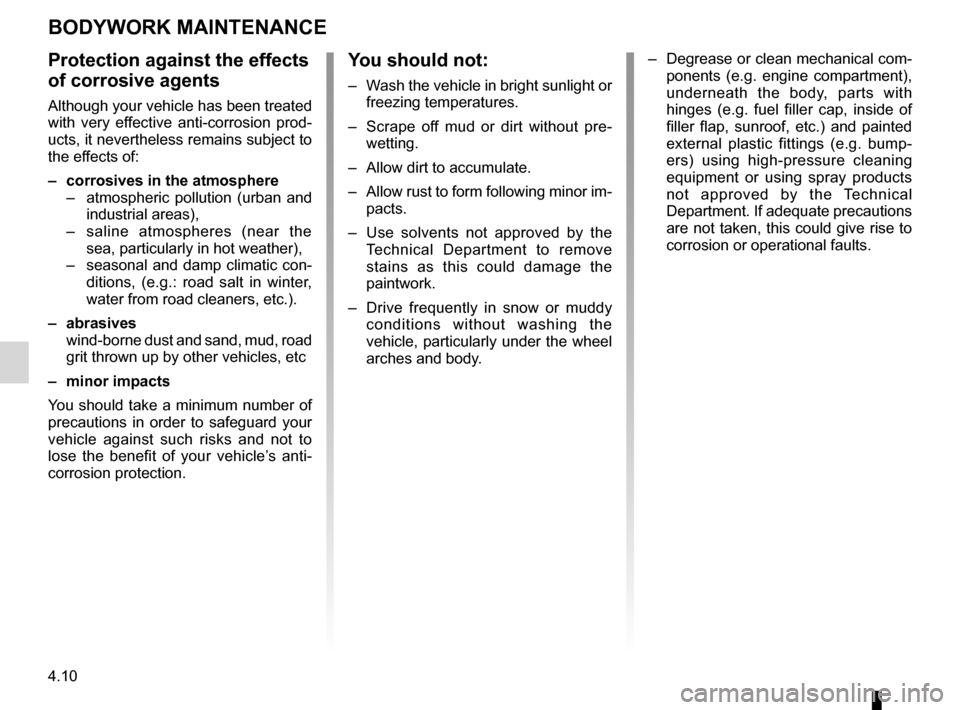
BODYWORK MAINTENANCE
Protection against the effects
of corrosive agents
Although your vehicle has been treated with very effective anti-corrosion prod- ucts, it nevertheless remains subject to the effects of:
– corrosives in the atmosphere
– atmospheric pollution (urban and
industrial areas),
– saline atmospheres (near the sea, particularly in hot weather),
– seasonal and damp climatic con- ditions, (e.g.: road salt in winter, water from road cleaners, etc.).
– abrasives
wind-borne dust and sand, mud, road grit thrown up by other vehicles, etc
– minor impacts
You should take a minimum number of precautions in order to safeguard your vehicle against such risks and not to lose the benefit of your vehicle’s anti- corrosion protection.
You should not:
– Wash the vehicle in bright sunlight or freezing temperatures.
– Scrape off mud or dirt without pre
- wetting.
– Allow dirt to accumulate.
– Allow rust to form following minor im
- pacts.
– Use solvents not approved by the
Technical Department to remove stains as this could damage the paintwork.
– Drive frequently in snow or muddy
conditions without washing the vehicle, particularly under the wheel arches and body. –
Degrease or clean mechanical com
- ponents (e.g. engine compartment), underneath the body, parts with hinges (e.g. fuel filler cap, inside of filler flap, sunroof, etc.) and painted external plastic fittings (e.g. bump- ers) using high-pressure cleaning equipment or using spray products not approved by the Technical Department. If adequate precautions are not taken, this could give rise to corrosion or operational faults.
Page 127 of 146
practical advice .....................................(up to the end of the DU)filterdiesel filter .......................................(up to the end of the DU)
5.27
ENG_UD5525_1Filtre à gazole (U90 - Dacia)ENG_NU_817-2_NU_Dacia_5
Filtre à gazole
DIESEL FILTER
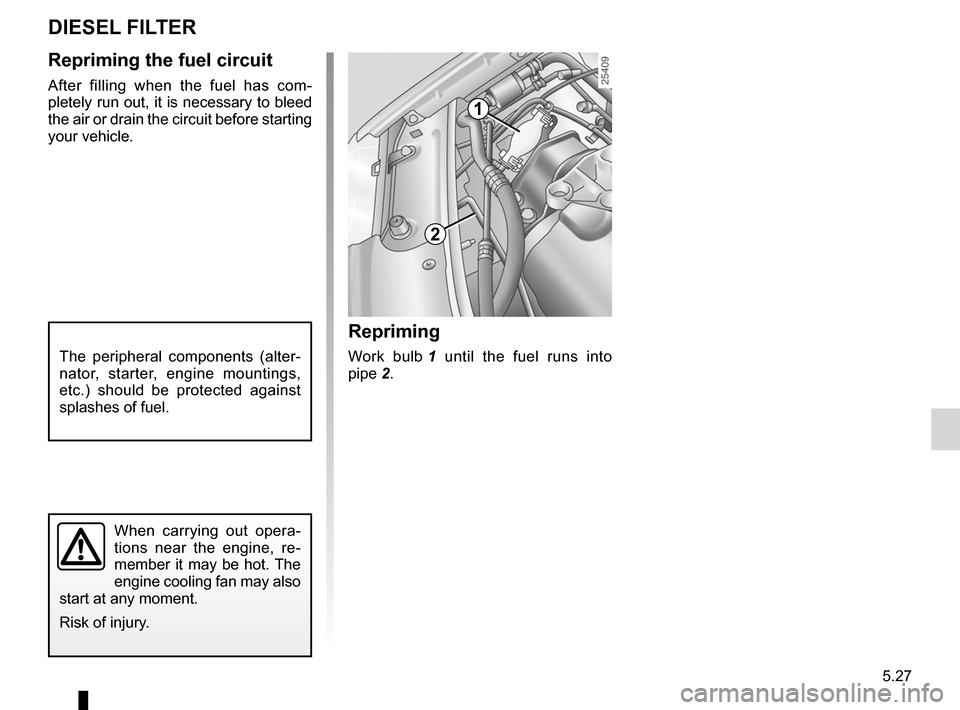
Repriming the fuel circuit
After filling when the fuel has com- pletely run out, it is necessary to bleed the air or drain the circuit before starting your vehicle.
The peripheral components (alter- nator, starter, engine mountings, etc.) should be protected against splashes of fuel.
When carrying out opera- tions near the engine, re- member it may be hot. The engine cooling fan may also start at any moment.
Risk of injury.
Repriming
Work bulb 1 until the fuel runs into
pipe 2.
1
2
Page 138 of 146
engine specifications ............................(up to the end of the DU)technical specifications .........................(up to the end of the DU)fuelgrade ...............................................(up to the end of the DU)enginetechnical specifications ...................(up to the end of the DU)
6.4
ENG_UD5619_1Caractéristiques moteur (B90 - Dacia)ENG_NU_817-2_NU_Dacia_6
Caractéristiques moteurs
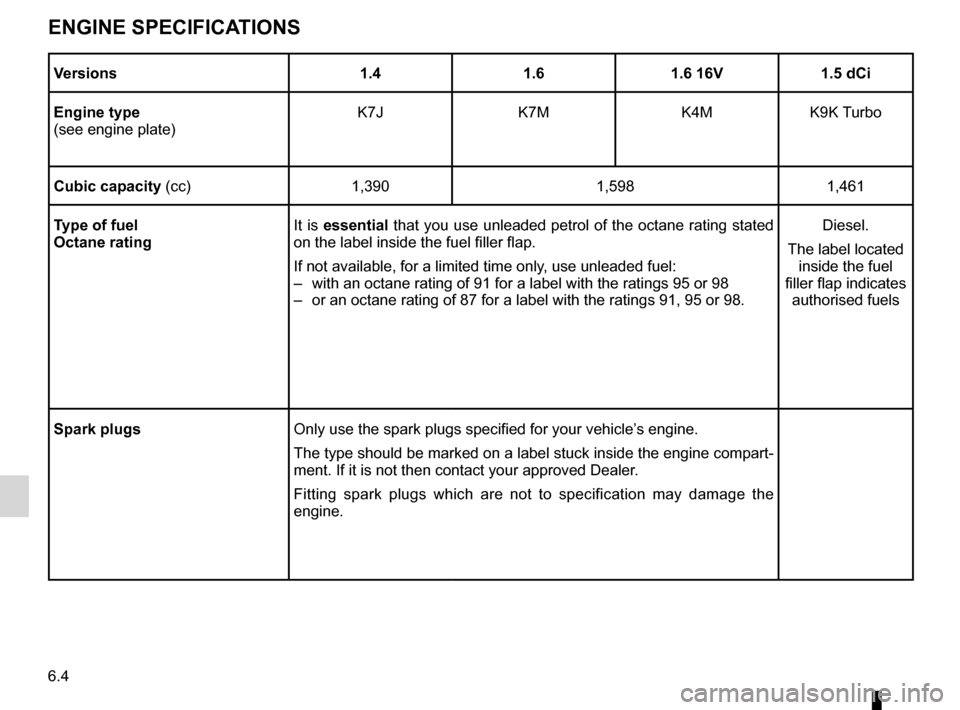
ENGINE SPECIFICATIONS
Versions1.41.61.6 16V1.5 dCi
Engine type(see engine plate)K7JK7MK4MK9K Turbo
Cubic capacity (cc)1,3901,5981,461
Type of fuelOctane ratingIt is essential that you use unleaded petrol of the octane rating stated on the label inside the fuel filler flap.
If not available, for a limited time only, use unleaded fuel:
– with an octane rating of 91 for a label with the ratings 95 or 98
– or an octane rating of 87 for a label with the ratings 91, 95 or 98.
Diesel.
The label located inside the fuel filler flap indicates authorised fuels
Spark plugsOnly use the spark plugs specified for your vehicle’s engine.
The type should be marked on a label stuck inside the engine compart- ment. If it is not then contact your approved Dealer.
Fitting spark plugs which are not to specification may damage the engine.
Page 144 of 146

7.2
FRA_UD8707_2Index (B90 - Dacia)ENG_NU_817-2_NU_Dacia_7
JauneNoirNoir texte
iignition switch ......................................................................2.2indicator lights....................................................................5.15indicators ..................................................................1.49, 5.11indicators:direction indicators .......................................................1.49instrument panel ....................................................1.36 → 1.40interior trimmaintenance ................................................................4.12
Jjack ........................................................................\
.......5.3, 5.6
Kkeys ........................................................................\
.... 1.2 – 1.3replacing the battery ....................................................5.19
llevels ........................................................................\
.4.3 → 4.8lifting the vehiclechanging a wheel .................................................5.2 → 5.6lighting:exterior ......................................... 1.46 – 1.47, 5.11 → 5.15interior ....................................................... 3.9, 5.16 → 5.18lights ......................................................................1.46 → 1.48additional .....................................................................5.12adjustment ...................................................................1.48lights:adjusting ......................................................................1.48brake lights ....................................................... 5.13 – 5.14dipped beam headlights ......................................1.46, 5.11direction indicators ..............................................1.49, 5.11fog lights .............................................................1.47, 5.12hazard warning ............................................................1.49main beam headlights .........................................1.46, 5.11reversing lights .................................................. 5.13 – 5.14
diesel filter ....................................................................5.27oil filter ........................................................................\
...4.5fitting a radio ......................................................................5.28fittings ..................................................................... 3.13 – 3.14fog lights ........................................................................\
....1.47front passenger air bag deactivation .................................1.30front seat adjustment .........................................................1.10front seatsadjustment ...................................................................1.10fueladvice on fuel economy .......................................2.6 → 2.8filling ........................................................................\
.....1.53grade .....................................................................1.52, 6.4
fuel economy .............................................................2.6 → 2.8fuel filler cap ......................................................................1.52fuel grade........................................................................\
...1.52fuel level ........................................................................\
....1.40fuel tank .................................................................. 1.52 – 1.53fuel tank capacity ...............................................................1.52fuses ......................................................................5.22 → 5.24
Ggear lever........................................................................\
...2.10glove box ........................................................................\
...3.13grab handle........................................................................\
3.11
hhandbrake........................................................................\
..2.11hazard warning lights signal ..............................................1.49headlight beam adjustment ...............................................1.48headlight flashers ..............................................................1.49headrest...................................................................... 1.8 – 1.9heating and air conditioning system ..........................3.2 → 3.8heating system ..........................................................3.2 → 3.8horn ........................................................................\
...........1.49
AlphABEtiCAl inDEx (continued)