2013 DACIA SANDERO key
[x] Cancel search: keyPage 45 of 146

control instruments ...............................(up to the end of the DU)trip computer and warning system........(up to the end of the DU)warning lights........................................(up to the end of the DU)
1.41
ENG_UD5561_1Ordinateur de bord (B90 - Dacia)ENG_NU_817-2_NU_Dacia_1
Ordinateur de bord
TRIP COMPUTER AND w ARNING SYSTEM
Display 1
General reset and trip
mileage recorder reset key
2
To reset the trip mileage recorder, the display must show the Trip mileometer function.
Press and hold button
2.
Display selection key 3
Keep pressing key 3 briefly to scroll through the following information (de- pending on the vehicle) in sequence:
a) total mileage recorder,b) trip mileage recorder,c) fuel used,d) average consumption,e) estimated range,f) distance travelled,g) average speed.
Refer to the table on the following pages showing display examples.
The information displayed DEPENDS ON THE VEHICLE EQUIPMENT AND COUNTRY.
1
23
Page 56 of 146

fuel filler cap ..........................................................(current page)fuel tank capacity ...................................................(current page)fuelgrade ................................................................(current page)fuel tank ................................................(up to the end of the DU)fuel filler cap ..........................................................(current page)fuel grade...............................................................(current page)
1.52
ENG_UD5567_1Réservoir carburant (B90 - Dacia)ENG_NU_817-2_NU_Dacia_1
JauneNoirNoir texte
Réservoir carburant (remplissage carburant)
FUEL TANK
Capacity of the fuel tank: 50 litres ap- proximately.
Depending on the vehicle, the cap
1 may be unlocked with the ignition key.
For details on filling the fuel tank, refer to the information on “Filling with fuel”.
There is a cap holder on the fuel filler flap for holding the cap when the tank is being filled.
Fuel filler cap: this is spe- cific to the vehicle type. If you have to replace it, make sure the new cap is of the same type. Contact an approved dealer.
Never place the cap near a source of heat or flame.
Do not wash the filler area with a high-pressure washer.
Fuel grade
Use a high grade fuel that complies with the standards currently in force in each country.
Petrol version
It is essential to use unleaded petrol. The octane rating (RON) must conform with the specifications given on the
label inside the fuel filler flap A.
Refer to the “Engine specifications” table in section 6.
v ehicles running on ethanol-based
fuel
Always use unleaded petrol or fuel containing a maximum of 85 percent ethanol (E85).
Note: you may notice an increase in fuel consumption with this type of fuel.
When the fuel is changed the engine must adjust, which may cause minor in- conveniences for a few minutes (longer starting times, cutting out, etc.).
1
A
Do not mix even small amounts of petrol (unleaded or E85) with diesel.Do not use ethanol based fuel or diesel containing more than 10% bio additives if your vehicle is not adapted to these fuels.
Page 60 of 146
running in ...............................................................(current page)ignition switch ........................................................(current page)engine immobiliser (switch) ...................................(current page)driving ....................................................................(current page)starting ...................................................................(current page)
2.2
ENG_UD5481_1Rodage / Contacteur de démarrage (U90 - Dacia)ENG_NU_817-2_NU_Dacia_2
Rodage - Contacteur de démarrage
RUNNING IN
Petrol version
For the first 600 miles (1,000 km), do not exceed 78 mph (130 km/h) in the highest gear, or 3,000 to 3,500 rpm.
After 600 miles (1,000 km), you may use your vehicle normally. However, it is only after 1,800 miles (3,000 km) have been covered that you may rea- sonably expect full performance.
Service intervals: refer to the Mainte- nance Service Booklet for your vehicle.
Diesel version
For the first 900 miles (1,500 km), do not exceed 2,500 rpm. After complet- ing this mileage you may drive faster, although you may only expect top p e r f o r m a n c e a f t e r a p p r o x i m a t e l y 3,600 miles (6,000 km).
During the running in period, do not ac- celerate hard while the engine is still cold and do not let the engine over-rev.
Service intervals: refer to the Mainte- nance Service Booklet for your vehicle.
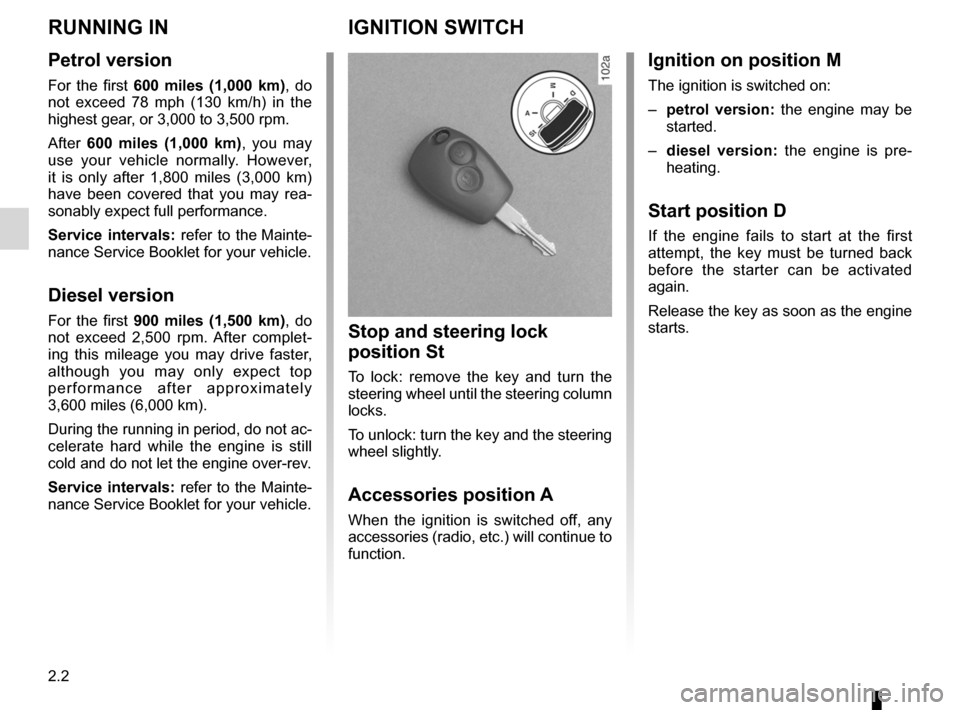
IGNITION SWITCH
Stop and steering lock
position St
To lock: remove the key and turn the steering wheel until the steering column locks.
To unlock: turn the key and the steering wheel slightly.
Accessories position A
When the ignition is switched off, any accessories (radio, etc.) will continue to function.
Ignition on position M
The ignition is switched on:
–
petrol version: the engine may be started.
–
diesel version: the engine is pre- heating.
Start position D
If the engine fails to start at the first attempt, the key must be turned back before the starter can be activated again.
Release the key as soon as the engine starts.
Page 61 of 146

driving ...................................................(up to the end of the DU)starting ..................................................(up to the end of the DU)starting the engine ................................(up to the end of the DU)
2.3
ENG_UD5482_1Mise en route / Arrêt du moteur (U90 - Dacia)ENG_NU_817-2_NU_Dacia_2
Stopping the engine
With the engine idling, turn the key back to “Stop” position St.
ÉDiesel injection
Turn the ignition key to ignition “On” po- sition M, and hold this position until the preheating warning light goes out.
Turn the key to starter position D with- out depressing the accelerator pedal.
Release the key as soon as the engine starts.
Starting the engine
Special feature on vehicles equipped with an engine immobiliser system
In very cold conditions (temperatures below –20°C): so that it is easier to start the engine, switch on the ignition for several seconds before starting the engine.
Make sure the engine immobiliser is not activated. Refer to the information on the “Engine immobiliser” in Section 1.
Petrol injection
Engine warm or cold
– Turn the key to the start position
without depressing the accelera- tor.
– Release the key as soon as the
engine starts.
Mise en route / Arrêt du moteur
STARTING/STOPPING THE ENGINE
Never leave your vehicle with the keys inside when leaving a child (or \
animal) in the car, even for a short period.
The reason for this is that the child may endanger himself or others by starting the engine, activating equipment such
as the window winders for example, or locking the doors.
Risk of serious injury.
Never switch off the ignition before the vehicle has stopped completely. Once the engine has stopped, the brake servo, power assisted steering and passive safety equipment such as air bags wi\
ll no longer operate.
The steering is locked when the key is removed.
Page 80 of 146
electric windows ...................................(up to the end of the DU)
3.10
ENG_UD5583_1Lève-vitres / pare soleil - poignée de maintien (B90 - Dacia)ENG_NU_817-2_NU_Dacia_3
JauneNoirNoir texte
Lève-vitres
ELECTRIC WINDOWS
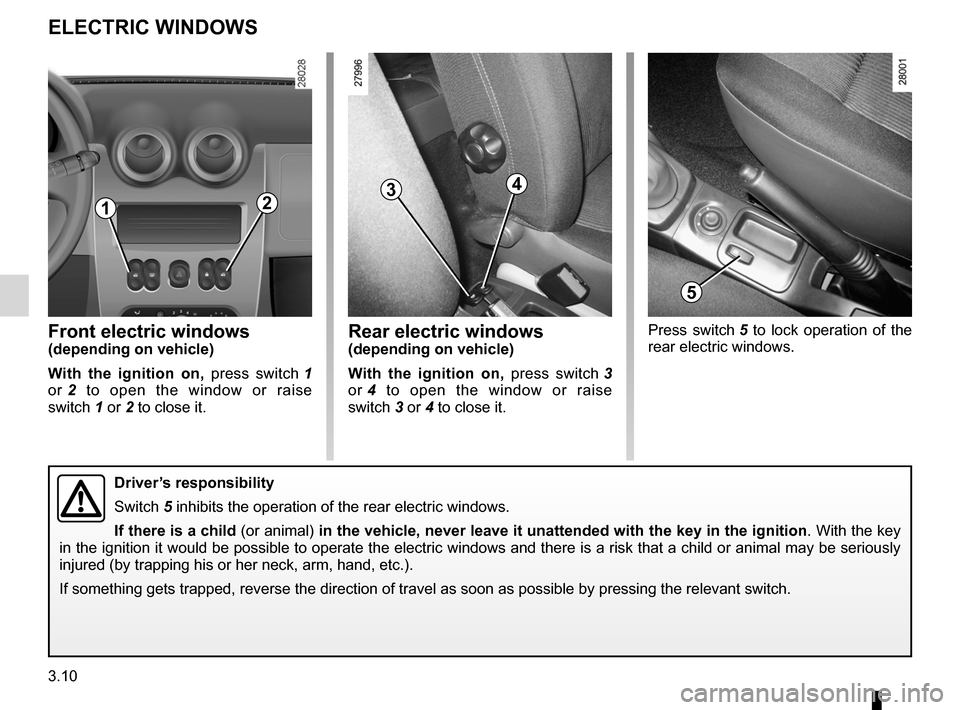
Front electric windows(depending on vehicle)
With the ignition on, press switch 1
or 2 to open the window or raise
switch 1 or 2 to close it.
Rear electric windows(depending on vehicle)
With the ignition on, press switch 3
or 4 to open the window or raise
switch 3 or 4 to close it. Press switch
5 to lock operation of the rear electric windows.
1234
5
Driver’s responsibility
Switch
5 inhibits the operation of the rear electric windows.
If there is a child (or animal) in the vehicle, never leave it unattended with the key in the ignition. With the key in the ignition it would be possible to operate the electric windows and there is a risk that a child or animal may be seriously injured (by trapping his or her neck, arm, hand, etc.).
If something gets trapped, reverse the direction of travel as soon as po\
ssible by pressing the relevant switch.
Page 86 of 146
tailgate ...................................................................(current page)transporting objectsin the luggage compartment ............................(current page)
3.16
ENG_UD5587_1Coffre à bagage / transport d’objets dans le coffre (B90 - Dacia)ENG_NU_817-2_NU_Dacia_3
Coffre à bagages - Transport d’objets dans le coffre
LUGGAGE COMPARTMENT - TRANSPORTING OBJECTS IN THE LUGGAGE COMPARTMENT
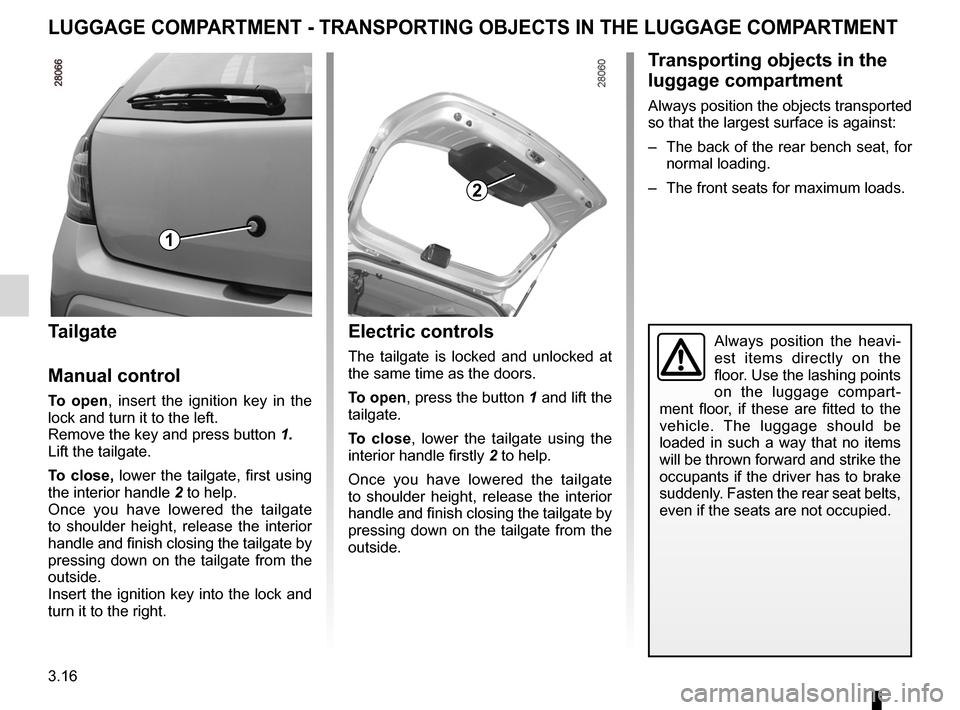
Tailgate
Manual control
To open, insert the ignition key in the lock and turn it to the left.
Remove the key and press button 1.Lift the tailgate.
To close, lower the tailgate, first using
the interior handle 2 to help.Once you have lowered the tailgate to shoulder height, release the interior handle and finish closing the tailgate by pressing down on the tailgate from the outside.Insert the ignition key into the lock and turn it to the right.
Always position the heavi- est items directly on the floor. Use the lashing points on the luggage compart- ment floor, if these are fitted to the vehicle. The luggage should be loaded in such a way that no items will be thrown forward and strike the occupants if the driver has to brake suddenly. Fasten the rear seat belts, even if the seats are not occupied.
Transporting objects in the
luggage compartment
Always position the objects transported so that the largest surface is against:
– The back of the rear bench seat, for
normal loading.
– The front seats for maximum loads.
Electric controls
The tailgate is locked and unlocked at the same time as the doors.
To open , press the button 1 and lift the tailgate.
To close, lower the tailgate using the
interior handle firstly 2 to help.
Once you have lowered the tailgate to shoulder height, release the interior handle and finish closing the tailgate by pressing down on the tailgate from the outside.
1
2
Page 119 of 146
keysreplacing the battery .......................(up to the end of the DU)practical advice .....................................(up to the end of the DU)battery (remote control) ........................(up to the end of the DU)
5.19
ENG_UD5520_1Télécommande à radiofréquence : piles (U90 - Dacia)ENG_NU_817-2_NU_Dacia_5
Télécommande à radiofréquence : pile
RADIO FREQUENCY REMOTE CONTROL: battery
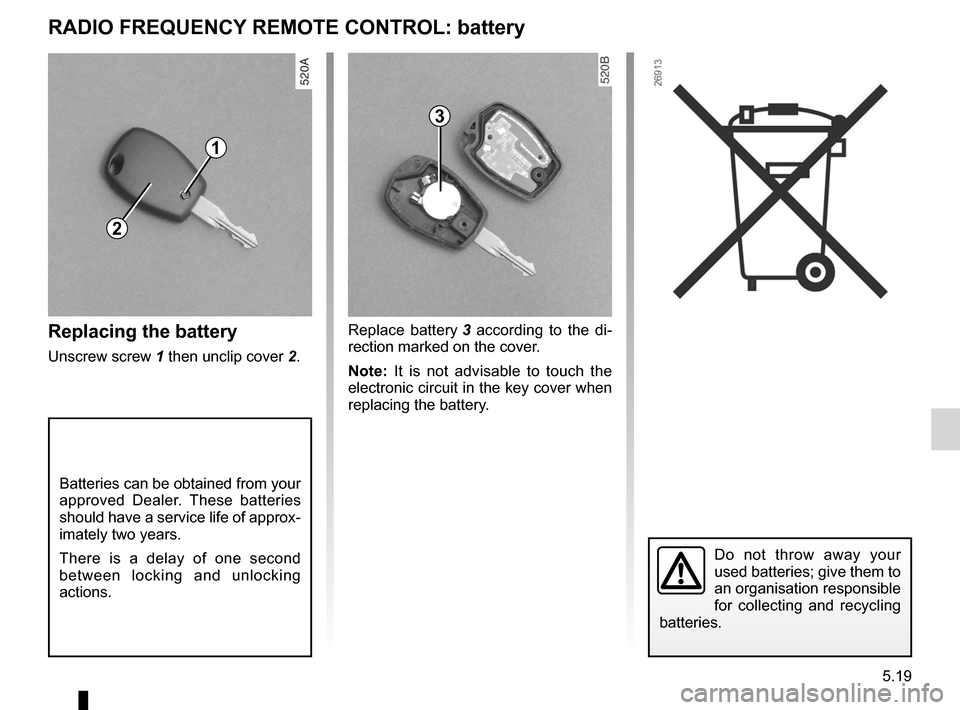
Replacing the battery
Unscrew screw 1 then unclip cover 2. Replace battery
3 according to the di- rection marked on the cover.
Note: It is not advisable to touch the electronic circuit in the key cover when replacing the battery.
Batteries can be obtained from your approved Dealer. These batteries should have a service life of approx- imately two years.
There is a delay of one second between locking and unlocking actions.
Do not throw away your used batteries; give them to an organisation responsible for collecting and recycling batteries.
2
1
3
Page 125 of 146
towing hitch...........................................(up to the end of the DU)practical advice .....................................(up to the end of the DU)towingbreakdown ......................................(up to the end of the DU)
5.25
ENG_UD5611_1Remorquage : dépannage (B90 - Dacia)ENG_NU_817-2_NU_Dacia_5
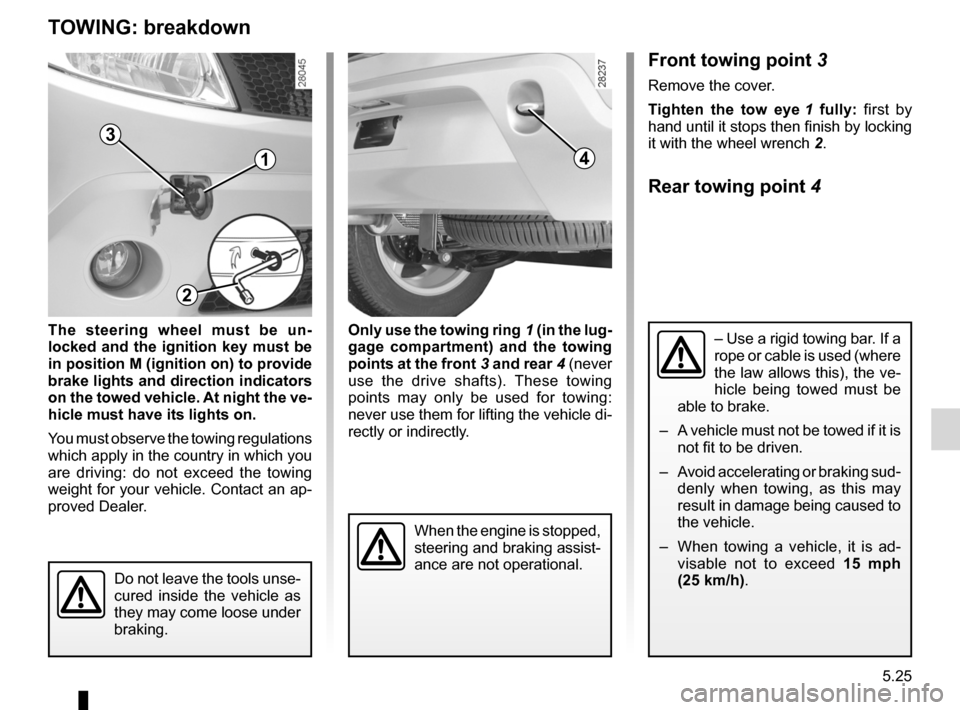
Front towing point 3
Remove the cover.
Tighten the tow eye 1 fully: first by hand until it stops then finish by locking
it with the wheel wrench 2.
Rear towing point 4
Remorquage : dépannage
TOWING: breakdown
The steering wheel must be un- locked and the ignition key must be in position M (ignition on) to provide brake lights and direction indicators on the towed vehicle. At night the ve- hicle must have its lights on.
You must observe the towing regulations which apply in the country in which you are driving: do not exceed the towing
weight for your vehicle. Contact an ap- proved Dealer.
Only use the towing ring 1 (in the lug- gage compartment) and the towing points at the front 3 and rear 4 (never use the drive shafts). These towing points may only be used for towing: never use them for lifting the vehicle di- rectly or indirectly.
When the engine is stopped, steering and braking assist- ance are not operational.Do not leave the tools unse- cured inside the vehicle as they may come loose under braking.
41
3
2
– Use a rigid towing bar. If a rope or cable is used (where the law allows this), the ve- hicle being towed must be able to brake.
– A vehicle must not be towed if it is
not fit to be driven.
– Avoid accelerating or braking sud
- denly when towing, as this may result in damage being caused to the vehicle.
– When towing a vehicle, it is ad
- visable not to exceed 15 mph
(25 km/h).