2013 DACIA SANDERO doors
[x] Cancel search: doorsPage 66 of 146
ENG_NU_817-2_NU_Dacia_2
ADVICE ON ANTIPOLLUTION, FUEL ECONOMY AND DRIVING (continued)
– In vehicles fitted")
2.8
ENG_UD5485_1Conseils antipollution, économies de carburant, conduite (U90 - Daci\
a)ENG_NU_817-2_NU_Dacia_2
ADVICE ON ANTIPOLLUTION, FUEL ECONOMY AND DRIVING (continued)
– In vehicles fitted with air condi- tioning, it is normal to observe an increase in fuel consumption (es- pecially in city conditions) when it is used. For vehicles fitted with manual air conditioning, switch off the system when it is not required.
Some advice for reducing fuel consumption and therefore help- ing to protect the environment:
– It is advisable to drive with the air
vents open and the windows closed.
– If the vehicle has been parked in the
sun, open the doors for a few mo- ments to let the hot air escape before starting the engine.
– Never fill the fuel tank to the brim to
avoid overflow.
– Do not leave an empty roof rack
fitted to the vehicle.
– It is better to fit a trailer for bulky ob
- jects.
– When towing a caravan, fit a wind
deflector and adjust it carefully.
Advice on use
– Electricity is fuel; switch off all the electrical components which are not really needed.
However (safety first), keep your lights on when the visibility is bad (“see and be seen”).
– Use the air vents. Driving with the
windows open will increase fuel consumption by 4% at a speed of 60 mph (100 km/h). –
Avoid using the vehicle for door-to
- door journeys (short journeys, with long stops in-between) because in these conditions, the engine never reaches its ideal temperature.
Tyres
Increased fuel consumption could be the result of:
– insufficient pressure,
– using non-recommended tyres.
Page 78 of 146
air conditioning .....................................(up to the end of the DU)heating system .....................................(up to the end of the DU)heating and air conditioning system .....(up to the end of the DU)ventilationheating and air conditioning system (up to the end of the DU)air conditioning ......................................................(current page)
3.8
ENG_UD5493_1Air conditionné : informations et conseils utilisation (U90 - Dacia)\
ENG_NU_817-2_NU_Dacia_3
AIR CONDITIONING: information and advice on use
Fuel consumption
You will normally notice an increase in fuel consumption (especially when driving in town) when the air conditioning is operating.
For vehicles fitted with manual air conditioning, switch off the system when it is not required.
Some advice for reducing fuel consumption and therefore help- ing to protect the environment:It is advisable to drive with the vents open and the windows closed.
If the vehicle has been parked in the sun, open the doors for a few moments to let the hot air escape before starting the engine.
Maintenance
Refer to the Maintenance Service Booklet for your vehicle for the in- spection frequency.
Operating faults
As a general rule, contact your approved dealer in the event of an operating fault.
No cold air is being produced.
Check that the controls are set cor- rectly and that the fuses are sound. Otherwise, switch off the system.
Do not open the refriger- ant fluid circuit. The fluid may damage the eyes or skin.
Presence of water under the ve- hicle. After prolonged use of the air conditioning system, it is normal for water to be present under the ve- hicle. This is caused by condensa- tion.
Page 79 of 146
lighting:interior .............................................(up to the end of the DU)courtesy light ........................................(up to the end of the DU)map reading lights ................................(up to the end of the DU)
3.9
ENG_UD5582_1Eclairage intérieur (B90 - Dacia)ENG_NU_817-2_NU_Dacia_3
Éclairage intérieur
INTERIOR LIGHTING
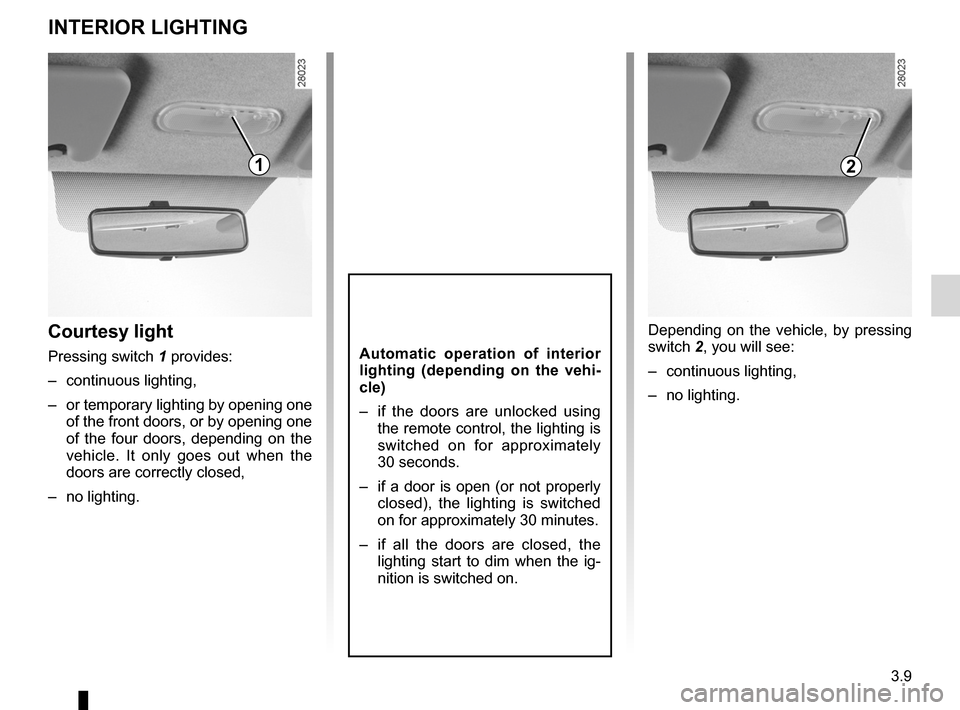
Courtesy light
Pressing switch 1 provides:
– continuous lighting,
– or temporary lighting by opening one
of the front doors, or by opening one of the four doors, depending on the vehicle. It only goes out when the doors are correctly closed,
– no lighting.
Automatic operation of interior lighting (depending on the vehi- cle)
– if the doors are unlocked using
the remote control, the lighting is switched on for approximately
30 seconds.
– if a door is open (or not properly
closed), the lighting is switched on for approximately 30 minutes.
– if all the doors are closed, the
lighting start to dim when the ig- nition is switched on.
Depending on the vehicle, by pressing
switch 2, you will see:
– continuous lighting,
– no lighting.
12
Page 86 of 146
tailgate ...................................................................(current page)transporting objectsin the luggage compartment ............................(current page)
3.16
ENG_UD5587_1Coffre à bagage / transport d’objets dans le coffre (B90 - Dacia)ENG_NU_817-2_NU_Dacia_3
Coffre à bagages - Transport d’objets dans le coffre
LUGGAGE COMPARTMENT - TRANSPORTING OBJECTS IN THE LUGGAGE COMPARTMENT
Tailgate
Manual control
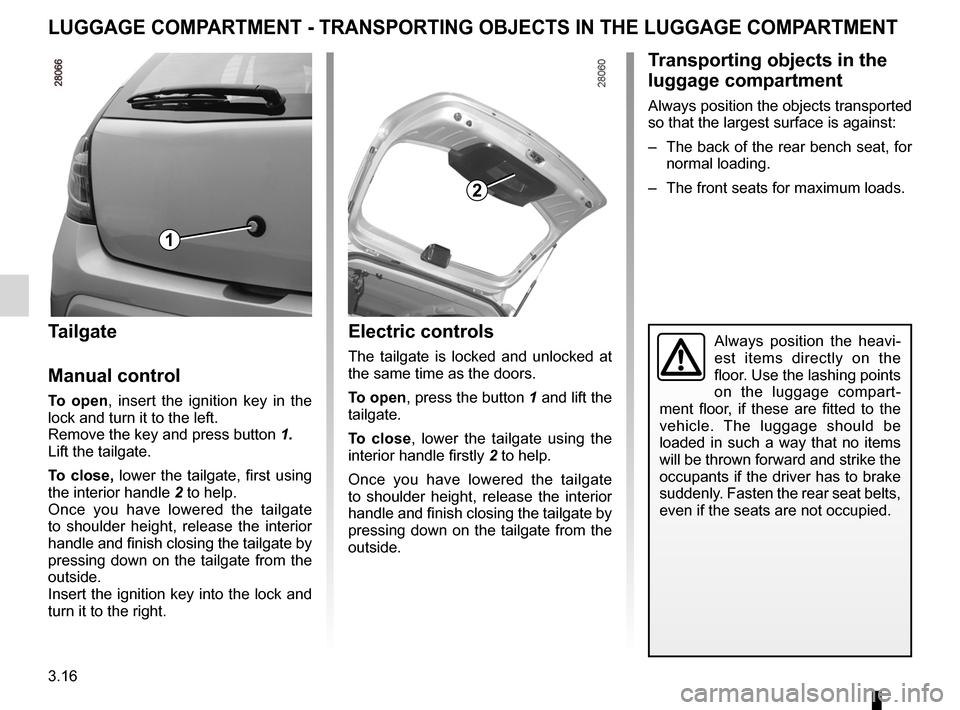
To open, insert the ignition key in the lock and turn it to the left.
Remove the key and press button 1.Lift the tailgate.
To close, lower the tailgate, first using
the interior handle 2 to help.Once you have lowered the tailgate to shoulder height, release the interior handle and finish closing the tailgate by pressing down on the tailgate from the outside.Insert the ignition key into the lock and turn it to the right.
Always position the heavi- est items directly on the floor. Use the lashing points on the luggage compart- ment floor, if these are fitted to the vehicle. The luggage should be loaded in such a way that no items will be thrown forward and strike the occupants if the driver has to brake suddenly. Fasten the rear seat belts, even if the seats are not occupied.
Transporting objects in the
luggage compartment
Always position the objects transported so that the largest surface is against:
– The back of the rear bench seat, for
normal loading.
– The front seats for maximum loads.
Electric controls
The tailgate is locked and unlocked at the same time as the doors.
To open , press the button 1 and lift the tailgate.
To close, lower the tailgate using the
interior handle firstly 2 to help.
Once you have lowered the tailgate to shoulder height, release the interior handle and finish closing the tailgate by pressing down on the tailgate from the outside.
1
2
Page 123 of 146

JauneNoirNoir texte
5.23
ENG_UD5610_1Fusibles (B90 - Dacia)ENG_NU_817-2_NU_Dacia_5
FUSES (continued)
SymbolAllocation
ÌHorn
ôMain power supply
ñHeated seats
sHeated door mirrors
hElectric front windows
ZInterior lighting
eElectric door mirror
àHeating
àTowing
SymbolAllocation
ÅAir bag
PRight-hand main beam headlight
QLeft-hand main beam headlight
LLeft-hand dipped beam headlight
TRight-hand dipped beam headlight
VRight-hand side light
YLeft-hand side light
FRear fog light
hElectric rear windows
Allocation of fuses(the presence of certain fuses DEPENDS ON THE VEHICLE EQUIPMENT LEVEL)\
SymbolAllocation
nABS
îRadio
ßBrake lights and reversing light
àAir conditioning
GFront fog lights
aInstrument panel Injection
fWindscreen wiper
]Central locking of doors and tailgate
CRear screen de-icing
ÙFitting for alarm
Page 143 of 146

7.1
FRA_UD8707_2Index (B90 - Dacia)ENG_NU_817-2_NU_Dacia_7
children .............................................................. 1.4 – 1.5, 1.14cigar lighter ........................................................................\
3.12clock ........................................................................\
..........1.45control instruments ................................................1.36 → 1.47controls ................................................................... 1.34 – 1.35courtesy light .......................................................................3.9
Ddashboard............................................................... 1.34 – 1.35demistingwindscreen .....................................................................3.6dimensions ........................................................................\
..6.5dipstick.......................................................................4.3 → 4.5doors........................................................................\
... 1.4 – 1.5driver’s position ...................................................... 1.34 – 1.35driving .................................................... 2.2 → 2.9, 2.11 – 2.12
Eelectric door locking .............................................................1.5electric windows ..................................................... 3.10 – 3.11emergency spare wheel ..................................... 5.2, 5.7 → 5.9enginetechnical specifications ..................................................6.4engine coolant .....................................................................4.7engine immobiliser...............................................................1.7engine immobiliser (switch) .................................................2.2
engine oil ...................................................................4.3 → 4.5engine oil grade .......................................................... 4.4 – 4.5engine specifications ...........................................................6.4environment ........................................................................\
.2.9
Ffaultsoperating faults ................................................5.30 → 5.33filterair filter ........................................................................\
...4.8
AABS ........................................................................\
...........2.12accessories........................................................................\
5.29accessories - installation ...................................................5.29adjusting your driving position ......................... 1.9, 1.11 – 1.12advice on antipollution ...........................................5.22 → 5.24air bag....................................................................1.15 → 1.20activating the front passenger air bags ........................1.31deactivating the front passenger air bags ....................1.30air conditioning ..........................................................3.4 → 3.8air vents ...................................................................... 3.2 – 3.3anti-lock braking system: ABS ...........................................2.12antipollutionadvice ..................................................................2.6 → 2.8ashtrays ........................................................................\
.....3.12
Bbattery........................................................................\
..........4.9troubleshooting ................................................. 5.20 – 5.21battery (remote control) .....................................................5.19bodywork (maintenance) ........................................ 4.10 – 4.11bonnet........................................................................\
..........4.2brake fluid ........................................................................\
....4.6bulbschanging ..........................................................5.11 → 5.18
Ccapacity of mechanical components.............................4.3, 4.9catalytic converter................................................................2.4central door locking .............................................................1.5changing a bulb .....................................................5.11 → 5.18changing a wheel.................................................................5.6child booster seat ................................................... 1.21 – 1.22child restraint/seat .................................................1.21 → 1.29child safety...................................................... 1.4, 1.21 → 1.29child seats..............................................................1.21 → 1.29
AlphABEtiCAl inDEx