2013 DACIA LODGY heating
[x] Cancel search: heatingPage 93 of 258

Downloaded from www.Manualslib.com manuals search engine JauneNoir Noir texte
2.23
ENG_UD33448_2
Frein à main / Direction assistée (X67 - X92 - Renault) ENG_NU_975-8_X92_Dacia_2
Handbrake
To release
Pull lever 1 up slightly, press button 2
and then lower the lever to the floor.
The red warning light on the instrument
panel will come on if you are driving
with an incorrectly released handbrake.
HANDBRAKE/POWER-ASSISTED STEERING
To apply
Pull lever 1 upwards and make sure the
vehicle is immobilised.
Depending on the gradient
and/or vehicle load, it may
be necessary when station-
ary to apply the brake by
at least a further two notches and
engage a gear (1
st or reverse gear).
Never switch off the igni-
tion when travelling down-
hill, and avoid doing so in
normal driving (assistance
is not provided).
Make sure that the hand-
brake is properly released
when driving (red indicator
light off), otherwise over-
heating, or even damage, may
occur.
1
2
Power-assisted steering
With the engine running, do not leave
the steering wheel at full lock while sta-
tionary as this may damage the power-
assisted steering pump.
With the engine switched off, or if there
is a system fault, it is still possible to
turn the steering wheel. The force re-
quired will be greater.
Page 109 of 258

Downloaded from www.Manualslib.com manuals search engine JauneNoir Noir texte
2.39
ENG_UD24437_1
Boîte de vitesses automatique (X92 - Renault) ENG_NU_975-8_X92_Dacia_2
AUTOMATIC TRANSMISSION (2/3)
Driving in manual modeWith the selector lever in position D,
move the lever to the left into the M
position. Shifting the lever repeatedly
allows you to change gears manually:
– to move down through the gears,
push the lever forwards;
– to move up through the gears, push
the lever backwards.
The gear selected is displayed on the
instrument panel.
Special circumstances
– If the bends and road surface do
not allow you to stay in automatic
mode (e.g. in the mountains), we
recommend that you change to
manual mode. This will prevent the
automatic gearbox from changing
gear repeatedly when climbing, and
permit engine braking on long de-
scents.
– On a slippery surface or surface
with little grip, change to manual
mode M and select second gear
before accelerating to avoid wheel-
spin.
Special cases
In certain driving conditions (e.g. re-
quiring engine protection, operation of
the Electronic Stability Program: ESC)
the automatic system may change the
gear automatically. Likewise, to prevent
incorrect manoeuvres, a gear change
may be refused by the automatic
system: in this case the gear display
flashes for a few seconds as a warning.
An impact to the under-
side of the vehicle while
manoeuvring (e.g.: strik-
ing a post, raised kerb or
other street furniture) may result in
damage to the vehicle (e.g.: defor-
mation of an axle).
To avoid any risk of accident, have
your vehicle checked by an ap-
proved Dealer.
When facing uphill, to remain
stopped, do not keep your foot on
the accelerator.
Risk of overheating the automatic
gearbox.
Page 111 of 258

Downloaded from www.Manualslib.com manuals search engine JauneNoir Noir texte
3.1
ENG_UD38222_8
Sommaire 3 (X92 - Renault) ENG_NU_975-8_X92_Dacia_3
Section 3: Your comfort
Air vents, air outlets . . . . . . . . . . . . . . . . . . . . . . . . . . . . . . . . . . . . . . . . . . . . . . . . . . . . . . . . . . . . . . 3.2
Heating, Ventilation, Air conditioning . . . . . . . . . . . . . . . . . . . . . . . . . . . . . . . . . . . . . . . . . . . . . . . . . 3.4
Air conditioning: information and advice on use . . . . . . . . . . . . . . . . . . . . . . . . . . . . . . . . . . . . . . . . 3.7
Electric windows . . . . . . . . . . . . . . . . . . . . . . . . . . . . . . . . . . . . . . . . . . . . . . . . . . . . . . . . . . . . . . . . 3.8
Interior lighting . . . . . . . . . . . . . . . . . . . . . . . . . . . . . . . . . . . . . . . . . . . . . . . . . . . . . . . . . . . . . . . . . . 3.11
Sun visor, Grab handle . . . . . . . . . . . . . . . . . . . . . . . . . . . . . . . . . . . . . . . . . . . . . . . . . . . . . . . . . . . 3.12
Passenger compartment storage space and fittings . . . . . . . . . . . . . . . . . . . . . . . . . . . . . . . . . . . . . 3.13
Ashtrays, Cigarette lighter, Accessories socket . . . . . . . . . . . . . . . . . . . . . . . . . . . . . . . . . . . . . . . . . 3.17
Rear headrests . . . . . . . . . . . . . . . . . . . . . . . . . . . . . . . . . . . . . . . . . . . . . . . . . . . . . . . . . . . . . . . . . 3.19
Rear seats: . . . . . . . . . . . . . . . . . . . . . . . . . . . . . . . . . . . . . . . . . . . . . . . . . . . . . . . . . . . . . . . . . . . . 3.21
second row . . . . . . . . . . . . . . . . . . . . . . . . . . . . . . . . . . . . . . . . . . . . . . . . . . . . . . . . . . . . . . . 3.21
third row . . . . . . . . . . . . . . . . . . . . . . . . . . . . . . . . . . . . . . . . . . . . . . . . . . . . . . . . . . . . . . . . . 3.24
grouping of seats . . . . . . . . . . . . . . . . . . . . . . . . . . . . . . . . . . . . . . . . . . . . . . . . . . . . . . . . . . 3.27
Boot . . . . . . . . . . . . . . . . . . . . . . . . . . . . . . . . . . . . . . . . . . . . . . . . . . . . . . . . . . . . . . . . . . . . . . . . . . 3.30
Boot storage space and fittings . . . . . . . . . . . . . . . . . . . . . . . . . . . . . . . . . . . . . . . . . . . . . . . . . . . . . 3.31
Transporting objects in the boot . . . . . . . . . . . . . . . . . . . . . . . . . . . . . . . . . . . . . . . . . . . . . . . . . . . . 3.32
Transporting objects: towing, attachments . . . . . . . . . . . . . . . . . . . . . . . . . . . . . . . . . . . . . . . . . . . . 3.33
Luggage net. . . . . . . . . . . . . . . . . . . . . . . . . . . . . . . . . . . . . . . . . . . . . . . . . . . . . . . . . . . . . . . . . . . . 3.34
Luggage compartment cover . . . . . . . . . . . . . . . . . . . . . . . . . . . . . . . . . . . . . . . . . . . . . . . . . . . . . . . 3.35
Roof bars . . . . . . . . . . . . . . . . . . . . . . . . . . . . . . . . . . . . . . . . . . . . . . . . . . . . . . . . . . . . . . . . . . . . . . 3.36
Multimedia equipment . . . . . . . . . . . . . . . . . . . . . . . . . . . . . . . . . . . . . . . . . . . . . . . . . . . . . . . . . . . . 3.37
Page 114 of 258

Downloaded from www.Manualslib.com manuals search engine JauneNoir Noir texte
3.4
ENG_UD38154_2
Chauffage, Ventilation, Air Conditionné (X92 - Dacia) ENG_NU_975-8_X92_Dacia_3
HEATING, VENTILATION, AIR CONDITIONING (1/3)
Controls
The controls will depend on the vehicle
equipment level.
1 Distribution of air.
2 Switching air conditioning on or off.
3 Adjusting the ventilation fan speed.
4 Adjusting the air temperature.
5 Switching passenger compartment
isolation mode/air recirculation mode
on
Adjusting the air temperature
Turn the control 4 to obtain the desired
temperature. The further the pointer is
in the red, the more the temperature will
be increased.
Adjusting the ventilation fan
speed.
Turn control 3 from 0 to 4. The further
to the right it is positioned, the more air
is blown into the passenger compart-
ment. If you want to shut off the flow of
air completely and stop the system, set
control 3 to 0.
The system is deactivated: the ventila-
tion speed for the passenger compart-
ment air is zero (vehicle stationary),
you can however still feel a slight flow
of air when the vehicle is moving.
Information and advice on use: refer
to information on “Air conditioning: in-
formation and advice on use”.
123
5
4
Leaving this control in position 0 for
prolonged periods can lead to con-
densation forming on the side win-
dows and windscreen and problems
due to the use of non-renewed air in
the passenger compartment.
Page 115 of 258

Downloaded from www.Manualslib.com manuals search engine JauneNoir Noir texte
3.5
ENG_UD38154_2
Chauffage, Ventilation, Air Conditionné (X92 - Dacia) ENG_NU_975-8_X92_Dacia_3
HEATING, VENTILATION, AIR CONDITIONING (2/3)
Switching passenger
compartment isolation mode/
air recirculation mode on.
Bring lever 5 to position â.
Under these conditions, air is taken
from the passenger compartment and
is recirculated, with no air being taken
from outside the vehicle.Air recirculation is used to:
– to isolate the passenger compart-
ment from the external atmosphere
(e.g. driving in polluted areas, etc.);
– to bring the passenger compartment
to the desired temperature as quickly
as possible.
Prolonged use of air recirculation
can lead to condensation form-
ing on the side windows and wind-
screen, and discomfort due to the
use of non-renewed air in the pas-
senger compartment.
You should return to normal mode
(external air) as soon as air recircu-
lation is no longer required, by turn-
ing the control 5 to the right.
31
5
Rapid demisting
Turn controls 1, 3 and 5 to positions
W:
– air from the outside;
– maximum fan speed;
– demisting.
Using the climate control increases the
speed of demisting.
Page 116 of 258
Downloaded from www.Manualslib.com manuals search engine JauneNoir Noir texte
3.6
ENG_UD38154_2
Chauffage, Ventilation, Air Conditionné (X92 - Dacia) ENG_NU_975-8_X92_Dacia_3
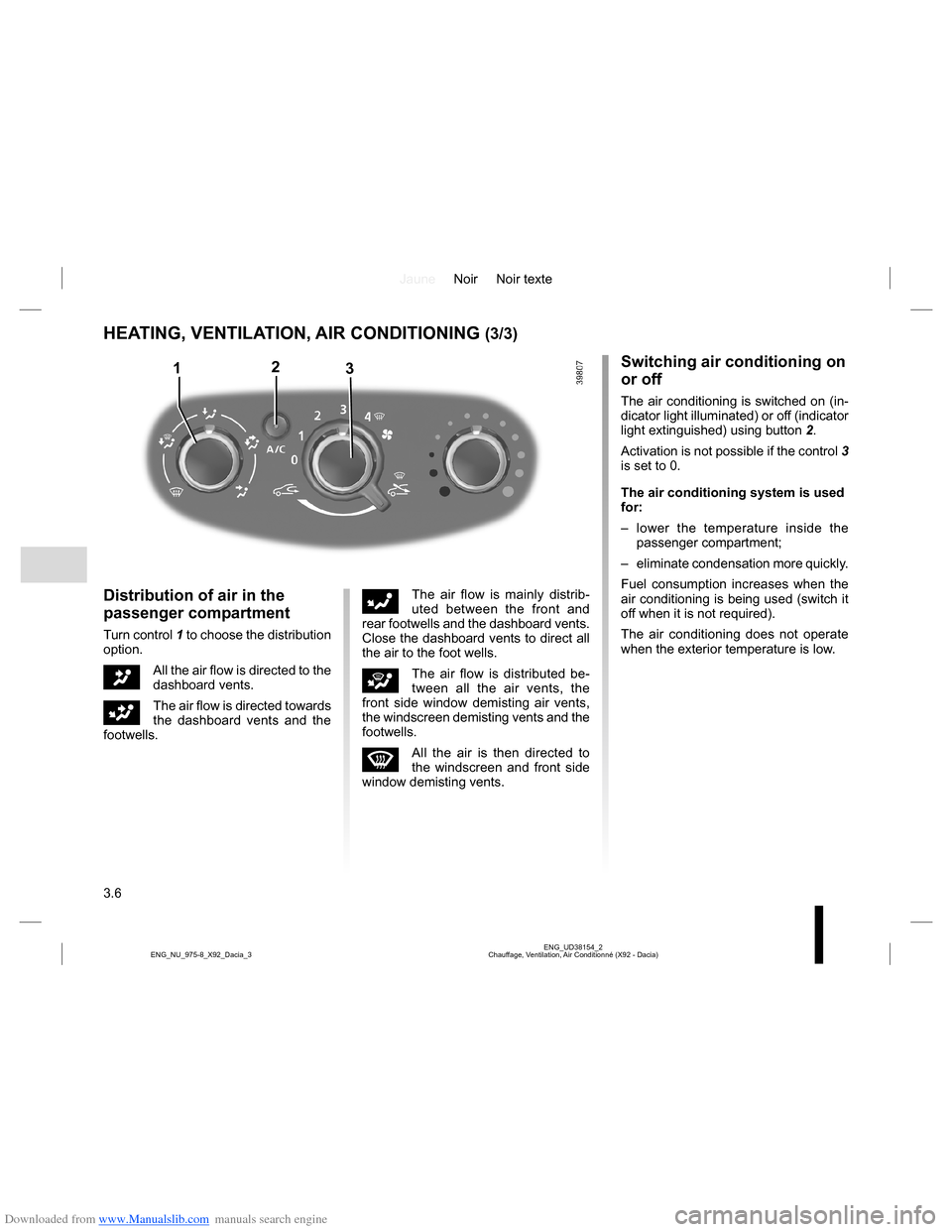
HEATING, VENTILATION, AIR CONDITIONING (3/3)
Distribution of air in the
passenger compartment
Turn control 1 to choose the distribution
option.
JAll the air flow is directed to the
dashboard vents.
GThe air flow is directed towards
the dashboard vents and the
footwells.
FThe air flow is mainly distrib-
uted between the front and
rear footwells and the dashboard vents.
Close the dashboard vents to direct all
the air to the foot wells.
iThe air flow is distributed be-
tween all the air vents, the
front side window demisting air vents,
the windscreen demisting vents and the
footwells.
WAll the air is then directed to
the windscreen and front side
window demisting vents.
Switching air conditioning on
or off
The air conditioning is switched on (in-
dicator light illuminated) or off (indicator
light extinguished) using button 2.
Activation is not possible if the control 3
is set to 0.
The air conditioning system is used
for:
– lower the temperature inside the
passenger compartment;
– eliminate condensation more quickly.
Fuel consumption increases when the
air conditioning is being used (switch it
off when it is not required).
The air conditioning does not operate
when the exterior temperature is low.
132
Page 197 of 258

Downloaded from www.Manualslib.com manuals search engine JauneNoir Noir texte
5.31
ENG_UD24481_1
Balais d’essuie-vitres (X92 - Renault) ENG_NU_975-8_X92_Dacia_5
WIPER BLADES
Replacing windscreen wiper
blades 1
– With the ignition switched off, lift
wiper arm 3;
– turn the blade horizontally (move-
ment A);
– press tab 2 and slide the wiper blade
downwards (movement D) until
hook 4 on the wiper arm is released.
– slide the blade (movement C) then
lift it (movement B) to release it.
12
3
4
Replacing the rear screen
wiper blade 6
– With the ignition switched off, lift
wiper arm 5;
– pivot the blade 6 until some resist-
ance is met;
– pull the blade to release it (move-
ment E).
Refitting a front or rear wiper
blade
To refit the wiper blade, proceed in re-
verse order to removal. Make sure that
the blade is correctly locked in position.
Check the condition of the wiper
blades. You are responsible for their
service life:
– clean the blades, windscreen and
rear screen regularly with soapy
water;
– do not use them when the wind-
screen or rear screen are dry;
– free them from the windscreen or
rear screen when they have not
been used for a long time.
– In frosty weather, make
sure that the wiper blades
are not stuck by ice (to
avoid the risk of the motor
overheating).
– Check the condition of the wiper
blades.
Replace the wiper blades as soon
as they begin to lose efficiency
(approximately once a year).
Whilst changing the blade, take care
not to drop the arm onto the window
after it has been removed as this
may break the window.
A
D
C
B
5
6E
Page 228 of 258

Downloaded from www.Manualslib.com manuals search engine JauneNoir Noir texte
7.2
FRA_UD38226_8
Index (X92 - Renault) ENG_NU_975-8_X92_Dacia_7
ALPHABETICAL INDEX (2/5)
emergency braking ................................................2.24 → 2.26
emergency spare wheel ........................5.3 – 5.4, 5.14 → 5.16
engine
technical specifications .................................................. 6.4
engine coolant ..................................................................... 4.8
engine immobiliser (switch) ................................................. 2.2
engine oil ...................................................................4.4 → 4.6
engine oil level ............................................................ 4.5 – 4.6
engine specifications ........................................................... 6.4
engine standby ..........................................................2.5 → 2.7
environment ....................................................................... 2.18
ESC: electronic stability control .............................2.24 → 2.26
F
faults
operating faults ................................................5.36 → 5.40
filter
diesel filter .................................................................... 1.65
particle filter ................................................................... 2.9
fitting a radio ...................................................................... 5.34
fittings ....................................................................3.13 → 3.16
fog lights ............................................................................ 1.56
front passenger air bag deactivation ................................. 1.36
front seat adjustment ......................................................... 1.11
front seats .......................................................................... 1.11
adjustment ................................................................... 1.11
fuel
advice on fuel economy ...................................2.13 → 2.16
consumption ....................................................2.13 → 2.16
filling ............................................................................. 1.62
grade ..................................................................... 1.61, 6.4
fuel consumption ...................................................2.13 → 2.16
fuel economy .........................................................2.13 → 2.16
fuel filler cap ...................................................................... 1.61
fuel grade........................................................................... 1.61
fuel level ............................................................................ 1.48fuel priming bulb ................................................................ 1.65
fuel tank .................................................................1.61 → 1.65
fuel tank capacity ............................................................... 1.61
fuses ......................................................................5.24 → 5.27
G
gear lever........................................................................... 2.22
glove box ........................................................................... 3.13
grab handle........................................................................ 3.12
H
handbrake.......................................................................... 2.23
hands-free telephone integrated control ............................ 3.37
hazard warning lights signal .............................................. 1.58
headlight beam adjustment ............................................... 1.57
headlight flashers .............................................................. 1.58
headrest......................................................... 1.10, 3.19 – 3.20
heated seats ...................................................................... 1.11
heating and air conditioning system ..........................3.2 → 3.7
heating system ..........................................................3.2 → 3.7
horn ................................................................................... 1.58
hubcap tool .......................................................................... 5.2
I
ignition switch ...................................................................... 2.2
indicators .................................................................. 1.58, 5.17
indicators:
direction indicators ....................................................... 1.58
instrument panel ............................................... 1.47 – 1.48
instrument panel ....................................................1.42 → 1.53
instrument panel messages...................................1.49 → 1.53
interior trim
maintenance ..................................................... 4.16 – 4.17
Isofix ......................................................................1.26 → 1.35