2013 CITROEN C4 DAG battery
[x] Cancel search: batteryPage 90 of 340

4
ACCESS
88
*
According to country.
ALARM *
System which protects and provides a
deterrent against theft and break-ins. It
provides the following types of monitoring.
- exterior perimeter
The system checks for opening of the
vehicle.
The alarm is triggered if anyone tries to
open a door, the boot, the bonnet...
- interior volumetric
The system checks for any variation in the
volume in the passenger compartment.
The alarm is triggered if anyone breaks a
window, enters the passenger compart-
ment or moves inside the vehicle.
- tilt
The system checks for any change in
the attitude of the vehicle.
The alarm is triggered if the vehicle is
lifted, moved or knocked.
Self-protection function
The system checks for the putting out
of service of its components.
The alarm is triggered if the battery, the
central control or the siren wiring are
put out of service or damaged.
For all work on the alarm sys-
tem, contact a CITROËN dealer
or a qualifi ed workshop.
Locking the vehicle with full
alarm system
Activation
Switch off the ignition and get out of
the vehicle.
Press the locking button on the re-
mote control.
The monitoring system is active: the in-
dicator lamp in the button fl ashes once
per second.
After the locking button on the remote
control is pressed, the exterior perime-
ter monitoring is activated after a delay
of 5 seconds and the interior volumetric
and anti-tilt monitoring after a delay of
45 seconds. If an opening (door, boot...) is
not closed fully, the vehicle is not
locked but the exterior perimeter
monitoring will be activated af-
ter a delay of 45 seconds at the
same time as the interior volu-
metric and anti-tilt monitoring.
Deactivation
Press the unlocking button on the
remote control.
The alarm system is deactivated: the
indicator lamp in the button goes off.
Page 93 of 340

4
ACCESS
91
BOOT
Opening
After unlocking the boot or the ve-
hicle using the remote control or the
key, press the opening control, then
raise the tailgate.
Closing
Lower the tailgate using the interior
grab handle.
If necessary, press down on the tail-
gate to fully close it.
Tailgate release
System allowing the mechanical unlock-
ing of the boot in the event of a battery or
central locking system malfunction.
Unlocking
Fold back the rear seats to gain
access to the lock from inside the
boot.
Insert a small screwdriver into hole A
of the lock to unlock the tailgate.
Move the latch to the left.
If the tailgate is not closed correctly:
- when the engine is running
,
this warning lamp comes on,
accompanied by the display
of an alert message for a few
seconds,
- when the vehicle is moving
(speed
above 6 mph (10 km/h)), this warn-
ing lamp comes on, accompanied by
an audible signal and the display of
an alert message for a few seconds.
Locking after closing
If the fault persists after closing again,
the boot will remain locked.
Page 95 of 340
4
ACCESS
93
Reinitialisation
After reconnecting the battery or a fault,
you must be reinitialise the operation of
the electric windows. For each of the
control switches on the driver's side
control panel:
pull the control until the window
stops,
release the control and pull it again
until the window closes fully,
continue to hold the control for ap-
proximately one second after the
window has closed,
press the control to lower the win-
dow automatically to the low posi-
tion,
when the window has reached the
low position, press the control again
for approximately one second.
The safety anti-pinch function is not
operational during these operations.
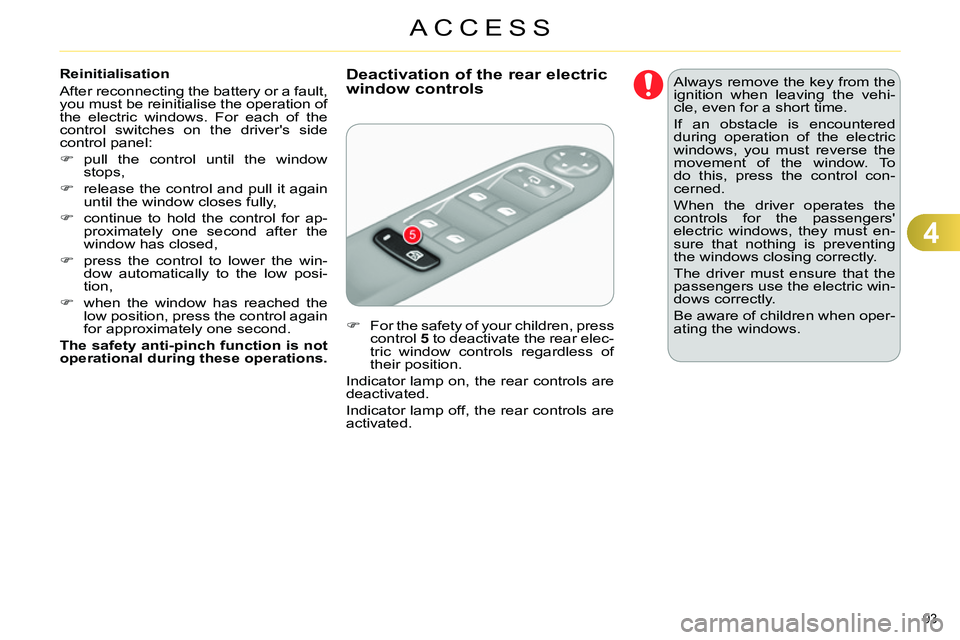
For the safety of your children, press
control 5
to deactivate the rear elec-
tric window controls regardless of
their position.
Indicator lamp on, the rear controls are
deactivated.
Indicator lamp off, the rear controls are
activated.
Deactivation of the rear electric
window controls
Always remove the key from the
ignition when leaving the vehi-
cle, even for a short time.
If an obstacle is encountered
during operation of the electric
windows, you must reverse the
movement of the window. To
do this, press the control con-
cerned.
When the driver operates the
controls for the passengers'
electric windows, they must en-
sure that nothing is preventing
the windows closing correctly.
The driver must ensure that the
passengers use the electric win-
dows correctly.
Be aware of children when oper-
ating the windows.
Page 96 of 340
4
ACCESS
94
PANORAMIC SUNROOF
Your vehicle is fi tted with a tinted glass
panoramic sunroof which increases
the light and visibility in the passenger
compartment. Its electric blind helps
control the temperature in the passen-
ger compartment.
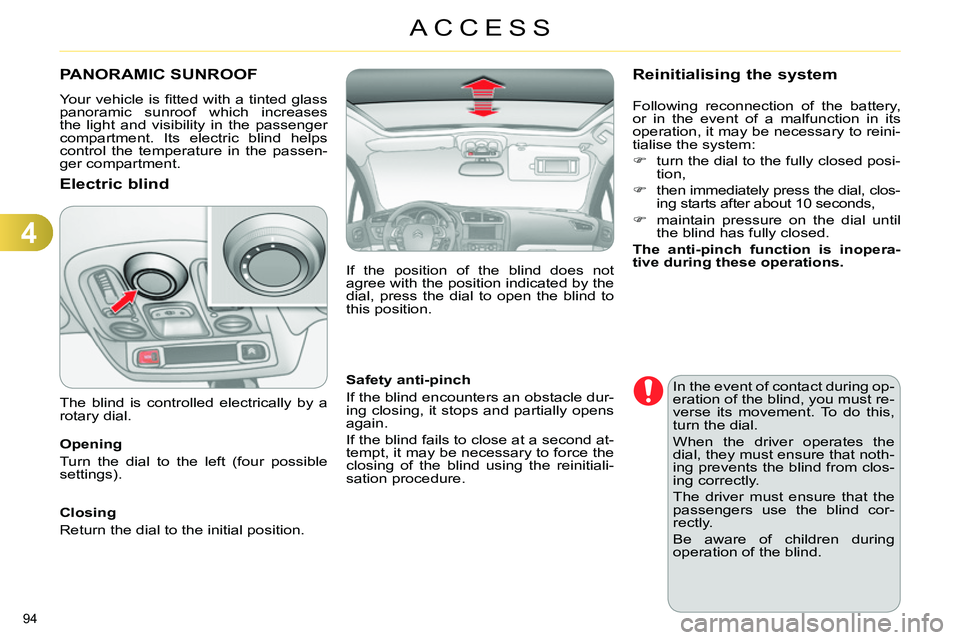
Electric blind
Opening
Turn the dial to the left (four possible
settings).
Closing
Return the dial to the initial position.
Safety anti-pinch
If the blind encounters an obstacle dur-
ing closing, it stops and partially opens
again.
If the blind fails to close at a second at-
tempt, it may be necessary to force the
closing of the blind using the reinitiali-
sation procedure.
The blind is controlled electrically by a
rotary dial.
In the event of contact during op-
eration of the blind, you must re-
verse its movement. To do this,
turn the dial.
When the driver operates the
dial, they must ensure that noth-
ing prevents the blind from clos-
ing correctly.
The driver must ensure that the
passengers use the blind cor-
rectly.
Be aware of children during
operation of the blind.
Reinitialising the system
Following reconnection of the battery,
or in the event of a malfunction in its
operation, it may be necessary to reini-
tialise the system:
turn the dial to the fully closed posi-
tion,
then immediately press the dial, clos-
ing starts after about 10 seconds,
maintain pressure on the dial until
the blind has fully closed.
The anti-pinch function is inopera-
tive during these operations.
If the position of the blind does not
agree with the position indicated by the
dial, press the dial to open the blind to
this position.
Page 103 of 340

5
VISIBILITY
101
Parking lamps
Side markers for the vehicle by illumi-
nation of the sidelamps on the traffi c
side only.
Within one minute of switching off
the ignition, operate the lighting con-
trol stalk up or down depending on
the traffi c side (for example: when
parking on the left; lighting control
stalk upwards; the right hand side-
lamps are on).
This is confi rmed by an audible signal
and illumination of the corresponding
direction indicator warning lamp in the
instrument panel.
To switch off the parking lamps, return
the lighting control stalk to the central
position.
Switching off the lighting when
switching off the ignition
When the ignition is switched off,
all of the lamps switch off immedi-
ately, except for the dipped beam
headlamps if automatic guide-
me-home lighting is activated.
Manual guide-me-home lighting
The temporary illumination of the dipped
beam headlamps after the vehicle's ignition
has been switched off makes the driver's
exit easier when the light is poor.
Switching on
With the ignition off, "fl ash" the
headlamps using the lighting stalk.
A further "headlamp fl ash" switches
the function off.
Switching off
The manual guide-me-home lighting
switches off automatically after a set
time.
Switching on the lighting
when switching on the ignition
To reactivate the lighting control stalk, turn the ring A
to position "0"
- lighting off, then to the position of
your choice.
If the lighting is switched on manu-
ally after switching off the ignition,
there is an audible signal when a
front door is opened to warn the
driver that they have forgotten to
switch off the vehicle's lighting, with
the ignition off.
They switch off automatically after a
period which depends on the state
of charge of the battery (entry to en-
ergy economy mode).
Page 125 of 340
6
FITTINGS
123
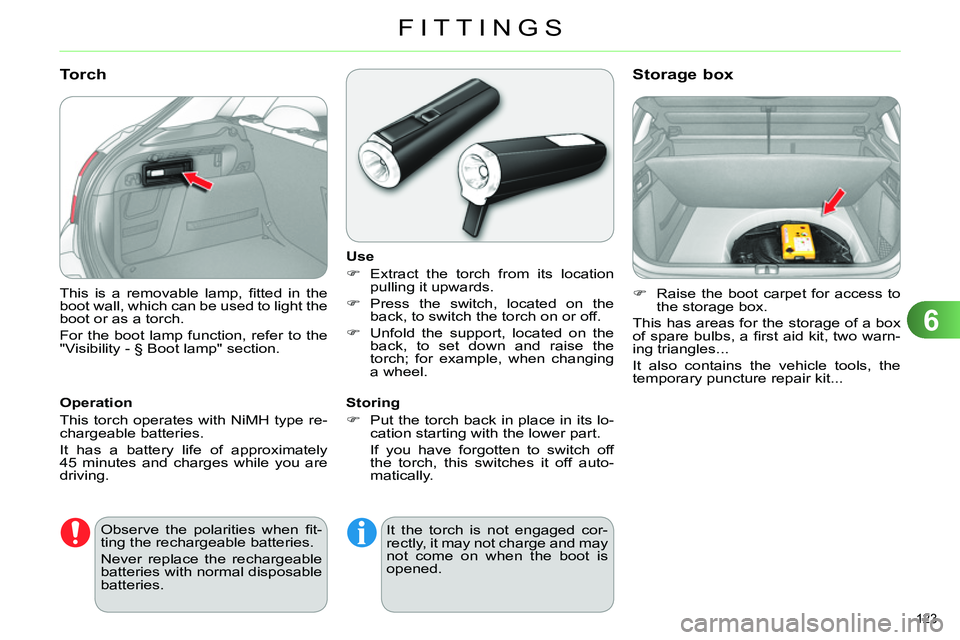
This is a removable lamp, fi tted in the
boot wall, which can be used to light the
boot or as a torch.
For the boot lamp function, refer to the
"Visibility - § Boot lamp" section.
Torch
Operation
This torch operates with NiMH type re-
chargeable batteries.
It has a battery life of approximately
45 minutes and charges while you are
driving.
Use
Extract the torch from its location
pulling it upwards.
Press the switch, located on the
back, to switch the torch on or off.
Unfold the support, located on the
back, to set down and raise the
torch; for example, when changing
a wheel.
Storing
Put the torch back in place in its lo-
cation starting with the lower part.
If you have forgotten to switch off
the torch, this switches it off auto-
matically.
Raise the boot carpet for access to
the storage box.
This has areas for the storage of a box
of spare bulbs, a fi rst aid kit, two warn-
ing triangles...
It also contains the vehicle tools, the
temporary puncture repair kit...
Storage box
Observe the polarities when fi t-
ting the rechargeable batteries.
Never replace the rechargeable
batteries with normal disposable
batteries. It the torch is not engaged cor-
rectly, it may not charge and may
not come on when the boot is
opened.
Page 154 of 340

9
DRIVING
152
Automatic release
The electric parking brake releases auto-
matically and progressively
when you
press the accelerator:
Manual gearbox:
press down fully
on the clutch pedal, engage fi rst
gear or reverse, press on the accel-
erator pedal and move off.
Electronic gearbox
: select position A
,
M
or R
then press on the accelerator
pedal.
Full release of the parking brake is con-
fi rmed by:
- the braking warning lamp
and the P
warning lamp in
the control lever A
going off,
- display of the message
"Parking brake off".
When stationary, with the engine
running, do not press the ac-
celerator pedal unnecessarily,
as you may release the parking
brake.
Immobilising the vehicle,
engine running
With the engine running and the vehi-
cle stationary, in order to immobilise the
vehicle it is essential to manually
ap-
ply the parking brake by pulling
control
lever A
.
- illumination of the braking
warning lamp and the P
warn-
ing lamp in the control lever A
,
- display of the message
"Parking brake on".
Before leaving the vehicle, en-
sure that parking brake warning
lamp in the instrument panel is
on fi xed, not fl ashing.
Particular situations
In certain situations (e.g. starting the
engine), the parking brake can auto-
matically alter its force. This is normal
operation.
To advance your vehicle a few centime-
tres without starting the engine, but with
the ignition on, press on the brake pedal
and release the parking brake by pull-
ing
then releasing
the control lever A
.
The full release of the parking brake is
confi rmed by the warning lamps in the
control lever A
and in the instrument
panel going off and display of the mes-
sage "Parking brake off".
If the parking brake develops a fault
while applied
or if the battery runs fl at,
an emergency release is always pos-
sible.
When the driver’s door is opened, a
message is displayed accompanied by
an audible signal, if the parking brake
has not been applied. The application of the parking brake is
confi rmed by:
Page 155 of 340

9
DRIVING
153
Emergency braking
In the event of failure of the
electronic stability control sys-
tem, signalled by the illumi-
nation of this warning lamp,
braking stability is then not guaranteed.
In this event, stability must be assured
by the driver by repeating alternate
"pull-release" actions on the control
lever A
.
In the event of a failure of the main ser-
vice brake or in an exceptional situation
(e.g. driver taken ill, under instruction,
etc) a continuous pull on the control
lever A
will stop the vehicle.
The electronic stability control provides
stability during emergency braking.
If the emergency braking malfunctions,
the message "Parking brake faulty" will
be displayed.
The emergency braking must
only be used in exceptional cir-
cumstances.
Emergency release
In the event of the electric parking brake
malfunctioning or the battery running
fl at, an emergency device can be used
to release the parking brake manually.
Access to tools
The tools are stowed in the storage box
under the boot carpet.
* Available according to equipment: if
these tools are not present, contact a
CITROËN dealer or a qualifi ed work-
shop to obtain them.
B
Chocks*.
C
Release crank*.