Page 298 of 408

Black plate (34,1)Chevrolet TRAX Owner Manual - 2013 - CRC - 3/6/13
10-34 Vehicle Care
Mini Fuses Usage1 Sunroof
2 Outside Rearview Mirror Switch
3 Canister Vent Solenoid (1.4L Only)
4 Not Used
5 Electronic Brake Control Module
Valve
6 Not Used
7 Not Used
8 Transmission Control Module
Battery
9 Not Used
10 Fuel System Control Module
R/C (1.4L Only)/
Headlamp Leveling
11 Rear Wiper Mini Fuses Usage
12 Rear Window Defogger
13 Not Used
14 Outside Rearview Mirror Heater
15 Fuel System Control Module Battery
(1.4L Only)
16 Heated Seat Module
17 Transmission Control Module R/C
18 Engine Control Module R/C
19 Fuel Pump (1.8L Only)
20 Not Used
21 Fan Relay (Auxiliary Fuse Block –1.4L)/
Fan 3 Relay
85 (1.8L)
22 Cold Start Pump (1.8L Only) Mini Fuses Usage
23 Ignition Coil/Injectors
24 Washer Pump
25 Not Used
26 Canister Purge Solenoid/Water
Valve Solenoid/
Oxygen Sensors –
Pre and Post/
Turbo Wastegate
Solenoid (1.4L)/
Turbo Bypass
Solenoid (1.4L)/
IMTV
Solenoid (1.8L)
27 Not Used
28 Not Used
29 Engine Control Module Powertrain
Ignition 1/Ignition 2
30 Mass Air Flow Sensor
31 Left High-Beam Headlamp
Page 299 of 408
Black plate (35,1)Chevrolet TRAX Owner Manual - 2013 - CRC - 3/6/13
Vehicle Care 10-35
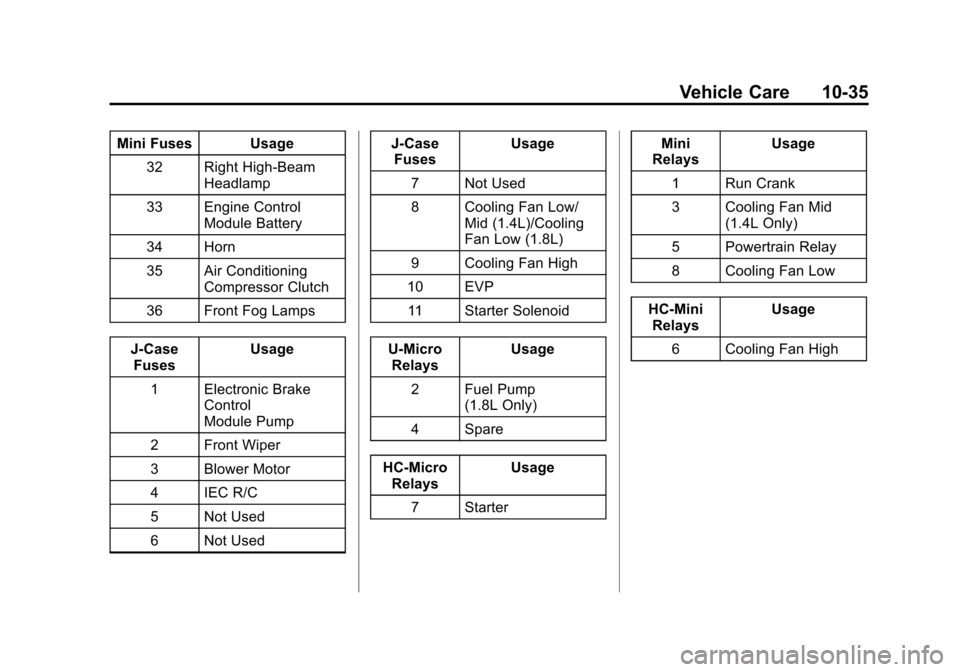
Mini Fuses Usage32 Right High-Beam Headlamp
33 Engine Control Module Battery
34 Horn
35 Air Conditioning Compressor Clutch
36 Front Fog Lamps
J-Case Fuses Usage
1 Electronic Brake Control
Module Pump
2 Front Wiper
3 Blower Motor
4 IEC R/C
5 Not Used
6 Not Used J-Case
Fuses Usage
7 Not Used
8 Cooling Fan Low/ Mid (1.4L)/Cooling
Fan Low (1.8L)
9 Cooling Fan High
10 EVP 11 Starter Solenoid
U-Micro Relays Usage
2 Fuel Pump (1.8L Only)
4 Spare
HC-Micro Relays Usage
7 Starter Mini
Relays Usage
1 Run Crank
3 Cooling Fan Mid (1.4L Only)
5 Powertrain Relay
8 Cooling Fan Low
HC-Mini Relays Usage
6 Cooling Fan High
Page 301 of 408
Black plate (37,1)Chevrolet TRAX Owner Manual - 2013 - CRC - 3/6/13
Vehicle Care 10-37
Instrument Panel Fuse Block
The vehicle may not be equipped
with all of the fuses, relays, and
features shown. Mini Fuses Usage
1 Body Control Module 1
2 Body Control Module 2
3 Body Control Module 3
4 Body Control Module 4
5 Body Control Module 5
6 Body Control Module 6
7 Body Control Module 7
8 Body Control Module 8
9 Discrete Logic Ignition Sensor
10 Sensing Diagnostic Module Battery
11 Data Link Connection Mini Fuses Usage
12 Heater, Ventilation, and Air Conditioning
MDL/ICS
13 Liftgate Relay
14 UPA Module
15 LDW Module/Inside Rearview Mirror
16 Adaptive Forward Lighting Module
17 Power WNDWSW DR
18 Rain Sensor
19 Body Control Module Regulated
Voltage Control
20 Steering Wheel Switch Backlighting
21 A/C Accessory Power Outlet/
PRNDL
Page 302 of 408
Black plate (38,1)Chevrolet TRAX Owner Manual - 2013 - CRC - 3/6/13
10-38 Vehicle Care
Mini Fuses Usage22 Cigar Lighter/DC Accessory Power
Outlet
23 Spare
24 Spare
25 Spare
26 Sensing Diagnostic Module RC/
Automatic Occupant
Sensing Display
27 IPC/Compass Module
28 Headlamp Switch// DC Converter/Clutch
Switch
29 Spare
30 Spare Mini Fuses Usage
31 IPC Battery
32 Radio/Chime
33 Display
34 OnStar/VLBS
S/B Fuses Usage 1 PTC 1
2 PTC 2
3 Power Window Motor Front
4 Power Window Motor Rear
5 Logistic Mode Relay
6 Spare
7 Spare
8 Spare Circuit
Breaker Usage
CB1 Spare
Midi Fuse Usage M01 PTC
Relays Usage 01 Accessory/Retained Accessory Power
02 Liftgate
03 Spare
04 Blower Relay
05 Logistic Mode
Page 304 of 408
Black plate (40,1)Chevrolet TRAX Owner Manual - 2013 - CRC - 3/6/13
10-40 Vehicle Care
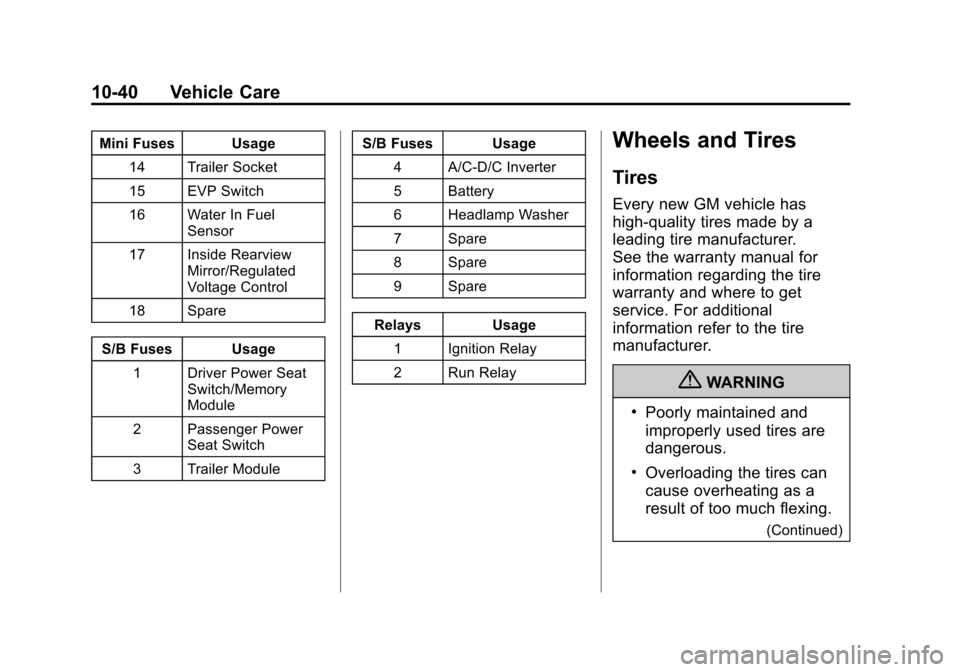
Mini Fuses Usage14 Trailer Socket
15 EVP Switch
16 Water In Fuel Sensor
17 Inside Rearview Mirror/Regulated
Voltage Control
18 Spare
S/B Fuses Usage 1 Driver Power Seat Switch/Memory
Module
2 Passenger Power Seat Switch
3 Trailer Module S/B Fuses Usage
4 A/C-D/C Inverter
5 Battery
6 Headlamp Washer
7 Spare
8 Spare
9 Spare
Relays Usage 1 Ignition Relay
2 Run RelayWheels and Tires
Tires
Every new GM vehicle has
high-quality tires made by a
leading tire manufacturer.
See the warranty manual for
information regarding the tire
warranty and where to get
service. For additional
information refer to the tire
manufacturer.
{WARNING
.Poorly maintained and
improperly used tires are
dangerous.
.Overloading the tires can
cause overheating as a
result of too much flexing.
(Continued)
Page 332 of 408

Black plate (68,1)Chevrolet TRAX Owner Manual - 2013 - CRC - 3/6/13
10-68 Vehicle Care
After installing the spare tire on the
vehicle, stop as soon as possible
and check that the spare is correctly
inflated. The spare tire is made to
perform well at speeds up to
112 km/h (70 mph) at the
recommended inflation pressure, so
you can finish your trip.
Have the damaged or flat road tire
repaired or replaced and installed
back onto the vehicle as soon as
possible so the spare tire will be
available in case it is needed again.
Do not mix tires and wheels of
different sizes, because they will not
fit. Keep the spare tire and its wheel
together.Jump Starting
For more information about the
vehicle battery, seeBattery on
page 10‑24.
If the battery has run down, try to
use another vehicle and some
jumper cables to start your vehicle.
Be sure to use the following steps to
do it safely.
{WARNING
Batteries can hurt you. They can
be dangerous because:
.They contain acid that can
burn you.
.They contain gas that can
explode or ignite.
.They contain enough
electricity to burn you.
If you do not follow these steps
exactly, some or all of these
things can hurt you. Notice:
Ignoring these steps
could result in costly damage to
the vehicle that would not be
covered by the warranty.
Trying to start the vehicle by
pushing or pulling it will not
work, and it could damage the
vehicle.1.4L L4 Engine Shown, 1.8L L4
Engine Similar
1. Discharged Battery Negative Grounding Point
2. Discharged Battery Positive Terminal
Page 333 of 408

Black plate (69,1)Chevrolet TRAX Owner Manual - 2013 - CRC - 3/6/13
Vehicle Care 10-69
3. Good Battery Negative Terminal
4. Good Battery Positive Terminal
The jump start negative grounding
point (1) for the discharged battery
is the engine block or an engine
mounting bolt. Connect to a spot as
far away from the discharged
battery as possible.
The jump start positive terminal on
the discharged battery (2) is located
in the engine compartment on the
driver side of the vehicle.
The jump start positive terminal (3)
and negative terminal (4) are on the
battery of the vehicle providing the
jump start.
The positive jump start connection
for the discharged battery is under a
trim cover. Open the cover to
expose the terminal.
1. Check the other vehicle. It musthave a 12-volt battery with a
negative ground system.
Notice: Only use a vehicle that
has a 12-volt system with a
negative ground for jump starting. If the other vehicle does
not have a 12-volt system with a
negative ground, both vehicles
can be damaged.
2. Position the two vehicles so that
they are not touching.
3. Set the parking brake firmly and put the shift lever in P (Park)
with an automatic transmission,
or Neutral with a manual
transmission. See Shifting Into
Park on page 9‑18 with an
automatic transmission,
or Parking on page 9‑21 with a
manual transmission.
Notice: If any accessories are left
on or plugged in during the jump
starting procedure, they could be
damaged. The repairs would not
be covered by the vehicle
warranty. Whenever possible,
turn off or unplug all accessories
on either vehicle when jump
starting the vehicle. 4. Turn the ignition to LOCK/OFF.
Turn off all lights and
accessories in both vehicles,
except the hazard warning
flashers if needed.
{WARNING
An electric fan can start up even
when the engine is not running
and can injure you. Keep hands,
clothing and tools away from any
underhood electric fan.
{WARNING
Using a match near a battery can
cause battery gas to explode.
People have been hurt doing this,
and some have been blinded.
Use a flashlight if you need
more light.
(Continued)
Page 334 of 408

Black plate (70,1)Chevrolet TRAX Owner Manual - 2013 - CRC - 3/6/13
10-70 Vehicle Care
WARNING (Continued)
Be sure the battery has enough
water. You do not need to add
water to the battery installed in
your new vehicle. But if a battery
has filler caps, be sure the right
amount of fluid is there. If it is low,
add water to take care of that
first. If you do not, explosive gas
could be present.
Battery fluid contains acid that
can burn you. Do not get it on
you. If you accidentally get it in
your eyes or on your skin, flush
the place with water and get
medical help immediately.
{WARNING
Fans or other moving engine
parts can injure you badly. Keep
your hands away from moving
parts once the engine is running.
5. Connect one end of the red positive (+) cable to the
positive (+) terminal on the
discharged battery.
6. Connect the other end of the red positive (+) cable to the
positive (+) terminal of the good
battery.
7. Connect one end of the black negative (–) cable to the
negative (–) terminal of the good
battery.
8. Connect the other end of the black negative (–) cable to the
negative (–) grounding point for
the discharged battery. 9. Start the engine in the vehicle
with the good battery and run
the engine at idle speed for at
least four minutes.
10. Try to start the vehicle that had the dead battery. If it will not
start after a few tries, it
probably needs service.
Notice: If the jumper cables are
connected or removed in the
wrong order, electrical shorting
may occur and damage the
vehicle. The repairs would not be
covered by the vehicle warranty.
Always connect and remove the
jumper cables in the correct
order, making sure that the
cables do not touch each other or
other metal.
Jumper Cable Removal
Reverse sequence exactly when
removing jumper cables.