2013 CADILLAC CTS oil
[x] Cancel search: oilPage 314 of 478

Black plate (14,1)Cadillac CTS/CTS-V Owner Manual - 2013 - crc2 - 8/22/12
10-14 Vehicle Care
How to Check and Add Fluid
Visually check the clutch fluid
reservoir to make sure the fluid level
is at the MIN (minimum) line on the
side of the reservoir. The hydraulic
clutch fluid system should be closed
and sealed.
Do not remove the cap to check the
fluid level or to top‐off the fluid level.
Remove the cap only when
necessary to add the proper fluid
until the level reaches the MIN line.
Engine Air Cleaner/Filter
The engine air cleaner/filter is in the
engine compartment on the driver
side of the vehicle, near the front.
SeeEngine Compartment Overview
on page 10‑5.
When to Inspect the Engine Air
Cleaner/Filter
Inspect the air cleaner/filter at the
scheduled maintenance intervals
and replace it at the first oil change
after each 80 000 km (50,000 mile)
interval. See Maintenance Schedule
on page 11‑3. If you are driving in
dusty/dirty conditions, inspect the
filter at each engine oil change.
How to Inspect the Engine Air
Cleaner/Filter
To inspect the air cleaner/filter,
remove the filter from the vehicle
and lightly shake the filter to release
loose dust and dirt. If the filter
remains covered with dirt, a new
filter is required.
To inspect or replace the engine air
cleaner/filter:
1. Turn the ignition off.
2. Remove the side cover by pulling up on the front of the
cover.
Page 317 of 478

Black plate (17,1)Cadillac CTS/CTS-V Owner Manual - 2013 - crc2 - 8/22/12
Vehicle Care 10-17
Notice:Using coolant other than
DEX-COOL®can cause premature
engine, heater core, or radiator
corrosion. In addition, the engine
coolant could require changing
sooner, at 50 000 km (30,000 mi)
or 24 months, whichever occurs
first. Any repairs would not be
covered by the vehicle warranty.
Always use DEX-COOL
(silicate-free) coolant in the
vehicle.
Engine Coolant
The cooling system in the vehicle
for all engines and the intercooler is
filled with DEX-COOL
®. This coolant
is designed to remain in the vehicle
for 5 years or 240 000 km
(150,000 mi), whichever occurs first.
The following explains the cooling
system and how to check and add
coolant when it is low. If there is a
problem with engine overheating,
see Engine Overheating on
page 10‑21.
What to Use
{WARNING
Adding only plain water or some
other liquid to the cooling system
can be dangerous. Plain water
and other liquids, can boil before
the proper coolant mixture will.
The coolant warning system is set
for the proper coolant mixture.
With plain water or the wrong
mixture, the engine could get too
hot but you would not get the
overheat warning. The engine
could catch fire and you or others
could be burned. Use a 50/
50 mixture of clean, drinkable
water and DEX-COOL coolant. Use a 50/50 mixture of clean,
drinkable water and DEX-COOL
coolant. If using this mixture,
nothing else needs to be added.
This mixture:.Gives freezing protection down
to
−37°C (−34°F), outside
temperature.
.Gives boiling protection up to
129°C (265°F), engine
temperature.
.Protects against rust and
corrosion.
.Will not damage aluminum parts.
.Helps keep the proper engine
temperature.
Notice: If improper coolant
mixture, inhibitors, or additives
are used in the vehicle cooling
system, the engine could
overheat and be damaged. Too
much water in the mixture can
freeze and crack engine cooling
parts. The repairs would not be
covered by the warranty. Use only
the proper mixture of engine
Page 318 of 478

Black plate (18,1)Cadillac CTS/CTS-V Owner Manual - 2013 - crc2 - 8/22/12
10-18 Vehicle Care
coolant for the cooling system.
SeeRecommended Fluids and
Lubricants on page 11‑13.
Never dispose of engine coolant by
putting it in the trash, pouring it on
the ground, or into sewers, streams,
or bodies of water. Have the coolant
changed by an authorized service
center, familiar with legal
requirements regarding used
coolant disposal. This will help
protect the environment and your
health.
Checking Coolant
The vehicle must be on a level
surface when checking the coolant
level.
The engine coolant reservoir is in
the engine compartment on the
driver side of the vehicle. See
Engine Compartment Overview on
page 10‑5.
Check to see if coolant is visible in
the surge tank. If the coolant inside
the surge tank is boiling, do not do
anything else until it cools down. If coolant is visible but the coolant
level is not at or above the FULL
COLD mark, add a 50/50 mixture of
clean, drinkable water and
DEX-COOL coolant at the coolant
surge tank, but be sure the cooling
system is cool before this is done.
If the engine is warm or hot, the
coolant level should be at or above
the FROID/FULL COLD line on the
side of the coolant surge tank. If the
engine is cold, the coolant level
should be near the FROID/FULL
COLD line on the side of the coolant
surge tank. If it is not, there could
be a leak in the cooling system.
How to Add Coolant to the
Surge Tank
{WARNING
You can be burned if you spill
coolant on hot engine parts.
Coolant contains ethylene glycol
(Continued)
WARNING (Continued)
and it will burn if the engine parts
are hot enough. Do not spill
coolant on a hot engine.
Notice: This vehicle has a
specific coolant fill procedure.
Failure to follow this procedure
could cause the engine to
overheat and be severely
damaged.
{WARNING
Steam and scalding liquids from a
hot cooling system can blow out
and burn you badly. Never turn
the cap when the cooling system,
including the surge tank pressure
cap, is hot. Wait for the cooling
system and surge tank pressure
cap to cool.
Page 326 of 478
Black plate (26,1)Cadillac CTS/CTS-V Owner Manual - 2013 - crc2 - 8/22/12
10-26 Vehicle Care
Notice
.Using the wrong fluid can
badly damage brake
hydraulic system parts. For
example, just a few drops of
mineral-based oil, such as
engine oil, in the brake
hydraulic system can
damage brake hydraulic
system parts so badly that
they will have to be replaced.
Do not let someone put in
the wrong kind of fluid.
.If brake fluid is spilled on the
vehicle's painted surfaces,
the paint finish can be
damaged. Be careful not to
spill brake fluid on the
vehicle. If you do, wash it off
immediately.
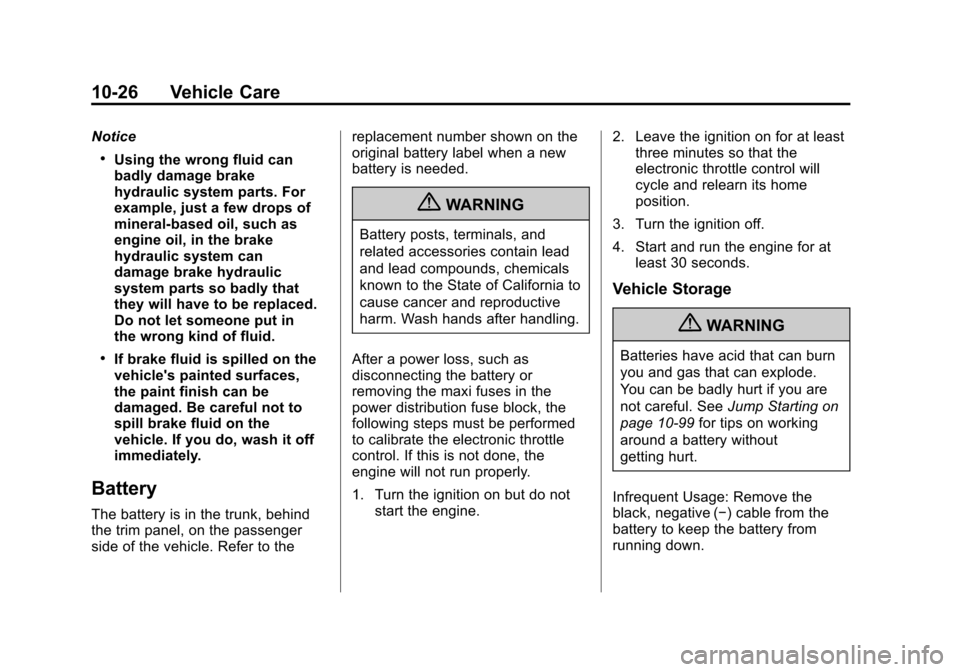
Battery
The battery is in the trunk, behind
the trim panel, on the passenger
side of the vehicle. Refer to thereplacement number shown on the
original battery label when a new
battery is needed.
{WARNING
Battery posts, terminals, and
related accessories contain lead
and lead compounds, chemicals
known to the State of California to
cause cancer and reproductive
harm. Wash hands after handling.
After a power loss, such as
disconnecting the battery or
removing the maxi fuses in the
power distribution fuse block, the
following steps must be performed
to calibrate the electronic throttle
control. If this is not done, the
engine will not run properly.
1. Turn the ignition on but do not start the engine. 2. Leave the ignition on for at least
three minutes so that the
electronic throttle control will
cycle and relearn its home
position.
3. Turn the ignition off.
4. Start and run the engine for at least 30 seconds.
Vehicle Storage
{WARNING
Batteries have acid that can burn
you and gas that can explode.
You can be badly hurt if you are
not careful. See Jump Starting on
page 10‑99 for tips on working
around a battery without
getting hurt.
Infrequent Usage: Remove the
black, negative (−) cable from the
battery to keep the battery from
running down.
Page 337 of 478
Black plate (37,1)Cadillac CTS/CTS-V Owner Manual - 2013 - crc2 - 8/22/12
Vehicle Care 10-37
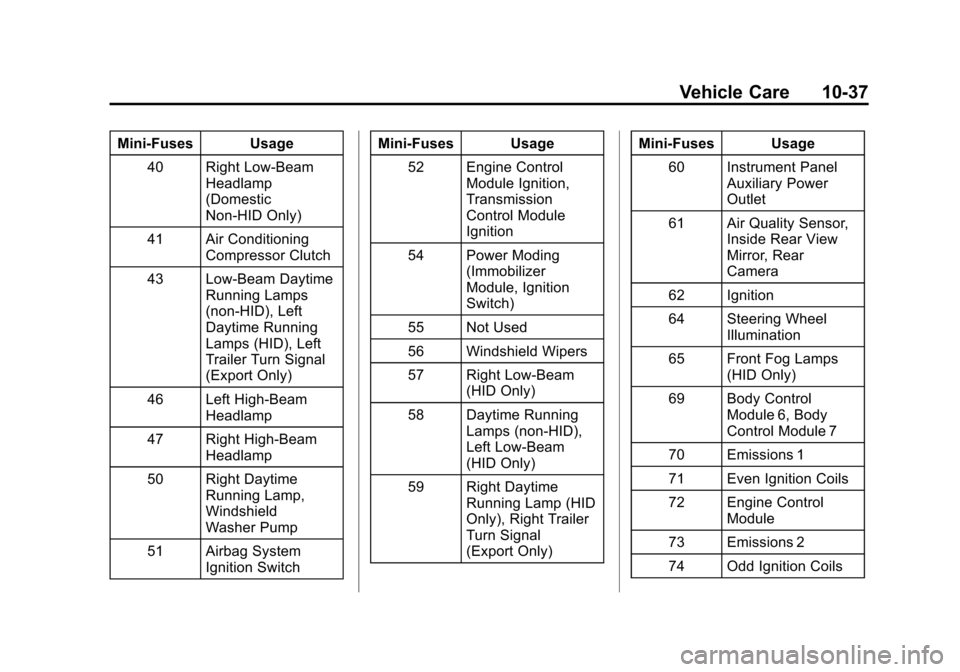
Mini-Fuses Usage40 Right Low-Beam Headlamp
(Domestic
Non-HID Only)
41 Air Conditioning Compressor Clutch
43 Low-Beam Daytime Running Lamps
(non-HID), Left
Daytime Running
Lamps (HID), Left
Trailer Turn Signal
(Export Only)
46 Left High-Beam Headlamp
47 Right High-Beam Headlamp
50 Right Daytime Running Lamp,
Windshield
Washer Pump
51 Airbag System Ignition Switch Mini-Fuses Usage
52 Engine Control Module Ignition,
Transmission
Control Module
Ignition
54 Power Moding (Immobilizer
Module, Ignition
Switch)
55 Not Used
56 Windshield Wipers
57 Right Low-Beam (HID Only)
58 Daytime Running Lamps (non-HID),
Left Low-Beam
(HID Only)
59 Right Daytime Running Lamp (HID
Only), Right Trailer
Turn Signal
(Export Only) Mini-Fuses Usage
60 Instrument Panel Auxiliary Power
Outlet
61 Air Quality Sensor, Inside Rear View
Mirror, Rear
Camera
62 Ignition
64 Steering Wheel Illumination
65 Front Fog Lamps (HID Only)
69 Body Control Module 6, Body
Control Module 7
70 Emissions 1
71 Even Ignition Coils
72 Engine Control Module
73 Emissions 2
74 Odd Ignition Coils
Page 341 of 478

Black plate (41,1)Cadillac CTS/CTS-V Owner Manual - 2013 - crc2 - 8/22/12
Vehicle Care 10-41
Mini‐Fuses Usage43 Left Daytime Running
Lamps (HID)
46 Left High‐Beam Headlamp
47 Right High‐Beam Headlamp
50 Right Daytime Running Lamp,
Windshield
Washer Pump
51 Airbag System Ignition Switch
52 Engine Control Module Ignition,
Transmission
Control Module
Ignition
54 Power Moding (Immobilizer
Module, Ignition
Switch)
55 Intercooler Pump Mini‐Fuses Usage
56 Windshield Wipers
57 Right Low‐Beam (HID Only)
58 Left Low‐Beam (HID Only)
59 Right Daytime Running Lamp
(HID Only)
60 Instrument Panel Auxiliary Power
Outlet
61 Air Quality Sensor, Inside Rear View
Mirror, Rear
Camera
62 Ignition
64 Steering Wheel Illumination
65 Front Fog Lamps (HID Only) Mini‐Fuses Usage
69 Body Control Module 6, Body
Control Module 7
70 Emissions 1
71 Even Ignition Coils
72 Odd Ignition Coils
73 Emissions 2
74 Engine Control Module
75 Not Used
76 Spare
77 Spare
78 Spare
79 Spare
80 Spare
81 Spare
Page 345 of 478

Black plate (45,1)Cadillac CTS/CTS-V Owner Manual - 2013 - crc2 - 8/22/12
Vehicle Care 10-45
Mini‐Fuses Usage60 Instrument Panel Auxiliary Power
Outlet
61 Air Quality Sensor, Inside Rear View
Mirror, Rear
Camera
62 Ignition
64 Steering Wheel Illumination
65 Front Fog Lamps (HID Only)
69 Body Control Module 6, Body
Control Module 7
70 Emissions 1
71 Even Ignition Coils
72 Engine Control Module
73 Emissions 2
74 Odd Ignition Coils Mini‐Fuses Usage
75 Transmission Output Speed
Sensor, Brake
Vacuum Relay
76 Spare
77 Spare
78 Spare
79 Spare
80 Spare
81 Spare
J-Case Fuses Usage
6 Cooling Fan 2
7 Cooling Fan 1
8 Starter
9 Brake Vacuum Pump
10 Antilock Brake System Motor J-Case
Fuses Usage
13 Not Used
14 Electric Parking Brake
15 Not Used
16 Not Used
17 Blower Motor
18 Transmission Control Module
Battery
37 Trailer (Export Only)
Relays Usage 1 Cooling Fan 2
2 Cooling Fan 1
3 Starter
4 Rear Window Defogger
5 Instrument Panel Auxiliary Power
Outlet
Page 348 of 478

Black plate (48,1)Cadillac CTS/CTS-V Owner Manual - 2013 - crc2 - 8/22/12
10-48 Vehicle Care
Mini-Fuses Usage43 Left Daytime Running
Lamp (HID)
46 Left High-Beam Headlamp
47 Right High-Beam Headlamp
50 Right Daytime Running Lamp
51 Airbag System Ignition Switch
52 Engine Control Module Ignition,
Transmission
Control Module
Ignition
54 Power Moding (Immobilizer
Module, Ignition
Switch)
55 Intercooler Pump
56 Windshield Wipers Mini-Fuses Usage
57 Right Low-Beam (HID Only)
58 Left Low-Beam (HID Only)
59 Right Daytime Running Lamp
(HID Only)
60 Instrument Panel Auxiliary Power
Outlet
61 Air Quality Sensor, Inside Rear View
Mirror, Rear
Camera
62 Ignition
64 Steering Wheel Illumination
65 Front Fog Lamps (HID Only)
69 Body Control Module 6, Body
Control Module 7 Mini-Fuses Usage
70 Emissions 1
71 Even Ignition Coils
72 Odd Ignition Coils
73 Emissions 2
74 Engine Control Module
75 Not Used
76 Spare
77 Spare
78 Spare
79 Spare
80 Spare
81 Spare
J-Case Fuses Usage
6 Cooling Fan 2
7 Cooling Fan 1
8 Starter