2013 AUDI RS5 CABRIOLET oil temperature
[x] Cancel search: oil temperaturePage 210 of 286

208 Check ing and filling
- To reduce the r isk of being burned, never
open the hood if you see or hear steam
or coolant escaping from the engine
compartment . Wait until no steam or
coolant can be seen or heard before care
fully opening the hood.
- Keep children away from the engine com
partment.
- Never spill flu ids on hot engine compo
nents . They can cause a fire.
- Never touch the radiator fan. The auxili
ary electr ic fan is temperature controlled
and can switch on suddenly.
- Never open the coolant reservoir cap
when the eng ine is still warm . The cool
ant system is pressur ized and hot coo l
ant could spray out.
- Protect your face, hands and arm from
steam o r hot eng ine coolant by placing a
thi ck rag over the cap when you open the
coolant reservoir .
- Do not remove the engine cover under
any c ircumstances. Th is increases the
risk of burns.
- If wo rk on the fuel system or the electri
c al system is necessa ry:
- Always disconnect the battery.
- Never smoke or work near heaters or
open flames . Fluids in the engine com
pa rtment cou ld start a fire.
- Keep an approved fire extinguisher im
mediately avai lable.
- To avoid electrical s hock and persona l in
jury while the engine is running or being
started, never touch:
- Ignition cables
- Othe r components of the high voltage
e lectronic ignition system.
- If you must perform a check or repa ir
with the engine running:
- First, fully apply the parking bra ke,
move se lector lever o f automat ic trans
missio n to "P" (Park). -
Always use extreme caution to p revent
clothing, jewel ry, or long hair from get
ting caught in the radiator fan, V-belts
or other moving parts, or from contact ing hot parts. Tie back hair before
starting, and do not wea r clothing that
will hang o r droop into t he engine.
- Mi nimize exposure to em ission and
chemical hazards~ &.
A WARNING
Ca lifo rnia Proposition 65 Wa rning:
- Eng ine exhaust, some of its const ituents,
and certain vehicle components contain
or emit chemicals know n to the State of
California to cause cancer and birt h de
fects and reproduc tive harm. In addition,
certain fl uids contained in vehicles and
certain products of component wear con
tain or emit chemicals known to the
State of California to cause cancer and b irth defects or other reproductive harm.
- Battery posts, terminals and related ac cessories conta in lead and lead com ·
pounds, chemicals known to the State of
California to cause cancer and reproduc
tive harms. Wash hands afte r handling .
(I) Note
When adding f lu ids, always make sure that
they are poured i nto the proper conta iner
or filler opening, otherwise serious dam
age to vehicle systems w ill occur.
@) For the sake of the environment
To detect leaks in time, inspect the vehicle
floor pan from underneath regularly. If
you see spots from oil or other veh icle flu
i ds, have yo ur vehicle inspected by a n au
thor ized Audi dea ler.
Page 213 of 286

temperatures stay below freezing point for l ong periods.
Detergent add itives in the o il w il l make fresh
oil look dark after the eng ine has been run
ning fo r a short time . This is norma l and is not
a reason to change the oi l more often than
recommended.
D am ag e or m alfun ction s due to lack of
ma intenanc e
It is essential that you change your oil at the
r ecommended inte rva ls using only engine o il
t hat complies with A udi oi l standard
VW 502 00 . Your Limited New Vehicle War
ranty does not cover damage or malfunctions
due to fa ilure to fo llow recommended mainte
nance and use requ irements as set forth in
the Audi Owner's Manual and Warranty
&
Maintenance book let . Your dealer will have to
deny warranty coverage u nless you present to
the dea ler p roof in the fo rm of Serv ice or Re
pa ir Orde rs that all s chedu led maintenance
was pe rformed in a t imely manner .
Engine oil consumption
The engine in your vehicle depends on an ade
quate amount of oil to lubricate and cool all
of its moving parts.
In o rder to provide effective lubrication and
cool ing of internal engine components, a ll in
ternal combustion eng ines consume a certa in
amo unt of o il. Oil consumption varies from
engine to engine and may change significantly
over the life of the engine. Typ ica lly, engines
with a specified break-in period (see
¢
page 184) consume more oil during the
break-in per iod than they consume after oil
consumption has stabilized .
Under normal conditions, the rate of oil con
sumpt ion depends on the quality and viscosity
of the oil, the RPM (revo lutions per m inute) at
which the engine is operated, the ambient
temperature and road condit ions. Furthe r fac
tors are the amount of o il d ilution from wate r
condensation or fuel residue and the ox ida
tion level of the oil. As any engine is s ubje ct to
Checkin g and fillin g 211
wear as mi leage builds up, the oil consump
tion may increase over time until replacement
of worn components may become necessary.
Wi th a ll these variab les coming into p lay, no
standard rate of oil consumpt ion can be es
tablished or specified. There is no alternative
to regular and frequent check ing of the o il lev
el, see
Note .
If the yellow engine oil leve l warning symbo l
1\1 in the instrument cluster lights up , you
shou ld check the oil leve l as soon as possib le
¢
page 212. Top off the oil at your earliest
convenience
¢ page 212.
A WARNING
Before you check anythi ng i n the engine
compartment, always read a nd heed all
WARNINGS¢ .&.
in Working in the engine
c ompartment on page 207.
(D Note
Driving w ith an insufficient o il level is like
ly to cause severe damage to the engine .
(D Tips
- The oil pressure warning display. is
not an indi cator of the oil le vel. Do not
rely on it . Instead, check the oil level in
your engine at regu lar intervals, pref
erably ea ch time you r efuel, and alway s
before going on a long trip .
-If you have the impression you r engi ne
c ons umes ex cess ive amoun ts of o il, we
recommend that you consul t an a uthor
ized Aud i dea ler to have the cause of
your concern properly diagnosed. Keep in mind that the accurate measurement of
oil consumption requ ires great care and
may take some t ime. An authorized Aud i
dealer has instructions about how to
measu re oil consumption accurately.
-
•
•
Page 214 of 286
212 Checking and filling
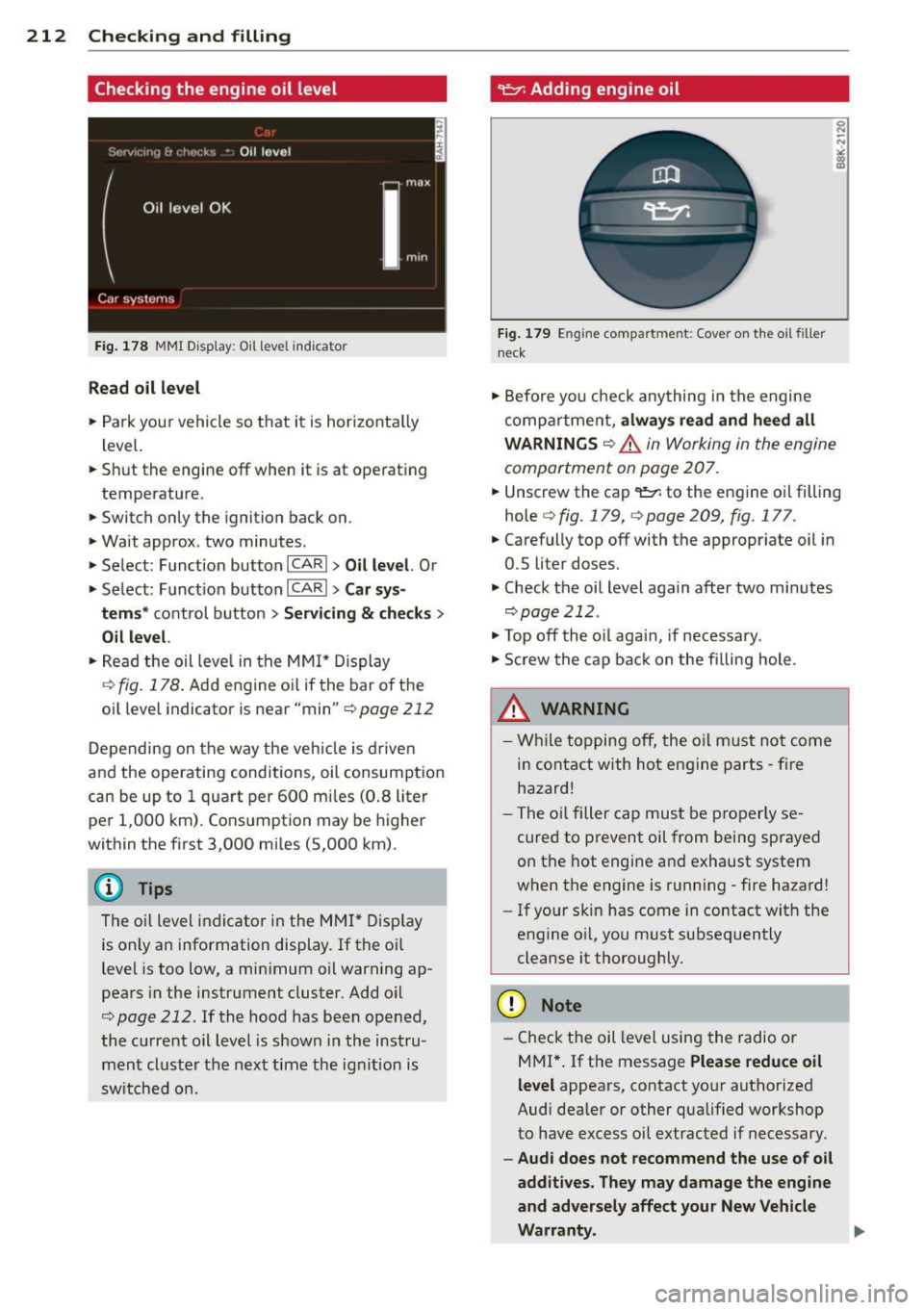
Checking the engine oil level
Fig. 178 MMI Display: Oil level in dicator
Read oil level
.. Park your vehicle so that it is horizontally
lev el.
.. Shut the engine off when it is at operating
temperature.
• Switch only the ignition back on.
• Wait approx. two minutes.
> Select: Function button ICARI > Oil level. Or
> Select: Function button ICAR I > Car sys-
tems *
control button > Servicing & checks >
Oil level.
.. Read the oil level in the MMI* Display
¢
fig. 178. Add engine oil if the bar of the
oil level indicator is near "min"¢
page 212
Depending on the way the vehicle is driven
and the operating conditions, oil consumption
can be up to 1 quart per 600 miles (0.8 liter
per 1,000 km). Consumption may be higher
within the first 3,000 miles (5,000 km).
The oil level indicator in the MMI* Display
is only an information display. If the oil
level is too low, a minimum oil warning ap
pears in the instrument cluster. Add oil
¢
page 212. If the hood has been opened,
the current oil level is shown in the instru
ment cluster the next time the ignition is
switched on.
~ Adding engine oil
Fig. 179 Engine compartment: Cover on the oil filler
n ec k
• Before you check anything in the engine
compartment,
always read and heed all
WARNINGS
¢ .A in Working in the engine
compartment on page 207 .
.. Unscrew the cap '1:::1: to the engine oil filling
hole
q fig. 179, q page 209, fig. 177.
.. Carefully top off with the appropriate oil in
0.5 liter doses.
.. Check the oil level again after two minutes
qpage212.
• Top off the oil again, if necessary.
• Screw the cap back on the filling hole .
.8_ WARNING
- While topping off, the oil must not come
in contact with hot engine parts -fire
hazard!
- The oil filler cap must be properly se
cured to prevent oil from being sprayed
on the hot engine and exhaust system
when the engine is running -fire hazard!
- If your skin has come in contact with the
engine oil, you must subsequently
cleanse it thoroughly.
(D Note
- Check the oil level using the radio or
M Ml*.
If the message Please reduce oil
level
appears, contact your authorized
Audi dealer or other qualified workshop
to have excess oil extracted if necessary.
- Audi does not recommend the use of oil
additives. They may damage the engine
and adversely affect your New Vehicle
Warranty. .,..
Page 216 of 286

214 Checking and filling
Engine cooling system
Coolant
The engine coolant performs two functions: it
keeps the engine from overheating and it pro
tects the engine from freezing in the winter .
The cooling system is sealed and generally re
quires little attention .
The cooling system has been filled at the fac tory with a permanent coolant which does not need to be changed. The coolant consists of a
mixture of water and the manufacturer's gly
col-basedcoolant additive G13 antifreeze with
anticorrosion add itives (50% for USA models;
60% for Canadian models). This mixtu re both
assures the necessary frost protection and
protects metal components in the engine 's
cooling system from corrosion and scaling. It
also raises the boiling point of the coolant .
Do not reduce the concentration of the cool
ant in the summer by adding plain water .
The
proportion of coolant additive must be at
least 50% but not more than 60%
to main
tain antifreeze protection and cooling efficien
cy. If the coolant frost protection is too low,
the coolant could freeze and damage the vehi
cle heating and eng ine cooling system .
For year-round driving, antifreeze is added at
the factory for temperatures down to:
- -31 ° F ( - 3 S °C) USA
- -40 °F ( - 40 °C) Canada .
_&. WARNING
Before you check anything in the engine
compartment, always read and heed all
WARNINGS ~
A in Working in the engine
compartment on page 207.
(D Note
- Before winter sets in, have the coolant
checked to see if the coolant additive in
your vehicle is sufficient to meet the cli
mate conditions . This is especially impor
tant if you live in a region where the win
ter is extremely cold. If necessary, in- crease the
proportion of coolant additive
to 60%.
- When adding coolant additive to your
cooling system, remember:
- We recommend using on ly coolant ad
ditive G12++ or G13 for your vehicle.
This coolant additive is availab le at au
thor ized Audi dealers. Other types of
antifreeze can significantly reduce cor
rosion protection. The resulting corro
sion cah cause a loss of coolant and se
rious engine damage.
- Do not add any type of rad iator leak seal
ant to your vehicle's engine coolant .
Adding radiator repair fluid may adverse
ly affect the function and performance of
your cooling system and could result in
damage not covered by your New Veh icle
Limited Warranty.
· Checking the engine coolant level and
adding coolant
Be very careful when adding engine coolant.
Fig. 180 E n g in e compart men t: Cover on the coo la nt
expansio n tan k
Fig. 181 En g in e compart men t: markings in the coo la n t
expansion tank
ll>
Page 235 of 286

A WARNING
Sudden tire failure can lead to loss of con
trol, a crash and serious personal injury!
- Never drive a vehicle when the tread on
any tire is worn down to the wear indica
tors.
- Worn tires are a safety hazard, they do
not grip well on wet roads and increase
your risk of "hydroplaning" and loss of
control.
- Always keep chemicals that can cause
tire damage, such as grease, oil, gasoline
and brake fluid away from t ires.
- Tires age even if they are not be ing used
and can fail suddenly, especially at high
speeds . Tir es that are more than 6 years
old can only be used in an emergency
and then with special care and at lower
speeds.
- Never mount used tires on your vehicle if
you are not sure of their" previous histo
ry ." Old used tires may have been dam
aged even though the damage cannot be
seen that can lead to sudden tire failure
and loss of vehicle control.
Tires and wheels 233
New tires and replacing tires and wheels
New tires and wheels have to be broken in .
Fig. 189 Tir e specificat ion codes on t he s idewall o f a
tire
No. Description
CD Passenger car tire (where applicable)
@ Nominal width of tire in millimeters
® Ratio of height to width (aspect ratio)
© Radial
® Rim diameter code
® Load index and speed rat ing
(f) U.S. DOT tire identification number
® Audi Original tire
® Sever snow conditions
@ Tire ply composition and materials
used
@ Maximum load rating
@ Treadwear, traction and temperature
grades
@ Maximum permissible inflation pres-
sure
The tires and rims are essential parts of the
vehicle's design . The ti res and rims approved
by Audi are spec ially matched to the charac
teristics of the vehicle and can make a major .,.
•
Page 266 of 286

264 Consumer Information
Consumer Information
Warranty coverages
You r Audi i s covered by the following war
ranties:
- New Vehicle Limited Warranty
- Limited Warranty Against Corrosion Perfo-
ration
- Emissions Control System Warranty
- Emissions Performance Warranty
- California Emissions Control Warranty (USA
vehicles only)
- California Emissions Performance Warranty
(USA vehicles only)
Detailed information regarding your warran
ties can be found in your
Warranty & Mainte
nance booklet .
Operating your vehicle
outside the U.S.A. or
Canada
Government regu lations in the United States
and Canada require that automobiles meet
specific emission regulations and safety
standards. Therefore, veh icles built for the
U.S.A . and Canada differ from vehicles sold in
other countries .
If you p lan to take your vehicle outside the
continental limits of the United States or Can
ada, there is the possibility that:
- unleaded fuels for vehicles with cata lytic
converter may not be available;
- fuel may have a considerably lowe r octane
rating. Improper fuel may cause engine
damage ;
- service may be inadequate due to lack of
proper service facilities, tools or testing
equipment ;
- replacement pa rts may not be readily availa
ble.
- Navigation systems for vehicles built for the
U.S.A. and Canada will not necessar ily work
in Europe, and may not work in other coun
tries outside of North America.
(D Note
Audi cannot be responsible for mechanical
damage that could result from inadequate
fuel, service or parts availability.
Audi Service Repair Manuals and Literature
Audi Official Factory Service Manuals and Lit
erature are published as soon as possible after
model introduction. Service manuals and lit
erature are available to order from the Audi
T echnical Literature Ordering Center at:
www.audi.techliterature.com
Maintenance
General
Your vehicle has been designed to help keep
maintenance requirements to a minimum.
However, a certain amount of regular mainte
nance is still necessary to assure your vehicle's
s afety, economy and rel iability. For detailed
vehicle maintenance consult your Warranty &
Maintenance booklet.
Under difficult operating conditions, for ex
ample at extremely low outside temperatures,
i n very dusty regions , when towing a trailer
very frequently, etc., some service work
should be performed between the intervals
specified. This applies particularly to:
- oil changes, and
- cleaning or replacing the air filter .
(® For the sake of the environment
By regularly maintaining your vehicle, you
help make sure that emission standards
are maintained, thus minimizing adverse
effects on the environment.
Important considerations for you and
your vehicle
The increasing use of electronics, sophisticat
ed fuel injection and emission contro l sys-
tems, and the genera lly increasing technical
liJJ,
Page 271 of 286

A
Accessories 266
Active rollover p rotection system ... .. . 127
Retract ing ro llover p rotection . .. .. .. . 128
AC (automatic climate control) . .. .. .. .. 70
Adapt ive cr uise con trol ...... .. .. .. .. .. 9 2
C leaning sensors/camera . ... .. .. .. . 193
M essages . . . . . . . . . . . . . . . . . . . . . . . . . 99
Request for driver intervention . . . . . . . . 97
Sett ing the driving program .. .. .. .. .. 97
Ad apt ive light ............. .... .. .... 52
Adapt ive Lig ht (defect ive) .... ... . ... .. 22
Adding Eng ine coolant ........... .. .. .. ... 214
Eng ine oil .. ............. .... .. ... 212
W indshield washer fluid ... .. .. .. .. . 221
Additiona l accessories
Add it ives 26
6
E ng ine oi l .. ............. .... .. .. . 212
Ad justab le steer ing column .. .. .. .. .. .. 74
Ad justing
Ai r distribution (automatic climate con-
trol) ... .. .. .. .... .. .... ... .. .. .... 7 1
Instrument illum inat ion ... .. .. .. .. .. 55
Steer ing colum n .......... .. .. .. .. .. 74
Temperature (automat ic climate co ntrol) 71
A irbag
War ning/indicator lights ... .. .. .. .. .. 20
A irbag system . . . . . . . . . . . . . . . . . 137, 1 56
A dva nced A irbag Sys tem ... .. .. .. .. . 141
A dvanced Airba g Sys tem components . 14 4
Care ... .. .. .. .. .. .. .... ... .. .. ... 150
C hildren ... .. .... .... ... .. .. .. ... 159
Ch ild restra ints ........... .... .. .. . 160
Components (front airbags) .. .. .. .. . 144
Da nger of fitti ng a child safety seat on
the front passenger seat . ...... ... .. 138
D isposal ... ... .. .. ...... .. .. .. .. . 150
F ront airbags . . . . . . . . . . . . . . . . 14 1, 1 42
H ow do the fron t airbags wo rk? . .. .. . 14 6
H ow many airbags does my ve hicl e
have? ... .. .. ... .. ..... ... .. .. ... 14 4
H ow t he Advanced Airbag System com
ponents work together . . . . . . . . . . . . . 145
Important safety instructions on the knee airbag system . . . . . . . . . . . . . . . . 154
Important th ings to know ...... ... .. 137
Inde x 269
Indicator lig ht ... .. . .. .. ..... ... .. 14 8
Knee a irbags ... .... . ... ...... ... .. 152
Monito ring . . . . . . . . . . . . . . . . . . . . . . . 148
PASSE NGER AIR BAG OFF light ..... .. 148
Repairs ... .. .. .. .... ............. 150
Safety instructions .. .............. . 150
S ide a irbags ... .. .. . .. .... .... .. .. 155
Weight-sensing mat ............... 159
When must t he sys tem be inspected? . 1 48
all-wheel drive .. .. ................. 181
A lloy whee ls .. .... .. . .. .. ..... ... .. 195
All wheel d rive
Winter tires . .. .. .... ........... .. 23 7
A lternator
refer to Generator . . . . . . . . . . . . . . . . . . 17
Anti -free ze
refer to Eng ine coolant system ... .. .. 214
A nti- lock b rak ing system ............. 176
Warning/ind ica tor lights ........ .. .. . 19
Anti-slip reg ulation .. .. .. ...... .... . 176
Anti-theft a la rm warning system ... .. .. . 31
Anti-theft systems El ec tronic immob ilizer .......... .... . 37
Arm rest ...... .. .. ................. . 64
Asht ray . ... .. .. .... . ... ...... ... .. . 65
Aste risk
What does it mean w hen so mething is
m ark ed w it h an aster is k? . . . . . . . . . . . . . . 6
Audi braking guard
refer to brak ing guard ............. .. 92
Audi drive select ..... . .. .. ..... ... .. 104
Description .... .. ................. 104
Dynam ic steering ..... ............. 104
Setting the driv ing mode . ....... .. .. 105
S po rt d iffe rential ................. . 104
Audi Se rvice Repair Manuals and Litera-
ture ....... .. .. .. ................. 264
A UTO
A utomat ic climate control .... ... .. .. . 71
Automatic hea dlights ... .... ... .. .. . 52
Auto Lock . . . . . . . . . . . . . . . . . . . . . . . . . . 31
Automat ic be lt retractor ............. 133
A utoma tic car wash
refer to Washing . . . . . . . . . . . . . . . . . . 190
•
•
Page 274 of 286

272 Index
Data recorder ..... ..... ... .. .. .... . 176
Date display . .............. ... .. ... . 12
Daytime running lights. . . . . . . . . . . . 52, 53
Declaration of compl iance
Adaptive cruise control . ... .. ... ... . 267
Audi side assist .. ..... ... .. .. .... . 267
Ce ll phone package .. ... .. .. ... ... . 267
Convenience key ..... ..... .... .... . 267
Electronic immobili zer ..... .. .. .. .. . 267
H omelink ® universal remo te control . . 267
Remote control key ........... .. .. . 267
Defective light bulb warning . . . . . . . . . . . 2 1
Defrosting (w indows) ..... .. .. .. .. .. .. 71
Determin ing correct load limit . .. .. ... 230
D igita l clock ............. ... .. .... .. 12
Dig ita l compass ............ ... .. .. .. 59
Dimensions .. ............... .. .... . 262
D imm ing the rea rview mir ro r .. .. .. .. . . 56
Doors emergency lock ing . ..... .. .. .. .. .. .. 36
Driver information system Eng ine oil temperature indicator ...... 28
Open door or front lid warning . . . . . . . . 24
Outside temperature display .. .... .. .. 24
Sound system display . . . . . . . . . . . . . . . 24
Driver seat
refer to Seat ing pos ition . . . . . . . . . . . . 119
Driving safely ............. .. .. .. .. . 118
Driving through water . . . . . . . . . . . . . . . 184
Driving time . . . . . . . . . . . . . . . . . . . . . . . . 25
Dust filter
refer to Po llutant filte r (automatic AC
sys tem) .. .. ............. .. .. .... .. 69
Dynamic steering . . . . . . . . . . . . . . 104 , 180
E
Easy entry function ......... .. .. .. .. .. 63
Electro -mechanical power assist . . . . . . . 180
Electromechanical park ing brake
E me rgency braking ....... .. .. .. .. . . 81
I ndicator ligh t . . . . . . . . . . . . . . . . . . . . . 79
Par king .. .. .. . .......... .. .. .. .. .. 80
Releasing and clos ing ... .. .. .... .. . . 79
Starting assist . .. ..... ... .. .. .... .. 80
Starting from rest ..... ... .. .. .... .. 80
Warn ing/ indicator lights ..... .. .... .. 16 El
ectronic differential lock ( EDL) . . . . . . . 176
Warning/indicator lights ..... ... .. .. . 19
El ectronic immob ilizer . . . . . . . . . . . . 12, 3 7
Electronic power control (EPC) warning/indicator light . . . . . . . . . 20
E lectronic Stabilization Contro l (ESC) . .. 176
Warning/indicator lights ..... ... .. .. . 19
E mergen cy actua tion
Doors .. .. .. .. .. .. ........... .. .. . 36
Ignit ion key ..... ... .. ..... .... . .. . 34
Emergency brak ing .... .. .. ... ..... .. . 81
Emergency flasher . . . . . . . . . . . . . . . . . . . 54
Warning/ind icator lights ........ .. .. . 22
E mergency key . . . . . . . . . . . . . . . . . . . . . . 32
Starting engine . ... ... ..... ... .. .. . 76
Emergency operation Emergency bra king funct ion (pa rking
brake) .. .. .. .. .. .. ... ........ .. .. . 81
Luggage compartment lid . . . . . . . . . . . . 38
Power top ..... .. .. ... ..... ... .. .. . 47
Emergency starting ................ . 255
Emergency towing . ............. .... 257
E nergy management ............ .. .. 182
Battery power . . . . . . . . . . . . . . . . . . . . . 17
Drive r notif ication . . . . . . . . . . . . . . . . . . 17
Engine Compartment .. .. ... .......... .. .. 209
Coolant . .. .. .. .. ............. .. .. 214
Hood . .... .... ................... 207
Starting . . . . . . . . . . . . . . . . . . . . . . 7 4 , 77
Starting with jumper cables ... .. .. .. 255
Stopping . . . . . . . . . . . . . . . . . . . . . . 76, 78
E ngine compartment
Sa fety instr uctions ............. .... 207
Working the eng ine compartment 207
Engine coolant In dicator light ... ............. .... . 18
Engine coolant system ........... .... 214
Adding coolant ..... ... ..... ... .. .. 214
Checking coolant level .............. 214
Checking the engine coo lant level . .. .. 214
Radiator fan . .. .. ............. .. .. 216
Engine coolant temperature Temperature gauge .............. .. . 10
Engine data ..... .. .. ... ..... ... .. .. 263