2013 AUDI A7 brake
[x] Cancel search: brakePage 214 of 310

212 Trailertowing
If you move the selector lever of the auto
mat ic transm ission to P before app lying
the park ing brake and before blocking the
wheels, you may have to use mo re force
later to move the lever out of the P posi
tion .
Page 215 of 310

Cleaning and protect ion
General information
Regular core preserves vehicle value.
Any automobile is exposed to industrial
fumes , corrosive road salt, etc. A well cared
for Audi can look like new many years after
purchase . Regu lar and correct care w ill con
tr ibute to maintaining the beauty and value of
your Aud i.
F u rth ermor e, good c are may be a conditi on
for subs tantiati ng a w arrant y cla im sho uld
c orrosion d amag e or paint d efects oc cur.
Your authorized Audi dealer has a variety of
dedic ated veh icle-car e products and can ad
vise which ones to use for cleaning the exter i
or and interior of your vehicle.
Whether you use products recommended by
Aud i or other commercially available clean ing
agents, please make sure you apply them cor
rectly .
A WARNING
-Cleaning agents may be poisonous. Keep
them out of the reach of children.
- Heed all caut ion labels.
- Always read directions on the container
before using any product. Follow the di
rect ions carefu lly.
- Most chemical cleaners are concentrated
and have to be diluted .
- Use spot removing fluids only in well
ventilated areas.
- Do not use gasoline, kerosene, d iesel
fuel, nail polish remover or other volatile
fluids. They may be toxic, flammab le or
haza rdous in other ways. Do not wash,
wax or dry the vehicle with the ign it ion
on or the engine running.
- Do not clean the undersides of chassis,
fenders, wheel covers, e tc. w ithout pro
tecting your hands and arms. You may c u t yourself on sharp -edged metal parts .
Cleaning and protec tion 213
- Moisture and ice on brakes may impair
brak ing effic iency¢
page 199, General
information.
Test the brakes carefully
each time you wash the vehicle.
@) For the sake of the environment
Select on ly environmentally friend ly clean
i ng products . Leftover cleaning products
should not d isposed of in the household
waste.
Care of exterior
Washing
Frequent washing protects the vehicle .
The best protection against environmental i n
fluences is
frequent washing and waxing . How
often t his is required depends on:
- How much the veh icle is used
- Where the veh icle is parked (garage, in the
open under trees, etc.)
- The seasonal and weather conditions
- Environmental infl uences
T he longer b ird droppings, insects, tree resin,
road and indus tria l gr ime, ta r, soot, road salt
and other materials remain on the vehicle
body, the more lasting their destructive ef
fects wi ll be . High temperatures caused by ex
posure to intense sun light intens ify the corro
s ive effect, particularly when humid ity is high
as well.
Under certain circumstances,
weekl y washing
may be necessary. Under other cond itions, a
monthly washing and waxing may be ade
quate .
After the winter, the underside of the vehicle
should be thoroughly washed, preferab ly in a
professional car wash .
Vehicles with matte finish paint¢
page 215 .
A WARNING
Always read and heed all WARNINGS and
other information
¢page 213.
•
•
Page 221 of 310

To preserve the decorative appearance of the
cast a lloy whee ls , some specia l care is neces
sary. In add it ion to road dirt and sa lt, brake
dust is also corros ive. If left on for too long,
brake dust can cause pitting.
Use only specia l
acid-free cleaners formulated
for a lloy rims. Safe products are available at
your Aud i dealer. Never leave the cleaner on
t he r ims longer than spec ified on the label. If
not rinsed off promptly, the acid conta ined in
some cleaners can attack the threads on the
wheel bo lts.
Never use abras ive or metal polishing clean
ing agents . If the protective coat ing has been
chipped, e .g . by k icked up road d irt, touch it
up as soon as possib le.
.8, WARNING
- Moist ure and ice on brakes may affect
braking efficiency
r::!;> page 199, General
information .
Test the brakes caref ully
each time you wash the vehicle.
- Alw ays read and hee d all WARN INGS and
other information ¢
page 213 .
-
Body cavity sealing
The body cavity sealing does not need to be
checked.
All body cavities wh ich could be affected by
corrosion have been thoroughly p rotected at
the facto ry.
This sea ling does not require any inspection or
addit ional treatment . If any wax should seep
out of the cav ity w hen the ambient tempera
ture is high, it can be removed wit h a plastic
scrape r and a su itab le solvent.
.8, WARNING
So lvents can be dangerous.
- Benzine is flammable and toxic.
If you
u se benzine for removing the wax, keep
sparks, flame and lighted c igarettes
away. Never dump benzine on t he
ground, into open streams or down sew
age drains .
Cleaning and protec tion 219
- Be s ure to observe all safety and environ
mental reg ulations . Follow all instruc
tions on the container.
- Always read and heed a ll WARNINGS and
other information
r::!;> page 213.
Chassis
Have the undercoating checked for damage
from time to time .
The lower body shell of your Aud i is also thor
oughly protected against corrosion .
A ny damage to the unde rcoa ting caused by
road hazards sho uld be repaired prompt ly.
.8, WARNING ,.____
T oo much undercoating in the wrong p la
ces can cause a fire.
- Do not app ly addition al u nder coati ng or
r u stp roof ing on or nea r the exhaust
manifold, exhaust pipes, catalytic con
verter or heat shields . While driving, the
substance used for undercoating could
overheat and cause a fire.
- Always read and heed a ll WARNINGS and
other information
r::!;> page 213.
Exhaust tail pipes
Road salt and other corrosive materials will
damage the material in the exhaust tail pipes
if they are not clea ned regular ly . Do not clea n
the tail pipes with w heel cleaner, pa int polish,
c hr ome polish or other ab ras ive clea ne rs.
C lean t he tail pipes with ca r c are products
that are suitable for stainless steel.
Your authorized Audi dea ler ca n provide clean
ing products that have been tested and ap
proved for yo ur vehicle .
Care of interior
Infotainment components
The MMI/RSE* display may be cleaned w it h a
soft clot h and commercia lly-available "LCD
cleaner" . T he cloth should be coated lightly .,..
•
•
Page 232 of 310

230 Checking and filling
Checking and filling Engine hood
Releasing the engine hood
The engine hood is released from inside the
vehicle .
Fig. 187 Driver foo twell: release lever
Fig. 188 Rocker switch un der the hood
Make sure the wiper arms are not raised up
from the windshield. Otherwise the paint
could be damaged .
.,. Pull the lever under the instrument panel in
the direction of the arrow
~ fig. 187.
.,. Raise the hood slightly~,&. .
... Press the rocker switch under the hood up
ward
~ fig. 188. This releases th e catch.
... Open the hood.
&_ WARNING
Hot engine coolant can burn you.
- To reduce the risk of being burned, never
open the hood if you see or hear steam
or coolant escaping from the engine compartment . Wait until no steam or
coolant can be seen or heard before care
fully opening the hood .
'Working in the engine compartment
Be especially careful whenever you work in
the engine compartment.
Whenever you must perform any work in the
engine compartment, for example checking
and filling different fluids, there is a risk of injury, burns and accidents. To prevent per
sonal injury always observe the following
WARNINGS. The engine compartment of any
vehicle is a hazardous area
~ ,&. .
A WARNING
To help avoid injury, before you check any
thing under the hood:
- Turn off the engine.
- Switch off the ignition .
- Apply the parking brake.
- Move selector lever to P (Park).
- Always let the engine cool down. Hot
components will burn skin on contact.
- To reduce the risk of being burned, never
open the hood if you see or hear steam
or coolant escaping from the engine
compartment. Wait until no steam or
coolant can be seen or heard before care
fully opening the hood.
- Keep children away from the engine com
partment.
- Never spill fluids on hot engine compo
nents . They can cause a fire .
- Never touch the radiator fan. The auxili
ary electric fan is temperature controlled
and can switch on suddenly .
- Never open the coolant reservoir cap
when the engine is still warm . The cool
ant system is pressurized and hot cool
ant could spray out.
- Protect your face, hands and arm from
steam or hot engine coolant by placing a
thick rag over the cap when you open the
coolant reservoir.
- Do not remove the engine cover under
any circumstances. This increases the
risk of burns.
- If work on the fuel system or the electri
cal system is necessary:
Page 233 of 310

-Always disconnect the battery.
- Never smoke or work near heaters or open flames. Fluids in the engine com
partment could start a fire.
- Keep an approved fire extinguisher im
mediately available.
- To avoid electrical shock and personal in
jury while the engine is running or being
started, never touch :
- Ignition cables
- Other components of the high voltage
electronic ignition system.
- If you must perform a check or repair
with the engine running:
- First, fully apply the parking brake,
move selector lever to P (Park).
- Always use extreme caution to prevent
clothing, jewelry, or long hair from get
ting caught in the radiator fan, V-belts
or other moving parts, or from contact ing hot parts. Tie back hair before
starting, and do not wear clothing that
will hang or droop into the engine.
- Minimize exposure to emission and
chemical ha zards c:::> & .
A WARNING
California Proposition 65 Warning:
- Engine exhaust, some of its constituents,
and certain vehicle components contain
or emit chemicals known to the State of
California to cause cancer and birth de
fects and reproductive harm. In addition ,
certain fluids contained in vehicles and
certain products of component wear con
tain or emit chemicals known to the
State of California to cause cancer and
birth defects or other reproductive harm .
Checking and filling 231
-Battery posts, terminals and related ac
cessories contain lead and lead com
pounds, chemicals known to the State of
California to cause cancer and reproduc
tive harms. Wash hands after handling.
(D Note
When adding fluids, always make sure that
they are poured into the proper container
or filler opening, otherwise serious dam
age to vehicle systems will occur.
(® For the sake of the environment
To detect leaks in time, inspect the vehicle
floor pan from underneath regularly . If
you see spots from oil or other vehicle flu ids, have your vehicle inspected by an au
thorized Audi dealer.
Closing the engine hood
.,. Pull the hood down until the pressure from
the struts is reduced.
.,. Let the hood
drop down and latch in place.
Do not try to push it shut; it may fail to en
gage
c:::> ,A .
A WARNING
-
A hood that is not completely latched
could fly up and block your view while driv
ing .
- When you close the engine hood, check it
to make sure the safety catch has proper ly engaged. The hood should be flush
with the surrounding vehicle body parts.
- If you notice while driving that the hood
is not secured properly , stop at once and
close it. •
•
Page 234 of 310
232 Checking and filling
Engine compartment
Engine compartment overview
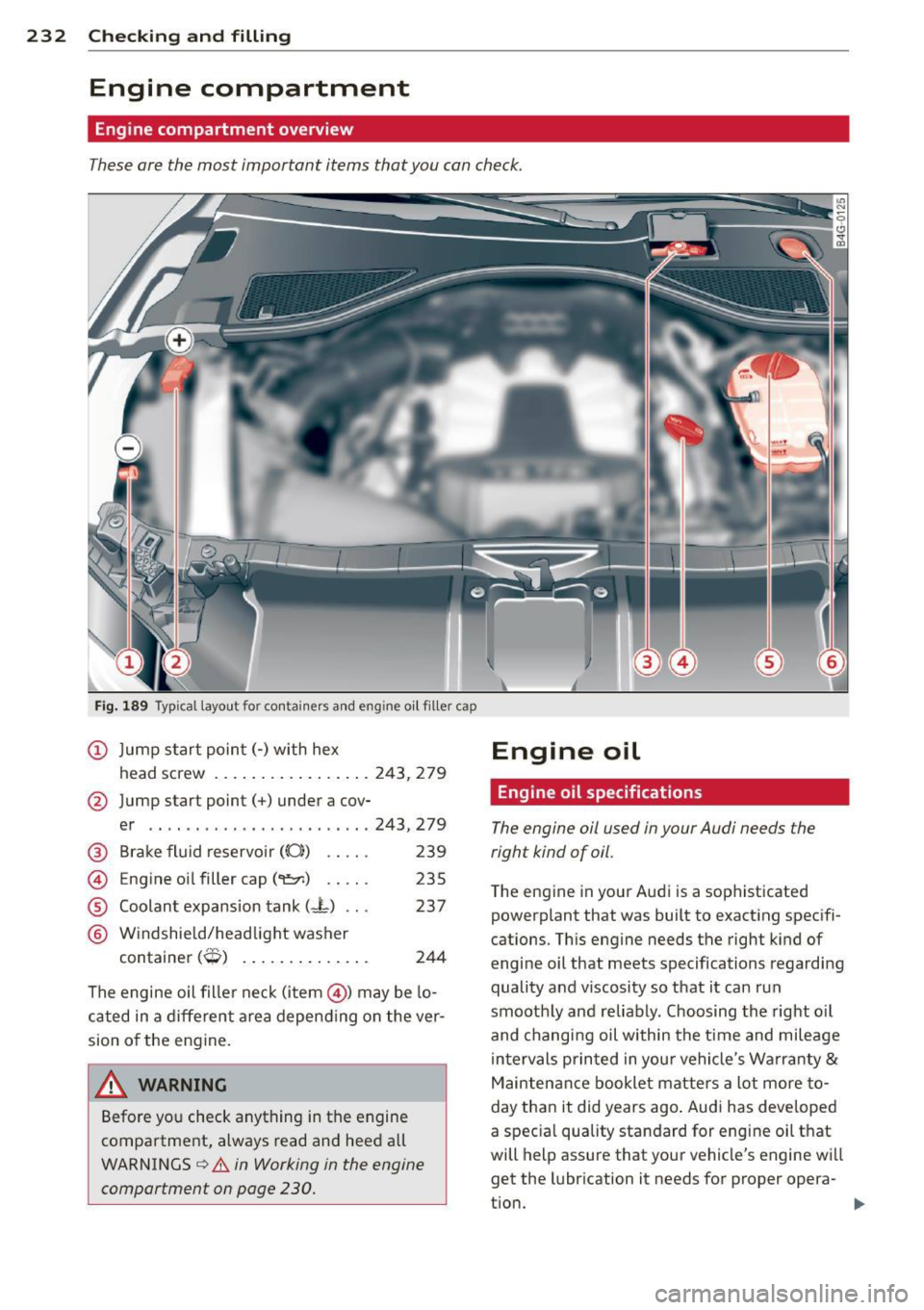
These are the most important items that you can check.
Fig. 189 Typ ical layout for contai ners and eng ine o il filler cap
(D Jump start point(-) with hex
head screw .... .............
243, 279
@ Jump start point(+) under a cov-
er .. .. ............... .... .
243,279
®
©
®
®
Brake fluid reservoir ((0)) . . . . . 239
Engine oil filler cap (
(-L) ...
Windshield/headlight washer
237
t . (.'R) con ainer ,,.., ............ . . 244
The engine oil filler neck (item @) may be lo
cated in a different area depending on the ver
sion of the engine.
~ WARNING
Before you check anything in the engine
compartment, always read and heed all
WARNINGS
¢ &. in Working in the engine
compartment on page 230.
-
Engine oil
Engine oil specifications
The engine oil used in your Audi needs the
right kind of oil.
The engine in your Audi is a sophisticated
powerplant that was built to exacting specifi
cations . This engine needs the right kind of
engine oil that meets specifications regarding
quality and viscosity so that it can run
smoothly and reliably . Choosing the right oil
and changing oil within the time and mileage
intervals printed in you r vehicle's Warranty
&
Maintenance booklet matters a lot more to
day than it did years ago . Audi has developed
a special quality standard for engine oil that
will help assure that your vehicle's engine wi ll
get the lubrication it needs for proper opera-
tion. ..,.
Page 241 of 310
scalding from hot coo lant by following
these steps.
- Turn
off the engi ne and a llow it to cool
down.
- Protect your face, hands and arms from
escapi ng fl uid and steam by cover ing
the cap with a large, thick rag .
- Turn the cap slowly and very ca refully
i n a cou nte r-clockw ise dir ect ion while
a pply ing lig ht, downwa rd p ress ure on
the top of the cap.
- To avo id being burned, do no t sp ill an
tifree ze o r coolan t on t he exh aust sys
tem or ho t engine parts . Un der certain
conditions, the ethylene glyco l in en
gine coolant can catch fire .
- Antifree ze is poisono us. Always store an
tifreeze in its or iginal co ntainer and we ll
o ut o f the reac h of children.
- If you drain the coolant , it must be
caught and safely stored in a p roper con
tainer clear ly marked "poison".
(D Note
- Coolant po llutes the env ironment and
could ca use a n engine fire . Excess coo l
ant wi ll be forced out through the pres
sure re lief va lve in the cap when the en
gine becomes hot.
- If, in an emergency, only water can be
added , the correct ratio between water
and antifreeze¢
page 237 must be re
stored as soon as possib le .
@ For the sake of the environment
Drained coolant should not be re used . Al
ways dispose of used c oolant while observ
ing all envir onmental regulations .
Radiator fan
The radiator fan switches on automa tically by
itself
An auxiliary e lectric radiator fa n switches on
and
off depending on coolant temperature
and other ve hicle operating conditions.
Checkin g and fillin g 239
After you switch the engine off, the auxi liary
fan can continue running for up to 10 minutes
- even w ith the ign ition off. It can even switch
o n again later by itself¢.& , if
- the temperature of the engine coo lant rises
due to the heat build- up from the engine in
the engi ne compartment, or
- the engine compa rtment heats up because
the vehicle is parked in intense sunlight.
&_ WARNING
--To reduce the risk of persona l in ju ry nev-
er touch the radiator fan .
- The a uxiliary electric fan is tempe rat ure
contro lled and can switch on suddenly
even when the engine is not ru nning.
- The a uxiliary radiator fan sw itches on a u
tomatically when the engine coo lant
reaches a certai n temperature and will
cont inue to ru n until the coo lant temper
atur e drops.
Brake fluid
Checking brake fluid level
N
N
N
.,; 0:, a,
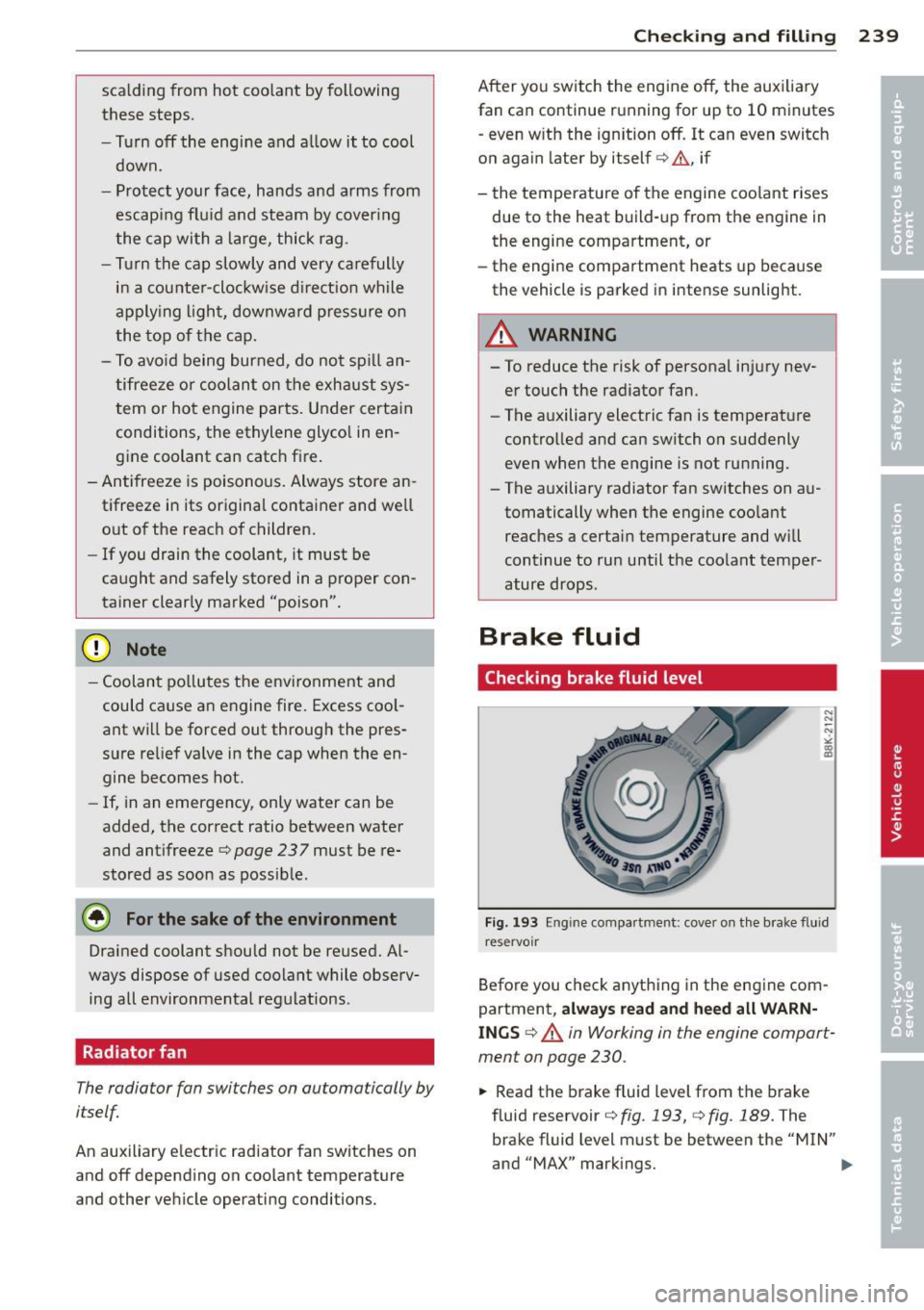
Fig. 193 Engin e co mpa rt m ent: cove r on t he bra ke fluid
reservo ir
Before you check anything in the eng ine com
partment,
alw ays r ead and heed all WARN
INGS c:> A in Working in the engine compart
ment on page 230 .
.. Read t he brake fluid level from the brake
fluid reservoir
c:> fig. 193, c:> fig. 189. The
brake fluid level must be between the "MIN"
and "MAX" markings. .,..
Page 242 of 310

24 0 Ch eck ing and filling
The location of the brake fluid reservo ir can be
seen in the engine compartment illustration
¢ page 232.
The fl uid level may drop slightly after some
time due to the automatic adjustment of the
brake pads. This is not cause for alarm.
I f the brake fluid level falls
considerably be
low the "MIN" mark, the brake warning/ind i
cator light
1111 (U .S . models)/ . (Canadian
models) will come on¢
page 15. Do not con
tinue to operate the vehicle. The comp lete
brake system shou ld be thoroughly checked
by an au thorized Audi dealer or other quali
fied facility and the cause corrected . If the
brake fluid level is too low, the brake warn ing/
indicator light w ill illuminate . Contact an au
thor ized Audi dealer
imm ediatel y.
Changing brake fluid
Have the brake fluid changed by an experi
enced technician .
Brake fluid absorbs moisture from the a ir . If
the water content in the brake fluid is too
h igh , corros ion in the brake system may result
after a per iod of t ime . The bo iling po int of the
brake fluid w ill also decrease considerably and
dec rease braking performance.
Therefore, the brake flu id must be changed
ev ery two year s. Always use new b rake fluid
which conforms to Fede ral Motor Vehicle
Standard "FMVSS
116 DO T 4".
The brake flu id reservoir can be difficult to
r each, therefo re , we recommend that you
have the brake fl uid changed by yo ur author
ized
Audi d ealer. Your dea ler has the correct
too ls, the right brake fluid and the know -how
to do this for you .
A WARNING
-Brake fluid is poisonous . It must be stor
ed only in the closed orig inal container
out of the reach of children!
- Brake fa ilure can result from old or inap
propriate brake fluid. Observe these pre
caut ions: -
Use only brake fluid that meets SAE
specification
J 1703 and conforms to
Federa l Motor Vehicle Standard
116.
Always check with your authorized Audi
dealer to make sure you are using the
correct brake fluid . The correct type of
brake f lu id is also ind icated on the
brake flu id reservoir.
- T he brake fluid must be new. Heavy use
of the bra kes ca n cause a vapo r lock if
the b rake fluid is left in the system too
l ong . This can seriously affect the effi
c iency of the brakes as well as your
safety. This co uld resu lt in an accident.
(D Note
Bra ke fluid will damage the paint of you r
vehicle .
(® For the sake of the environment
Because of the p rob lem of p roper disposal
of b ra ke fluid as well as the spec ial too ls
r equired and the necessary expertise, we
re commend that you have the brake fluid
changed by yo ur authorized Aud i dea ler.
Battery
General information
U nder normal ope rat ing cond itions , the bat
tery in yo ur Audi does not need any ma inte
nance. With
high o utside tempe ra tu res or
l ong daily drives we recommend that you have
the e lectrolyte level checked by a service fa
cility. The electrolyte leve l should a lso be
checked each t ime the battery is charged
<=> page 243.
Have th e battery checked when yo u take your
veh icle in for service. You are well advised to
replace a battery that is o lder than S years .
With certain types of airbag deployment, the battery is disconnected from the veh icle elec
trical system for safety reasons<=>.&
in Re
pair , care and dispo sal of the airbags on
page
165.