2013 AUDI A6 engine oil
[x] Cancel search: engine oilPage 234 of 306

232 Check ing and filling
Engine cooling system
Coolant
The engine coolant performs two functions: it
keeps the engine from overheating and it pro
tects the engine from freezing in the winter .
The cooling system is sealed and generally re
quires little attention.
The cooling system has been filled at the fac
tory with a permanent coolant which does not need to be changed. The coolant consists of a
mixture of water and the manufacturer's gly
col-based coolant additive Gl3 ant ifreeze
with ant icorros ion add itives (50% for USA
models; 60% for Canad ian models). This mix
ture both assu res the necessary frost protec
tion and protects metal components in the
engine's cooling system from corrosion and
scaling. It also raises the boiling point of the
coolant.
Do not reduce the concentration o f the coo l
ant in the summer by adding plain water .
The
propo rtion of coolant add it iv e mu st be at
l eas t 50 % but not mo re than 6 0%
to main
tain antifree ze protection and cooling efficien
cy. If the coolant frost protect ion is too low,
the coolant could freeze and damage the veh i
cle heating and eng ine cooling system .
For year-round driving, antifree ze is added at
the factory for temperatures down to:
- -31°F(-35°C)USA
- - 40 ° F ( -40 °C) Canada.
A WARNING
Before yo u check anything in the engine
compartment, always read and heed all
WARNINGS
c:> &. in Working in the engine
compartment on page 225.
- Before winter sets in, have the coolant
checked to see if the coo lant addit ive in
your vehicle is suffic ient to meet the cli
mate cond itions. Th is is especially impor
tant if you live in a region where the w in- ter is extreme
ly cold . If necessary, in
crease the proportion of coo lant additive
to 60%.
- When adding coolant additive to your
cooling system, remember:
- We recommend us ing only coolant ad
d itive Gl2++ or G l3 (check the labe l)
fo r your vehicle. This coolant additive is
ava ilable at a utho rized Aud i dea le rs.
Other types of antifreeze can sign ifi
cantly reduce corros ion protection. The
res ulting corrosion can cause a loss of
coolant and serious engine damage.
- Do not add any type of radiator leak seal
ant to yo ur vehicle's engine coolant .
Add ing radiator repair flu id may adverse
ly affect the function and performance of
your cooling system and could resu lt in
damage not covered by your New Veh icle
Limited War ranty.
Checking the engine coolant level
The engine coolant level can be checked with
a quick glance .
Fig. 1 87 Engin e compar tmen t: cover on t he coo la nt
expansio n ta nk
Before you check anyth ing in the engine com
partment,
alwa ys read and heed all WARN
I NGS c:> &. in Working in the engine compart
ment on page 225 .
.. Park your vehicle on a level surface .
.. Switch off the ignition.
.. Read the engine coolant level from the
coola nt expansion tank
c:> fig . 187,
c:> fig. 184 . With a cold engine, the coolant
level shou ld be between the "min" and
"max" markings. When the eng ine is wa rm, ..,.
Page 235 of 306

the level may be slightly above the "max"
marking .
The location of the coolant expansion tank
can be seen in the engine compartment illus
tration ¢ page 22 7.
To obtain an accurate reading, the engine must be switched
off.
The expansion tank in your vehicle is equipped
with an electric coolant level sensor.
When the coolant level is too low, the warning
light in the Auto-Check System ¢page 16will
illuminate until you add coolant and the level
has been restored to normal. Even though
there is an electric coolant level sensor , we
still recommend you check the coolant level
from time to time.
Coolant loss
Coolant loss may indicate a leak in the cooling
system. In the event of coolant loss, the cool
ing system should be inspected immediately
by your authorized Audi dealer.
It is not
enough merely to add coolant.
In a
sealed system, losses can occur only if
the boiling point of the coolant is exceeded as
a result of overheating.
& WARNING
The cooling system is under pressure and
can get very hot. Reduce the risk of scald
ing from hot coolant by following these
steps.
- Turn
off the engine and allow it to cool
down.
- Protect your face, hands and arms from
escaping fluid and steam by covering the
cap with a large, thick rag.
- Turn the cap slowly and very carefully in
a counter-clockwise direction while ap
plying light, downward pressure on the
top of the cap.
- To avoid being burned, do not spill anti freeze or coolant on the exhaust system or hot engine parts . Under certain condi
tions, the ethylene glycol in engine cool
ant can catch fire .
Checking and filling 233
@ Note
Do not add any type of radiator leak seal
ant to your vehicle's engine coolant. Add
ing radiator repair fluid may adversely af
fect the function and performance of your
cooling system and could result in damage not covered by your New Vehicle limited
Warranty .
Adding coolant
Be very careful when adding engine coolant.
Before you check anything in the engine com
partment,
always read and heed all WARN
INGS ¢ & in Working in the engine compart
ment on page 225 .
.,. Turn
off the engine .
.,. let the engine cool down.
.,. Place a thick rag over the coolant expansion
tank ¢ fig .
187 and carefully twist the cap
counter-clockwise ¢&_ .
.,. Add coolant.
.,. Twist the cap on again tightly.
Replacement engine coolant must conform to
exact specifications ¢ page
2 32, Coolant. We
recommend using only coolant additive G12+
+, G13 or in an emergency G12+. Do
not use a
different additive. In an emergency use plain
water until you can get the correct additive
and can restore the correct ratio. This should
be done as soon as possible.
If you have lost a considerable amount of
coolant, then you should add cold antifreeze
and cold water only when the engine is cold.
Always use new engine coolant when refilling.
Do not fill coolant above the "MAX" mark. Ex
cess coolant will be forced out through the pressure relief valve in the cap when the en
gine becomes hot.
A WARNING
- The cooling system is under pressure and
can get very hot. Reduce the risk of
II-
•
•
Page 273 of 306

Fuse panel@ (black )
No. Equipment Amps
= = 7 Audi adaptive cruise control 10
8
Airbag control module, front
5
passenger's seat sensor system
Gateway 5
Homelink (garage door opener),
10 night vision system control
5
module
Image processing (Audi active
11 lane assist, Audi adaptive cruise
10
control)
12 Steering 5
1 13 Terminal 15 in the luggage com-
15
partment
14 Terminal 15 in the
instrument
30
panel (front passenger's side)
15 Terminal 15 engine 15
16 Starter 40
Fuse panel
B (brown)
No. Equipment Amps
1 Gateway 5
2 Climate control 10
3 ESC control module 10
Front door (driver's side) 30
s
Power seat adjustment (driver's
7,5
seat)
6 Steering 35
7 Sunroof 20
8
Rear door control module (driv-
15
er's side)
9 Lumbar support (Front passen
-
5
ger seat)
11 Sunroof, rear spoiler (Sportback) 20
12 Driver door control module
15
Fuse panel
c (red)
No. Equipment Amps
2 Fuel pump 25
3 Brake light sensor/brake pedal
sensor system 5/5
4 Engine acoustics 7,5
Fuses and bulbs
-Fuse panel © (red)
No.
u Equipment
5 Rear door
control module (driv-
er's side)
6 Left
rear seat
Horn
Windshield wiper
9 Light/rain sensor
10 L
umbar support (driver seat)
11 Front passenger door control
module
12 Right rear door control modu le
Front passenger side cockpit fuse
assignment Amps
30
7,5 15
30 5
5
15
15
Fig. 212 Front passenger side cockpit: fuse panel wit h
p last ic bracket
Fuse panel A (black)
No. Equipment
Amps
1 Head-up Display 5
2 MMI Display 5
3 CD/DVD changer 5
4 MMI unit/drives
7,5
5 Chip card reader (not in all coun
-
5
tries)
6 Instrument cluster
5
7 Steering column switch module
5
8
Headlight range adjustment/
5/7,5
adaptive lighting system
10 Left
headlight (headlight with
7,5
adaptive light)
I
271
...
Page 281 of 306

heavy components such as the engi ne
b lock or transmiss ion are removed.
- W hen removing heavy components like
these, ancho r vehicle to hoist o r add cor
respond ing weig hts to ma inta in the cen
ter of g ravity . Otherwise, the vehicle
m ight tilt o r sli p off the hoist, causi ng
ser ious p erso na l in ju ry.
([) Note
-Be awa re of the fo llowing points befo re
li fting t he vehicle:
- The vehicle should never be lifted or
jacked up from underneath the engine oil pan, the transmission housing, the
front or rear axle or the body side
members. This could lead to serious
damage.
- To avoid damage to the underbody or
chassis frame , a rubber pad must be
i nserted between the floor jack and
the lift points.
- Before driving over a workshop hoist,
check that the veh icle weight does not
exceed the permissible lifting capacity
of the hoist.
- Before driving over a workshop hoist,
ensure that there is sufficient clear
ance between the hoist and low parts
of the vehicle.
Emergency situations 2 79
•
•
Page 284 of 306

282 Data
Data
A6 211 hp, 2.0 Liter 4-cylinder engine
Applies to vehicles: with 2.0 liter 4-cylinder engine
Engine data Ma ximum output SAE ne t
M aximum torque SAE net
No. of cylinders
Displacement
Stroke
Bo re
C ompress ion ratio
Fuel
Dimensions (approx .)
Leng th (w it h li cense pl ate bracket)
Width (across mirrors) He igh t (unloaded) hp@r
pm
lb-ft@ rpm
CID (cm
3 )
in (mm)
in (mm)
211 @4300-6000
4
121 (1984)
3.65 (92. 8)
3 .25 (82 .5)
9.6: 1
Premium unleaded (91 AKI) Recommended for maxi
mum engine performance. Further details<=>
page 220,
Gasoline
in (mm) 1 9 3.9 (4 925)
in (mm) 82.1 (2086)
in (mm) 57 .8 (1 468)
Turning circle diameter (curb to curb) ft. (m) 39.0 (11.9)
Capacities (appro x.)
Fuel tank
- Total capacity
- Reserve (o f to tal capacity)
Windshield fluid container
Windshield and headlight wa sher
fluid container *
Engine oil with filter c hange gal (li
ters)
19.8 (75.0)
ga l (li ters) 2.6 (1 0 .0 )
quarts (liters) 3.7 (3.5)
qu arts ( li1ters) 5 .2 (4 .9)
quarts (li ters) 4.9 (4.6)
Page 285 of 306

Data
A6 310 hp, 3.0 liter 6-cylinder engine
Applies to vehicles: with 3.0 liter 6-cylinder engine and all-wheel drive
Engine data
Maximum output SAE ne t
Maximum torque SAE net
No. of cylinders
Displacement
Stroke
Bore
C ompression ratio
Fuel
Dimensions (approx .)
L eng th (wit h license pl ate brac ket)
Width (across mirrors) He igh t (unloaded)
310@ 5500-6500 hp@ rpm
lb-ft@ rpm
-.. .--
C ID (cm3
)
in (mm)
in (mm)
__ ,
-~-- ,
325 @ 290 0-4500
6
182 (2995)
3.50 (89.0)
3 .33 (84.5)
10.3: 1
Premium unleaded (91 AKI) Recommended for maxi
mum engine performance. Further details¢
page 220,
Gasoline
in (mm) 193.9 ( 4925)
in (mm) 82.1 (2086)
in (mm) 57 .8 ( 1468)
Turning circle diameter (curb to curb) ft. (m) 39.0 (11.9)
Capacities (appro x.)
Fuel tank
- Total capac ity
- Reserve (o f to tal capacity)
Windshield fluid container
Windshield and headlight washer
fluid container *
Engine oil with filter change gal (liters)
19.8 (75.0)
gal (li
ters) 2. 6 (10.0)
quarts (liters) 3.7 (3.5)
qu arts ( liters) 5 .2 ( 4.9)
quarts (lite rs) 7.2 (6.8)
283
•
•
Page 286 of 306
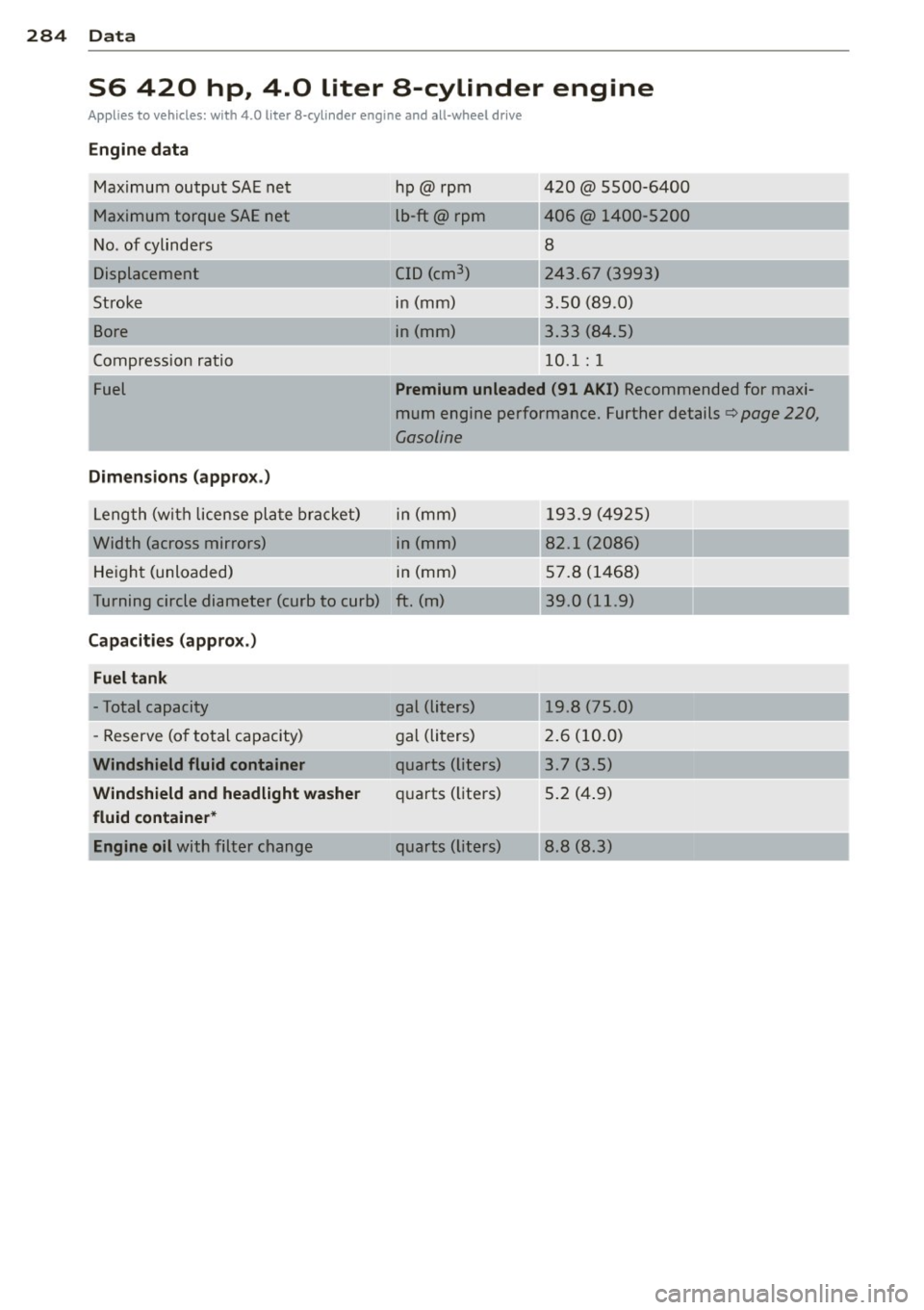
284 Data
S6 420 hp, 4.0 Liter a-cylinder engine
Applies to vehicles: with 4.0 liter 8-cylinder engine and all-wheel d rive
Engine data
Maximum outpu t SAE ne t
Maximum torque SAE net
No. of cylinders
Stroke
Bore
Compressio n ratio
Fuel
Dimensions ( approx .)
Leng th (with lice nse pl ate bra cket)
Width (across mirrors) He igh t (unloaded) hp@ rpm
lb-ft@ rpm
CID (cm
3 )
in (mm)
in (mm)
__ ,
-~ .. ,
420 @ 5500-6400
406@ 140 0-5200
8
24 3 .67 (3993)
3 .50 (89 .0)
3 .33 (84.5)
10 .1: 1
Premium unleaded (91 AKI) Recommended for maxi
mum engine performance . Further details¢
page 220,
Gasoline
in (mm) 193 .9 (4 925)
in (mm) 82.1 (2086)
in (mm) 57 .8 ( 1468)
Turning circle diamet er (curb to curb) ft. (m) 39 .0 (11.9)
Capacities (appro x.)
Fuel tank
- Total capacity
-Reserve (o f to tal capacity)
Windshield fluid container
Windshield and headlight wa sher
fluid container *
Engine oil
with filter c hange gal (li
ters)
19 .8 (75 .0)
gal (li ters) 2. 6 (10. 0)
q uarts (lit ers) 3 .7 (3 .5)
qu arts ( li1ters) 5 .2 ( 4.9)
quarts (li te rs) 8 .8 (8.3)
Page 287 of 306

Consumer Information
Warranty coverages
Your Audi is covered by the following war
ranties :
- New Vehicle Limited Warranty
- Limited Warranty Against Corrosion Perfo-
ration
- Emissions Control System Warranty
- Emissions Performance Warranty
- California Emissions Control Warranty (USA
vehicles only)
- California Emissions Performance Warranty
(USA vehicles only)
Detailed information regarding yo ur warran
ties can be found in your
Warranty & Mainte
nance booklet .
Operating your vehicle
outside the U.S.A. or
Canada
Government regulations in the United States
and Canada require that automobiles meet
specific emission regulations and safety
standards. Therefore, veh icles built for the
U.S.A. and Canada differ from vehicles sold in
other countries .
I f you p lan to take your vehicle outside the
continental limits of the United States or Can
ada, there is the possibility that:
- unleaded fuels for vehicles with cata lytic
converter may not be available;
- fuel may have a considerably lower octane
rating . Improper fuel may cause engine
damage;
- service may be inadequate due to lack of
proper service facilities, tools or testing
equipment;
- replacement parts may not be readily availa
ble.
- Navigation systems for vehicles built for the
U.S.A. and Canada will not necessari ly work
in Europe, and may not work in other coun
tries outside North America .
Consumer Information 285
@ Note
Audi cannot be responsible for mechanical
damage that could result from inadequate
fuel, serv ice or parts availab ility.
Audi Service Repair
Manuals and Literature
Audi Offic ial Factory Service Manuals and Lit
erature are published as soon as possible after
model introduct ion. Service manuals and lit
erat ure are available to order from the Audi
T echnical Literature Ordering Center at:
www.audi.techliterature.com
Maintenance
' General
Your vehicle has been designed to help keep
maintenance requirements to a m inimum.
However, a certain amount of regular mainte
nance is still necessary to assure your vehicle's
safety, economy and reliability . For detailed
vehicle maintenance consult your Warranty
&
Maintenance booklet.
Under difficult operating conditions , for ex
ample at extremely low outside temperatures,
in very dusty regions, when towing a trailer
very frequently, etc., some serv ice work
shou ld be pe rformed between the intervals
specified. This applies particularly to:
- oil changes, and
- cleaning or replacing the air filter.
® For the sake of the environment
By regularly maintaining your veh icle, you
help make sure that emission standards
are maintained, thus min imiz ing adverse
effects on the environment .
Important considerations for you and
your vehicle
The increasing use of electronics, sophistica t
ed fuel injection and emission contro l sys-
tems, and the genera lly increasing technica l ..,_
•
•