2013 AUDI A4 SEDAN steering
[x] Cancel search: steeringPage 146 of 294
144 Airbag sys tem
Airbag system
Important things to know
Importance of wearing safety belts and
sitting properly
Airbags are only supplemental restraints. For
airbags to do their job , occupants must al
ways properly wear their safety belts and be
in a proper seating position.
F or your safety and the safety of your passen
gers, before driving off, a lways:
• Adjust the dr iver's seat and steering wheel
properly ¢
page 12 7,
• Adjust the front passenger's seat properly
r=;page 55,
• Wear safety be lts properly r=:; page 139,
• Always properly use the proper child re-
stra int to protect children¢
page 165.
In a collision airbags must inflate within the
blink of an eye and with considerable force .
The supplementa l airbags can cause injuries if
the dr iver or the front seat passenger is not
seated properly . T herefore in order to he lp the
a irbag to do its job, it is important, both as a
d river and as a passenge r to s it properly at all
times.
By keeping room between your body and the
steering wheel and the front of the passenge r
compartment, the airbag ca n inflate fully and
comp letely and provide supp lemen tal p rotec
tion in ce rtain frontal collisions
r=:; page 127,
Proper occupant seating positions .
For detai ls
on the operat ion of the seat adjustment con
trols ¢
page 56.
It's especially important that children a re
properly restrained
r=:; page 165.
There is a lot tha t the driver and the passen
ge rs can and must do to help the individua l
safety features ins talled in your A udi work to
gether as a system.
Prope r seat ing pos ition is important so that
the front airbag on the driver s ide can do i ts
job. If yo u have a physical impa irment or con- dition that prevents yo
u from sitting properly
on the driver seat with the safety belt properly
fastened and reaching the peda ls , spec ial
modifications to your vehicle may be necessa
ry.
Contact your a uthorized Audi dea ler, or call
Audi C ustomer Re lations at 1-800-822-2834 .
When the airbag sys tem dep loys, a gas gener
ator will f ill the ai rbags, break open the pad
ded covers, and inf late between the steering
whee l and the dr iver and between the instru
ment pane l and the front passenger. The air
bags will deflate immediately after dep loy
ment so that the front occupants can see
th rough the w indshield aga in without inter
ruption .
All of th is take s place in the blink of an eye, so
fast that many people don't even realize that
the a irbags have dep loyed . The airbags also
inflate with a g reat dea l of force and nothing
sho uld be in their way when they deploy.
F ron t air bags in combination w ith properly
worn safety bel ts slow down and lim it the oc
c u pant's forward movement. Together they
help to prevent the drive r and front seat pas
senger from hitting parts of the inside the ve
hicle while reducing the forces acting on the
occupant dur ing the crash. In this way they
help to reduce the risk of injury to the head
and uppe r body i n the c rash . A irbags do not
protect the a rms or the lower parts of the
body.
Both front a irbags w ill not i nflate in all fronta l
collisions . The t rigge ring of the a irbag system
depends on the vehicle dece lerat ion rate
c a u sed by the co llision and reg istered by the
elect ron ic cont ro l u nit. If thi s rate is below
the re ference value programmed into the con
trol unit, the airbags will not be trigge red ,
even though the car may be bad ly damaged as
a res ult of the collision . Veh icle damage, re
pair costs or even the lack of veh icle damage
is no t necessarily an indication of whether an
airbag should inflate or not .
It is not possible to define a range of vehicle
speeds that w ill cover every possib le kind and .,.
Page 147 of 294
angle of impact that will always trigger the
airbags, since the circumstances will vary con
siderably between one collision and another.
Important factors include, for example, the nature (hard or soft) of the object which the
car hits, the angle of impact, vehicle speed,
etc. The front airbags will also not inflate in
side or rear collisions, or in ro ll-overs .
Alwa ys rem ember : Airbags will deploy only
once, and only in certa in kinds of collisions .
Your safety belts are always there to offer pro
tection in those s ituations in which airbags
are not supposed to deploy , or when they have
a lready deployed ; fo r example , when yo ur ve
h icle strikes or is struck by another after the
first collision .
This is just one of the reasons why an a irbag is
a supplementary restra int and is not a s ubst i
tute for a safety belt . The airbag system
works most effectively when used with the
safety belts. Therefore, always properly wear
your safety belts
¢ page 136.
A WARNING
Sitting too close to the steer ing wheel or
instrument panel will decrease the effec
tiveness of the airbags and will increase
the risk of pe rsonal injury in a co llision .
- Never sit closer than
10 inches (25 cm)
to the stee ring wheel or instrument pan
el.
- If you cannot sit more than
10 i nches
(25 cm) from the steer ing whee l, investi
gate whether adaptive equipment may
be available to help you reach the pedals
and increase your seating dis tance from
the steering wheel.
- If you are unrestrained, lean ing fo rward,
sitting sideways or out of position in any
way, yo ur risk of inj ury is much highe r.
- You w il l also receive serio us inju ries and
cou ld even be killed if you are up against
the airbag or too close to it when it in
flates -even with an Advanced Airbag.
- To reduce the r isk o f injury when an air
bag inflates, a lways wear safety belts
proper ly ¢
page 139, Safety belts .
Airbag system 145
-Always make certain that chi ld ren age 12
or younger a lways ride in the rear seat. If
children are not properly restrained, they may be severe ly inju red or killed when an
airbag inf lates .
- Never let ch ildren ride unrestra ined or
improperly restrained in the vehicle . Ad
just the front seats prope rly.
- Never ride with the backrest reclined.
- Always sit as far as possible from the
steer ing whee l or the instrument pane l
¢page 127.
-Always sit upright with your back against
the backrest of your seat.
- Never p lace your feet on the instrument
panel or on the seat. Always keep both
feet on the f loor in front of the seat to
he lp prevent serio us in juries to the legs
a nd h ips if the airbag inflates.
- Never recline the front passenger 's seat
to tra nsport objects. Items can a lso
move i nto the area of the s ide a irbag or
the front a irbag du ring bra king or in a
sud den maneuve r. Obje cts ne ar the air
bags can become projectiles and cause
injury when an airbag inflates.
_&. WARNING ~
A irbags that have de ployed in a crash must
be replaced.
- Use on ly original equipment airbags ap
proved by Audi and installed by a trai ned
technician who has the necessary too ls
and d iagnost ic equipment to properly re
place any airbag in your vehicle and as
sure system effectiveness in a crash .
- Never perm it salvaged or recycled air
bags to be installed in your vehicle .
Child restraints on the front seat - some
important things to know
.,. Be su re to read t he important information
and head the WARNINGS fo r important de
tails about children and Advanced Airbags
¢ page 165. ..,.
•
•
Page 150 of 294
148 Airbag system
-Never place additional items on the seat
that can increase the total weight regis
tered by the weight-sensing mat and can
cause injury in a crash .
Front airbags
Description of front airbags
The airbag system can provide supplemental
protection to properly restrained front seat
occupants.
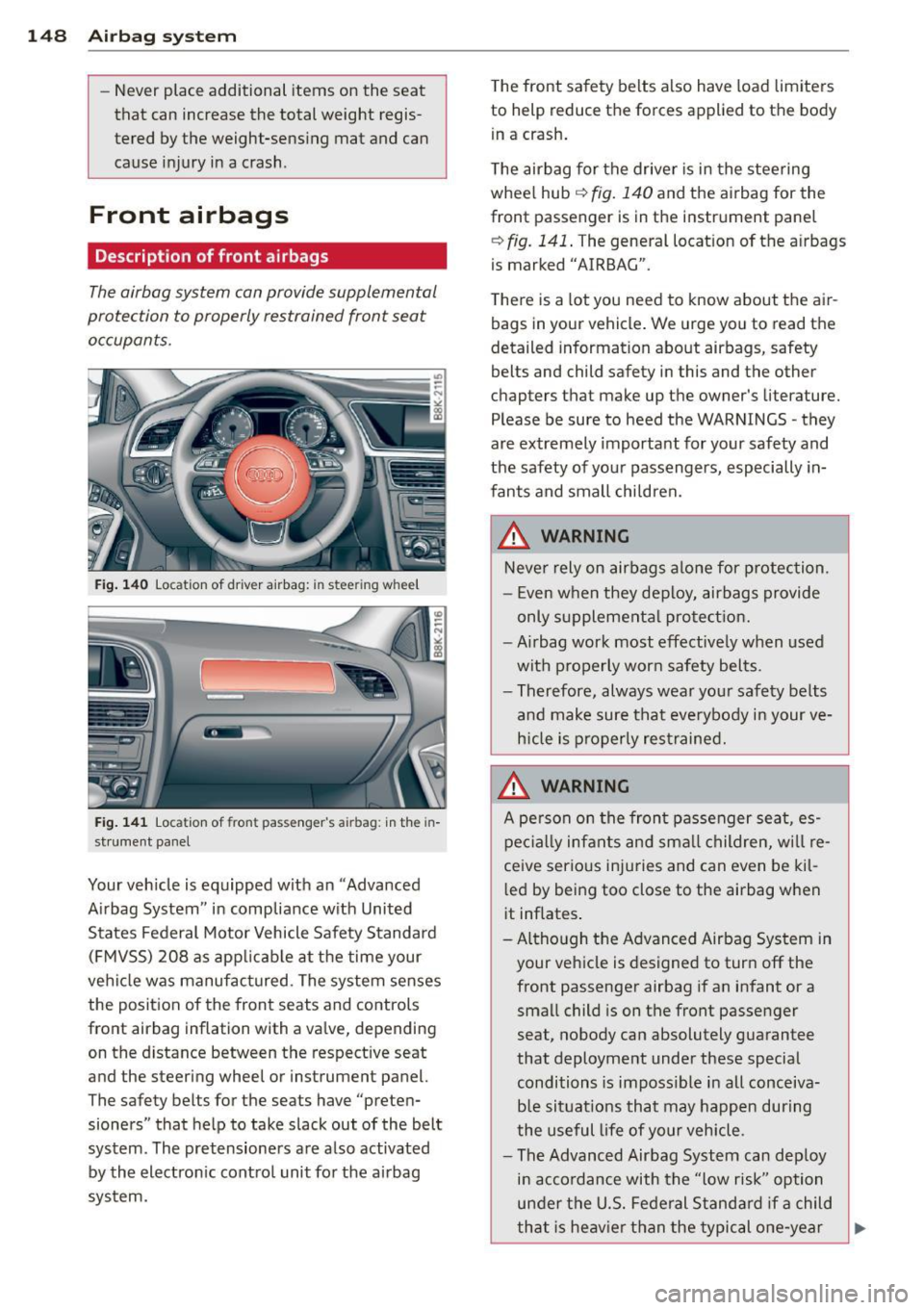
Fig. 140 Locat ion of dr iver airbag: in stee ring wheel
Fig. 141 Loca tion of front pass enger's a irbag: in the in
strument panel
Your veh icle is equipped with an "Advanced
Airbag System" in compliance with United
States Federal Motor Vehicle Safety Standard (FMVSS) 208 as applicable at the time your
vehicle was manufactured . The system senses
the position of the front seats and controls
front airbag inflation with a valve, depend ing
on the distance between the respective seat
and the steering wheel or instrument panel.
The safety belts for the seats have "preten
sioners" that help to take slack out of the belt
system. The pretensioners are also activated by the electronic contro l unit for the airbag
system. The
front safety belts also have load limiters
to help reduce the forces applied to the body
in a crash.
The airbag for the driver is in the steering
wheel hub ¢
fig. 140 and the airbag for the
front passenger is in the instrument panel
~ fig. 141 . The general locat ion of the a irbags
i s marked "AIRBAG".
There is a lot you need to know about the air
bags in your vehicle . We urge you to read the
detailed information about airbags, safety
belts and child safety in this and the other
ch apters that make up the owner 's literature.
Please be sure to heed the WARNINGS -they
are extremely important for your safety and
the safety of your passengers, especially in
fants and small children.
_&. WARNING
Never rely on airbags alone for protection.
- Even when they deploy, airbags provide
only supplemental protection.
-Airbag work most effectively when used
with properly worn safety bel ts.
- Therefore, always wear your safety belts
and make sure that everybody in your ve
h icle is properly restrained.
_&. WARNING
A person on the front passenger seat, es
pecially infants and sma ll children, will re
ceive serious injuries and can even be kil
led by being too close to the airbag when
it inflates .
- Although the Advanced Airbag System in
your vehicle is designed to turn off the
front passenger airbag if an infant or a
small child is on the front passenger
seat, nobody can absolutely guarantee
that deployment under these special
conditions is imposs ible in all conceiva
b le situat ions that may happen during
the useful life of your vehicle .
- The Advanced Airbag System can deploy
in accordance with the "low risk" option
under the U.S. Federal Standard if a child
that is heav ier than the typical one-year
-
.
Page 151 of 294
old child is on the front passenger seat
and the other conditions for airbag de
ployment are met.
- Accident statistics have shown that chil
dren are generally safer in the rear seat
area than in the front seating position.
- For their own safety, all children, espe cially 12 years and younger, should al
ways ride in the back properly restrained
for their age and size.
Advanced front airbag system
Your vehicle is equipped with a front Advanced
Airbag System in compliance with United
States Federal Motor Vehicle Safety Standard
208 as applicable at the time your vehicle was
manufactured.
The front Advanced Airbag System supple ments the safety belts to provide additional
protection for the driver's and front passeng
er's heads and upper bodies in frontal crashes.
The airbags inflate only in frontal impacts
when the vehicle deceleration is high enough .
The front Advanced Airbag System for the
front seat occupants is not a substitute for
your safety belts. Rather, it is part of the over
all occupant restraint system in your vehicle.
Always remember that the ai rbag system can
only help to protect you, if you are sitting up right, wearing your safety belt and wearing it
properly . This is why you and your passengers
must always be properly restrained, not just
because the law requires you to be.
T he Advanced Airbag System in your vehicle
has been certified to meet the "low risk" re
quirements for 3 and 6 year-old children on
the passenger side and very small adults on
the driver side. The low risk deployment crite
ria are intended to help reduce the risk of in
jury through interaction with the front airbag
that can occur , for example , by being too
close to the steering wheel and instrument panel when the airbag inflates.
In addition, the system has been certified to
comply with the "suppression" requirements
Airbag system 149
of the Safety Standard, to turn off the front
airbag for infants 12 months old and younger
who are restrained on the front passenger
seat in child restraints that are listed in the
Standard
¢ page 167 , Child restraints and
Advanced Airbags .
"Suppression" requires the front airbag on the
passenger side to be turned off if:
- a child up to about one year of age is re
strained on the front passenger seat in one
of the rear-facing or forward-facing infant restraints listed in Federal Motor Vehicle
Safety Standard 208 with which the Ad
vanced Airbag System in your vehicle was
certified . For a listing of the child restraints
that were used to certify your vehicle's com pliance with the US Safety Standard
¢page 167,
-weight less than a threshold level stored in
the control unit is detected on the front pas
senger seat.
When a person is detected on the front pas
senger seat, weighing more than the total
weight of a child that is about 1 year old re
strained in one of the rear-facing or forward
facing infant restraints (listed in Federal Mo
tor Vehicle Safety Standard 208 with which
the Advanced Airbag System in your vehicle
was certified), the front airbag on the passen ger side may or may not deploy.
The
PASSENGER AIR BAG OFF light comes on
when the electronic control unit detects a to
tal weight on the front passenger seat that re
quires the front airbag to be turned off. If the
PASSENGER AIR BAG OFF light does not
come on, the front airbag on the passenger
side has not been turned off by the control unit and can deploy if the control unit senses
an impact that meets the conditions stored in
its memory.
If the total weight on the front passenger
seat is more than that of a typical 1 year-old ,
but less than the weight of a small adult, the
front airbag on the passenger side may deploy
(the
PASSENGER AIR BAG OFF light does not
come on). ..,. •
•
Page 156 of 294
154 Airbag system
must always sit in an upright position,
must not lean against or place any part
of their body too close to the area where
the airbags are located .
- Occupants who are unbelted, out of posi
tion or too close to the airbag can be se riously injured by an airbag as it unfolds
with great force in the blink of an eye
~page 145.
A WARNING
A child in a rearward-facing child safety
seat installed on the front passenger seat
will be seriously injured and can be killed if
the front airbag inflates -even with an Ad
vanced Airbag System.
- The inflating airbag will hit the child
safety seat or infant carrier with great
force and will smash the child safety seat
and child against the backrest, center
armrest, door or roof.
- Always install rear-facing child safety
seats on the rear seat.
- If you must install a rearward facing
child safety seat on the front passenger
seat because of exceptional circumstan
ces and the
PASSENGER AIR BAG OFF
light does not come on and stay on, im
mediately install the rear-facing child
safety seat in a rear seating position and
have the airbag system inspected by your
authorized Audi dealer.
A WARNING
Objects between you and the airbag will
increase the risk of injury in a crash by in
terfering with the way the airbag unfolds
or by being pushed into you as the airbag
inflates.
- Never hold things in your hands or on
your lap when the vehicle is in use.
- Never transport items on or in the area of the front passenger seat. Objects
could move into the area of the front air
bags during braking or other sudden ma
neuver and become dangerous projec- tiles that can cause serious personal in
jury if the airbags inflate.
- Never place or attach accessories or oth
er objects (such as cupholders, tele phone brackets, large, heavy or bulky ob
jects) on the doors, over or near the area marked "AIRBAG" on the steering wheel,
instrument panel, seat backrests or be
tween those areas and yourself. These
objects could cause injury in a crash, es
pecially when the airbags inflate.
- Never recline the front passenger's seat
to transport objects. Items can also
move into the area of the side airbag or
the front airbag during braking or in a
sudden maneuver. Objects near the air
bags can become projectiles and cause
injury, particularly when the seat is re
clined.
A WARNING
'-
The fine dust created when airbags deploy
can cause breathing problems for people
with a history of asthma or other breath
ing conditions.
- To reduce the risk of breathing problems, those with asthma or other respiratory
conditions should get fresh air right
away by getting out of the vehicle or
opening windows or doors.
- If you are in a collision in which airbags
deploy, wash your hands and face with
mild soap and water before eating.
- Be careful not to get the dust into your
eyes, or into any cuts or scratches.
- If the residue should get into your eyes,
flush them with water.
Page 160 of 294
158 Airb ag sys te m
There are some impor tant things you have to
know to make sure that the effectiveness of
the system will not be impa ired and t hat dis
carded components do not cause injury or pol
l ute t he e nvironm ent.
A WARNING
Improp er care, s ervicing a nd r epair proce
dures can increase t he risk of personal in
jury and death by preventing an airbag
from deploy ing when needed o r deploying
an airbag unexpectedly:
- Never cover, obstruct, or change the
steering wheel ho rn pad or airbag cover
or the instrument pane l or modify them
in any way.
- Never attach any objects such as cu
pholders or telephone mountings to the
surfaces covering the airbag units .
- F or cleaning the horn pad or instrumen t
pane l, use only a soft, dry cloth or one
moistened with plain water. Solvents or
cleaners co uld damage the airbag cover
or change the stiffness or strength of the
material so that the airbag cannot de
ploy and protect proper ly.
- Never repa ir, adjust, or change any parts
of the airbag system .
- All work on the steering wheel, instru
ment pane l, front seats or electrical sys
tem (including the installation of audio
equipment, cellular telephones and CB
radios, etc .) must be performed by a
qualified tech nician who has the t raining
and special equipment necessary.
- For any wor k on the ai rbag system, we
st rongly recommend that you see you r
au thori zed Audi dealer or qualified wo rk
shop .
- Never mod ify the front bumper or parts
of the veh icle body.
- Always make su re that the side airbag
can infla te wi tho ut interferen ce:
- Never insta ll seat covers or replace
ment upho lstery over the front seat
backs that have not been spec ifically
approved by Audi . -
Never use additional seat c ushions that
cover the areas where the side a irbags
inflate.
- Damage to the orig inal seat covers or
to the seam in the area of the side a ir
bag module must a lways be repaired
immediately by an author ized Audi
dealer .
- The airbag system can be activated only
once. After an airbag has inflated, it
m ust be replaced by an autho rized Aud i
dea le r o r qualified technician who has
the techni cal info rmation, training and
specia l equipment necessary.
- T he airbag system can be deployed only
once . After an airbag has been deployed,
it mus t be replaced with new replace
ment parts designed an d approved espe
cially fo r your A udi model version. Re
p lacement of complete airbag systems
or airbag components must be per
formed by qualified workshops on ly.
Make sure that any airbag serv ice action
is entered in your Audi Warranty
& Main
tenance booklet unde r
AIRBAG REPLAC E
M ENT RECORD .
-In accidents when an airbag is dep loyed,
the vehicle batte ry separates the alterna
tor and the star ter from the vehicle elec
tr ica l system fo r safe ty reasons w ith a
py rotechn ic circuit inte rrupter.
- Work on the pyrotechnic c ircuit inter
rupter must only be performed by a
qualified dea le r - risk of an accident!
- If the vehicle or the circuit interr upter
is scrapped, all applicable safety pre
cautions must be fo llowed.
@ For the sake of the environment
Undeployed airbag modules and preten
s ione rs might be classif ied as Perchlorate
Ma teria l -special handling may app ly, see
www.dtsc.ca .gov/hazardouswaste/per
ch lorate. W hen the veh icle or parts o f th e
r est rain t sys tem including airb ag modu les
s a fety be lts wi th pre tensioners are scrap
ped, all applicab le laws and regulations
must be observed. Your authorized Audi
1J1-
Page 168 of 294

166 Child Safety
-If you must install a rearward facing
child safety seat on the front passenger
seat in exceptional circumstances and
the
PASSENGER AIR BAG OFF light does
not come on and stay on, immediately
install the rearward-facing child safety
seat in a rear seating position and have
the airbag system inspected immediately
by your authorized Audi dealer.
.&, WARNING
If, in exceptional circumstances, you must
install a forward-facing child restraint on
the front passenger's seat:
- Always make sure the forward-facing
seat has been designed and certified by
its manufacturer for use on a front seat
with a passenger front and side airbag.
- Always follow the manufacturer's in
structions provided with the child safety
seat or carrier.
- Always move the passenger seat into its
rearmost position in the seat's fore and
aft adjustment range, as far away from
the airbag as possible before installing
the child restraint. The backrest must be adjusted to an upright position .
- Always make sure that the
PASSENGER
AIR BAG OFF
light comes on and stays
on all the time whenever the ignition is
switched on.
(D Tips
Always replace child restraints that were
installed in a vehicle during a crash. Dam
age to a child restraint that is not visible
could cause it to fail in another collision
situation.
Advanced front airbag system and children
Your vehicle is equipped with a front "Ad
vanced Airbag System" in compliance with
United States Federal Motor Vehicle Safety
Standard (FMVSS) 208 as applicable at the
time your vehicle was manufactured . The
Advanced Airbag system in your vehicle
has been certified to meet the "low-risk" re
quirements for 3- and 6-year old children on
the passenger side and small adults on the driver side. The low risk deployment criteria
are intended to reduce the risk of injury
through interaction with the airbag that can
occur, for example, by being too close to the
steering wheel and instrument panel when
the airbag inflates . In addition, the system
has been certified to comply with the "sup
pression" requirements of the Safety Stand
ard, to turn off the front airbag for infants up
to 12 months who are restrained on the front
passenger seat in child restraints that are list
ed in the Standard.
Even though your vehicle is equipped with an
Advanced Airbag system, all children, espe
cially those 12 years and younger, should al
ways ride in the back seat properly restrained
for their age and size. The airbag on the pas
senger side makes the front seat a potentially
dangerous place for a child to ride . The front
seat is not the safest place for a child in a for
ward-facing child safety seat.
It can be a very
dangerous place for an infant or a larger child
in a rearward-facing seat.
Advanced Airbags and the weight
sensing mat in the front seat
The Advanced Airbag System in your vehicle detects the presence of an infant or child in a
child restraint on the front passenger seat us
ing the weight-sensing mat in the seat cush
ion and the sensor below the safety belt latch
on the front passenger seat that measures the
tension on the safety belt.
The weight-sensing mat measures total
weight of the child and the child safety seat
and a child blanket on the front passenger
seat. The weight on the front passenger seat
is related to the design of the child restraint
and its "footprint", the size and shape of the
bottom of the child restraint as it sits on the
seat. The weight of a child restraint and its "footprint" vary for different kinds of child re -
straints and for the different models of the .,.
Page 186 of 294

184 Intelligent technology
Intelligent technology
Notice about data
recorded by vehicle
control modules
Your veh icle is not equipped with an Event Da
ta Recorde r (EDR), ins talled by some manu
facture rs fo r the express p urpose of capturing
data for retrieval after an accident or cras h
event . EDR's are sometimes ca lled "crash re
corders".
Some state laws restr ict the retr ieval or down
loading of data stored by EDR's that were in
stalled in a vehicle for the express purpose of retrieving data after an accident or crash
event without the owner's consent.
A ltho ugh yo ur vehicle is not equ ipped wit h an
EDR, it is equipped with a number of electron
ic control modules for various vehicle systems
such as, for examp le, eng ine f unction, em is
sion control, as well as for the airbags and
safety belts.
These electronic contro l modules also record
vehicle-re lated data during norma l vehicle op
erat ion for diagnostic and repa ir purposes.
The recording capacity of the electronic con
trol modules is limited to data (no sound is re
corded) and only a small amount of data is ac
tually recorded ove r a ve ry limited pe riod of
time and stored when a sys tem faul t or o ther
cond ition is sensed by a cont ro l u nit. Some of
the data then stored may re late to vehicle
speed, direction, braking as we ll as restraint
system use and performance in the event of a
crash or other condit ion. Stored data can only
be read and downloaded w ith special equip
ment.
Electronic Stabilization
Control (ESC)
Description
ESC helps to improve road holding and vehicle
dynamics to help reduce the probability of
skidd ing and loss of ve hicle control. It works
only when the eng ine is running. ESC detects certain difficult driving situat
ions, including
when the vehicle is beginning to spin (yaw)
o ut of control and he lps you to get the veh icle
back under control by se lectively braking the
whee ls, and/or reducing eng ine power and
providing steer ing ass istance to he lp hold the
vehicle o n the dr iver's intended course. The in
dicator light
G) in the inst rument cluster
blinks when ESC is ta king action to help yo u
control the veh icle.
ESC has limitations.
It is importa nt to remem
ber that ESC cannot overcome the laws of
physics. It wi ll not always be able to help out
under a ll cond it ions you may come up aga inst.
F or example, ESC may not always be able to
help you master situations where there is a
s u dden change in the coefficient of friction of
the road surface. When there is a section of
dry road that is sudden ly covered w ith water,
s lush or snow, ESC cannot perform the same
way it wou ld on the dry surface . If the ve hicle
hydroplanes (rides on a cushion of water in
stead of the road surface), ESC will not be
able to help you steer the vehicle because con
tact with the pavement has been in terrupted
and the vehicle cannot be braked or steered .
D uring fast cornering, particularly on winding
roads, ESC cannot always deal as effectively
with difficult driving situations than at lower
speeds. When towing a trailer, ESC is not able
to help you regain control as it would if you
were not tow ing a trailer.
Always adjust your speed and driving style to road, traffic; and weather condit ions. ESC can
not override the vehicle's physical limits, in
crease the availab le tract ion, or keep a ve hicle
on the road if road departure is a result of
drive r inattent io n. Instead, ESC imp roves the
poss ibil ity of keeping the vehi cle under con
trol and on the road during ex treme maneu
vers by using the d river's steering inputs to
help keep the vehicle going in the intended di
rection . If you are traveling at a speed that
ca uses you to run off the road before ESC can
provide any assistance, you may not experi
ence the benefits of ESC.