2013 AUDI A4 SEDAN ECO mode
[x] Cancel search: ECO modePage 169 of 294

same kind of child restrain t offered by child
restraint manufacturers.
T he weight ranges for the ind iv idual types,
makes and models o f ch ild restra ints tha t the
NHTSA has specified in the Safety Standard
together with the weight ranges of typical in
fants and typical 1 year-o ld child have been
stored in the control unit of the Advanced A ir
bag System. When a child restraint is being
used on the front passenger seat with a typi
cal 1 year-old ch ild, the Advanced Airbag Sys
tem compares the we ight measured by the
weight sens ing mat with the info rmat ion s to r
ed i n the electron ic cont rol unit.
The electron ic control unit a lso registers the
tension on the front passenger safety be lt.
The te nsio n on the safety be lt fo r the front
p assenger seat will be d iffe ren t fo r an ad ult
who is properly using the safety belt as com
pared to the tension on the be lt when it is
used to attach a child restraint to the seat.
The sensor below the latch for the safety be lt
for the front seat passenger measures the
tension on the be lt. The input from this sen
sor is then used with the we ight to "decide",
whether there is a ch ild restrai nt with a typ ical
1 year-o ld child on the front passenge r seat
and whether or no t the airbag must be turned
off.
Child restraints and Advanced Airbags
Regard less o f the child res traint that you use,
make sure that it has been ce rtified to meet
United States Federal Motor Vehicle Safety
Standards and has been certified by its manu-
facturer for use with an airbag. Always be sure
that the child restraint is properly insta lled at
one of the rea r seat ing pos itions .
If in excep-
tional c ircumstances you must use it on the
fr ont passenge r seat, caref ully read all of the
i n formation on c hild safety and Adv ance d Air-
b ags an d heed a ll of the app licable WAR N-
I NGS . Ma ke certai n that the child restraint is
correctly recognized by the weig ht-sensing
mat inside the front passenger seat, that the
fro nt passenger airbag is turned off and that
Child Sa fet y 167
the a irbag s tat us is always cor rect ly signaled
by the
PASSENGER AIR BAG OFF light .
Many types and models of child res traints
have been available over t he years, new mod
els are introduced regu larly incorporating new
and improved designs and o lde r models are
ta ken o ut of product ion . Ch ild restraints are
not standard ized. Child restraints of the same
type typically have d ifferent weights and sizes
and different 'footpr ints,' the size and shape
of the bottom of the ch ild restra int that sits
on the seat, when they a re insta lled on a vehi
cl e sea t. T hese d iffe rences make i t vir tually
i mpossible to certify compl iance wi th t he re
quiremen ts for advanced airbags with each
and every ch ild restraint that has eve r been
sold in the past or wi ll be sold over the course
of the useful life of your veh icle.
For t his reason, the United S tates Na tional
Hig hway T raffic Safety Administration has
published a list of specific type, makes and
models of child restraints that must be used
to certify comp liance of the Advanced Airbag
System in your veh icle with the suppression
requirements of Federal Motor Vehicle Safety
Standard 208. These child res traints are:
Subpart A - Car bed child restraints
Model
Angel Guard A ngel
Ride AA2403FOF
Manufactured on or
after
September 25, 2007
Subpart B -Rear-facing child restraints
Model Manufactured on or
after
Ce ntury SmartF it December 1, 1 999
4 54 3
Cosco Arriva September 25, 2007
22-013PAW and base
22-999W HO
Evenflo Discove ry Ad -December 1, 1999
just Right 212
Evenflo First Choice December
1, 1999
20 4
Graco Infant 8457 December 1, 1999
I
•
•
Page 188 of 294

186 Intelligent technology
-Always accelerate with special care on
even, smooth surfaces such as those that
are wet or covered with ice and snow.
The drive wheels can spin even with
these assistance systems that cannot al
ways help to reduce the risk of loss of ve hicle control.
(i_) Tips
- ABS and ASR only work correctly when
all four wheels are equipped with identi
cal tires . Different tire sizes can lead to a
reduction in engine power.
- You may hear noises when the systems
described are working .
- If the indicator light
I] or l;S (USA
models);tl] (Canada models) appears,
there may be a malfunction ¢
page 19,
¢page 19.
Switching on /off
ESC turns on automatically when you start
the engine .
Fig. 159 Vers ion A: low er ce nter c onsol e, 1', OFF but
to n
.... .. [ I _j nw· 1-_, .. _ , 1 -- - .-=---1
I;· . i-a~ -~ ~-,' I ' .;- c;.il..-~ -~ 1,1
~' . -' '
1 ' ...... ~ ... ~- ;. '"~ l __,
Fig. 160 Versio n B: upper ce nter console,!'> OFF but
to n
Turning off ASR
In some situations, it may be useful to switch
ASR
off to allow the wheels to spin. For exam
ple:
- Rocking the vehicle to free it when it is stuck
- Driving in deep snow or on loose ground
- Driving with snow chains
Qu ickly press the
i.i, OFF I button ¢ fig. 159
and¢ fig. 160. The fi indicator light turns on
and the message
Traction control (ASR): Off.
Warning! Restricted stability
appears in the
display .
It is only possible to turn off the ASR up to
30 mph (SO km/h) for vehicles with front
wheel drive . At about 45 mph (70 km/h) it au
tomatically turns on again .
It is possible to
turn
off the ASR at any speed for vehicles with
all wheel drive.
Turning off ESC
Press and hold the I B OFFI button for three
seconds . The
Ii ESC indicator light turns on
and the message
Stabilization control (ESC):
off. Warning! Restricted stability
appears in
the display. ASR is also switched
off when ESC
is switched off.
Switching on
Press the 1 .$ OFFI button again. The 11 indica
tor light turns on and the message
Stabiliza
tion control (ESC): On
appears in the display .
_&. WARNING
- Drive wheels can spin and you can lose
control of the vehicle more easily when
ASR and ESC are switched off, especially
when the road is slippery .
- Switch ASR/ESC
off only when your driv
ing skills, traffic and weather conditions
permit.
(D Tips
You cannot switch ASR and ESC
off when
adaptive cruise control* is working.
-
Page 196 of 294
194 Driving and en vironm ent
@ For the sa ke of the environment
Even when the Emission Contro l System is
operating properly, the exhaust gas can
have a sulfur-like exhaust gas smell under
some operating states. This depends on
the sulfur content of the fue l being used .
Using a different brand of fuel may help,
or filling the tank w ith lead-free super
grade gasoline.
Operate your vehicle
economically and minimize pollution
General
Your personal style of driving will determine
t he economy of your vehicle, as well as ex
haust and noise levels.
Fue l economy, environmental impact , and
wear on you r engine, bra kes and t ires la rgely
depend on th ree factors:
= yo ur personal dr iv ing sty le
- operating conditions
- technical lim itations
If yo u anticipate what you need to do next and
drive economically, you can easi ly cut your
fue l consumption by 10-15 percent. This sec
tion will give you some t ips on how you ca n
he lp the environmen t and your pocketbook.
(D Tips
The consumpt ion estimates as published
by ENVIRONMENTAL PROTECTION AGENCY
(EPA) and Transport Canada may not co rre
spond to your actual consumption on the
road, wh ich will vary depending upon vehi
cle load an d speed, road and weather con
ditions, tr ip le ngth, etc.
Drive smoothly and keep a lookout
ahead
Vehicles use the most fuel when they are ac
celerating .
.,. Avoid unnecessa ry accelerating and braking. Vehicles use the most fuel when they are ac
ce le rating. If you anticipate what is going to
happen next, you will need to brake less and,
th us, acce lerate less. Let the vehicle coast
whenever possible -for example when you see
that the next traff ic light is red .
· Avoid full throttle
Driving at moderate speeds saves fuel and
improves your mileage.
.. Try and keep well below your car's maxi-
m um speed .
Acce lerat ing gently red uces fue l cons ump
tion, engine wear, and does not disturb the
environment.
F uel consumpt ion, exhaust emissions a nd en
gine noise inc rease disproportionate ly at high
speeds . If yo u drive at approximately th ree
quarters of top speed, fuel consumption w ill
be reduced by one half. Never drive faster
than the posted speed limit and weathe r con
ditions pe rm it.
Reducing unnecessary idling
Even when your car is jus t idling it burns up
fuel.
.. Shut the eng ine off when you are not driv
ing the vehicle .
.. Do not warm up the vehicle by letti ng the
eng ine run at idle .
It makes sense to shut off the engine in traffic
jams, when wa it ing for tra ins to pass at rail
r oad crossings, or at traffic lig hts that have
long wai ts on red . Tu rn ing the eng ine off for
j ust 30-40 seconds saves more fuel tha n is
burned start ing t he e ngine aga in.
It takes a long t ime for the engine to warm up
fully when it is ru nning at id le. However, wea r
and noxious emissions a re espec ia lly high
whe n the eng ine is wa rm ing up. So you s hou ld
dr ive away as soon as yo u start the engine and
avo id running at high rpms whi le the engine is
still warming up.
ll-
Page 220 of 294

218 Check ing and filling
Modern engine lubrication has taken a quan
tum leap in the last few years. Many synthetic
oils ava ilable today provide better engine lu
brication that can outlast traditional petrole
um-based oils, making them a smart choice
for use throughout the life of your Audi .
Whether you use synthetic or petroleum
based engine oil, the oil that you use must
conform to Audi 's oil quality standard
VW 502 00 to he lp keep your vehicle's engine
running smoothly and help prevent the for
mat ion of harmfu l deposits, sometimes called
"sludge ", that ove r time can lead to expensive
repairs .
At the time of print ing , engine o ils available in
the U .S . and Canada that meet the exacting
specifications of Audi oi l standard VW 502 00
a re synthetic engine oils. This does not mean,
however, that every synthetic engine oil will
meet Audi oil standard VW 502 00. So always
be sure that you use an approved oil.
To help prevent the format ion of harmful de
posits use only oi l with the fo llowing specifi
cations printed on the oil container :
Audi oil standard VW 502 00
O il container labe ls may carry the specif ica
tion s ingly or in comb inat ion with other des ig
nations and oil qua lity standards .
Visco sity
Engine oils are graded accord ing to their vis
cosity. The proper viscosity grade oil for your
engine depends on cl imactic or seasonal con
d itions where you drive. You can use oil with a
viscosity grade of SA E SW40 across all tem
pe ratu re ranges for normal driving conditions .
However, if eng ine o il viscos ity grade SA E
SW40 is not available, you can also use viscos
ity grade SAE SW -30 or SAE OW-40 as long as
it meets Audi o il quality standard VW 502 00
specif ications .
Because engine oil that meets the Audi oil
standard may not be available everywhere
when you need it, we strongly recommend
that you always carry with you an extra quart (
li ter) of oil that exp ress ly con forms to the
VW 502 00 spec ification, in case you have to
top
off the oil while on the road.
Only if the level of the o il is at or be low the
minimum mark -and no oi l that expressly
conforms to Audi oil standard VW 502 00
specifications is available - may you top
off
with a high quality engine o il, preferab ly syn
thet ic-based, tha t mee ts ACEA A3 or API SM
specifications, but even then , only in v iscosity
grades SAE SW-40 , SAE SW-30, or SAE
OW-40. However, dur ing the entire time be
tween oil change inte rva ls , never top
off with
more than a total of 0.5 q t/ liter engine o il
t h at does not con form to Audi oi l specification
vw 502 00.
For more informa tion about eng ine oi l that
has been approved for your veh icle, please
contact e ither your authorized Aud i dealer or
Audi C ustomer Re lations at 1 (800) 822 -2834
or visit our web site at www .audiusa.com or
www.aud icanada .ca. Here you w ill also find a
current list of oils (manufacturers, brand
names e tc.) tha t conform to Audi oil s tanda rd
vw 502 00 .
Changing the engine oil
The eng ine oi l and oil fi lter must be changed
according to the mileage (kilometers) and
time intervals specified in your ve hicle's War
ranty
& Maintenance booklet. Do not exceed
these intervals -harmful deposits from old
engine oil can reduce engine performance and
can lead to expensive engine repairs .
Changi ng the oil at the recommended inter
vals is so very important because the lubricat ing proper ties of oil decrease gradually during
normal veh icle use . If you are not sure when
you have your oil changed, ask your author ized Audi Serv ice Adv isor.
Under some circumstances the engine oil
should even be changed more frequent ly .
Change oil more often if you drive mostly
short distances, operate the ve hicle in dusty
areas o r most ly unde r stop-and-go t raff ic con-
ditions, o r when you use your vehi cle where .,..
Page 224 of 294

222 Check ing and filling
Engine cooling system
Coolant
The engine coolant performs two functions: it
keeps the engine from overheating and it pro
tects the engine from freezing in the winter .
The cooling system is sealed and generally re
quires little attention.
The cooling system has been filled at the fac
tory with a permanent coolant which does not need to be changed. The coolant consists of a
mixture of water and the manufacturer's gly
col-basedcoolant additive G 13 antifreeze with
anticorrosion add itives (SO% for USA mode ls;
60% for Canadian models). This mixture both
assures the necessary frost protection and protects metal components in the engine's
cooling system from corrosion and scaling. It
a lso raises the boiling point of the coolant .
Do not reduce the concentration of the coo l
ant in the summer by adding plain water .
The
p ro po rti on of c ool ant add it iv e mu st b e at
lea st 50 % but not mo re th an 60%
to main
tain antifree ze protection and cooling efficien
cy. If the coolant frost protect ion is too low,
the coolant could freeze and damage the veh i
cle heating and eng ine cooling system .
For year-round driving, antifreeze is added at
the factory for temperatures down to:
- -31° F(-3S°C)USA
- - 40 ° F ( - 40 °C) Canada.
_& WARNING
Before yo u check anything in the engine
compartment, always read and heed all
WARNINGS
¢ &. in Working in the engine
compartment on page 215.
(]) Note
-
- Before winter sets in, have the coolant
checked to see if the coo lant additive in
your vehicle is s uffic ient to meet the cli
mate cond it ions . Th is is especially impor
tant if you live in a region where the w in
ter is extremely cold . If necessary, in- crease the p
roportion of coo lant additive
to 60%.
- When adding coolant additive to your
cooling system, remember:
- We recommend us ing on ly coolant ad
d itive G12++ or G13 for your veh icle .
This coolant additive is availab le at au
thor ized Audi dealers. Other types of
ant ifreeze can s ignificantly reduce cor
rosion pro tection. The resulting cor ro
sion can cause a loss o f coolant and se
rious engine damage.
- Do not add any type of rad iator leak seal
ant to yo ur vehicle's engine coolant .
Adding radiator repair fl uid may adverse
ly affect the function and performance of
your cooling system and cou ld resu lt in
damage not covered by your New Veh icle
Limited Warranty.
' Checking the engine coolant level
The engine coolant level can be checked with
a quick glance.
F ig. 170 En gin e compa rtm en t: Cover o n the coo la n t
expans io n ta nk
-"' -"' >< .,
"'
.. Before yo u check anything in the engine
compartment,
alwa ys read and heed all
W ARNINGS ¢ .&. in Working in the engine
compartment on page 215 .
.,. Park your vehicle o n a level surface .
.,. Tu rn off the ignition .
.. Read t he engine coolant level from the
coo la nt expansion tank ¢
fig. 170 ,
r=:> page 217, fig . 167. With a cold engine,
the coolant leve l should be between the
"MIN" and "MAX" markings . When the en
gine is warm, the level may be slightly above
the "MAX" marking.
IJII,
Page 227 of 294

~ Read the brake fluid level from the brake
fluid reservoir ¢
fig. 171, ¢ page 217,
fig . 167.
T he brake fluid level must be be
tween the "MIN" and "MAX" markings.
The brake f luid reservoir is located at the rear
partition of the engine compartment on the
l eft side ¢
page 217 .
The fluid level may drop slightly after some
time due to the automatic adjustment of the brake pads . This is not cause for alarm .
If the brake fluid level falls considerably be
l ow the "M IN" mark, the bra ke wa rning/ind i
cator light (U .S . mode ls:
1111 , Canadian
models: .) will come on
¢ page 15. Do not
continue to operate the vehicle. The complete
brake system shou ld be thoroughly checked
by an authorized Audi dealer or qualified
workshop and the cause co rrected . If the
b rake fluid level is too low, the b rake wa rn ing/
i nd icator lig ht w ill illuminate . Co ntact an a u
thor ized Audi dealer immediately.
@ Tips
The brake f luid rese rvoir is located unde r
neath the cove r.
Changing brake fluid
Have the brake fluid changed by an experi
enc ed technician .
Brake fluid ab sorbs moisture from the a ir. If
the water content in the brake fluid is too
hi gh, corrosion in the b rake system may result
after a per iod of t ime . The bo iling po int of t he
b ra ke fluid w ill also decrease con siderab ly and
d ec rease brak ing per forman ce.
Therefore, the brake flu id must be changed
every two year s. Always use new b ra ke fluid
which confo rms to Fede ral Motor Vehicle
S tand ard "FMVSS 1 16 DOT 4".
The brake flu id rese rvoir can be difficult to
r eac h, therefo re , we recommend that yo u
have the brake fl uid changed by yo ur aut ho r
iz ed Audi dealer. Your dealer has the correc t
Checking and fillin g 225
tools, the right brake fl uid and t he know -how
to do this for you .
A WARNING
- Brake fl uid is poisonous. It must be stor
ed only in the closed or iginal container
out of the reach of children!
- Brake failure can res ult from o ld or inap
propriate brake f lu id. Observe these pre
cautions:
- Use only brake fluid th at mee ts SA E
spe cificat ion
J 17 03 and conforms to
Fe dera l Mo to r Ve hicl e Standard 1 16.
Always check with yo ur autho rized Au di
dealer to make sure yo u are using the
correct brake fluid. The c orrect type of
brake f luid is also ind icated on t he
brake f luid reservoir .
- The bra ke fl uid must be new. Heavy use
of the brakes ca n cause a vapor lock if
the b rake fluid is left i n the system too
long. This can se riously affect the effi
c iency of the b rakes as well as your
safety , T his could result in an accide nt.
(!) Note
Brake fluid will damage the pai nt of your
vehicle.
@) For the sake of the environment
Because of the prob lem of proper disposal
of brake fluid as well as the spec ial too ls
r equired an d th e nec essary exper tise, w e
r ecomme nd that yo u have th e brake flu id
c hanged by yo ur aut ho rize d Aud i dea le r.
Battery
General information
U nder normal operating cond itions, the bat
te ry in your Audi does not need any ma inte
nance . With
high outside temperat ures or
lo ng da ily drives we recommend that you have
t h e e lectrolyte leve l che cked by an autho riz ed
A udi de aler or qu alified workshop. The elec
tro lyte leve l should also be checked e ach time
the battery is charged
¢ page 2 28 . 1J1>
•
•
Page 237 of 294
Tires and wheels 235
change. In the event of discrepancies, the tire
pressure label is located on the driver's side B
p ill ar a lways takes precedence.
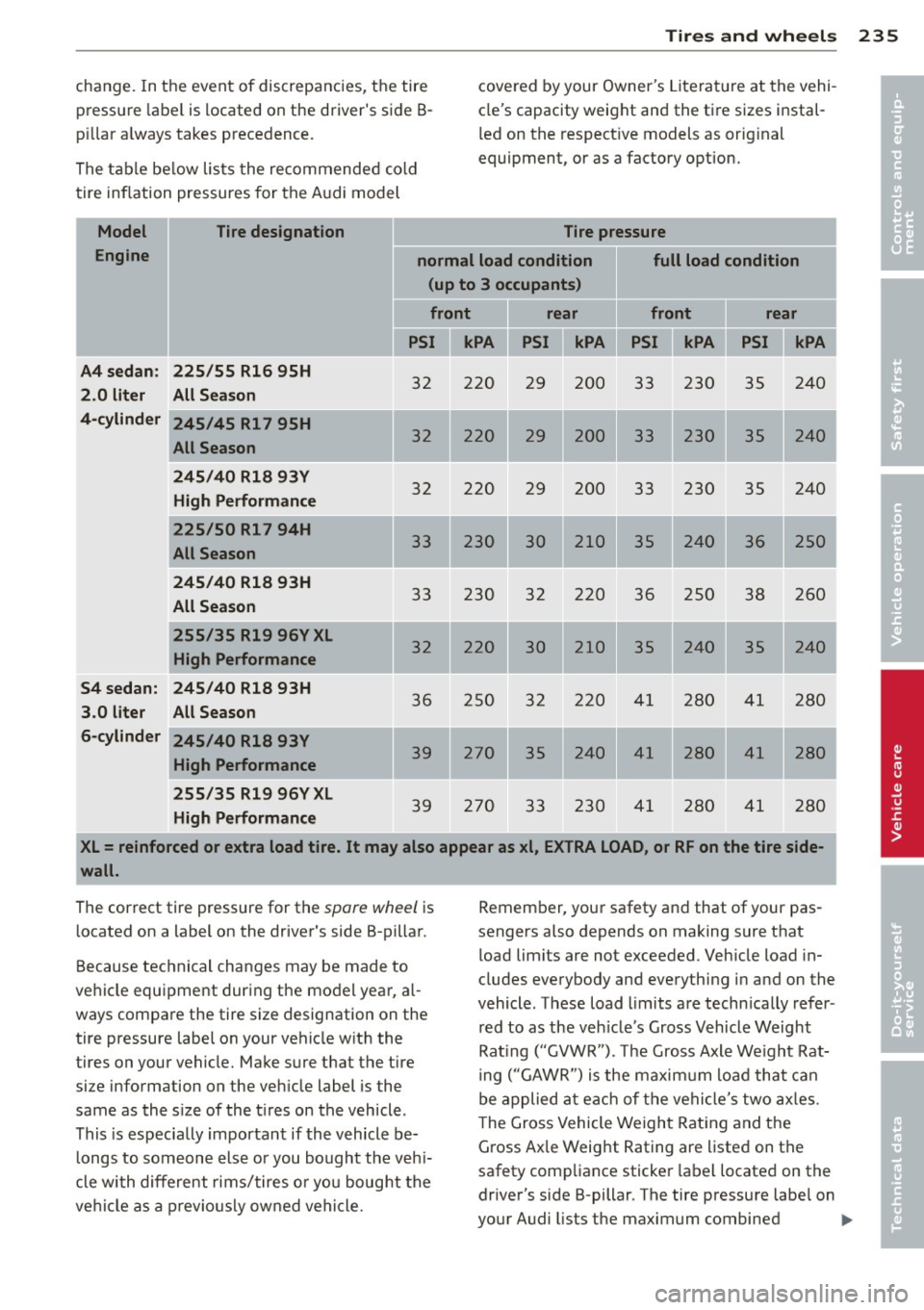
The table below lists the recommended cold
tire inflation pressures for the Audi model
I Model II Tire designation
covered by your Owner 's Literature at the vehi
cle's capacity weight and the tire sizes instal
led on the respective models as orig inal
equipment, or as a factory option.
Tire pressure
Engine normal load condition full load condition
(up to 3 occupants)
front rear
front rear I
PSI Jl kPA PSI Jl kPA PSI Jl kPA
PSI ll kPA
A4 sedan: 225/55 R16 95H
2.0 liter All Season
4-cylinder
245/45 R17 95H
All Season
245/40 R18 93V
High Performance
225/50 Rl 7 94H
All Season
245/40 R18 93H
All Season
255 /35 R19 96V XL
I High Performance
S4 sedan: 245/40 R18 93H
3.0 liter All Season
6-cylinder
245/40 R18 93Y
High Performance
255/35 R19 96V XL
High Performance
32 220
32 220
32 220 33 230
33 230
32
220
36 250
39 270
--. -
39
270 29
200 33 230 35 240
'
29 200 33 230 35 240
J
29 200 33 230 35 240
'
30 210 35 2
40 36 250
32 220 36 250 38 260
30 210 35 240 35 240
I
32
220 41 280 41 280
35 240 41 280 41 280
. -. -
33 230 41 280 41 280
XL= reinforced or extra load tire. It may also appear as xl, EXTRA LOAD, or RF on the tire side·
wall.
The correct tire pressure for the spore wheel is
l ocated on a label on the driver's side 8-pillar.
Because technical changes may be made to
vehicle equipment during the model year, a l
ways compare the tire size designation on the
tire p ressure label on your vehicle with the
tires on your vehicle. Make sure that the tire
size information on the vehicle label is the
same as the size of the t ires on the vehicle .
This is especially important if the vehicle be
longs to someone else or you bought the veh i
cle with different rims/tires or you bought the
vehicle as a previously owned vehicle. Remember, your safety and that of your pas
sengers also depends on making sure that load limits are not exceeded . Veh icle load in
cludes everybody and everything in and on the
vehicle . These load limits are technically refer
red to as the veh icle 's Gross Vehicle Weight
Rat ing ("GVWR") . The Gross Axle We ight Rat
ing (" GAWR") is the maximum load that can
be applied at each of the vehicle 's two axles.
T he Gross Vehicle Weight Rating and the
Gross Axle Weight Rating are listed on the
safety compliance sticker label located on the
driver's side 8-pillar. The tire pressure label on
your Audi lists the maximum combined .,.
•
•
Page 249 of 294

driving a few yards and correct if neces
sary . Follow the instructions from the
snow cha in manufacturer when doing so.
(D Tips
Where snow chains are mandatory oncer
tain roads, this norma lly also applies to
veh icles with all wheel drive.
Wheel bolts
Wheel bolts must always be tightened to the
correct torque.
The design o f whee l bolts is matched to the
factory insta lled r ims . If different rims are fit
ted, the correct wheel bo lts wit h the right
l ength and correctly shaped bolt heads must
be used. This ensures that wheels are f itted
securely and that the brake system functions
correctly .
In certain circumstances, you may not use
wheel bo lts from a different vehicle -even if it
is the same model
<=> page 274.
A WARNING
Improperly tightened or maintained wheel
bolts can become loose caus ing loss of
cont ro l, a co llision and serious persona l in
Jury .
- Always keep the w heel bolts and the
threads in the wheel hubs clea n so the
w hee l bolts can t urn easily and be p rop
erly t igh tened.
- Never grease or oil the wheel bolts and
the threads in the wheel h ubs. They can
become loose wh ile d riving if greased or
oiled, even if tightened to the specified
torq ue.
- Only use whee l bo lts that belong to the
rim being installed .
- Never use different whee ls bolts on your
vehicle.
- Alw ays m ain ta in the co rrec t tig hten ing
torq ue fo r the wheel bo lts to reduce the
risk of a wheel loss . If the tightening tor
que of the wheel bo lts is too low, they
can loosen and come out when the vehi-
Tire s an d wheel s 24 7
cle is mov ing. If the tightening torq ue is
too high, the wheel bolts and threads
can be damaged and the whee l can be
come loose.
@ Note
The specified torque for the whee l bolts is
90 ft lbs . (120 Nm) w ith a tolerance of
± 7,4 ft lbs. (± 10 Nm). Torque whee l bolts
diagonally . After changi ng a wheel, the
torque m ust be checked as soon as poss i
ble with a to rque wrench -preferably by an
a uthorized Aud i dea le r or qualified wor k
shop.
Low aspect ratio tires
Your A udi is fac tory -eq uipped w ith low aspect
ratio tires . These tires have been tho ro ughly
tested and been se lected specifically for your
model for their superb performance, road fee l
and handling under a variety of driving condi
tions . Ask your authorized Aud i dealer for
more details.
The low aspect ratio of these t ires is ind icated
by a numeral of
55 or less in the tire's size
designation. The numera l represents the ratio
of the tire's sidewa ll height in relation to its
tread width exp ressed in percentage. Conven
tiona l tires have a he ight/w idth ratio of 60 or
more.
The performance of low-a spect-r atio tire s is
particularly sensit ive to improper inflation
pre ssure. It is therefor e important that low
a spect ratio tire s are inflated to the specified
pres sure and that th e inflation pr essure i s
regularly checked and maintained. Tire pre s
sure s should be chec ked at lea st once a
month and always before a long trip
<=> page 236, Checking tire pressure.
What you can do to avo id tire and rim
damage
Low aspect ratio tires can be damaged mo re
easily by impact w ith potholes, curbs, gull ies
or ridges on the road, particularly if the tire is
under inflated . ..,.
•
•