2013 Alfa Romeo Giulietta bonnet
[x] Cancel search: bonnetPage 186 of 292

Diesel VERSIONSThousands of miles21 42 63 84 105
Thousands of kilometres 35 70 105 140 175
Months24 48 72 96 120
Check tyre conditions/wear and adjust pressure, if required●●●●●
Check operation of lighting system (headlamps, direction indicators, hazard warning lights,
passenger compartment, luggage compartment, instrument panel warning lights, etc.)●●●●●
Check operation of windscreen washer/wiper system●●●●●
Check the position/wear of the windscreen/rear window wiper blades●●●●●
Check condition and wear of front disc brake pads and operation of pad wear indicator●●●●●
Check rear disc brake pad condition and wear●●●●●
Condition and status visual check: bodywork exterior, underbody protection, pipes and hoses
(exhaust - fuel system - brakes), rubber elements (boots - sleeves - bushes etc.)●●●●●
Check cleanliness of bonnet and boot locks, as well as cleanliness and lubrication of linkages●●●●●
Check and, if necessary, top up fluid levels (engine cooling, hydraulic brakes/clutch, screen washer,
battery, etc.)●●●●●
Check handbrake lever travel and adjust, if required●●●●●
Check exhaust fumes/emissions●●●●●
Visually inspect conditions of the accessory drive belts●●
Check engine management system operation (through the diagnosis socket)●●●●●
Check battery charge status and possibly recharge●●●●●
Replace accessory drive belts●
182GETTING TO KNOW
YOUR CAR
SAFETY
STARTING AND
DRIVING
IN AN EMERGENCYSERVICING AND
MAINTENANCE
TECHNICAL
SPECIFICATIONS
INDEX
Page 188 of 292

PERIODIC CHECKSEvery 1,000 km or before long journeys, check and restore the
following if necessary:
❒engine coolant, brake fluid and windscreen washer fluid level;
❒tyre inflation pressure and condition;
❒operation of lighting system (headlamps, direction indicators,
hazard warning lights, etc.);
❒operation of window washer/wiper system and positioning/wear of
windscreen/rear window wiper blades
Check and top up, if required, the engine oil level every 3,000 km.
HEAVY-DUTY USE OF THE CARIf you use the car mainly under one of the following conditions:
❒towing a trailer or caravan;
❒dusty roads;
❒short, repeated journeys (less than 7-8 km) at sub-zero outside
temperatures;
❒engine often idling or driving long distances at low speeds or long
periods of idleness;
the following checks must be performed more frequently than indicated
in the Scheduled Servicing Plan:
❒check front disc brake pad conditions and wear;
❒check cleanliness of bonnet and boot locks, cleanliness and
lubrication of linkage;
❒visually inspect conditions of: engine, gearbox, transmission, pipes
and hoses (exhaust - fuel system - brakes) and rubber elements
(boots - sleeves - bushes - etc.);
❒check battery charge and battery fluid level (electrolyte);
❒visually inspect condition of the accessory drive belts;
❒check and, if necessary, change engine oil and replace oil filter;
❒check and, if necessary, replace pollen filter;
❒check and, if necessary, replace air cleaner.
184GETTING TO KNOW
YOUR CAR
SAFETY
STARTING AND
DRIVING
IN AN EMERGENCYSERVICING AND
MAINTENANCE
TECHNICAL
SPECIFICATIONS
INDEX
Page 196 of 292

AIR CLEANER/POLLEN
FILTER/DIESEL FILTERContact Alfa Romeo Authorized Services to replace the filters.
BATTERYBattery F (see previous pages) does not require the electrolyte to be
topped up with distilled water. A periodic check carried out at Alfa
Romeo Authorized Services is, however, necessary to check efficiency.REPLACING THE BATTERYIf necessary, replace the battery with another genuine battery with the
same specifications. Follow the battery manufacturer's instructions
for maintenance.USEFUL ADVICE FOR EXTENDING THE
LIFE OF YOUR BATTERYTo avoid draining your battery rapidly and maintain its efficiency over
time, carefully observe the following instructions:
❒when you park the car, ensure that the doors, bonnet and flaps are
closed correctly, to prevent any roof lights from remaining on inside
the passenger compartment;
❒switch off all roof lights inside the car: the car is however equipped
with a system which switches all internal lights off automatically;
❒do not keep accessories (e.g. sound system, hazard lights, etc.)
switched on for a long time when the engine is not running;
❒before performing any operation on the electrical system, disconnect
the negative battery pole;
IMPORTANT After the battery is disconnected, the steering must be
initialised. The
warning light switches on to indicate this. To carry
out this procedure, simply turn the steering wheel all the way from one
end to the other or drive in a straight line for about a hundred metres.
192GETTING TO KNOW
YOUR CAR
SAFETY
STARTING AND
DRIVING
IN AN EMERGENCYSERVICING AND
MAINTENANCE
TECHNICAL
SPECIFICATIONS
INDEX
Page 203 of 292
PRESERVING THE BODYWORKPaint
Touch up abrasions and scratches immediately to prevent the formation
of rust.
Maintenance of paintwork consists of washing the car: the frequency
depends on the conditions and environment where the car is used. For
example, it is advisable to wash the car more often in areas with
high levels of atmospheric pollution or salted roads.
To correctly wash the car, follow these instruction:
❒remove the aerial from the roof when using a carwash;
❒if high pressure jets or cleaners are used to wash the car, maintain a
distance of at least 40 cm from the bodywork to avoid damage or
alteration. Bear in mind that a build up of water could cause
damage to the car in the long term.
❒wash the body using a low pressure jet of water;
❒wipe a sponge with a slightly soapy solution over the bodywork,
frequently rinsing the sponge;
❒rinse well with water and dry with a jet of air or a chamois leather.
Dry the less visible parts (e.g. door frames, bonnet, headlight frames
etc.) with special care, as water may stagnate more easily in these
areas. Do not wash the car after it has been left in the sun or with the
bonnet hot: this may alter the shine of the paintwork.
Exterior plastic parts must be cleaned in the same way as the rest of
the car.
Detergents pollute the environment. Only wash your car in
areas equipped to collect and treat wastewater from this
type of activity.
In order to preserve the aesthetic properties of the
paintwork, abrasive products and/or polishes should not
be used to clean the car.
IMPORTANT
Avoid parking under trees; the resin dropped by trees makes the
paintwork go opaque and increases the possibility of corrosion.
Bird droppings must be washed off immediately and thoroughly as the
acid they contain is particularly aggressive.
Windows
Use specific detergents and clean cloths to prevent scratching or
altering the transparency.
IMPORTANT Wipe the inside surface of the rear window gently with a
cloth in the direction of the filaments to avoid damaging the heating
device.
Front headlights
Use a soft, damp cloth soaked in water and detergent for washing
cars.
IMPORTANT Never use aromatic substances (e.g. petrol) or ketenes
(e.g. acetone) for cleaning the plastic lenses of the front headlights.
IMPORTANT When cleaning the car with a pressure washer, keep the
water jet at least 20 cm away from the headlights.
199GETTING TO KNOW
YOUR CAR
SAFETY
STARTING AND
DRIVING
IN AN EMERGENCYSERVICING AND
MAINTENANCETECHNICAL
SPECIFICATIONS
INDEX
Page 207 of 292
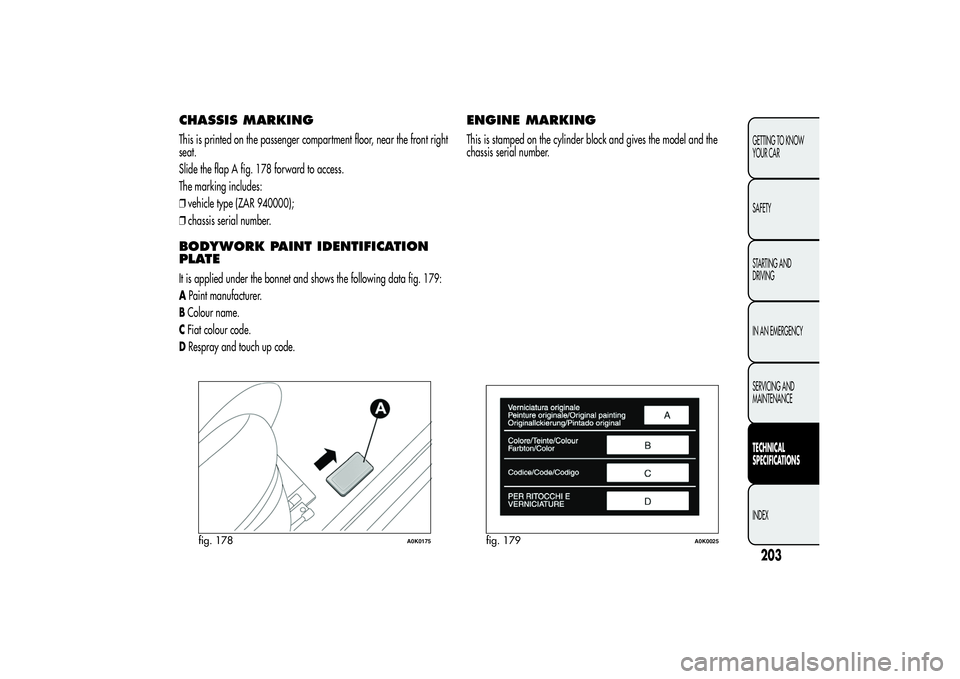
CHASSIS MARKINGThis is printed on the passenger compartment floor, near the front right
seat.
Slide the flap A fig. 178 forward to access.
The marking includes:
❒vehicle type (ZAR 940000);
❒chassis serial number.BODYWORK PAINT IDENTIFICATION
PLATEIt is applied under the bonnet and shows the following data fig. 179:
APaint manufacturer.
BColour name.
CFiat colour code.
DRespray and touch up code.
ENGINE MARKINGThis is stamped on the cylinder block and gives the model and the
chassis serial number.
fig. 178
A0K0175
fig. 179
A0K0025
203GETTING TO KNOW
YOUR CAR
SAFETY
STARTING AND
DRIVING
IN AN EMERGENCY
SERVICING AND
MAINTENANCETECHNICAL
SPECIFICATIONSINDEX
Page 286 of 292
INDEX
A
BS system ........................................ 96
– System intervention.......................... 96
Additional heater ................................. 61
AFS adaptive lights (Adaptive
Frontlight System) ............................... 74
Air cleaner .......................................... 192
Alarm ................................................. 38
“Alfa DNA” system ............................. 99
– Driving modes................................. 100
– Engagement/disengagement of
"All Weather" mode ........................ 101
– Engagement/disengagement of
"Dynamic" mode............................. 100
– "Natural" Mode .............................. 100A
lfa Romeo Code system .................... 32
Ashtray ............................................... 80
ASR system (AntiSlip Regulation) ........... 98
Automatic dual zone climate control ...... 55
Battery .............................................. 192
– advice for extending lifetime............. 192
– replacement .................................... 192
Battery (recharging).............................. 173
Body versions....................................... 204
Bodywork– bodywork codes .............................. 204
– maintenance ................................... 199
– protection against atmospheric
agents ............................................ 198
– warranty......................................... 198
Bonnet................................................. 93
– Closing ........................................... 93
– Opening ......................................... 93
Brake Assist ......................................... 98
Brakes ................................................. 212
– brake fluid level............................... 191
bulb replacement ................... 158-159-160
– interior lights................................... 162
Bulb replacement
– exterior lights .................................. 157
Bulbs
– types of bulbs.................................. 155
Carrying children safely ...................... 121
CBC (Cornering Brake Control) system ... 98
Central locking..................................... 74
Changing a bulb .................................. 154
– General instructions ......................... 154
Changing a wheel ................................ 143
Cigar lighter ........................................ 79
Cleaning and maintenance– bodywork ....................................... 198
– car interior...................................... 200
– engine compartment ........................ 200
– front headlights ............................... 199
– leather parts ................................... 201
– leather seats.................................... 201
– plastic and coated parts ................... 201
– seats and fabric parts ...................... 200
– windows ......................................... 199
Climate control..................................... 48
– Central air diffusers ......................... 48
– Rear air diffuser .............................. 49
– Side air diffusers ............................. 48
– Upper air diffusers .......................... 48
Climatic comfort ................................... 50
– Diffusers ......................................... 50
Clutch ................................................. 211
CO2 emissions..................................... 231
Code Card........................................... 33
Control buttons..................................... 21
Control panel and instruments ............... 4
– Multifunction display........................ 4
– Reconfigurable multifunction
display ........................................... 5
Controls............................................... 73
2GETTING TO KNOW
YOUR CAR
SAFETY
STARTING AND
DRIVING
IN AN EMERGENCY
SERVICING AND
MAINTENANCE
TECHNICAL
SPECIFICATIONS
INDEX
82