Page 2 of 364

Contents
Child Safety P. 52Exhaust Gas Hazard P. 64 Safety Labels P. 65Opening and Closing the Tailgate P. 107 Security System P. 113 Opening and Closing the Windows P. 115
Operating the Switches Around the Steering Wheel P. 119 Adjusting the Mirrors P. 133
Interior Lights/Interior Convenience Items P. 143 Climate Control System P. 152Audio Error Messages P. 187General Information on the Audio System P. 190
Bluetooth ® HandsFreeLink ® P. 196 Compass
* P. 225
Off-Highway Driving Guidelines P. 238 When Driving P. 240 Braking P. 257
Refueling P. 263 Fuel Economy P. 265Accessories and Modifications P. 266Maintenance Under the Hood P. 275 Replacing Light Bulbs P. 287
Checking and Maintaining Tires P. 301 Battery P. 310 Remote Transmitter Care P. 311Engine Does Not Start P. 325Jump Starting P. 328 Shift Lever Does Not Move P. 330
Fuses P. 337 Emergency Towing P. 340
When You Cannot Open the Tailgate P. 341
Devices that Emit Radio Waves P. 347 Reporting Safety Defects P. 348
Authorized Manuals P. 353 Client Service Information P. 354
Quick Reference Guide
P. 2
Safe Driving
P. 23
Instrument Panel
P. 67
Controls
P. 95
Features
P. 157
Driving
P. 227
Maintenance
P. 267
Handling the Unexpected
P. 317
Information
P. 343
Index
P. 355
Page 5 of 364
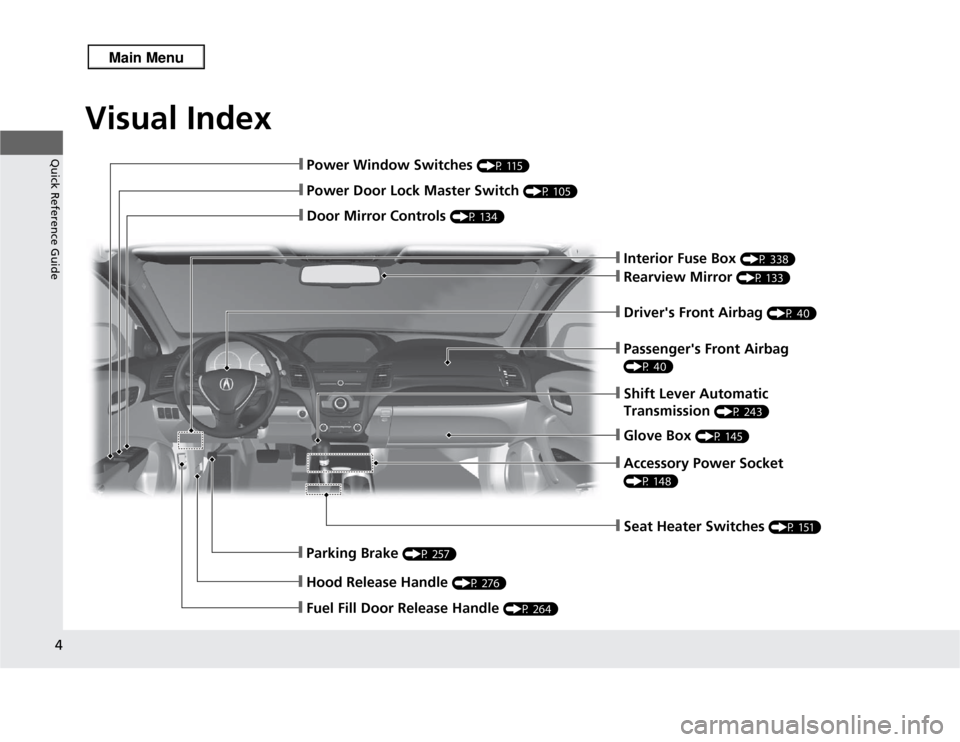
Visual Index
4Quick Reference Guide
❙Power Door Lock Master Switch
(P 105)
❙Power Window Switches
(P 115)
❙Rearview Mirror
(P 133)
❙Parking Brake
(P 257)
❙Hood Release Handle
(P 276)
❙Shift Lever Automatic
Transmission
(P 243)
❙Driver's Front Airbag
(P 40)
❙Door Mirror Controls
(P 134)
❙Passenger's Front Airbag (P 40)
❙Fuel Fill Door Release Handle
(P 264)
❙Glove Box
(P 145)
❙Accessory Power Socket (P 148)❙Seat Heater Switches
(P 151)
❙Interior Fuse Box
(P 338)
Page 7 of 364
Visual Index
6Quick Reference Guide
❙Windshield Wipers
(P 126, 297)
❙Door Lock/Unlock Control
(P 99)
❙How to Refuel
(P 264)
❙High-Mount Brake Light
(P 296)
❙Opening/Closing the Tailgate (P 107)❙Rear Wiper
(P 127, 299)
❙Back-Up Lights
(P 294)
❙Brake/Taillights
(P 292)
❙Rear Turn Signal Lights
(P 292)
❙Rear Side Marker Lights
(P 292)
❙Power Door Mirrors
(P 134)
❙Maintenance Under the Hood
(P 275)
❙Fog Lights
* (P 125, 289)
❙Multi-View Rear Camera
(P 262)
❙Front Turn Signal/Parking Lights
(P 122, 291)
❙Side Marker Lights
(P 122, 291)
❙Tires
(P 301, 319)
❙Headlights
(P 122, 287)
❙Tailgate Release Button
(P 108)
Page 17 of 364
16Quick Reference Guide
Maintenance
(P 267)
Under the Hood
(P 275)
● Check engine oil, engine coolant, and windshield washer
fluid. Add when necessary.
● Check brake fluid.
● Check the battery condition monthly.
a
Pull the hood release handle under the corner of the
dashboard.
b
Locate the hood latch lever, pull the lever up, and lift up
the hood.
c
When finished, close the hood and make sure it is firmly
locked in place.
Lights
(P 287)
● Inspect all lights regularly.
Wiper Blades
(P 297)
● Replace blades if they leave streaks
across the windshield.
Tires
(P 301)
● Inspect tires and wheels regularly.
● Check tire pressures regularly.
● Install snow tires for winter
driving.
Page 18 of 364
Quick Reference Guide17
Handling the Unexpected
(P 317)
Flat Tire
(P 319)
● Park in a safe location and replace the
flat tire with the compact spare tire in the
cargo area.
Indicators Come On
(P 333)
● Identify the indicator and consult the
owner's manual.
Engine Won't Start
(P 325)
● If the battery is dead, jump start using a
booster battery.
Blown Fuse
(P 337)
● Check for a blown fuse if an electrical
device does not operate.
Overheating
(P 331)
● Park in a safe location. If you do not see
steam under the hood, open the hood,
and let the engine cool down.
Emergency Towing
(P 340)
● Call a professional towing service if you
need to tow your vehicle.
Page 41 of 364
40
uuAirbags uTypes of Airbags
Safe Driving
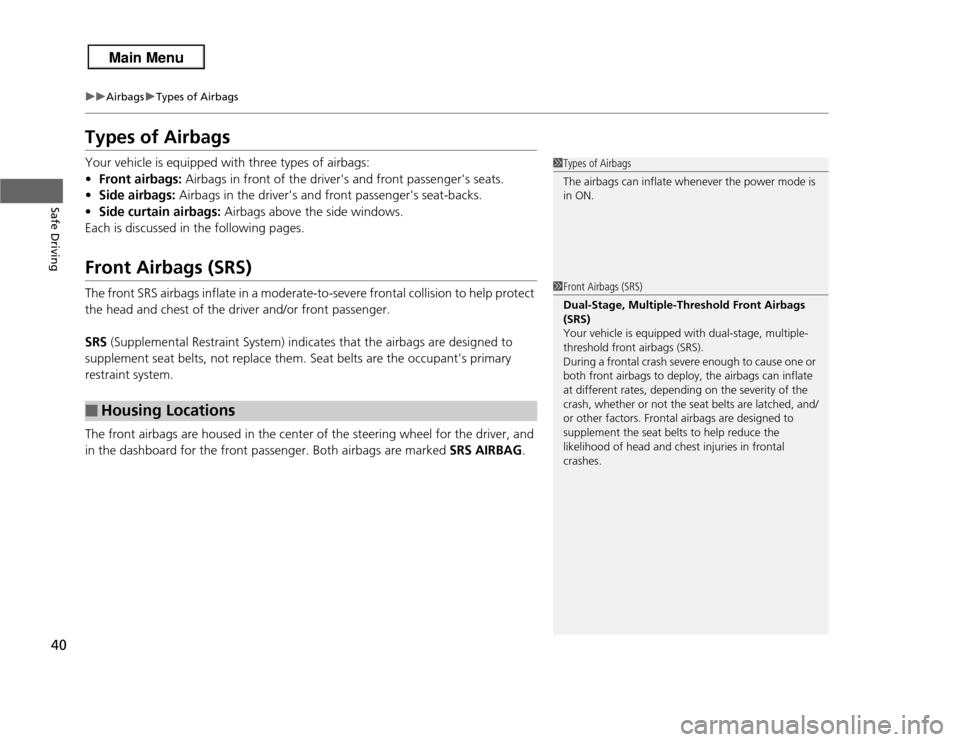
Types of AirbagsYour vehicle is equipped with three types of airbags:
• Front airbags: Airbags in front of the driver's and front passenger's seats.
• Side airbags: Airbags in the driver's and front passenger's seat-backs.
• Side curtain airbags: Airbags above the side windows.
Each is discussed in the following pages.Front Airbags (SRS)The front SRS airbags inflate in a moderate-to-severe frontal collision to help protect
the head and chest of the driver and/or front passenger.
SRS (Supplemental Restraint System) indicates that the airbags are designed to
supplement seat belts, not replace them. Seat belts are the occupant's primary
restraint system.
The front airbags are housed in the center of the steering wheel for the driver, and
in the dashboard for the front passenger. Both airbags are marked SRS AIRBAG.■
Housing Locations
1Types of Airbags
The airbags can inflate whenever the power mode is
in ON.1Front Airbags (SRS)
Dual-Stage, Multiple-Threshold Front Airbags
(SRS)
Your vehicle is equipped with dual-stage, multiple-
threshold front airbags (SRS).
During a frontal crash severe enough to cause one or
both front airbags to deploy, the airbags can inflate
at different rates, depending on the severity of the
crash, whether or not the seat belts are latched, and/
or other factors. Frontal airbags are designed to
supplement the seat belts to help reduce the
likelihood of head and chest injuries in frontal
crashes.
Page 44 of 364

43
uuAirbags uFront Airbags (SRS)
Safe Driving
Your front airbags have advanced features to help reduce the likelihood of airbag
related injuries to smaller occupants.
The driver's advanced front airbag system
includes a seat position sensor.
If the seat is too far forward, the airbag
inflates with less force, regardless of the
severity of the impact.
The passenger's advanced front airbag system
has weight sensors.
Although Acura recommends against carrying
an infant or small child in front, if the sensors
detect the weight of a child (up to about 65
lbs or 29 kg), the system will automatically
turn off the passenger's front airbag.■
Advanced Airbags
1Advanced Airbags
If there is a problem with the driver's seat position
sensor, the SRS indicator will come on and the airbag
will inflate with full (normal) force, regardless of the
driver's seating position.
For both advanced front airbags to work properly:•Do not spill any liquid on or under the seats.•Do not put any object under the passenger’s seat.•Make sure any objects are positioned properly on
the floor. Improperly positioned objects can
interfere with the advanced airbag sensors.•All occupants should sit upright and wear their seat
belts properly.•Do not place any cover over the passenger side
dashboard.
Driver’s
Seat
Position
Sensor
Passenger’s
Seat
Weight
Sensors
Page 47 of 364

uuAirbags uSide Airbags
46Safe Driving
To reduce the likelihood that a front passenger may be injured by an inflating side
airbag, the passenger side airbag is automatically turned off when:
• The height sensors detect a child or short-statured adult is seated in the front
passenger seat.
• The position sensor detects that the front passenger is leaning into the
deployment path of the side airbag.
When the side airbag cutoff system is activated, the side airbag off indicator comes
on.
2 Side Airbag Off Indicator P. 50
If the side airbag off indicator comes on, have the passenger sit upright. A few
seconds after the passenger is sitting properly, the side airbag will automatically be
turned on, and the indicator will go off.
If the front passenger is a child, stop when it is safe to do so, and have the child sit
properly restrained in a rear seat.■
Side Airbag Cutoff System
■
Side Airbag Off Indicator
1Side Airbag Cutoff System
The sensors that monitor the front passenger's height
and body position may not work if:•The seat-back is wet•The passenger is touching a metal or other
electrical conductive object•A seat cushion is on the seat•The passenger is wearing excessively thick clothing
Sensor that
monitor the
passenger’s height.
Sensor that monitor
the passenger’s position.