2013.5 Citroen DS4 RHD battery
[x] Cancel search: batteryPage 117 of 400
11 5Access
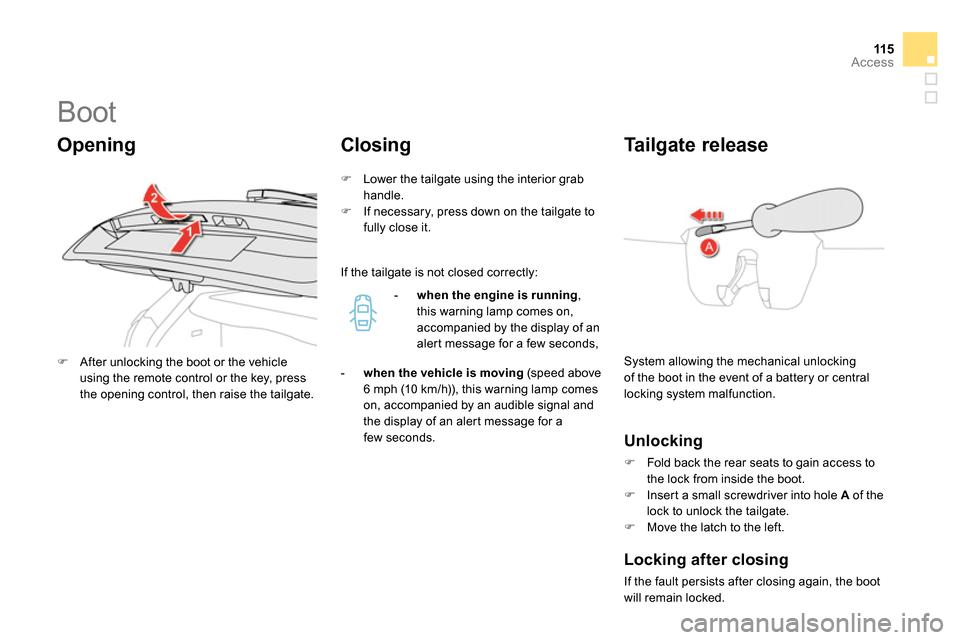
Boot
System allowing the mechanical unlocking
of the boot in the event of a battery or central
locking system malfunction.
Ta i l g a t e r e l e a s e
Unlocking
Fold back the rear seats to gain access to
the lock from inside the boot.
Insert a small screwdriver into hole A
of the
lock to unlock the tailgate.
Move the latch to the left.
After unlocking the boot or the vehicle
using the remote control or the key, press
the opening control, then raise the tailgate.
Opening
Closing
Lower the tailgate using the interior grab
handle.
If necessary, press down on the tailgate to
fully close it.
- when the engine is running
,
this warning lamp comes on,
accompanied by the display of an
alert message for a few seconds,
- when the vehicle is moving
(speed above
6 mph (10 km/h)), this warning lamp comes
on, accompanied by an audible signal and
the display of an alert message for a
few seconds.
Locking after closing
If the fault persists after closing again, the boot
will remain locked.
If the tailgate is not closed correctly:
Page 129 of 400

127Visibility
Switching off the lighting
when switching off the ignition
When the ignition is switched off, all
of the lamps switch off immediately,
except for the dipped beam headlamps
if automatic guide-me-home lighting is
activated.
The temporary illumination of the dipped beam
headlamps after the vehicle's ignition has been
switched off makes the driver's exit easier
when the light is poor.
Switching on
With the ignition off, "flash" the headlamps
using the lighting stalk.
A further "headlamp flash" switches the
function off.
Switching off
The manual guide-me-home lighting switches
off automatically after a set time.
Manual guide-me-home
lighting
Switching on the lighting when
switching on the ignition
To reactivate the lighting control stalk, turn
the ring A
to position "0"
- lighting off, then
to the position of your choice.
If the lighting is switched on manually after
switching off the ignition, there is an audible
signal when a front door is opened to warn
the driver that they have forgotten to switch
off the vehicle's lighting, with the ignition off.
They switch off automatically after a period
which depends on the state of charge of the
battery (entry to energy economy mode).
Parking lamps
Side markers for the vehicle by illumination of
the sidelamps on the traffic side only.
Within one minute of switching off the
ignition, operate the lighting control stalk
up or down depending on the traffic side
(for example: when parking on the left;
lighting control stalk upwards; the right
hand sidelamps are on).
This is confirmed by an audible signal and
illumination of the corresponding direction
indicator warning lamp in the instrument panel.
To switch off the parking lamps, return the
lighting control stalk to the central position.
Page 158 of 400

To connect a 12 V accessory
(max power: 120 W), remove the cap and
connect an appropriate adaptor.
Turn the key to the ignition on position.
12 V accessory socket
This is a removable lamp, fitted in the boot
wall, which can be used to light the boot or as
a torch.
For the boot lamp function, refer to the
" Visibility - § Boot lamp" section.
Torch
Operation
This torch operates with NiMH type
rechargeable batteries.
It has a battery life of approximately 45 minutes
and charges while you are driving.
Obser ve the polarities when fitting the
rechargeable batteries.
Never replace the rechargeable batteries
with normal disposable batteries.
Page 199 of 400
197Driving
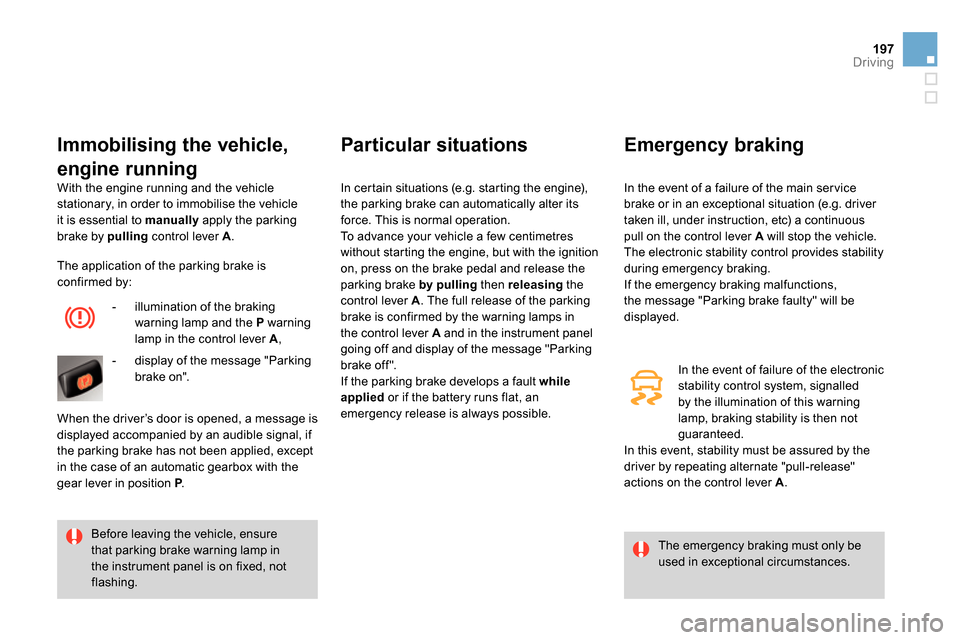
With the engine running and the vehicle
stationary, in order to immobilise the vehicle
it is essential to manually
apply the parking
brake by pulling
control lever A
.
Immobilising the vehicle,
engine running
The emergency braking must only be
used in exceptional circumstances.
Before leaving the vehicle, ensure
that parking brake warning lamp in
the instrument panel is on fixed, not
flashing.
The application of the parking brake is
confirmed by:
- illumination of the braking
warning lamp and the P
warning
lamp in the control lever A
,
- display of the message "Parking
brake on".
When the driver’s door is opened, a message is
displayed accompanied by an audible signal, if
the parking brake has not been applied, except
in the case of an automatic gearbox with the
gear lever in position P
.
Particular situations
In certain situations (e.g. starting the engine),
the parking brake can automatically alter its
force. This is normal operation.
To advance your vehicle a few centimetres
without starting the engine, but with the ignition
on, press on the brake pedal and release the
parking brake by pulling
then releasing
the
control lever A
. The full release of the parking
brake is confirmed by the warning lamps in
the control lever A
and in the instrument panel
going off and display of the message "Parking
brake off ".
If the parking brake develops a fault while
applied
or if the battery runs flat, an
emergency release is always possible.
Emergency braking
In the event of failure of the electronic
stability control system, signalled
by the illumination of this warning
lamp, braking stability is then not
guaranteed.
In this event, stability must be assured by the
driver by repeating alternate "pull-release"
actions on the control lever A
. In the event of a failure of the main ser vice
brake or in an exceptional situation (e.g. driver
taken ill, under instruction, etc) a continuous
pull on the control lever A
will stop the vehicle.
The electronic stability control provides stability
during emergency braking.
If the emergency braking malfunctions,
the message "Parking brake faulty" will be
displayed.
Page 200 of 400

In the event of the electric parking brake
malfunctioning or the battery running flat, an
emergency device can be used to release the
parking brake manually.
Emergency release
Immobilise the vehicle (or keep it stationary,
if the brake pedal is pressed), with the
engine running, by engaging first gear
(manual gearbox), position P
(automatic
gearbox) or position M
or R
(elec tronic
gearbox).
Switch off the engine but leave the ignition
on. If it is not possible to immobilise the
vehicle, do not operate the control and
contact a CITROËN dealer or a qualified
workshop without delay.
Immobilise the vehicle by placing the chocks
in front or behind the two front wheels,
opposite to the direction of the slope.
Access to tools
The tools are stowed in the storage box under
the boot carpet.
B
Chocks*.
C
Release crank*.
* Available according to equipment: if these
tools are not present, contact a CITROËN
dealer or a qualified workshop to obtain them.
Page 203 of 400

201Driving
Situations
Consequences
To apply the electric parking brake:
immobilise the vehicle and switch off the ignition.
pull the control for at least 5 seconds or until application is complete.
switch on the ignition and check the switching on of the electric parking brake
warning lamps.
The application is slower than during normal operation.
To release the electric parking brake:
switch on the ignition.
pull the control and hold it for approximately 3 seconds then release it.
If the braking warning lamp is flashing or if the warning lamps do not come on with
the ignition on, these procedures will not work. Place the vehicle on level ground
and have it checked by a CITROËN dealer or a qualified workshop. and possibly
flashing
Display of the message " Parking brake fault
" and of the
following warning lamps:
- Only the automatic application on switching off the engine and automatic
release on acceleration functions are available.
- The manual application/release of the electric parking brake and the
emergency braking are not available.
and possibly
flashing
Battery fault
- If the battery warning lamp comes on you must stop immediately as soon as
the traffic allows. Stop and immobilise your vehicle (if necessary, place the
two chocks under the wheels).
- Apply the electric parking brake before switching off the engine.
Page 213 of 400

211Driving
Invalid value during manual
operation
This symbol is displayed if a gear
is not engaged correctly (selector
between two positions).
Stopping the vehicle
Before switching off the engine, you can
engage position P
or N
to place the gearbox in
neutral.
In both cases, apply the parking brake to
immobilise the vehicle, unless it is programmed
to automatic mode.
If the lever is not in position P
, when the
driver's door is opened or approximately
45 seconds after the ignition is switched
off, there is an audible signal and a
message appears.
Return the lever to position P
;
the audible signal stops and the
message disappears.
Operating fault
When the ignition is on, the lighting of this
warning lamp, accompanied by an audible
signal and a message in the multifunction
screen, indicates a gearbox malfunction.
In this case, the gearbox switches to back-up
mode and is locked in 3rd gear. You may feel
a substantial knock when changing from P
to R
and from N
to R
. This will not cause any
damage to the gearbox.
Do not exceed 60 mph (100 km/h), local speed
restrictions permitting.
Have it checked by a CITROËN dealer or a
qualified workshop.
This warning lamp may also come on if a door
is opened.
You risk damaging the gearbox:
- if you press the accelerator and
brake pedals at the same time,
- if you force the lever from position P
to another position when the
battery is flat.
To reduce fuel consumption when
stationary for long periods with the
engine running (traffic jam...), position
the gear lever at N
and apply the
parking brake, unless it is programmed
in automatic mode.
Page 218 of 400
Stop & Start
The Stop & Start system puts the engine temporarily into standby - STOP mode - during stops in the traffic (red lights, traffic jams, or other...).
The engine restarts automatically - START mode - as soon as you want to move off. The restart takes place instantly, quickly and silently.
Per fect for urban use, the Stop & Start system reduces fuel consumption and exhaust emissions as well as the noise level when stationary.
Operation
Going into engine STOP mode
With an electronic gearbox, for your
comfort during parking maoeuvres,
STOP mode is not available for a few
seconds after coming out of reverse
gear.
STOP mode does not affect the
functionality of the vehicle, such as
braking, power steering, for example.
Never refuel with the engine in STOP
mode; you must switch off the ignition
with the key. The "ECO"
warning lamp comes on
in the instrument panel and the engine
goes into standby automatically:
- with a manual gearbox
, at speeds below
12 mph (20 km/h), when you put the gear
lever into neutral and release the clutch
pedal,
- with an electronic gearbox
, at a speed
below 5 mph (8 km/h), when you press
the brake pedal or put the gear lever into
position N
.
If your vehicle is fitted with the
system, a time counter calculates
the sum of the periods in STOP
mode during a journey. It resets
itself to zero every time the ignition
is switched on with the key. STOP mode is not invoked when:
- the driver's door is open,
- the driver's seat belt is not fastened,
- the vehicle has not exceeded 6 mph
(10 km/h) since the last engine start using
the key,
- the electric parking brake is applied or
being applied,
- the engine is needed to maintain a
comfortable temperature in the passenger
compartment,
- demisting is active,
- some special conditions (battery charge,
engine temperature, braking assistance,
ambient temperature...) where the engine is
needed to assure control of a system.
Special cases: STOP mode
unavailable
In this case, the "ECO"
warning
lamp flashes for a few seconds, then
goes off.
This operation is per fectly normal.