Page 95 of 168
4-33
CDI MAGNETO
CDI MAGNETO
REMOVING THE CDI MAGNETO
Order Part name Q'ty Remarks
Seat and fuel tankRefer to "SEAT, FUEL TANK AND SIDE
COVERS" section.
Bolt (Radiator) Refer to "RADIATOR" section.
Disconnect the CDI magneto lead.
1 Left crankcase cover 1
2 Nut (rotor) 1 Refer to removal section.
3 Rotor 1 Refer to removal section.
4 Stator 1
5 Woodruff key 1
Page 97 of 168
4-35
ENGINE REMOVAL
ENGINE REMOVAL
REMOVING THE ENGINE
Order Part name Q'ty Remarks
Hold the machine by placing the suitable stand
under the engine.Refer to "HANDLING NOTE".
Seat and fuel tank Refer to "SEAT, FUEL TANK AND SIDE
COVERS" section.
Carburetor Refer to "CARBURETOR AND REED
VALVE" section.
Exhaust pipe and silencer Refer to "EXHAUST PIPE AND SILENCER"
section.
Clutch cable Disconnect at the engine side.
Radiator Refer to "RADIATOR" section.
Spark plug cap
Disconnect the CDI magneto lead.
1 Drive chain sprocket cover 1
2 Nut (drive sprocket) 1 Refer to removal section.
3 Lock washer 1 Refer to removal section.
4 Drive sprocket 1 Refer to removal section.
5Clip 1
6 Bolt (brake pedal) 1
26 Nm (2.6 m kg, 19 ft lb)
64 Nm (6.4 m kg, 46 ft lb)
64 Nm (6.4 m kg, 46 ft lb)
85 Nm (8.5 m kg, 61 ft lb)
75 Nm (7.5 m kg, 54 ft lb)
5 Nm (0.5 m kg, 3.6 ft lb)
34 Nm (3.4 m kg, 24 ft lb)
Page 124 of 168
5-16
FRONT FORK
FRONT FORK
REMOVING THE FRONT FORK
Order Part name Q'ty Remarks
Hold the machine by placing the suitable stand
under the engine.Refer to "HANDLING NOTE".
Front wheel Refer to "FRONT WHEEL AND REAR
WHEEL" section.
Front brake caliper Refer to "FRONT BRAKE AND REAR
BRAKE" section.
Number plateRefer to "SEAT, FUEL TANK AND SIDE
COVERS" section in the CHAPTER 4.
1 Protector 1
2 Pinch bolt (upper bracket) 2 Only loosening.
3 Damper assembly 1Loosen when disassembling the front fork.
Refer to removal section.
4 Pinch bolt (lower bracket) 2 Only loosening.
5 Front fork 1
Page 137 of 168
5-29
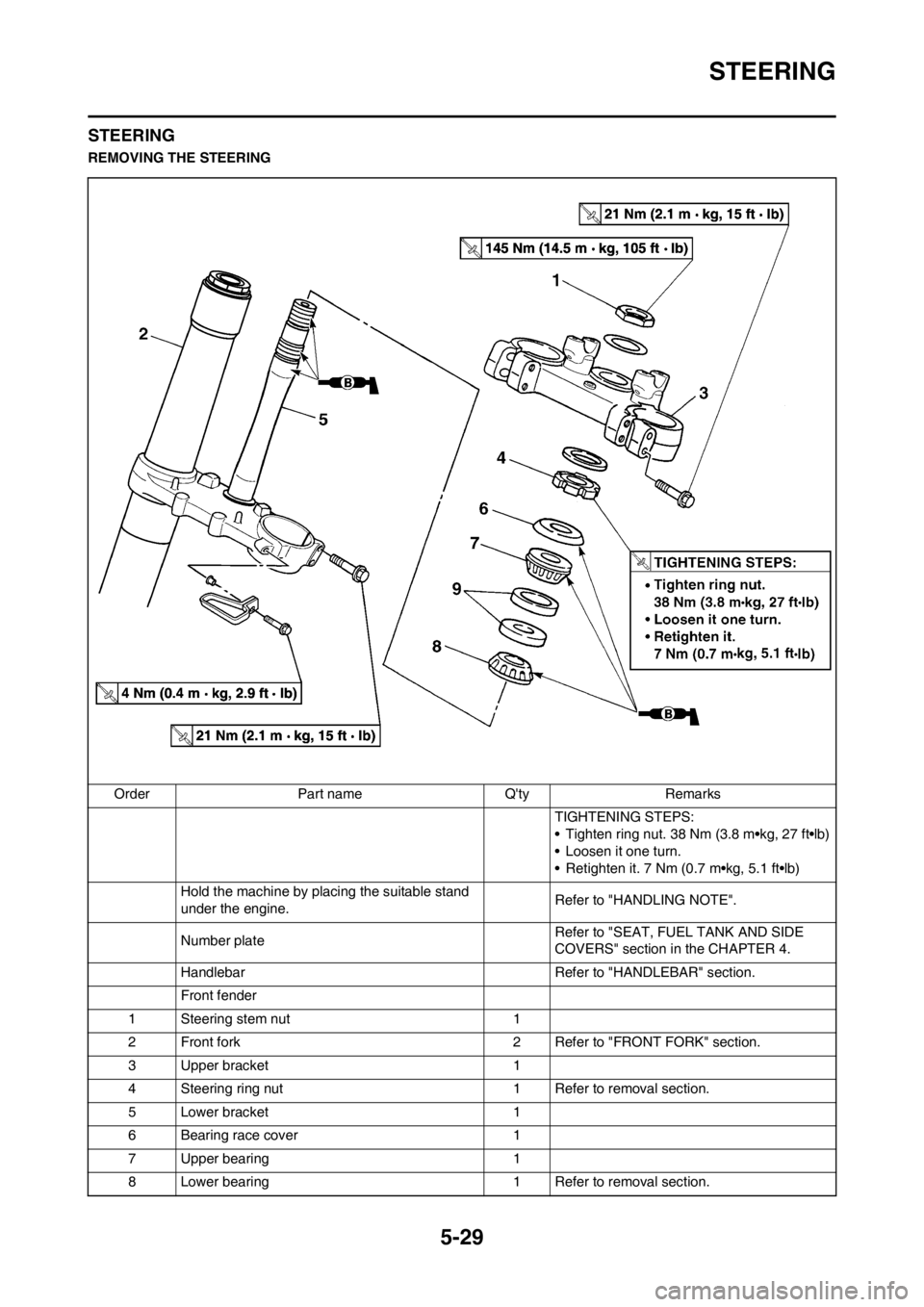
STEERING
STEERING
REMOVING THE STEERING
Order Part name Q'ty Remarks
TIGHTENING STEPS:
• Tighten ring nut. 38 Nm (3.8 m•kg, 27 ft•lb)
• Loosen it one turn.
• Retighten it. 7 Nm (0.7 m•kg, 5.1 ft•lb)
Hold the machine by placing the suitable stand
under the engine.Refer to "HANDLING NOTE".
Number plateRefer to "SEAT, FUEL TANK AND SIDE
COVERS" section in the CHAPTER 4.
Handlebar Refer to "HANDLEBAR" section.
Front fender
1 Steering stem nut 1
2 Front fork 2 Refer to "FRONT FORK" section.
3 Upper bracket 1
4 Steering ring nut 1 Refer to removal section.
5 Lower bracket 1
6 Bearing race cover 1
7 Upper bearing 1
8 Lower bearing 1 Refer to removal section.
Page 146 of 168
5-38
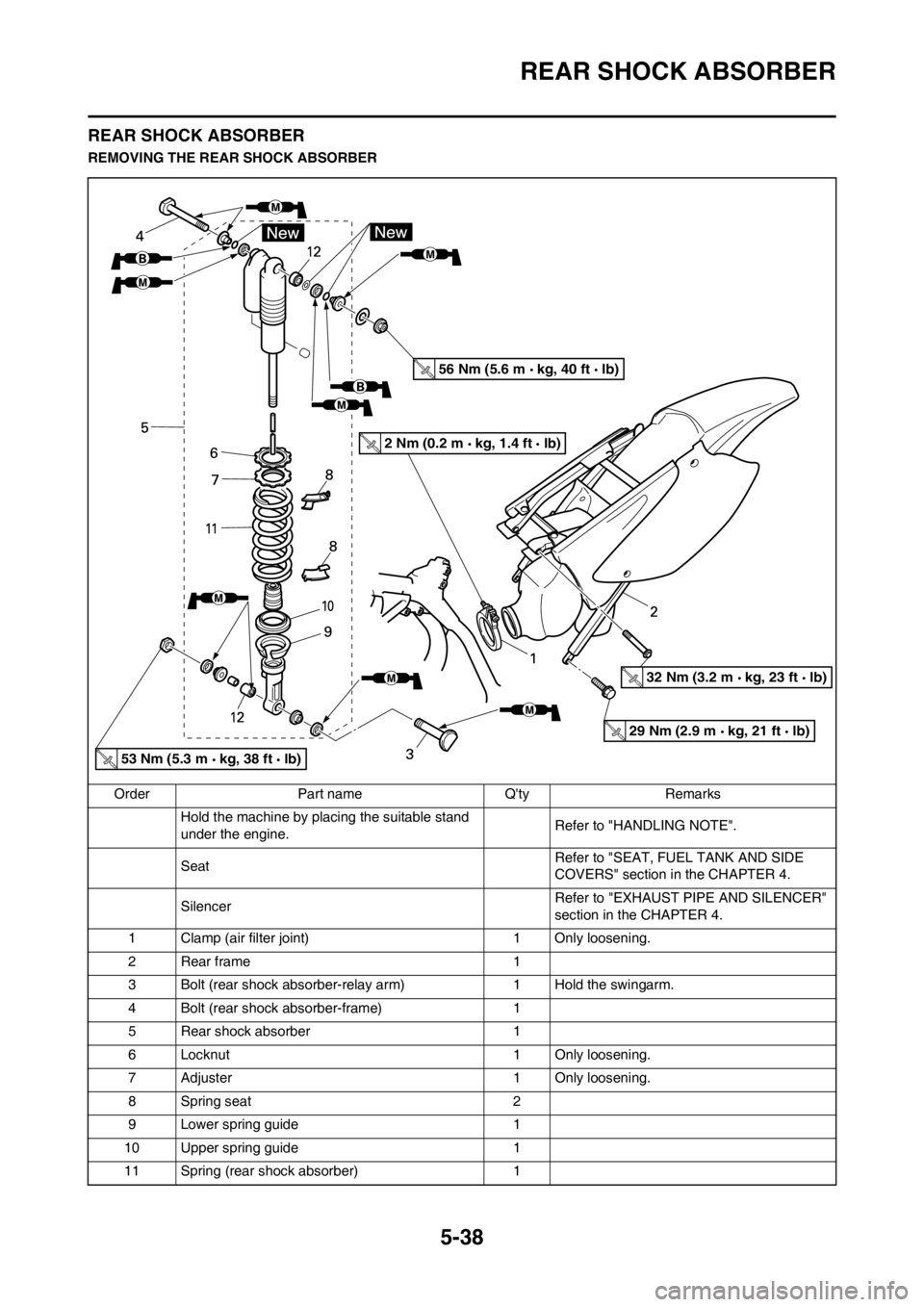
REAR SHOCK ABSORBER
REAR SHOCK ABSORBER
REMOVING THE REAR SHOCK ABSORBER
Order Part name Q'ty Remarks
Hold the machine by placing the suitable stand
under the engine.Refer to "HANDLING NOTE".
Seat Refer to "SEAT, FUEL TANK AND SIDE
COVERS" section in the CHAPTER 4.
Silencer Refer to "EXHAUST PIPE AND SILENCER"
section in the CHAPTER 4.
1 Clamp (air filter joint) 1 Only loosening.
2Rear frame 1
3 Bolt (rear shock absorber-relay arm) 1 Hold the swingarm.
4 Bolt (rear shock absorber-frame) 1
5 Rear shock absorber 1
6 Locknut 1 Only loosening.
7 Adjuster 1 Only loosening.
8 Spring seat 2
9 Lower spring guide 1
10 Upper spring guide 1
11 Spring (rear shock absorber) 1
53 Nm (5.3 m kg, 38 ft lb)
56 Nm (5.6 m kg, 40 ft lb)
2 Nm (0.2 m kg, 1.4 ft lb)
32 Nm (3.2 m kg, 23 ft lb)
29 Nm (2.9 m kg, 21 ft lb)
Page 153 of 168
6-3
IGNITION SYSTEM
IGNITION SYSTEM
INSPECTION STEPS
Use the following steps for checking the possibility of the malfunctioning engine being attributable to ignition system failure
and for checking the spark plug which will not spark.
*marked: Only when the ignition checker is used.
• Remove the following parts before inspection.
1. Seat
2. Fuel tank
• Use the following special tools in this inspection.
Spark gap test Spark→*Clean or replace spark plug.
No spark↓
Check entire ignition system for connection. No good→Repair or replace.
OK↓
Check engine stop switch. No good→Replace.
OK↓
Check ignition coil. (primary coil and secondary
coil)No good→
Replace.
OK↓
Check spark plug cap. No good→Replace.
OK↓
Check CDI magneto. (pickup coil and charging
coil)No good→
Replace.
OK↓
Replace CDI unit.
Dynamic spark tester:
YM-34487
Ignition checker:
90890-06754
Pocket tester:
YU-3112-C/90890-03112
Page 156 of 168

7-1
ENGINE
TUNING
ENGINE
CARBURETOR SETTING
• The role of fuel is to cool the engine,
and in the case of a 2-stroke en-
gine, to lubricate the engine in addi-
tion to power generation.
Accordingly, if a mixture of air and
fuel is too lean, abnormal combus-
tion will occur, and engine seizure
may result. If the mixture is too rich,
spark plugs will get wet with oil, thus
making it impossible to bring the en-
gine into full play or if the worst
comes to the worst, the engine may
stall.
• The richness of the air-fuel mixture
required for the engine will vary with
atmospheric conditions of the day
and therefore, the settings of the
carburetor must be properly suited
to the atmospheric conditions (air
pressure, humidity and tempera-
ture).
• Finally, the rider himself must make
a test-run and check his machine
for conditions (pick-up of engine
speed, road surface conditions)
and for the discoloration of the
spark plug(s). After taking these
into consideration, he must select
the best possible carburetor set-
tings.
It is advisable to make a note of set-
tings, atmospheric conditions, road
surface condition, lap-time, etc. so
that the memorandum can be used
as a reference useful for future.
ATMOSPHERIC CONDITIONS AND
CARBURETOR SETTINGS
The reason for the above tendency is
that the richness or leanness of a fuel
mixture depends on the density of the
air (i.e. the concentration of oxygen in
it).
• Higher temperature expands the air
with its resultant reduced density.• Higher humidity reduces the
amount of oxygen in the air by so
much of the water vapor in the
same air.
• Lower atmospheric pressure (at a
high altitude) reduces the density of
the air.
TEST RUN
After warming up the engine
equipped with the standard type car-
buretor(s) and spark plug(s), run two
or three laps of the circuit and check
the smooth operation of the engine
and discoloration of spark plug(s).
A. Normal
B. Over burned (too lean)
C. Oil fouled (too rich)
EFFECT OF SETTING PARTS IN
RELATION TO THROTTLE VALVE
OPENINGA. Closed
B. Full-open
1. Pilot air screw
2. Pilot jet
3. Jet needle
4. Diameter of straight portion
5. Clip position
6. Throttle valve
7. Main jet
ADJUSTING THE MAIN JET
The richness of air-fuel mixture with
1/2–4/4 throttle can be set by chang-
ing the main jet "1".
1. Spark plug is too hot.
• Select a main jet having higher
calibrating No. than standard. (To
be enriched)
2. Spark plug is wet.
• Select a main jet having lower cal-
ibrating No. than standard. (To be
leaned out)
ADJUSTING THE PILOT AIR
SCREW
The richness of the air-fuel mixture
with full closed to 1/4 throttle can be
set by turning the pilot air screw "1".
Turning in the pilot air screw will en-
rich the mixture at low speeds, and
turning out it will lean out the mixture. Air
temp
.Hu-
midi-
tyAir
pres-
sure
(alti-
tude)Mix-
tureSet-
ting
High HighLow
(high)Rich-
erLean
er
Low LowHigh
(low)Lean
erRich-
er
DiscolorationCondition of spark
plug
NormalInsulator is dry
and burnt brown.
Over burned
(too lean)Insulator is whit-
ish.
Oil fouled (too
rich)Insulator is sooty
and wet.
Standard main jet #430
Standard pilot
air screw posi-
tion2-1/4 turns out
Page 157 of 168

7-2
ENGINE
ADJUSTING THE PILOT JET
The richness of air-fuel mixture with
the throttle fully closed to 1/2 open
can be set by changing the pilot jet
"1". It is changed when adjustment
cannot be made by the pilot air screw
alone.
ADJUSTING THE JET NEEDLE
GROOVE POSITION
Should the engine be hard to run
smoothly at intermediate speeds, the
jet needle "1" must be adjusted. If the
mixture is too rich or too lean at inter-
mediate speed operation, irregular
engine operation and poor accelera-
tion will result. Whether or not the
richness of the mixture is proper is
hard to be determined by means of
the spark plug and therefore, it should
be judged from your feeling of actual
engine operation.
1. Too rich at intermediate speeds
• Rough engine operation is felt
and the engine will not pick up
speed smoothly.
In this case, step up the jet needle
clip by one groove or 0.5 groove
and move down the needle to
lean out the mixture.
2. Too lean at intermediate speeds
• The engine breathes hard and will
not pick up speed quickly.
In this case, step down the jet
needle clip by one groove or 0.5
groove and move up the needle to
enrich the mixture.ADJUSTING THE JET NEEDLE
On the carburetors used in the
YZ125, the main nozzle is a non dis-
assembly type, so it can not be re-
placed. Therefore, carburetor setting
requires the change of the jet needle.
1. The jet needle setting parts, hav-
ing the same taper angle, are
available in different straight por-
tion diameters and in different ta-
per starting positions.
In the case of the same number of clip
position, changing from 6BFY43-74
to 6BFY42-74 has the same effect as
a lowering of 0.5-clip position. And in
the case of the same number of clip
position, changing from 6BFY43-74
to 6BFY44-74 has the same effect as
a rising of 0.5-clip position.
A. Difference in straight portion
dia.
B. Difference in clip position
a. Reference needle
b. 0.5 richer
c. 0.5 leaner
RELATIONSHIP WITH THROTTLE
OPENING
The flow of the fuel through the car-
buretor main system is controlled by
the main jet and then, it is further reg-
ulated by the area between the main
nozzle and the jet needle. On the re-
lationship between the fuel flow and
the throttle opening, the fuel flow re-
lates to the straight portion of the jet
needle at full closed–1/8 throttle, to
the 1st tapered portion at 1/4 throttle,
to the second tapered portion at 1/2
throttle, to the third tapered portion at
3/4 throttle and to the fourth tapered
portion at full open.Therefore, the fuel flow is balanced at
each stage of throttle opening by a
combination of the jet needle diame-
ter and clip position.
A. Lean (larger diameter)
B. Rich (smaller diameter)
C. 1st taper
D. 2nd taper
E. 3rd taper
F. 4th taper
1. Full closed
2. 1/4 throttle
3. 1/2 throttle
4. 3/4 throttle
5. Full open
a. Main nozzle Standard pilot jet#40
*#45
*Except for USA and CDN
Standard clip
positionNo.3 groove
Standard jet
needle6BFY43-74
6BFY43-73
6BFY43-74
6BFY43-75
6BFY44-74
6BFY43-74
6BFY42-74
6BFY43-74-3
6BFY43-74-2
6BFY43-75-3
7