2012 YAMAHA VMAX wheel
[x] Cancel search: wheelPage 59 of 110

PERIODIC MAINTENANCE AND ADJUSTMENT
6-4
6
EAU1770C
General maintenance and lubrication chart NO. ITEM CHECK OR MAINTENANCE JOB ODOMETER READING
ANNUAL
CHECK
1000 km
(600 mi) 10000 km
(6000 mi) 20000 km
(12000 mi) 30000 km
(18000 mi) 40000 km
(24000 mi)
1 *Air filter element Replace. √
2 *Clutch Check operation, fluid level and
vehicle for fluid leakage. √√√√√
3 *Front brake Check operation, fluid level and
vehicle for fluid leakage. √√√√√√
Replace brake pads. Whenever worn to the limit
4 *Rear brake Check operation, fluid level and
vehicle for fluid leakage. √√√√√√
Replace brake pads. Whenever worn to the limit
5 *Brake hoses Check for cracks or damage.
Check for correct routing and
clamping. √√√√√
Replace. Every 4 years
6 *Wheels Check runout and for damage. √√√√
7 *Tires Check tread depth and for dam-
age.
Replace if necessary.
Check air pressure.
Correct if necessary. √√√√√
8 *Wheel bearings Check bearing for looseness or
damage. √√√√
U2S3E3E0.book Page 4 Monday, September 19, 2011 8:42 AM
Page 69 of 110

PERIODIC MAINTENANCE AND ADJUSTMENT
6-14
6
EAU46577
Final gear oil The final gear case must be checked
for oil leakage before each ride. If any
leakage is found, have a Yamaha deal-
er check and repair the vehicle. In addi-
tion, the final gear oil must be checked
and changed as follows at the intervals
specified in the periodic maintenance
and lubrication chart.
WARNING
EWA10370
●
Make sure that no foreign mate-
rial enters the final gear case.
●
Make sure that no oil gets on the
tire or wheel.
To check the final gear oil level1. Place the vehicle on a level sur- face and hold it in an upright posi-
tion.TIPMake sure that the vehicle is positioned
straight up when checking the oil level.2. Remove the final gear oil checkbolt and its gasket, and check that
oil flows out. 3. If no oil flows out, remove the final
gear case breather cap by remov-
ing the bolt and washer and then
remove the final gear oil filler bolt
and its gasket. 4. Check the gaskets for damage,
and replace them if necessary.
5. Pour the recommended type of oil in the final gear oil filler hole until it
flows out of the oil check bolt hole.
6. Install the oil check bolt, the oil filler bolt and their gasket, and then
tighten the bolts to the specified
torques.
1. Final gear oil check bolt
2. Gasket
1
2
1. Final gear case breather cap bolt
2. Washer
3. Final gear case breather cap
4. Final gear oil filler bolt
5. Gasket
Tightening torques:Final gear oil check bolt: 10 Nm (1.0 m·kgf, 7.2 ft·lbf)
Final gear oil filler bolt:
23 Nm (2.3 m·kgf, 17 ft·lbf)3 2 145
U2S3E3E0.book Page 14 Monday, September 19, 2011 8:42 AM
Page 76 of 110

PERIODIC MAINTENANCE AND ADJUSTMENT
6-21
6
WARNING
EWA10511
Never overload your vehicle. Opera-
tion of an overloaded vehicle could
cause an accident.
Tire inspection
The tires must be checked before each
ride. If the center tread depth reaches
the specified limit, if the tire has a nail or
glass fragments in it, or if the sidewall is
cracked, have a Yamaha dealer re-
place the tire immediately.TIPThe tire tread depth limits may differ
from country to country. Always comply
with the local regulations.
WARNING
EWA10471
●
Have a Yamaha dealer replace
excessively worn tires. Besides
being illegal, operating the vehi-
cle with excessively worn tires
decreases riding stability and
can lead to loss of control.
●
The replacement of all wheel
and brake-related parts, includ-
ing the tires, should be left to a
Yamaha dealer, who has the
necessary professional knowl-
edge and experience to do so.
●
Ride at moderate speeds after
changing a tire since the tire
surface must first be “broken
in” for it to develop its optimal
characteristics.
Tire air pressure (measured on cold
tires):0–90 kg (0–198 lb):Front:
250 kPa (2.50 kgf/cm², 36 psi)
Rear: 290 kPa (2.90 kgf/cm², 42 psi)
90–190 kg (198–419 lb): Front:250 kPa (2.50 kgf/cm², 36 psi)
Rear: 290 kPa (2.90 kgf/cm², 42 psi)
High-speed riding:
Front:290 kPa (2.90 kgf/cm², 42 psi)
Rear:
290 kPa (2.90 kgf/cm², 42 psi)
Maximum load*: 190 kg (419 lb)
* Total weight of rider, passenger, car- go and accessories
1. Tire sidewall
2. Tire tread depthMinimum tire tread depth (front and
rear): 1.6 mm (0.06 in)
U2S3E3E0.book Page 21 Monday, September 19, 2011 8:42 AM
Page 77 of 110

PERIODIC MAINTENANCE AND ADJUSTMENT
6-22
6
Tire information
This motorcycle is equipped with tube-
less tires, tire air valves and cast
wheels.
WARNING
EWA10481
●
The front and rear tires should
be of the same make and de-
sign, otherwise the handling
characteristics of the motorcy-
cle may be different, which
could lead to an accident.
●
Always make sure that the valve
caps are securely installed to
prevent air pressure leakage.
●
Use only the tire valves and
valve cores listed below to
avoid tire deflation during a
high-speed ride.
After extensive tests, only the tires list-
ed below have been approved for this
model by Yamaha Motor Co., Ltd.
WARNING
EWA10600
This motorcycle is fitted with super-
high-speed tires. Note the following
points in order to make the most ef-
ficient use of these tires.
●
Use only the specified replace-
ment tires. Other tires may run
the danger of bursting at super
high speeds.
●
Brand-new tires can have a rela-
tively poor grip on certain road
surfaces until they have been
“broken in”. Therefore, it is ad-
visable before doing any high-
speed riding to ride conserva-
tively for approximately 100 km
(60 mi) after installing a new tire.
●
The tires must be warmed up
before a high-speed run.
●
Always adjust the tire air pres-
sure according to the operating
conditions.
1. Tire air valve
2. Tire air valve core
3. Tire air valve cap with seal
Front tire:
Size:120/70R18M/C 59V
Manufacturer/model: BRIDGESTONE/BT028F
Rear tire:
Size:200/50R18M/C 76V
Manufacturer/model:
BRIDGESTONE/BT028R
FRONT and REAR: Tire air valve:
TR412
Va l ve c o r e : #9100 (original)
U2S3E3E0.book Page 22 Monday, September 19, 2011 8:42 AM
Page 78 of 110

PERIODIC MAINTENANCE AND ADJUSTMENT
6-23
6
EAU21962
Cast wheels To maximize the performance, durabil-
ity, and safe operation of your vehicle,
note the following points regarding the
specified wheels.●
The wheel rims should be checked
for cracks, bends, warpage or oth-
er damage before each ride. If any
damage is found, have a Yamaha
dealer replace the wheel. Do not
attempt even the smallest repair to
the wheel. A deformed or cracked
wheel must be replaced.
●
The wheel should be balanced
whenever either the tire or wheel
has been changed or replaced. An
unbalanced wheel can result in
poor performance, adverse han-
dling characteristics, and a short-
ened tire life.
EAU42850
Clutch lever Since this model is equipped with a hy-
draulic clutch, adjusting the clutch lever
free play is not needed. However, it is
necessary to check the hydraulic sys-
tem for leakage before each ride. If the
clutch lever free play does become ex-
cessive, and shifting becomes rough or
clutch slippage occurs, causing poor
acceleration, there may be air in the
clutch system. If there is air in the hy-
draulic system, have a Yamaha dealer
bleed the system before operating the
motorcycle.
EAU37913
Checking the brake lever free
play There should be no free play at the
brake lever end. If there is free play,
have a Yamaha dealer inspect the
brake system.
WARNING
EWA14211
A soft or spongy feeling in the brake
lever can indicate the presence of air
in the hydraulic system. If there is air
in the hydraulic system, have a
Yamaha dealer bleed the system be- fore operating the vehicle. Air in the
hydraulic system will diminish the1. No brake lever free play
1
U2S3E3E0.book Page 23 Monday, September 19, 2011 8:42 AM
Page 85 of 110

PERIODIC MAINTENANCE AND ADJUSTMENT
6-30
6
NOTICE
ECA10590
If any damage is found or the front
fork does not operate smoothly,
have a Yamaha dealer check or re-
pair it.
EAU23283
Checking the steering Worn or loose steering bearings may
cause danger. Therefore, the operation
of the steering must be checked as fol-
lows at the intervals specified in the pe-
riodic maintenance and lubrication
chart.1. Place a stand under the engine to raise the front wheel off the
ground. (See page 6-39 for more
information.) WARNING! To
avoid injury, securely support
the vehicle so there is no danger
of it falling over.
[EWA10751]
2. Hold the lower ends of the front fork legs and try to move them for-
ward and backward. If any free
play can be felt, have a Yamaha
dealer check or repair the steering.
EAU23291
Checking the wheel bearings The front and rear wheel bearings must
be checked at the intervals specified in
the periodic maintenance and lubrica-
tion chart. If there is play in the wheel
hub or if the wheel does not turn
smoothly, have a Yamaha dealer check
the wheel bearings.
U2S3E3E0.book Page 30 Monday, September 19, 2011 8:42 AM
Page 94 of 110
PERIODIC MAINTENANCE AND ADJUSTMENT
6-39
6
EAU46404
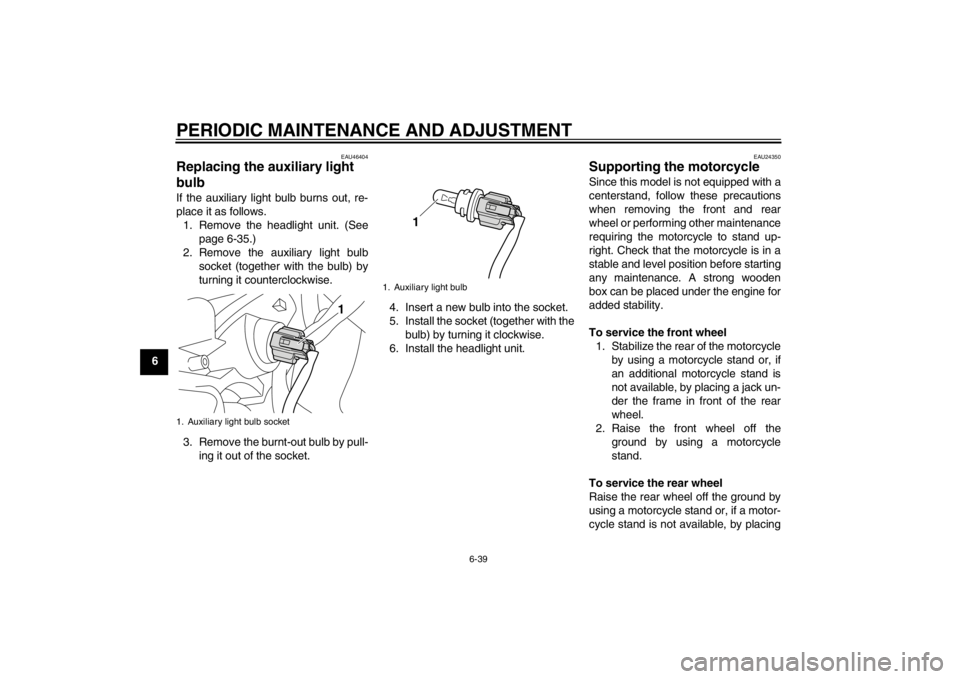
Replacing the auxiliary light
bulb If the auxiliary light bulb burns out, re-
place it as follows.1. Remove the headlight unit. (See page 6-35.)
2. Remove the auxiliary light bulb socket (together with the bulb) by
turning it counterclockwise.
3. Remove the burnt-out bulb by pull- ing it out of the socket. 4. Insert a new bulb into the socket.
5. Install the socket (together with the
bulb) by turning it clockwise.
6. Install the headlight unit.
EAU24350
Supporting the motorcycle Since this model is not equipped with a
centerstand, follow these precautions
when removing the front and rear
wheel or performing other maintenance
requiring the motorcycle to stand up-
right. Check that the motorcycle is in a
stable and level position before starting
any maintenance. A strong wooden
box can be placed under the engine for
added stability.
To service the front wheel 1. Stabilize the rear of the motorcycle by using a motorcycle stand or, if
an additional motorcycle stand is
not available, by placing a jack un-
der the frame in front of the rear
wheel.
2. Raise the front wheel off the ground by using a motorcycle
stand.
To service the rear wheel
Raise the rear wheel off the ground by
using a motorcycle stand or, if a motor-
cycle stand is not available, by placing
1. Auxiliary light bulb socket
1
1. Auxiliary light bulb
1
U2S3E3E0.book Page 39 Monday, September 19, 2011 8:42 AM
Page 95 of 110

PERIODIC MAINTENANCE AND ADJUSTMENT
6-40
6
a jack either under each side of the
frame in front of the rear wheel or under
each side of the swingarm.
EAU25871
Troubleshooting Although Yamaha motorcycles receive
a thorough inspection before shipment
from the factory, trouble may occur dur-
ing operation. Any problem in the fuel,
compression, or ignition systems, for
example, can cause poor starting and
loss of power.
The following troubleshooting charts
represent quick and easy procedures
for checking these vital systems your-
self. However, should your motorcycle
require any repair, take it to a Yamaha
dealer, whose skilled technicians have
the necessary tools, experience, and
know-how to service the motorcycle
properly.
Use only genuine Yamaha replace-
ment parts. Imitation parts may look like
Yamaha parts, but they are often inferi-
or, have a shorter service life and can
lead to expensive repair bills.
WARNING
EWA15141
When checking the fuel system, do
not smoke, and make sure there are
no open flames or sparks in the ar-
ea, including pilot lights from water heaters or furnaces. Gasoline or
gasoline vapors can ignite or ex-
plode, causing severe injury or
property damage.
U2S3E3E0.book Page 40 Monday, September 19, 2011 8:42 AM