2012 VOLVO V60 air
[x] Cancel search: airPage 276 of 400

06 During your journey
Fuel
06
274
General information on fuel
Fuel of a lower quality than that recommended
by Volvo must not be used as engine power
and fuel consumption is negatively affected.
WARNING
Always avoid inhaling fuel vapour and get-
ting fuel splashes in the eyes.
In the event of fuel in the eyes, remove any
contact lenses and rinse the eyes in plenty
of water for at least 15 minutes and seek
medical attention.
Never swallow fuel. Fuels such as petrol,
bioethanol and mixtures of them and diesel
are highly toxic and could cause permanent
injury or be fatal if swallowed. Seek medical
attention immediately if fuel has been swal-
lowed.
WARNING
Fuel which spills onto the ground can be
ignited.
Switch off the fuel-driven heater before star-
ting to refuel.
Never carry an activated mobile phone
when refuelling. The ring signal could cause
spark build-up and ignite petrol fumes,
leading to fire and injury.
IMPORTANT
Mixing different types of fuel or the use of
fuel not recommended invalidates Volvo's
guarantees, and any associated service
agreement. This applies to all engines.
NOTE: It does not apply to cars with engines
that are adapted to run on ethanol fuel (E85).
NOTE
Extreme weather conditions, driving with a
trailer or driving at high altitudes in combi-
nation with fuel grade are factors that could
affect the car's performance.
Catalytic convertersThe purpose of the catalytic converters is to
purify exhaust gases. They are located close to
the engine so that operating temperature is
reached quickly.
The catalytic converters consist of a monolith
(ceramic or metal) with channels. The channel
walls are lined with a thin layer of platinum/rho-
dium/palladium. These metals act as catalysts,
i.e. they participate in and accelerate a chem-
ical reaction without being used up them-
selves.
Lambda-sondTM oxygen sensorThe Lambda-sond is part of a control system
intended to reduce emissions and improve fuel
economy.
An oxygen sensor monitors the oxygen content
of the exhaust gases leaving the engine. This
value is fed into an electronic system that con-
tinuously controls the injectors. The ratio of fuel
to air directed to the engine is continuously
adjusted. These adjustments create optimal
conditions for efficient combustion, and
together with the three-way catalytic converter
reduce harmful emissions (hydrocarbons, car-
bon monoxide and nitrous oxides).
Petrol
Petrol must fulfil the EN 228 standard. Most
engines can be run with octane ratings of 95
and 98 RON. Only in exceptional cases should
91 RON be used.
•95 RON can be used for normal driving.
•98 RON is recommended for optimum per-
formance and minimum fuel consumption.
When driving in temperatures above +38 °C,
fuel with the highest possible octane rating is
recommended for optimum performance and
fuel economy.
ProCarManuals.com
Page 278 of 400

06 During your journey
Fuel
06
276* Option/accessory, for more information, see Introduction.
tank may need to be vented in the workshop in
order to restart the engine after fuelling.
Once the engine has stopped due to fuel star-
vation, the fuel system needs a few moments
to carry out a check. Do this before starting the
engine, once the fuel tank has been filled with
diesel:
1. Insert the remote control key in the ignition
switch and push it in to the end position
(see page 80).
2.
Press the START button without depress-
ing the brake and/or clutch pedal.
3. Wait approx. 1 minute.
4. To start the engine: Depress the brake and/
or clutch pedal and then press the
START button again.
NOTE
Before filling with fuel in the event of fuel
shortage:
•Stop the car on as flat/level ground as
possible - if the car is tilting there is a
risk of air pockets in the fuel supply.
Draining condensation from the fuel filterThe fuel filter separates condensation from the
fuel. Condensation can disrupt engine opera-
tion.The fuel filter must be drained at the intervals
specified in the Service and Warranty Booklet
or if you suspect that the car has been filled
with contaminated fuel.
IMPORTANT
Certain special additives remove the water
separation in the fuel filter.
Diesel particle filter (DPF)Diesel cars are equipped with a particle filter,
which results in more efficient emission con-
trol. The particles in the exhaust gases are col-
lected in the filter during normal driving. So-
called "regeneration" is started in order to burn
away the particles and empty the filter. This
requires the engine to have reached normal
operating temperature.
Regeneration of the filter is automatic and nor-
mally takes 10-20 minutes. It may take a little
longer at a low average speed. Fuel consump-
tion may increase slightly during regeneration.
Regeneration in cold weatherIf the car is frequently driven short distances in
cold weather then the engine does not reach
normal operating temperature. This means that
regeneration of the diesel particle filter does
not take place and the filter is not emptied.When the filter has become approximately
80% full of particles, a warning triangle on the
instrument panel illuminates, and the message
Soot filter full See manual is shown on the
instrument panel display.
Start regeneration of the filter by driving the car
until the engine reaches normal operating tem-
perature, preferably on a main road or motor-
way. The car should then be driven for approx-
imately 20 minutes more.
NOTE
A smaller reduction of engine power may be
noticed temporarily during regeneration.
When regeneration is complete the warning
text is cleared automatically.
Use the parking heater* in cold weather so that
the engine reaches normal operating tempera-
ture more quickly.
IMPORTANT
If the filter fills up with particles then it can
be difficult to start the engine and the filter
will be incapable of functioning. Then there
is a risk that the filter will have to be
replaced.
ProCarManuals.com
Page 291 of 400

06 During your journey
Towing and recovery
06
289 Towing
Find out the statutory maximum speed limit for
towing before towing begins.
1. Unlock the steering lock by inserting the
remote control key in the ignition switch
and giving a long press on the START/
STOP ENGINE button - key position II is
activated, see page 80 for more informa-
tion on key positions.
2. The remote control key must remain in the
ignition switch while the car is being towed.
3. Keep the towline taut when the towing
vehicle reduces speed by holding your foot
gently pressed on the brake pedal -
thereby avoiding unnecessary jerking.
4. Be prepared to brake to stop.
WARNING
•Check that the steering lock is unlocked
before towing.
•The remote control key must be in key
position II - in position I all airbags are
deactivated.
•Never remove the remote control key
from the ignition switch when the car is
being towed.
WARNING
The brake servo and power steering do not
work when the engine is switched off - the
brake pedal needs to be depressed
about 5 times more heavily and the steering
is considerably heavier than normal.
Manual gearboxPrior to towing:
–Move gear lever into neutral and release
the parking brake.
Automatic gearbox Geartronic
IMPORTANT
Note that the car must always be towed with
the wheels rolling forward.
•Cars with automatic gearbox must not
be towed at speeds above 80 km/h or
further than 80 km.
Prior to towing:
–
Move the gear selector to position N and
release the parking brake.
Automatic gearbox PowershiftThe model with Powershift transmission
should not be towed as it is dependent on the
engine running in order to receive sufficientlubrication. If towing still has to take place, the
route must be as short as possible and then
with very low speed.
In the event of uncertainty as to whether or not
the car is equipped with Powershift transmis-
sion, this can be verified by checking the des-
ignation on the decal number (5) under the
bonnet - see page 352. The designa-
tion ”MPS6” means that it is Powershift trans-
mission - otherwise it is Geartronic automatic
transmission.
IMPORTANT
Avoid towing.
•However, the car can be towed for a
short distance at low speed to move it
from a dangerous position - not further
than 10 km and not faster than
10 km/h. Note that the car must always
be towed with the wheels rolling for-
ward.
•In the event of moving a longer distance
than 10 km, the car must be transported
with the drive wheels raised from the
road - professional recovery is recom-
mended.
Prior to towing:
–
Move the gear selector to position N and
release the parking brake.
ProCarManuals.com
Page 294 of 400

292* Option/accessory, for more information, see Introduction.
General ................................................................................................. 294
Changing wheels .................................................................................. 298
Tyre pressure ....................................................................................... 301
Warning triangle and first-aid kit*.......................................................... 302
Tyre pressure monitoring (TPMS)*........................................................303
Emergency puncture repair (TMK) ....................................................... 305
ProCarManuals.com
Page 301 of 400
07 Wheels and tyres
Changing wheels
07
* Option/accessory, for more information, see Introduction.299
jack down so it is pressed squarely on the
ground.
IMPORTANT
The ground must be firm, smooth and level.
8. Lift the car so that the wheel is free.
Remove the wheel bolts and lift off the
wheel.
Installation
1. Clean the contact surfaces between wheel
and hub.
2. Put on the wheel. Tighten the wheel bolts
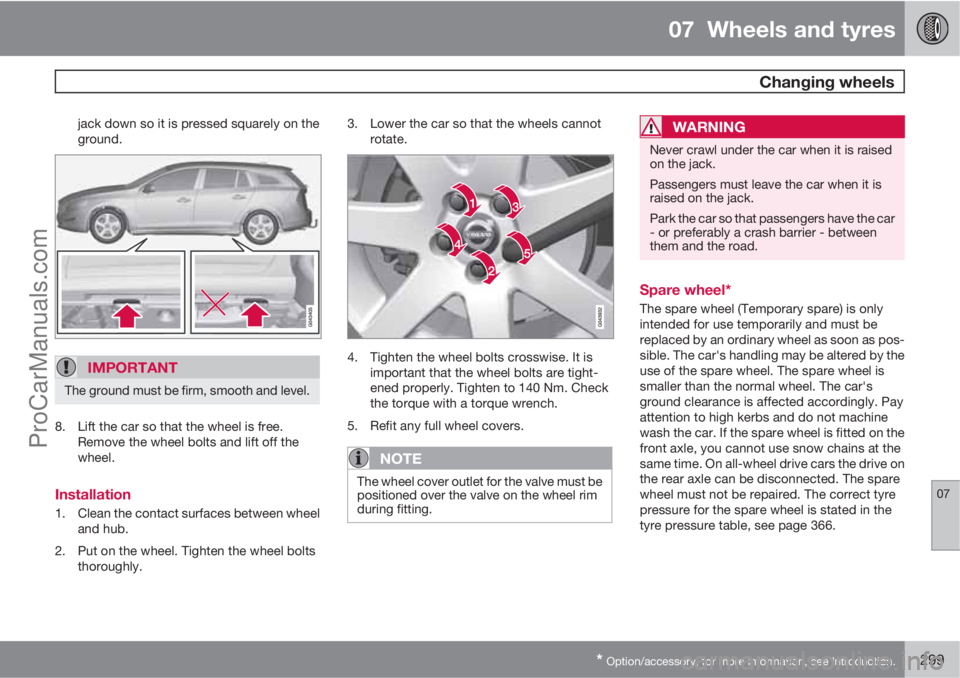
thoroughly.3. Lower the car so that the wheels cannot
rotate.
4. Tighten the wheel bolts crosswise. It is
important that the wheel bolts are tight-
ened properly. Tighten to 140 Nm. Check
the torque with a torque wrench.
5. Refit any full wheel covers.
NOTE
The wheel cover outlet for the valve must be
positioned over the valve on the wheel rim
during fitting.
WARNING
Never crawl under the car when it is raised
on the jack.
Passengers must leave the car when it is
raised on the jack.
Park the car so that passengers have the car
- or preferably a crash barrier - between
them and the road.
Spare wheel*
The spare wheel (Temporary spare) is only
intended for use temporarily and must be
replaced by an ordinary wheel as soon as pos-
sible. The car's handling may be altered by the
use of the spare wheel. The spare wheel is
smaller than the normal wheel. The car's
ground clearance is affected accordingly. Pay
attention to high kerbs and do not machine
wash the car. If the spare wheel is fitted on the
front axle, you cannot use snow chains at the
same time. On all-wheel drive cars the drive on
the rear axle can be disconnected. The spare
wheel must not be repaired. The correct tyre
pressure for the spare wheel is stated in the
tyre pressure table, see page 366.
ProCarManuals.com
Page 303 of 400
07 Wheels and tyres
Tyre pressure
07
301
Tyre pressure
G021830
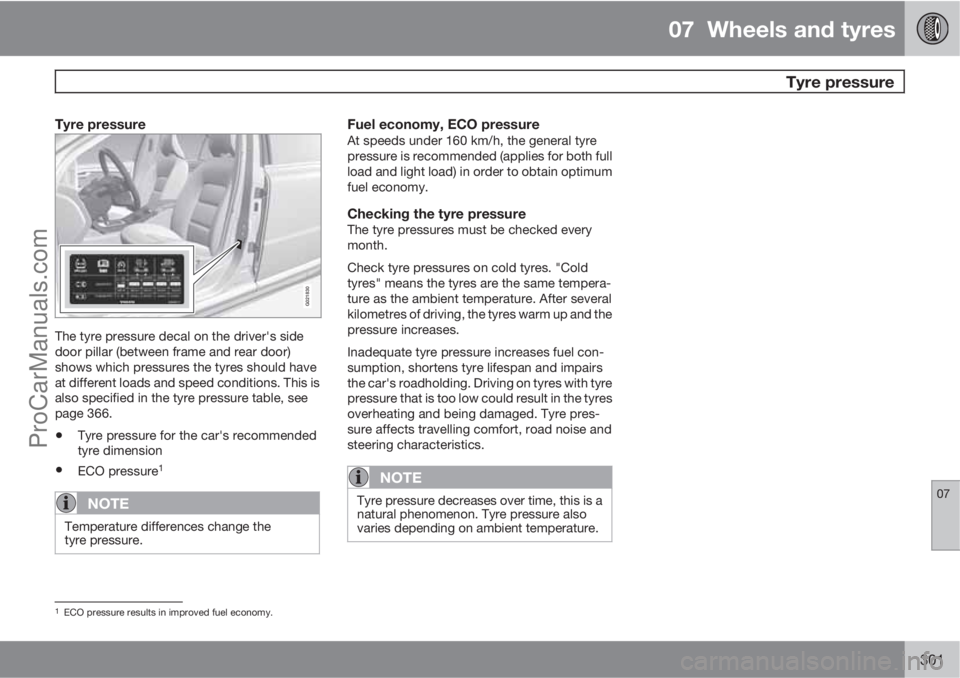
The tyre pressure decal on the driver's side
door pillar (between frame and rear door)
shows which pressures the tyres should have
at different loads and speed conditions. This is
also specified in the tyre pressure table, see
page 366.
•Tyre pressure for the car's recommended
tyre dimension
•ECO pressure1
NOTE
Temperature differences change the
tyre pressure.
Fuel economy, ECO pressureAt speeds under 160 km/h, the general tyre
pressure is recommended (applies for both full
load and light load) in order to obtain optimum
fuel economy.
Checking the tyre pressureThe tyre pressures must be checked every
month.
Check tyre pressures on cold tyres. "Cold
tyres" means the tyres are the same tempera-
ture as the ambient temperature. After several
kilometres of driving, the tyres warm up and the
pressure increases.
Inadequate tyre pressure increases fuel con-
sumption, shortens tyre lifespan and impairs
the car's roadholding. Driving on tyres with tyre
pressure that is too low could result in the tyres
overheating and being damaged. Tyre pres-
sure affects travelling comfort, road noise and
steering characteristics.
NOTE
Tyre pressure decreases over time, this is a
natural phenomenon. Tyre pressure also
varies depending on ambient temperature.
1ECO pressure results in improved fuel economy.
ProCarManuals.com
Page 305 of 400

07 Wheels and tyres
Tyre pressure monitoring (TPMS)*
07
* Option/accessory, for more information, see Introduction.303 General
TPMS (Tyre Pressure Monitoring System)*
warns the driver when the pressure is too low
in one or more of the car's tyres. It uses sensors
located inside the air valve in each wheel.
When the car is driven at about 40 km/h the
system detects the tyre pressure. If the pres-
sure is too low then a warning lamp
on the
instrument panel illuminates and a message is
shown on the display.
Only factory fitted wheels are equipped with
TPMS sensors in the valves.
If wheels without TPMS sensors are used then
Tyre press. syst Service required will be
shown every time the car is driven faster than
40 km/h for more than 10 minutes.
Always check the system after changing a
wheel in order to ensure that replacement
wheels work with the system.
For information on correct tyre pressures, see
page 366.
The system does not replace normal tyre main-
tenance.
IMPORTANT
If a fault should arise in the tyre pressure
system a warning lamp on the instru-
ment panel will illuminate and a message
will be shown. This can be for various rea-
sons, e.g. fitting a wheel not equipped with
a sensor adapted for Volvo's tyre pressure
monitoring system.
Adjusting tyre pressure monitoringTyre pressure monitoring can be adjusted in
order to follow Volvo's tyre pressure recom-
mendations, when driving with a heavy load for
example.
NOTE
The engine must not be running when the
tyres are calibrated.
The settings are made with the control in the
centre console, see page 145.
1. Inflate the tyres to the required pressure
and select key position I or II.
2.
Select the menu system MY CAR to open
the menus to Settings
Tyre pressure
3.
Select
Calibrate tyre pressure.
4.
Press OK.5. Start the car and drive at least at 40 km/h
for a total of at least 1 minute and check
that the message disappears.
> Calibration is complete.
Rectifying low tyre pressureIf a message for low tyre pressure is shown in
the display:
1. Check the tyre pressure in all four tyres.
2. Inflate the tyre(s) to the correct pressure.
3. Drive at least at 40 km/h for a total of at
least 1 minute and check that the message
disappears.
Deactivating/activating tyre pressure
monitoring
NOTE
The engine must not be running when tyre
pressure monitoring is activated/deacti-
vated.
The settings are made with the control in the
centre console, see page 145.
1.
Select key position I or II.
2.
Select the system MY CAR to open the
menus to Car settings
Tyre pressure
3.
Select
Tyre pressure system and press
OK.
ProCarManuals.com
Page 307 of 400
07 Wheels and tyres
Emergency puncture repair (TMK)
07
* Option/accessory, for more information, see Introduction.305 General
Emergency puncture repair (TMK; Temporary
Mobility Kit) is used to seal a puncture and
check and adjust tyre pressure. It consists of a
compressor and a bottle with sealing fluid. The
kit works as a temporary repair. The sealing
fluid bottle must be replaced before its expira-
tion date and after use.
The sealing fluid effectively seals tyres punc-
tured in the tread.
NOTE
The emergency puncture repair kit is only
intended for sealing tyres with a puncture in
the tread.
The emergency puncture repair kit has limited
capacity to seal tyres which have punctures inthe wall. Do not seal tyres with the emergency
puncture repair kit if they have larger slits,
cracks or similar damage.
For connecting the compressor there are 12 V
sockets in the centre console and by the rear
seat, as well as a 12 V socket in the cargo
area*. Choose the electrical socket that is near-
est the punctured tyre.
Location of the emergency puncture
repair kit
Set up the warning triangle if a tyre is being
sealed in a trafficked location. The emergency
puncture repair kit is located under the floor in
the cargo area, see page 302.
WARNING
You should not drive faster than 80 km/h
after the emergency tyre repair kit has been
used. Volvo recommends that you visit an
authorised Volvo workshop for inspection of
the sealed tyre (maximum driving distance
is 200 km). The staff there can determine
whether or not the tyre can be repaired or if
it needs to be replaced.
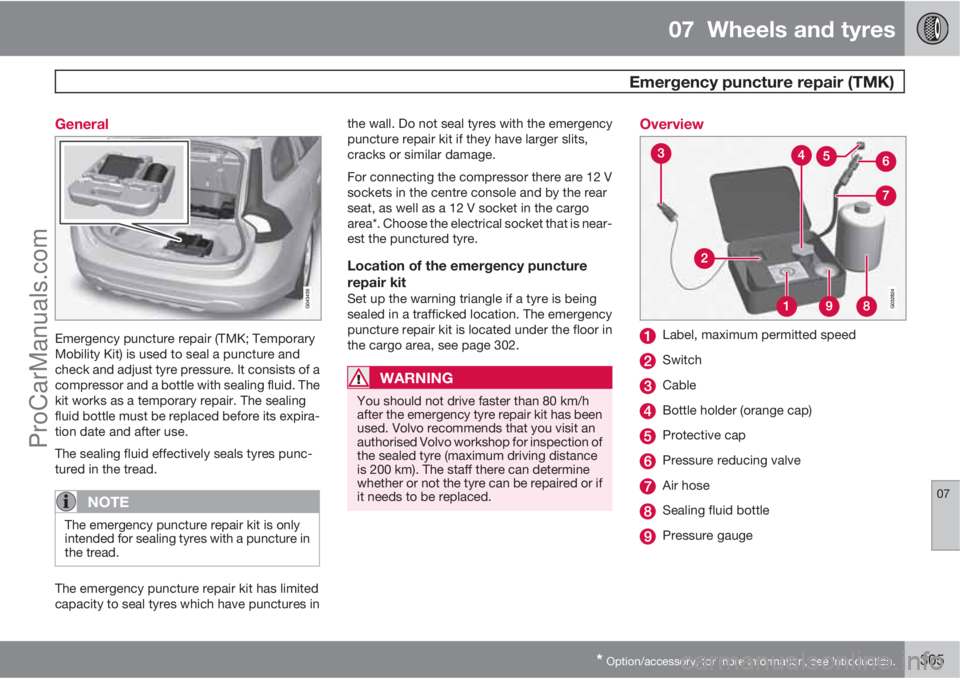
Overview
Label, maximum permitted speed
Switch
Cable
Bottle holder (orange cap)
Protective cap
Pressure reducing valve
Air hose
Sealing fluid bottle
Pressure gauge
ProCarManuals.com