2012 VOLVO V60 warning
[x] Cancel search: warningPage 31 of 400
01 Safety
When the systems deploy01
29 When the systems deploy
SystemTriggered
Seatbelt tensioner,
front seatIn the event of a
frontal collision,
and/or side-impact
collision, and/or
rear-end collision
and overturning
Seatbelt tensioner,
rear seatIn the event of a
frontal collision and
overturning
Airbags (SRS)In a frontal collisionA
Side airbags (SIPS)In a side-impact
accident
Inflatable Curtain ICIn the event of a
side-impact acci-
dent, overturning
and a frontal colli-
sion if the car is not
hit directly head-on
Whiplash protection
WHIPSIn a rear-end colli-
sion
AThe bodywork of the car could be greatly deformed in a col-
lision without airbag deployment. A number of factors such
as the rigidity and weight of the object hit, the speed of the
car, the angle of the collision etc. affects how the different
safety systems of the car are activated.
If the airbags have deployed, the following is
recommended:
•Recovering the car. Volvo recommends
that you have it conveyed to an authorised
Volvo workshop. Do not drive with
deployed airbags.
•Volvo recommends that you engage an
authorised Volvo workshop to handle the
replacement of components in the car's
safety systems.
•Always contact a doctor.
NOTE
The SRS, SIPS, IC and belt tensioner sys-
tems are deployed only once during a colli-
sion.
WARNING
The airbag control module is located in the
centre console. If the centre console is
drenched with water or other liquid, discon-
nect the battery cables. Do not attempt to
start the car since the airbags may deploy.
Recovering the car. Volvo recommends that
you have it conveyed to an authorised Volvo
workshop.
WARNING
Never drive with deployed airbags. They
can make steering difficult. Other safety
systems may also be damaged. The smoke
and dust created when the airbags are
deployed can cause skin and eye irritation/
injury after intensive exposure. In case of
irritation, wash with cold water. The rapid
deployment sequence and airbag fabric
may cause friction and skin burns.
ProCarManuals.com
Page 32 of 400

01 Safety
Safety mode 01
30
Driving after a collision
If the car is involved in a collision, the textSafety mode See manual may appear on the
information display. This means that the car
has reduced functionality. Safety mode is a
protective state that is enforced when the col-
lision may have damaged any of the car's vital
functions, such as the fuel lines, sensors for
one of the safety systems, or the brake system.
Attempting to start the carFirst, check that no fuel is leaking from the car.
There must be no smell of fuel either.
If everything seems normal and you have
checked for indications of fuel leakage, you
may attempt to start the car.
Remove the remote control key and open the
driver's door. If a message is now shown to theeffect that the ignition is on, press the start
button. Then close the door and reinsert the
remote control key. The car's electronics will
now try to reset themselves to normal mode.
Then try to start the car.
If the message
Safety mode See manual is
still shown on the display then the car must not
be driven or towed, but a vehicle recovery serv-
ice used instead. Even if the car appears to be
driveable, hidden damage may make the car
impossible to control once moving.
Moving the car
If Normal mode is shown after Safety mode
See manual has been reset, the car can be
moved carefully out of a dangerous position.
Do not move the car further than necessary.
WARNING
Never attempt to repair your car or reset the
electronics yourself if the car has been in
safety mode. This could result in personal
injury or the car not functioning as normal.
Volvo recommends that you engage an
authorised Volvo workshop to check and
restore the car to normal status after
Safety
mode See manual has been displayed.
WARNING
Never, under any circumstances, attempt to
restart the car if it smells of fuel when the
Safety mode See manual message is dis-
played. Leave the car at once.
WARNING
If the car is in safety mode it must not be
towed. It must be transported from its loca-
tion. Volvo recommends that it is transpor-
ted to an authorised Volvo workshop.
ProCarManuals.com
Page 34 of 400

01 Safety
Child safety 01
32
WARNING
Never place a child in a child seat or on a
booster cushion in the front seat if the airbag
(SRS) is activated.
No one shorter than 140 cm should ever sit
in the front passenger seat if the airbag
(SRS) is activated.
Failure to follow the advice given above can
endanger life.
WARNING
Booster cushions/child seats with steel
braces or some other design that could rest
on the seatbelt buckle's opening button
must not be used, as they could cause the
seatbelt buckle to open accidentally.
Do not allow the upper section of the child
seat to rest against the windscreen.
Label Airbag
Label fitted on the end face of the instrument panel
on the passenger side, see the illustration on page
22.
ProCarManuals.com
Page 39 of 400
01 Safety
Child safety01
37
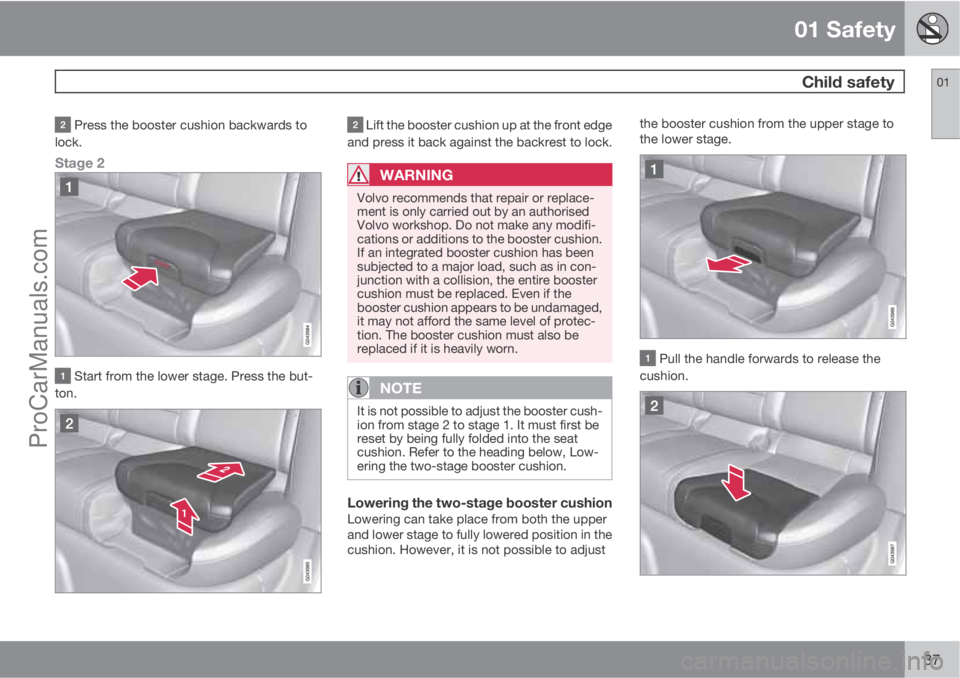
Press the booster cushion backwards to
lock.
Stage 2
Start from the lower stage. Press the but-
ton.
Lift the booster cushion up at the front edge
and press it back against the backrest to lock.
WARNING
Volvo recommends that repair or replace-
ment is only carried out by an authorised
Volvo workshop. Do not make any modifi-
cations or additions to the booster cushion.
If an integrated booster cushion has been
subjected to a major load, such as in con-
junction with a collision, the entire booster
cushion must be replaced. Even if the
booster cushion appears to be undamaged,
it may not afford the same level of protec-
tion. The booster cushion must also be
replaced if it is heavily worn.
NOTE
It is not possible to adjust the booster cush-
ion from stage 2 to stage 1. It must first be
reset by being fully folded into the seat
cushion. Refer to the heading below, Low-
ering the two-stage booster cushion.
Lowering the two-stage booster cushionLowering can take place from both the upper
and lower stage to fully lowered position in the
cushion. However, it is not possible to adjustthe booster cushion from the upper stage to
the lower stage.
Pull the handle forwards to release the
cushion.
ProCarManuals.com
Page 40 of 400
01 Safety
Child safety 01
38
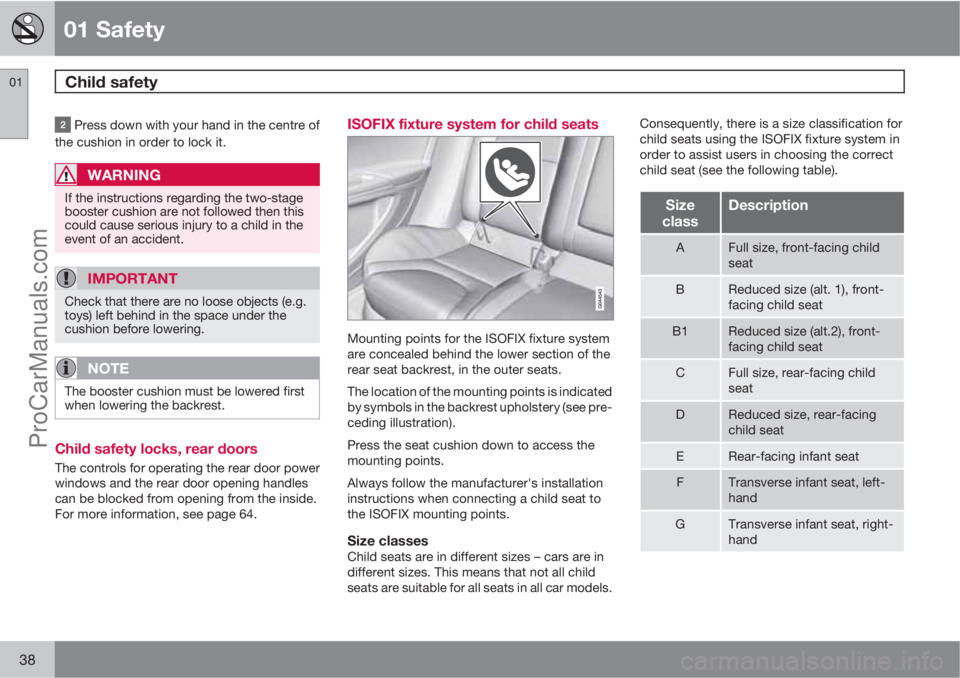
Press down with your hand in the centre of
the cushion in order to lock it.
WARNING
If the instructions regarding the two-stage
booster cushion are not followed then this
could cause serious injury to a child in the
event of an accident.
IMPORTANT
Check that there are no loose objects (e.g.
toys) left behind in the space under the
cushion before lowering.
NOTE
The booster cushion must be lowered first
when lowering the backrest.
Child safety locks, rear doors
The controls for operating the rear door power
windows and the rear door opening handles
can be blocked from opening from the inside.
For more information, see page 64.
ISOFIX fixture system for child seats
Mounting points for the ISOFIX fixture system
are concealed behind the lower section of the
rear seat backrest, in the outer seats.
The location of the mounting points is indicated
by symbols in the backrest upholstery (see pre-
ceding illustration).
Press the seat cushion down to access the
mounting points.
Always follow the manufacturer's installation
instructions when connecting a child seat to
the ISOFIX mounting points.
Size classesChild seats are in different sizes – cars are in
different sizes. This means that not all child
seats are suitable for all seats in all car models.Consequently, there is a size classification for
child seats using the ISOFIX fixture system in
order to assist users in choosing the correct
child seat (see the following table).
Size
classDescription
AFull size, front-facing child
seat
BReduced size (alt. 1), front-
facing child seat
B1Reduced size (alt.2), front-
facing child seat
CFull size, rear-facing child
seat
DReduced size, rear-facing
child seat
ERear-facing infant seat
FTransverse infant seat, left-
hand
GTransverse infant seat, right-
hand
ProCarManuals.com
Page 41 of 400
01 Safety
Child safety01
39
WARNING
Never place a child in the passenger seat if
the car is equipped with an activated airbag.
NOTE
If an ISOFIX child seat has no size classifi-
cation then the car model must be included
on the child seat's vehicle list.
NOTE
Volvo recommends that you contact an
authorised Volvo dealer for recommenda-
tions about which ISOFIX child seats Volvo
recommends.
Types of ISOFIX child seat
Type of child seatWeightSize classPassenger seats for ISOFIX installation of child seats
Front seatOuter rear seat
Infant seat transversemax 10 kgFXX
GXX
Infant seat, rear-facingmax 10 kgEXOK
(IL)
ProCarManuals.com
Page 44 of 400
01 Safety
Child safety 01
42
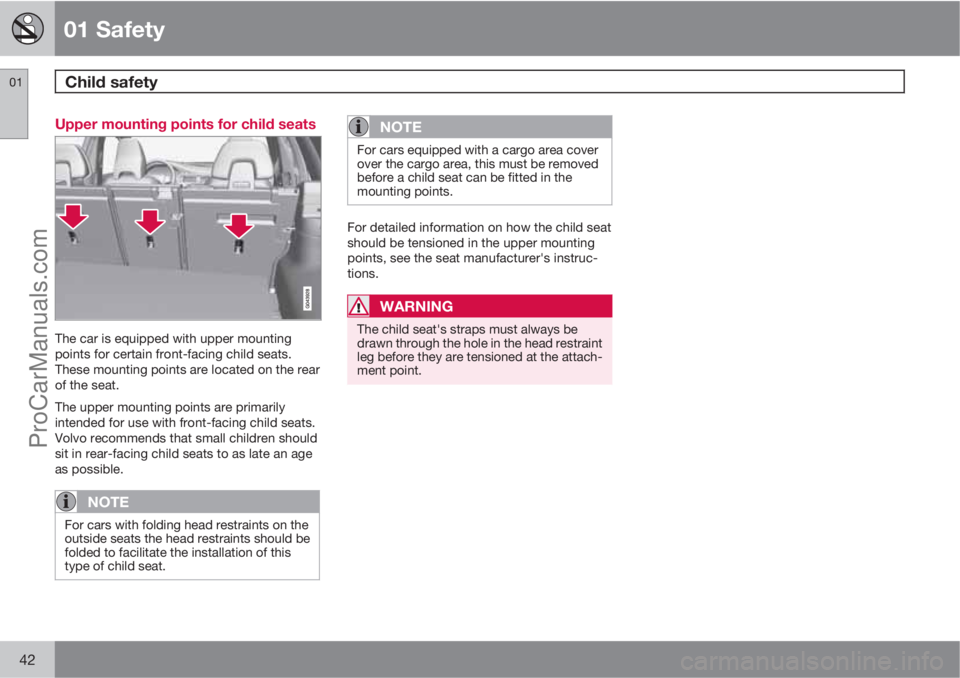
Upper mounting points for child seats
The car is equipped with upper mounting
points for certain front-facing child seats.
These mounting points are located on the rear
of the seat.
The upper mounting points are primarily
intended for use with front-facing child seats.
Volvo recommends that small children should
sit in rear-facing child seats to as late an age
as possible.
NOTE
For cars with folding head restraints on the
outside seats the head restraints should be
folded to facilitate the installation of this
type of child seat.
NOTE
For cars equipped with a cargo area cover
over the cargo area, this must be removed
before a child seat can be fitted in the
mounting points.
For detailed information on how the child seat
should be tensioned in the upper mounting
points, see the seat manufacturer's instruc-
tions.
WARNING
The child seat's straps must always be
drawn through the hole in the head restraint
leg before they are tensioned at the attach-
ment point.
ProCarManuals.com
Page 48 of 400

02 Locks and alarm
Remote control key/key blade
02
46
General
The car is supplied with 2 remote control keys
or PCCs (Personal Car Communicator). They
are used to start the car and for locking and
unlocking.
More remote control keys can be ordered – up
to 6 can be programmed and used for the same
car.
The PCC has increased functionality com-
pared with the remote control key. The contin-
uation of this chapter describes the functions
available in both the PCC and the remote con-
trol key.
WARNING
If there are children in the car:
Always remember to switch off the power
supply to power windows and sunroof by
removing the remote control key if the driver
leaves the car.
Loss of a remote control keyIf you lose a remote control key then new ones
can be ordered at a workshop - an authorised
Volvo workshop is recommended. The remain-
ing remote control keys must then be taken to
the workshop. The code of the missing remotecontrol key must be erased from the system as
a theft prevention measure.
The current number of keys registered to the
car can be checked in the menu system MY
CAR under Information
Number of keys.
For a description of the menu system, see
page 144.
Key memory1 – door mirrors and driver's
seat
The settings are automatically connected to
each respective remote control key, see pages
83 and 102.
The function can be activated/deactivated in
the menu system MY CAR under Settings
Car settingsCar key memory.
For a description of the menu system, see
page 144.
For cars with Keyless drive system, see
page 55.
Indicator for locking/unlockingWhen the car is locked or unlocked using the
remote control key, the direction indicators
confirm that locking/unlocking was correctly
performed.
•Locking - one flash and the door mirrors
are folded2 in.
•Unlocking - two flashes and the door mir-
rors are folded2 out.
After locking the indication is only given if all
locks have been activated once the doors have
been closed.
Selecting the functionDifferent options for indicating locking/unlock-
ing with light can be set in the car's menu sys-
tem, see page 144.
Search in the menu system MY CAR for
Settings
Car settingsLight settings
and select
Lock confirmation light and/orUnlock confirmation light.
1Only in combination with power driver's seat and power mirrors.2Only for cars with retractable power door mirrors.
ProCarManuals.com