Page 336 of 400
08 Maintenance and service
Fuses
08
334
Engine compartment
ProCarManuals.com
Page 337 of 400

08 Maintenance and service
Fuses
08
��
* Option/accessory, for more information, see Introduction.335
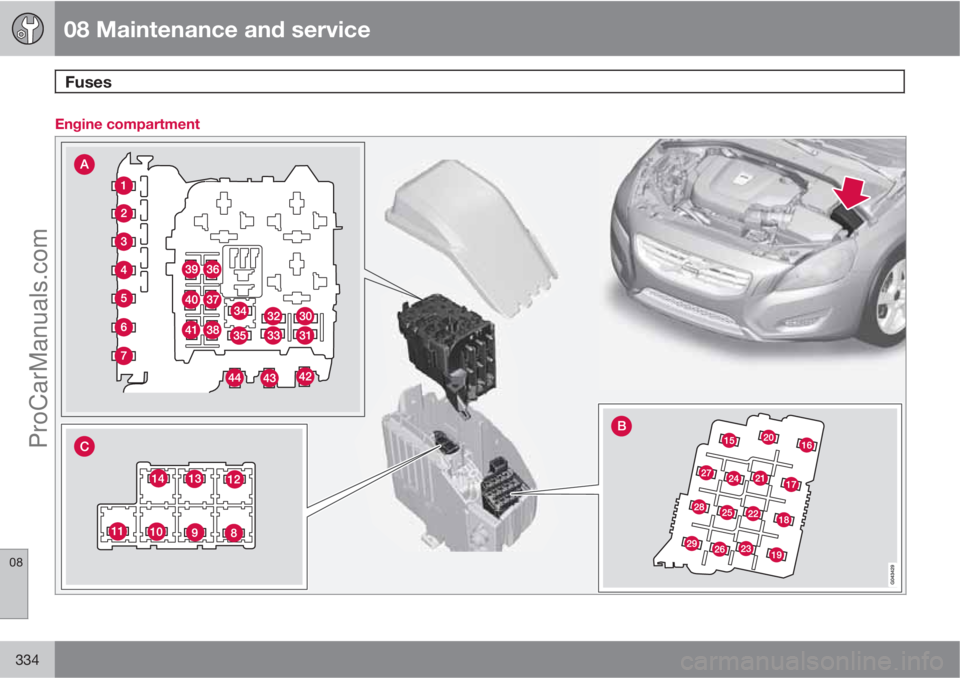
General fuses, engine compartmentOn the inside of the cover there are tweezers
that facilitate the procedure for the removal
and fitting of fuses.
Positions (see preceding illustration)Engine compartment, upper
Engine compartment, front
Engine compartment, lower
These fuses are all located in the engine com-
partment box. The fuses in (C) are located
under (A).
On the inside of the cover is a label that shows
the location of the fuses.
•Fuses 1-7 and 42-44 are of the "Midi Fuse"
type and must only be replaced by a work-
shop
1.
•Fuses 8-15 and 34 are of the "JCASE" type
and should be replaced by a workshop1.
•Fuses 16-33 and 35-41 are of the "Mini
Fuse" type.
FunctionA
Primary fuse for the central elec-
tronic module (CEM) with fuse
box B under the glovebox
A
50
Primary fuse for the central elec-
tronic module (CEM) with fuse
box B under the glovebox50
Primary fuse for central electri-
cal unit in cargo areaA60
Primary fuse for central electri-
cal unit in passenger compart-
ment with fuse box A under the
glovebox
A
60
Primary fuse for central electri-
cal unit in passenger compart-
ment with fuse box A under the
glovebox
A
60
--
PTC element, air preheater*A100
Headlamp washers*20
Windscreen wipers30
FunctionA
Parking heater*25
Ventilation fanA40
--
ABS pump40
ABS valves20
--
Headlamp levelling*, Active
Xenon headlamps - ABL*10
Primary fuse for the central elec-
tronic module (CEM) with fuse
box B under the glovebox20
ABS5
Speed related power steering*5
Engine control module, Trans-
mission control module, Air-
bags10
Heated washer nozzles*10
1An authorised Volvo workshop is recommended.
ProCarManuals.com
Page 338 of 400

08 Maintenance and service
Fuses
08
336* Option/accessory, for more information, see Introduction.
FunctionA
Relay coil, relay, vacuum pump
(5-cyl. petrol)5
Headlamp control5
--
--
--
Internal relay coils5
Auxiliary lamps*20
Horn15
Relay coil, main relay, engine
management system, Engine
control module (5, 6-cyl. petrol)10
Transmission control module15
Compressor A/C (not 5-cyl. die-
sel), Coolant pump (5-cyl. diesel
Start/Stop)15
FunctionA
Relay coil, relay, compressor A/
C (not 5-cyl. diesel), Relay coil,
relay, coolant pump (5-cyl. die-
sel Start/Stop)
Relay coils in central electrical
unit in engine compartment cold
zone Start/Stop5
Actuator solenoid, starter
motorA30
Ignition coils (4-cyl. petrol),
Glow control module (5-cyl. die-
sel)10
Ignition coils (5, 6-cyl. petrol),
Capacitor (6-cyl.)20
Engine control module (petrol)10
Engine control module (diesel)15
FunctionA
Valves (1.6 l petrol), Mass air
flow sensor (1.6 l petrol)
Mass air flow sensor (D4162T),
Control valve, fuel flow
(D4162T)10
Mass air flow sensor (5, 6-cyl.),
Control valves (5-cyl. diesel),
Injectors (5, 6-cyl. petrol),
Engine control module (6-cyl.)15
Compressor A/C (5, 6-cyl.),
Engine valves, Engine control
module (6-cyl.) Solenoids (6-cyl.
without turbo), Actuator motors,
intake manifold (6-cyl. without
turbo), Mass air flow sensor (4-
cyl. 2.0 l petrol), Oil level sensor
(5-cyl. diesel)
Coolant pump (D4162T)10
Lambda-sonds (4-cyl. petrol),
Lambda-sond (diesel), Control
module, radiator roller cover
(manual 5-cyl. 2.0 l diesel)10
EVAP valve (5, 6-cyl. petrol),
Lambda-sonds (5, 6-cyl. petrol)15
ProCarManuals.com
Page 344 of 400
08 Maintenance and service
Fuses
08
342* Option/accessory, for more information, see Introduction.
Engine compartment, cold zone - Start/Stop*
Location of fuses for the Start/Stop function.
•Fuses A1 and A2 are of the "MEGA Fuse"
type and must only be replaced by a work-
shop
2.
•Fuses 1-11 are of the "Midi Fuse" type and
must only be replaced by a workshop2.
•Fuse 12 is of the "Mini Fuse" type.
For more information on Start/Stop - see
page 123.
Positions
FunctionA
Main fuse for central electrical
unit in the engine compartment175
FunctionA
Main fuse for central electronic
module (CEM) with fuse box B
under the glovebox, central
electrical unit in passenger
compartment with fuse box A
under the glovebox, central
electrical unit in cargo area175
PTC element, air preheater*100
2An authorised Volvo workshop is recommended.
ProCarManuals.com
Page 346 of 400

08 Maintenance and service
Car care
08
344
Washing the car
Wash the car as soon as it becomes dirty.
Wash the car in a car wash with oil separator.
Use car shampoo.
•Remove bird droppings from the paintwork
as soon as possible. Bird droppings con-
tain chemicals that affect and discolour
paintwork very quickly. An authorised
Volvo workshop is recommended for the
removal of any discoloration.
•Hose down the underbody.
•Rinse the entire car to remove loose dirt.
Do not spray directly onto the locks.
•Wash using a sponge, car shampoo and
plenty of lukewarm water.
•Clean the wiper blades with a lukewarm
soap solution or car shampoo.
•Use cold degreasing agent on very dirty
surfaces.
•Dry the car using a clean, soft chamois or
a water scraper.
WARNING
Always have the engine cleaned by a work-
shop. There is a risk of fire if the engine is
hot.
IMPORTANT
Dirty headlamps have impaired functional-
ity. Clean them regularly, when refuelling for
example.
NOTE
Outside lighting such as headlamps, fog
lamps and rear lamps may temporarily have
condensation on the inside of the lens. This
is normal, all exterior lighting is designed to
withstand this. Condensation is normally
vented out of the lamp housing when the
lamp has been switched on for a time.
Cleaning the wiper bladesAsphalt, dust and salt residue on wiper blades,
as well as insects, ice etc. on the windscreen,
impair the service life of wiper blades.
For cleaning:
–Set the wiper blades in service position,
see page 325.
NOTE
Wash the wiper blades and windscreen reg-
ularly with lukewarm soap solution or car
shampoo.
Do not use any strong solvents.
Automatic car washesAn automatic car wash is a simple and quick
way of washing the car, but it cannot reach
everywhere. Handwashing the car is recom-
mended for achieving optimum results.
NOTE
During the first few months a new car must
only be handwashed. This is because the
paintwork is more sensitive when it is new.
High-pressure washingWhen using high-pressure washing, use
sweeping movements and make sure that the
nozzle does not come closer than 30 cm to the
surface of the car (the distance applies to all
exterior parts). Do not spray directly onto the
locks.
Testing the brakes
WARNING
Always test the brakes after washing the
car, including the parking brake, to ensure
that moisture and corrosion do not attack
the brake linings and reduce braking per-
formance.
Lightly depress the brake pedal now and then
when driving long distances in rain or slush.
The heat from the friction causes the brake lin-
ProCarManuals.com
Page 352 of 400

350
Type designations................................................................................. 352
Dimensions and weights....................................................................... 354
Engine specifications............................................................................ 358
Engine oil............................................................................................... 359
Fluids and lubricants............................................................................. 361
Fuel....................................................................................................... 363
Wheel and tyres, dimensions and pressure ......................................... 366
Electrical system................................................................................... 369
Type approval....................................................................................... 370
Symbols in the display.......................................................................... 382
ProCarManuals.com
Page 355 of 400
09 Specifications
Type designations09
353
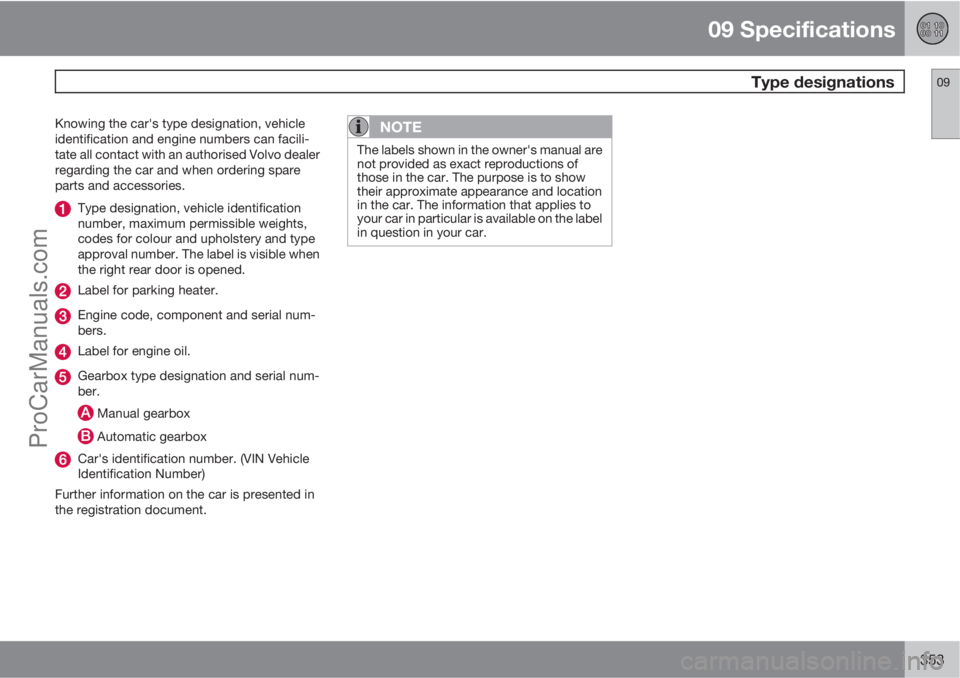
Knowing the car's type designation, vehicle
identification and engine numbers can facili-
tate all contact with an authorised Volvo dealer
regarding the car and when ordering spare
parts and accessories.
Type designation, vehicle identification
number, maximum permissible weights,
codes for colour and upholstery and type
approval number. The label is visible when
the right rear door is opened.
Label for parking heater.
Engine code, component and serial num-
bers.
Label for engine oil.
Gearbox type designation and serial num-
ber.
Manual gearbox
Automatic gearbox
Car's identification number. (VIN Vehicle
Identification Number)
Further information on the car is presented in
the registration document.
NOTE
The labels shown in the owner's manual are
not provided as exact reproductions of
those in the car. The purpose is to show
their approximate appearance and location
in the car. The information that applies to
your car in particular is available on the label
in question in your car.
ProCarManuals.com
Page 358 of 400
09 Specifications
Dimensions and weights 09
356
Towing capacity and towball load
EngineGearboxMax. weight braked trailer (kg)Max. towball load (kg)
T3AManual, MMT6160075
T4AManual, MMT6160075
T4AAutomatic, MPS6160075
T4FManual, MMT6160075
T4FAutomatic, MPS6160075
T5Manual, MMT6180090
T5Automatic, MPS6180090
T6 AWDAutomatic, TF-80SC180090
DRIVeManual, MMT6130075
D3Manual, M66160075
D3Automatic, TF-80SCB160075
D3Automatic, TF-80SDC160075
D5Manual, M66160075
D5Automatic, TF-80SC180090
D5 AWDAutomatic, TF-80SC180090
ADRIVe for certain markets.BWithout Start/Stop.CWith Start/Stop.
ProCarManuals.com