Page 221 of 541
the benchmark tire pressure used
b y
the swi tch on the igni
tion
and then press and hold the
Reset button until you hear a con
firmation chime. The Reset button
must be pressed for at least 2 sec
onds but no more than sect ions
each time
the tire pressure in one
or more tire s has bee n adjusted or
after
one or more tires has been
changed, exchanged or r
epaired.
The new tire pressures will not be
st
ore d in the system until the ve
hicle has b
een driven at normal
s p eeds for
at leas t minutes.
If you use the Reset button to reset
the ben chmark tire pressure when
yo
ur tires do not have the corre ct
t ir e pressure, this
will prevent the
After installin g tires on your ve
hicle
that h ave recom mended co ld
driving
tire infl ation pressures that are dif
ferent from the tires that were
taken off.
After any tire on you r ve hicl e has
b
een removed and remounted,
even if t he sa me tire
and w hee l rim
that were taken off are re-insta ll ed
(for instance, after repair).
After a ny tire on you r veh icle is
changed
and r ep lace d by another
tire, even if th e rep lace me
nt tire is
th e
same type and is inflated to the
same press ure as the tir e it re
pl ace d.
After adjusting the tire pressure
of an y tire on the ve hicl e
to its cor
rect cold tire in flation pressure, ei
ther by putting air in one or more
tires
or by let tin g air out. Do this
even though air was o
nly added (or
let out)
to bring the tir e to the infl a
tion pressure it should have had all
along .
After rotating the front and rear
w he els
page 276.
After mounting th e compact
s pare tir
e.
Improper use of the Reset button
can cause the to give false
warnings
or to give no warning
d espite dangerously low tire
pressure. Make certain
the tire
inflation pressure
of all tires is
correct before using
the Reset
button.
Page 222 of 541
Incorrect tire pressure can cause
sudden tire failure, loss of vehicle
control and serious personal in
jury.
Always make sure that all 4
tires
are inflated to the correct
tire pressure for the tires in
stalled on the vehicle. Then push
the Reset button for the Tire
sure Monitoring System
so that it can properly monitor
the pressure in the tires.
always read and heed all
of the information and WARN
page 276.
The Tire
malfunction
If a warning is g ive n about tire
pressure
being too low, the ve
hicle
must remain station ary for
about one minute. Keep the ve
h icle stationa1y until the
button
for the Tire
page 222, fig. 142 is
pressed to save the new tire pres
s
ure reference value.
224 225
Page 235 of 541
Refueling checklist
first rea d an d note the introductory information and heed the on page 234.
The engi ne compartment of moto r vehicle is a haza rdous engine or in the engin e compartment unless yo u -know exac tl y how to carry o ut the job,
-have the correct technical in formation and the proper too ls and supplies, and -ar e familiar with the necessary safety precautions page 242, Preparation s for working
have the work done by an authorized Volkswagen dealer or authorized Volkswag e n Serv ice Facility. Ser ious personal injury may result from improperly perform ed work. Make
s ure that y ou check the followin g item s re gu larly. The bes t thin g is to check them every time you refue l:
Wind sh ie ld was her fluid leve l page 128
E ng in e oil leve l page 247
Engin e coolant leve l page 252
Brake fluid level page 188
Tire pressure page 276
Vehicle lighting necessary for drivin g safe ty:
-Turn signal s
-
li ghts, low beams and high beams
- Taillights
- Brak e light s
Inf
ormat ion regard ing changing light bul bs page 344.
While dri ving
Page 273 of 541
Tires and wheels
Introduction
In this section you'll find informa
tion on th e following:
Tire and . . . . . . . . . 278
New and tires . . . . . . 281
Tire
tires . 285
Tread depth and tread wear
indicators . . . . . . . . . . . . . . . . . . . . . 286
Tir e wear and damage . . . . . . . . . . 286
Spare or compact spare
....... ................. 288
Braking, stopping and parking
188
Tire Pressure Monitoring System
Exterior care and cleaning
page262
Consume r information
Wheel covers page 328
Changing a wheel page
T ir e mobili ty page 336
Tire ...................
Winter tires . . . . . . . . . . . . . . . . . . . 29 4
Snow chains . . . . . . . . . . . . . . . . . . . 295
of tire and
. . . . . . . . . . . . . . . . . . . 296
Tires and . . . . . .
Determi ning the correc t
page 137
Trailer towing page 152
Core, maintenance
New tires or tires that are old,
worn or damaged cannot provide
maximum control and braking
performance.
New tires must be broken in
because new tires do not have
full traction and braking perfor
mance. Always drive with special
care for the first
Page 274 of 541
(contin ued )
tire inflation pressure
regularly when
the tires are cold
and always maintain the pre
scribed tire pressure .
Low tire
pressure
can cause tires to get too
hot, resulting in
tread separation,
sudden loss of pressure , and
blowouts . This is because tires
with excess ively low pressure
un
dergo more flexing, which can
cause the tire to overheat and de
stroy
the tire.
Never exceed the permissible
maximum speed
and load rating
of the tires on your vehicle.
The effectiveness of the driver
assistance systems
and the brak
ing
support systems depends
on the tire traction.
care and maintenance
To reduce the risk of losing
control,
crashes and serious per
sonal injuries, never loosen the
bolts on wheels with bolted rim
rings.
Never mount used tires on
your vehicle if you are not sure of
their past use.
Tires age even if they are not
being used and can fail suddenly,
especially
at high speeds,
causing loss of vehicle control,
accidents,
and severe personal
injuries. Tires that are more than
6 years old can be used only in an
emergency and then only with
special care and at low speed.
For technical reasons it is usu-
ally
not possible to use wheel
rims from other vehicles. Even
wh eel rims from
the same model
may not fit properly.
Fac ility if necessa1y.
276
Page 275 of 541
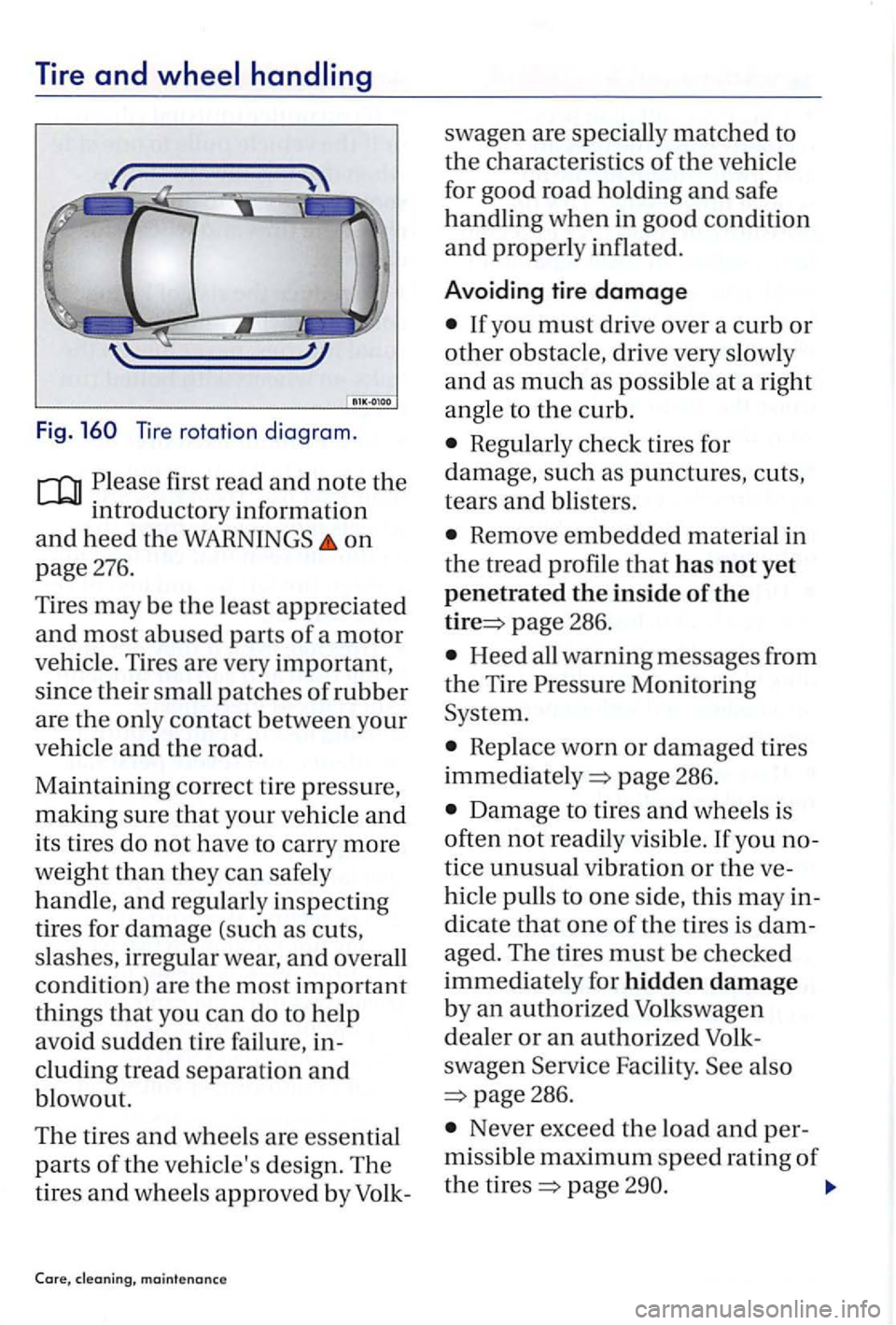
Tire and wheel handling
Fig. 160 Tire rotation diagram.
and note the
mtroductory mformation
and heed the WARNINGS on
page 276.
Tires may be the least appreciated
and most abused parts of a motor
vehicle. Tires are very important,
since their small patches of rubber
are the only contact between your
vehicle and the road.
Maintaining
correct tire pressure,
making sure that your vehicle and
its tires do not have to carry more
weight than they can safe ly
handle, and regularly inspecting
tires for damage (such as cuts,
s la sh es, irregular
wear, and overall
condition) are the
most important
things that you can do to help
avoid
sudden tire failure , in
cluding tread separation and
blowout.
The tires and wheels are essential
parts of the vehicl e's design. The
tires and wheels approved by Yolk-
If you must drive over a curb or
other obstacle, drive very slowly
and as much as possible at a right
angle to
the curb.
Regularly check tires for
damage,
such as punctures, cuts,
tears
and blisters .
Remove embedded material in
the tread profile that has not yet
penetrated the inside of the
page 286.
Heed all warning messages from
the Tir e
Rep lace worn or damaged tires
immediately=> page 286.
Damage to tires and wheels is
often not readily visible. If you no
tice unusual vibration or the ve
hicl e pulls
to one side, this may in
dicate
that one of the tires is dam
aged. The tires must be checked
immediate ly for hidden damage
by an authorized Volkswagen
dealer or an authorized Volk
swagen Service Facility.
Never exceed the load and per
missible maximum speed rating of
the tires=> page
Page 279 of 541
Tires must have the required
clearance. Tires
that do not have
enough clearance can rub
against parts of the vehicle body,
suspension,
and brake system,
causing brake system failure,
tread delamination, and sudden
blowouts.
Note
Never drive without valve stem
caps. The valves and sensors of the
Tire Pressure Monitoring
could be damaged.
Care, maintenance
(continued)
The sensors must be replaced at
scheduled intervals Booklet
Warranty and Maintenance
booklet.
Always dispose of old tires in
accordance with l
egal require
ments.
Replace it a tir e matchin g th e others on your ve hicle as soon as possible.
Although tire siz e specifica-
tions
can be the same, the ac
tual dimension s may differ from
those nominal values for different
tir e makes,
or the tire contours
may be significantly different.
Page 280 of 541
Tire
first read and note the
introduc to ry in
formation
a
nd h ee d the WARNINGS on
page 276.
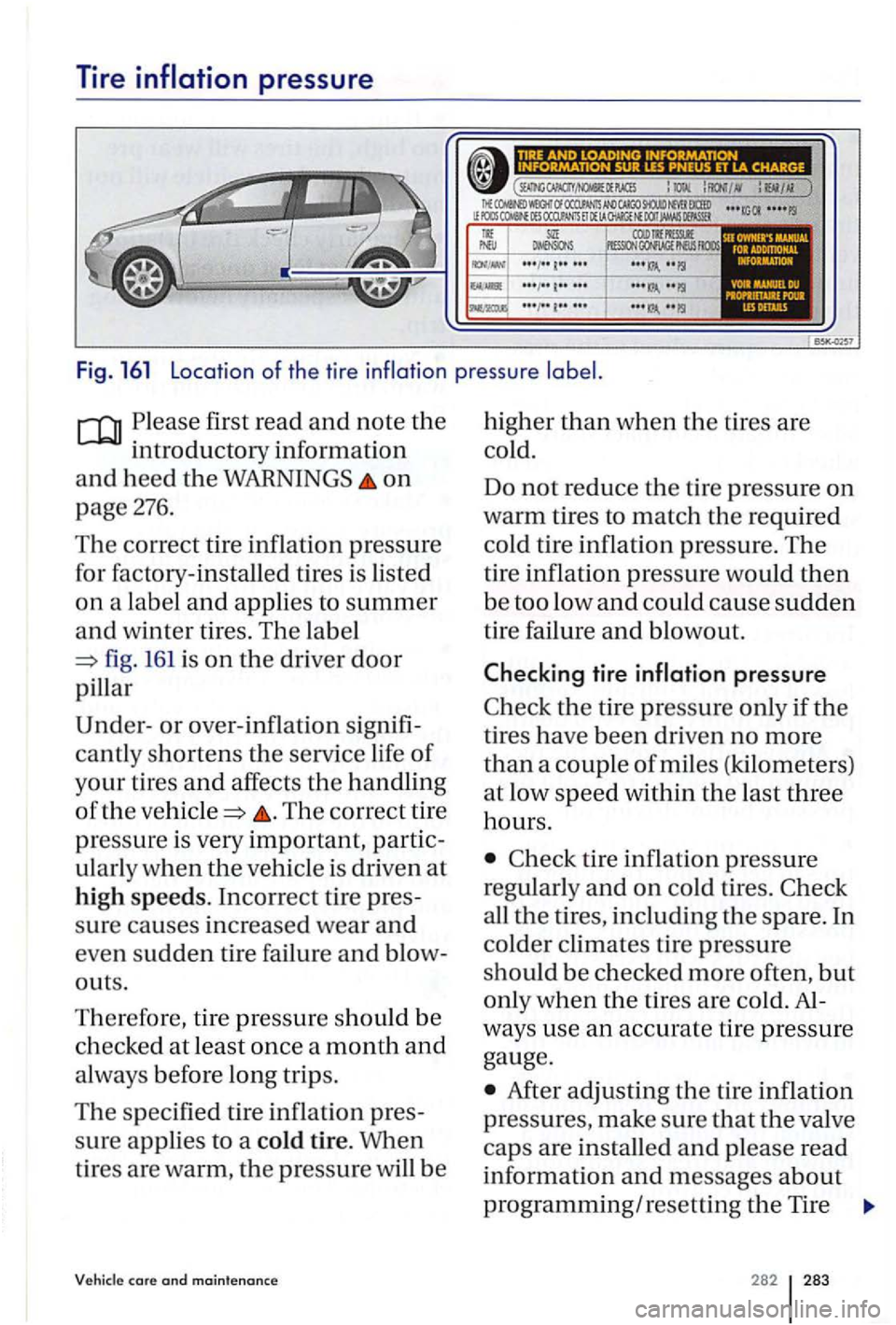
T he c orr ec t tir e infl atio n
pressure
f o r f ac
tory-install ed tires is lis te d
o n a la b el a
nd a ppli es to summer
and wint er tir es. T he la b el
fig. 161 is on the dri ver door
pillar
Chec k tir e infl ati on pressure
r eg ula
rly a nd on cold tires . C heck
al l
the tir es, includin g th e s pare. In
co l
der clim ates tire pressure
s h ould be c hec k
ed more o ften , but
only w hen th e tir es are c old . Al
w ays use an a cc
urate tir e pressure
ga uge .
Afte r adju stin g tl1e tire inflation
pressures, make sure th at the valve
ca ps a re i
nsta ll ed and please read
informati on and m essages about
programming/rese ttin g th e Tir e
282