2012 VOLKSWAGEN GOLF PLUS oil
[x] Cancel search: oilPage 190 of 541
Note
Always be careful when you park in areas with parking barriers or high cmbs. These vary in h eigh t and could damage your bumper andrelated parts ifLhe front of your ve hicl e hit s a barrier or curb that is too high while you are getting into or out of a parking spot . To help prevent damage, stop before the tires of your vehicle touch a parking barrier or curb.
Warning and indicator
Note (continu ed)
Always be careful when you enter a driveway or drive up or down steep ramps or over curbs or obstacles. of the vehicle close to Lhe ground may be damaged (s u ch as bumper covers,
spoilers, and parts of the engine, suspen sion, and exhaust
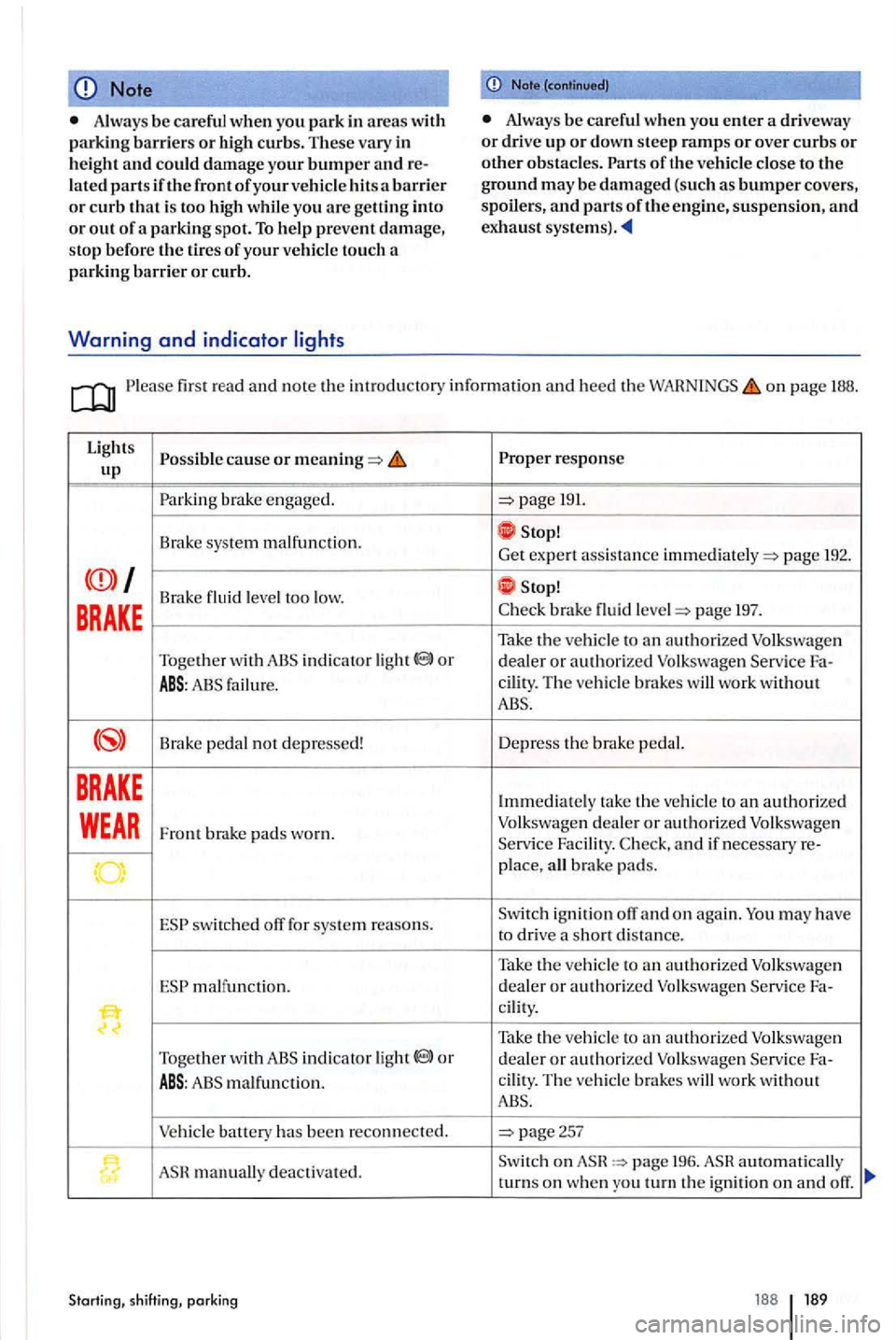
firs t read and note Lhe introdu ctory informat io n and hee d the WAHNINGS page 188.
Lig ht s
191.
Brak e syste m malfun ction. Stop!
Get
expert assi stance pag e 192.
Brake fluid leve l too low. Stop!
BRAKE brake fluid page 197.
Take the vehicle to an au thorized indicator light or dea ler or authorize d Volksw agen Service Fa-
ABS: failure. ci
lity. Th e ve hicl e brakes will work without ABS.
Brake pedal not depressed! Depress the brake
pedal.
BRAKE Immediate ly take the vehicle to an auth orized
WEAR Front brake pads wo rn. Volkswagen dealer or authorized Volk swage n
Serv ice Facility. and if necessary re-place, all brake pads.
switc h ed off for syste m r easo ns. Switch ignit ion off an d on again . You may have
to dri ve a short dis tan ce.
Take th e ve hicle to an authori zed Volksw age n malfunc ti on. dealer or a
uthorize d Volk sw agen Service Fa-cilit y .
Tak e the vehicl e to or d ea le r or a uthori zed Volksw agen Service Fa-
ABS:
page257
manually deacti va te d. S
witch on p age 196. a ut om atically
turns on w he n you turn the ig nition on and off.
Startin g, shift ing, parking 188 189
Page 194 of 541
Brake booster
Th e brak e boo ste r w ork s o
nly wh en the engi ne is
running . It increa se s th e forc e on the brake s above and beyond the pre ssure put on th e brake pedal by
the driver.
If the brake booster is not working, or if th e ve hicl e
ha s to be towed, you have to push th e brak e
p ed a l hard er to make up for the lack of booster
New brake pads do not provide maximum braking performance.
New brake pads do not have the best ping power for the first km) and must be You can compensate for the slightl y reduced braking force by putting more pressure on the brake pedal.
Drive with
Never follow otl1er vehicles too closely or put yourself into other sit uation s that might require sudden, hard braking ,especially when the brake pads have not been broken
Overheated brakes
When driving downhill , the brakes have to
work es pecially hard and heat up quickly.
Before driving downhill, es peciall y on th at are long or steep, alwa ys reduce s peed and shift into lower gear (manual or automatic
transmission) so that the engine he lp s to brake
the vehicl e. Othenvise, the brake system cou ld
ov erheat and pos sibly u se the brakes
w hen yo u need them to slow the v ehicl e down
m ore or to stop.
A damaged front spoiler or a non- standard spoiler can reduce airflow to the brakes and
Starting, shifting, parking
Wet brakes or brakes witl1 icc or road salt
react slow er and n eed lo n ger stoppin g tances.
Ca refully apply the brakes to test th em.
Always dry brak es and clean off ice and salt
coat ings with a few cautious
tions permit.
Driving when the booster is no t working
in creases stopping distances and can cause dent s and seriou s personal injuries.
Never le t the vehicl e coast when the en gine is
switc hed off.
If the brake booster is not working (such as
w he n the vehicle is bein g towed), a lot more pedal force is needed to slow down and stop.
Note
Neve r the by keeping your foot on the to brak e.
Constant pressure on the brake pedal can make th e brakes overheat. This sub stantially reduce
braking performance, increase stopping di stan ce, and can cause co mpl ete failure of th e brake
s y stem.
Before driving downhill, especially on that are long or steep, always reduce speed and shift into lower gear (manua l or automati c
When th e front brake s are serviced , you should have the rea r brake pads inspected
rized Volksw agen deal er or au th orize d Volkswa gen
Service Facility vis uall y insp ec t th e pads through
th e o pe nin gs in the wh eel rim s or from nea th tl1e ve hicle. If n ecess ary, the wheels ca n be
t ake n off for a mor e thorou gh
192 193
Page 197 of 541
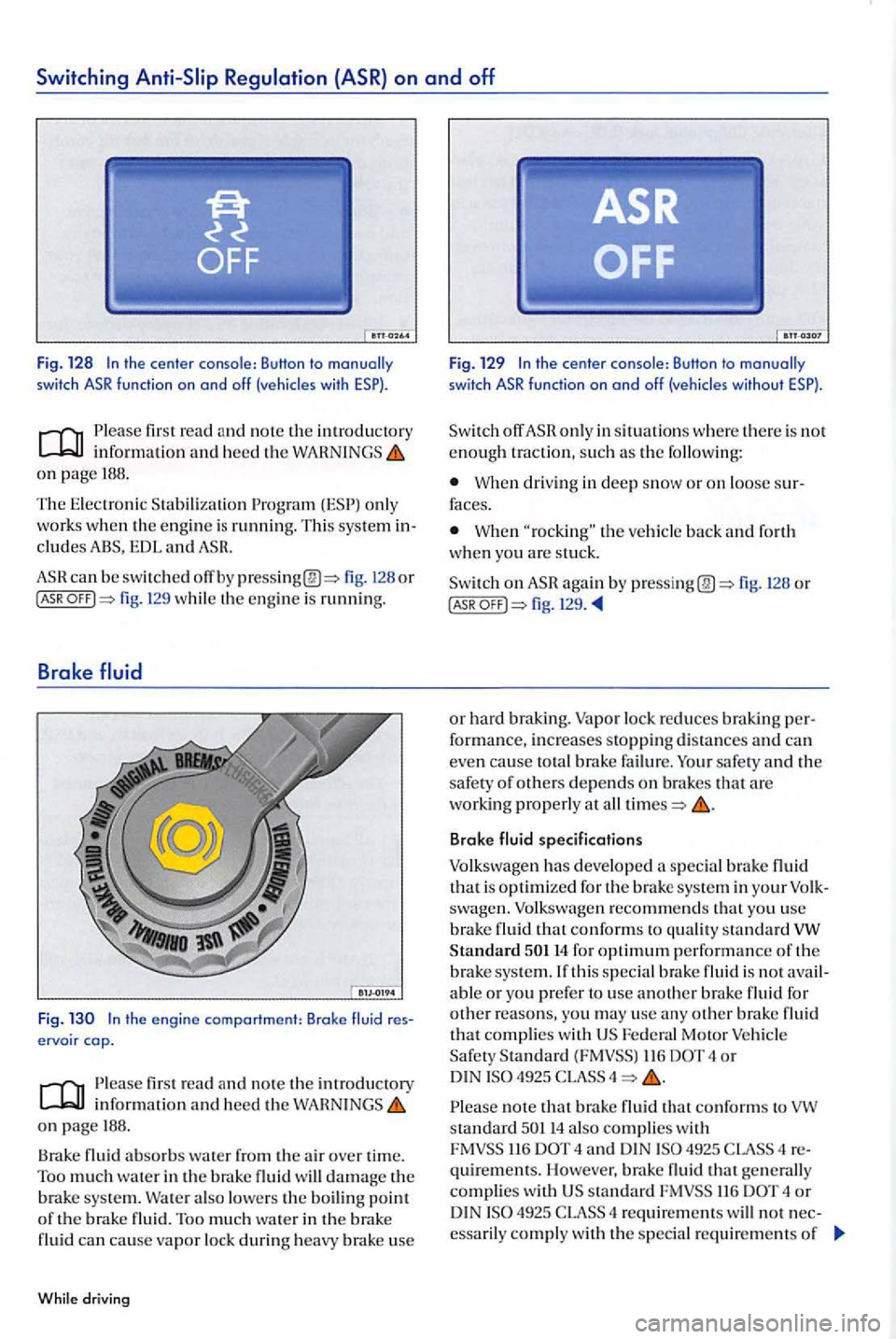
Switching
the center console: Button to with
Please fir st read and no te the introductory informatio n and heed the on page
The Electronic Stabili zation Program
cludes
can b e switched off by fig. (ASR fig. 129 whil e th e engi ne is running.
B rake
ervoir cop.
Please fir st r ead and note the introductory information and heed the on page 188.
Brake fluid
absorbs wate r from the air over time. Too much water in the brake fluid will damage the brake system. Wa te r a lso lowers th e boiling point o f the brake fluid. Too much wate r in the brake
fluid can cause vapor lock during heavy brake use
Whi le driving
Fig. 12 9 the center console: Button to switc h function on and without
off only in situations w here there is not enough traction, s u ch as the fo llo wing:
When driving in deep snow o r o n loose faces.
W hen
on again by fig. 128 or (ASR fig. 129 .
or hard braking. Vapo r lock reduces braking
safety and the safe ty of others d e pends o n brakes that are working properly at all
Brake
swagen. Volkswagen recommends that yo u use brake fluid that conforms to quality standard 14 for optimum p erformance of the brake system. If this s pecial brake fluid is not
Motor Vehicle 116 4 or 4
Please note that brake fluid that conforms to standard 14 a lso complies w ith 116 4 and DIN 4 quirements. However, brake fluid that generally complies with 116 4 or 4925 CLASS 4 requirements w ill not essarily comply with the s pecial requirements of
Page 200 of 541
Efficient driving
Please information and heed the on page 198.
Shifting faster
As a rule, the following applies: The higher gear is
a lways the more efficient gear. The rule of thumb for most vehicles is to drive in 3rd gear at mph f km/h, 4th gear at 25 mph f km/h, and 5th gear at mph f km /h.
If
and driving conditions permit, gears when upshifting also saves fuel.
Do
not run the gears up to their limit.
mati c transmissions .
Vehicles with gear recommendation aid in fuel fic ient dri ving by indicating the optimum time to shift gears.
livery to the engine is interrupted, which lowers
fuel consumption.
T herefore, when nearing a red stop light , for s tanc e, allow the vehicle to coast without using the accelera tor. Press the clutch pedal and release it only if the v ehicle is moving too slowly or the coasting distance is too long. The engine will then continue to run at idl e.
In situati ons
where the vehicle will be stopped for
a longer period of time, such as at a train cros sing,
physically switch off the engin e.
D efens ive driving
and with traffic
Fre
quent braking and accel eration increases fuel consumption sign ific antly. Just by driving sivel y and keeping a su fficiently large distance away fro m the vehicle in front of you can make up for the speed fluctuation s caused by taking your foot off the accelerator. Active braking and ating is then not necessarily required.
system information
The power stee ring syste m i s not hydrauli c.lt is an electro-mechanical syste m. The advantage of this
s te ering system is tha t no hydra uli c hoses, draulic oil, pumps, filters or other parts are quired . Th e e lectro-m echanica l system is more fue l effi cient. A hydraulic system requires constant oil pressure in the syste m; an electro -mechanical
s teerin g sys tem, however, needs power only whil e
s teering.
Th e el
ectro-mechanical power steering
chanical power steering works only when the gin e is running.
and smooth driving
Consistency is more important than speed. The more smoothly yo u drive, the less fuel the vehicle consumes.
When driving on the highwa y or freeway, a
stantly accelerating and braking. you can r each your destinatio n just as quickly by driving at a moderate, but steady speed.
The c rui se control syste m can a ssis t in
sciou s manner.
Some dev ices can increase fuel consumption when activated (examples):
C limate control air conditioning system:
trasting temperatures, it requires a large amount of energy, which is generated by the e ngin e. T he
tr emely different from that of the outside
windows increase fuel consumption.
Switch off seat heating once it has served its
purpose.
Sw itch off the windshield and rear window
Malfunctioning engine control.
Driving in the mountains.
Towing a trailer .
page 257
Towing and page 357
Turning the steering wheel is very hard when the power steering system is not working. This makes it harder to control the vehicle.
steering works only when the engine is running.
Never let the vehicle coast with the engine switched off.
Never remove the key from the ignition
switch while the vehicle is moving or rolling to a
stop. The steering column will lock and you will be unable to control the vehicle.
Page 201 of 541
Fuel-efficient driving
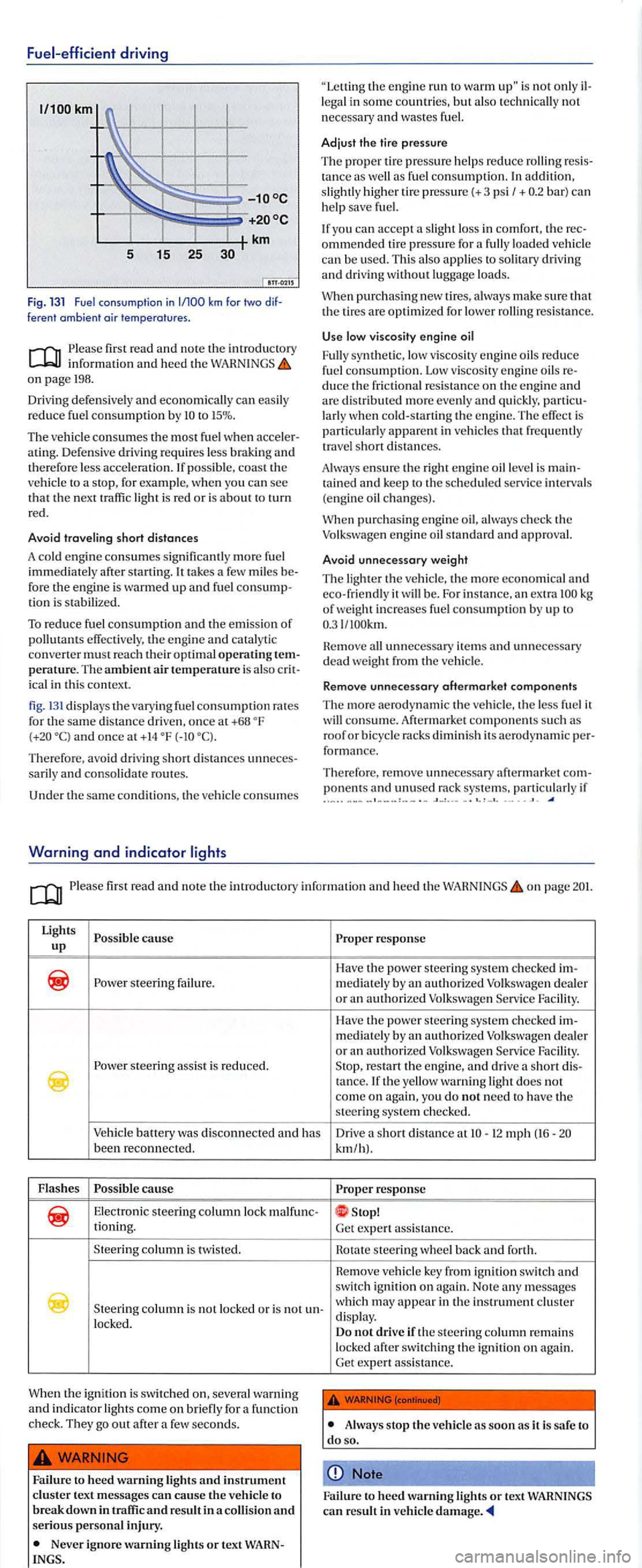
Fig. 131 Fuel consumption in ferent ambient air temperatures .
info rmation and heed the on page 198.
Dri vin g defensive ly and economically can easily
r educe fuel con sumption by to 15 % .
The ve hicle consu mes the most fu el w he n atin g. D efe nsive dri vin g require s less brakin g and therefore less accelerat ion. If possib le, coast the ve hicle to a sto p, for exa mple, when yo u ca n see th a t th e next traffic ligh t is red or is about to turn
red.
Avoid traveling short distanc
es
A cold engine consumes sig nificantl y more fuel
imm ediately after sta rtin g. It take s a few miles fore the engi ne is warm ed up and fuel tion i s stabili zed.
To reduce fuel consumptio n and the emission of pollutants effect ive ly, the e ng in e and ca talytic
conve rter must reach th eir optimal operating
ica l in thi s context.
fig. 13 1 displays the v a ry ing fuel consumption rates
for the same d istance dri ven, once at +68 and once at + 14
th e e ngin e run to warm is not o nl y lega l in some co untries, but also technicall y not
n ecessary and wastes fu el.
Adjust the tire pres sure
T he prop er tir e
pressure help s reduce rollin g tance as well as fue l co nsumption. In additi on ,
slig htl y higher tire pressure(+ 3 psi I+ bar) ca n
h e lp save fuel.
If you ca n a ccept a slight los s in comfort, the ommend ed tir e pressure for a fully loade d ve hicl e
ca n be used. This als o applies to so litary dri vin g and driv ing withou t lu ggage loa ds.
When purchasing new t ires, alway s ma ke sure th at
th e tires are optimi zed for lower rollin g resis tance.
Us e low viscosity engine oil
F ull y sy nth e
tic, low viscosity e ngine oils reduce
fuel consumption. Low viscosity e ngin e oils duce the fric tional res istance on th e engine and are dis tributed m ore evenly and qui ckly, larly w hen co ld -s tarting the engine. The effect is parti c ularl y apparent in vehicles th at frequentl y
tra vel s hort dis tan ces.
A lways ens
ure th e righ t e n g in e oil leve l is ta in ed and keep to the sc h edul ed serv ice interva ls
(e ng ine oil ch an ges).
W
hen purch asing e ngine oil, always ch eck th e Volksw agen en gine oil standard and approval.
Avoid unnecessary weight
The lighter th e ve hicl e, th e more economica l and ceo-friend ly it w ill be. For in stance, an extra
H e m ove
consum e. Aftermark et co mponents s uch as
ro of or b icycle racks dimin is h its aerod yn a m ic fonnan ce.
Th erefo re, re
mov e un necessary aftermark e t ponents and unused rac k systems, parti cul arly if ....... -
fir st read and note th e introductory informa tion and h ee d th e WAHNINGS page
response
Ha ve the power stee rin g sys te m ch ec ked ste eri ng failure. mediatel y by an authori zed Volk swag en deale r
o r a n authorized Volk swagen
Fac ility. steeri ng ass is t i s reduced. re start the e n gine, and dri ve a sh ort tan ce. If th e yello w warning light does not
c o m e on again, you do not need to have th e
s te ering syste m ch ec ke d .
Vehicle battery was di sconnected and has Drive a short distan ce at 12 mph been reconnec te d . km/h).
F lashes re sponse
Elec troni c steering column lo ck malfunc -
which m ay appea r in the in strument clu ste r
di sp lay. loc ke d.
W
hen the i g nit ion is switc h ed on, seve ra l wa rnin g and indicator lights come on bri efly for a f un ction ch e ck . T hey go out after a few seconds.
Failure to
heed warning light s and in strument cluster text m essages can cause th e vehicl e to break down in t raffic and result in a collisio n and seriou s personal injury.
Neve r igno re warning lights or tex t
Do not dri ve if th e s teerin g co lumn remains
l ocke d switch in g th e ig niti on on aga in.
Ge t expert assis ta nce.
Alwa ys sto p the vehicl e as soon as it is safe to do so .
Note
Failur e to heed warning lights or tex t WARNINGS can res ult in vehicl e damage
Page 235 of 541
Refueling checklist
first rea d an d note the introductory information and heed the on page 234.
The engi ne compartment of moto r vehicle is a haza rdous engine or in the engin e compartment unless yo u -know exac tl y how to carry o ut the job,
-have the correct technical in formation and the proper too ls and supplies, and -ar e familiar with the necessary safety precautions page 242, Preparation s for working
have the work done by an authorized Volkswagen dealer or authorized Volkswag e n Serv ice Facility. Ser ious personal injury may result from improperly perform ed work. Make
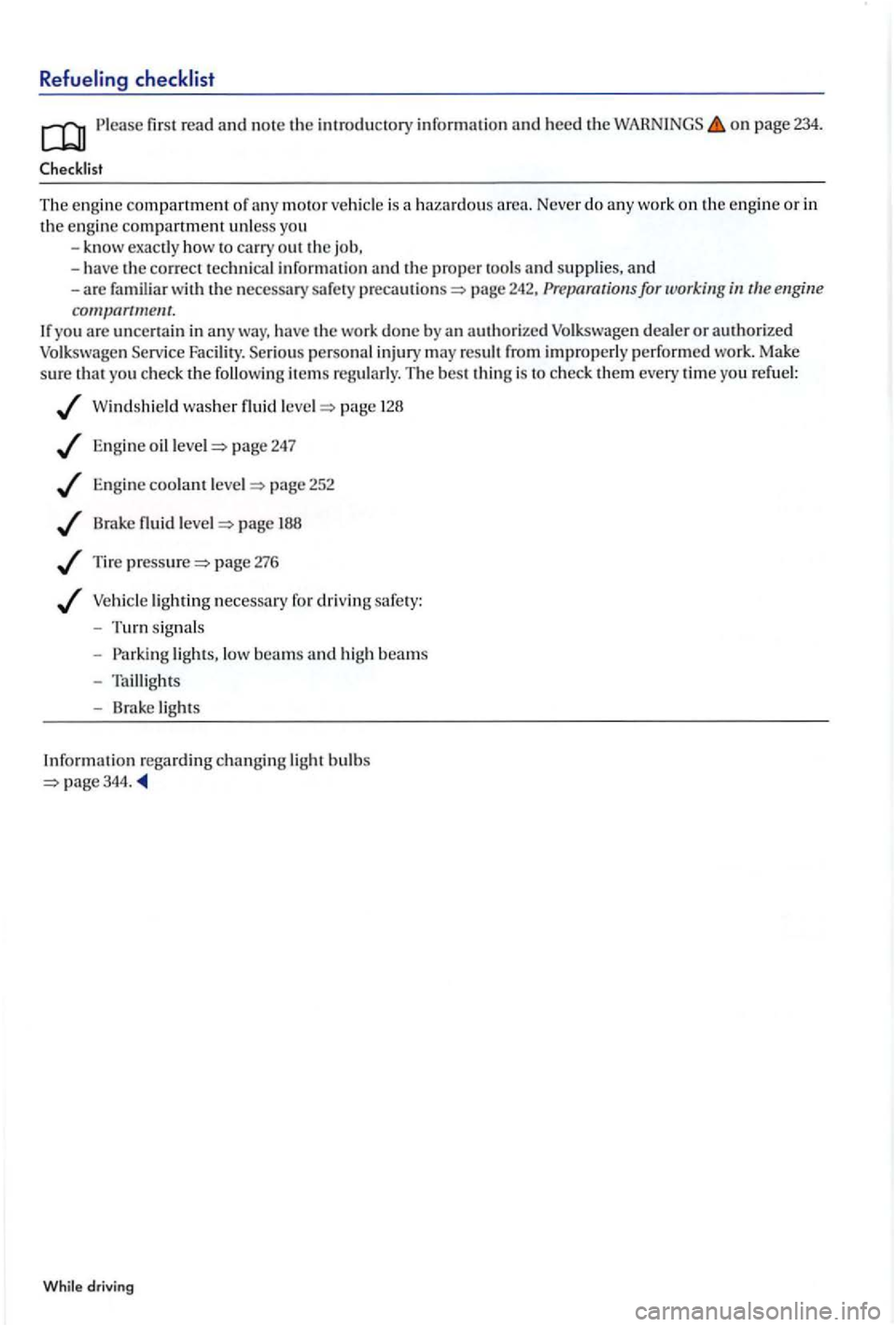
s ure that y ou check the followin g item s re gu larly. The bes t thin g is to check them every time you refue l:
Wind sh ie ld was her fluid leve l page 128
E ng in e oil leve l page 247
Engin e coolant leve l page 252
Brake fluid level page 188
Tire pressure page 276
Vehicle lighting necessary for drivin g safe ty:
-Turn signal s
-
li ghts, low beams and high beams
- Taillights
- Brak e light s
Inf
ormat ion regard ing changing light bul bs page 344.
While dri ving
Page 238 of 541
Always use only Ultra Low Sulphur Diesel (ULSD) fuel No.2
tio n
shoul d be clearly marked on th e pump. Before filling your vehicl e plea se m ak e sure you are
usin g ULSD. Acco rding to Fed era l regu lation s ULSD is th e only diese l fuel t ype allowe d for use in your vehicle.
Diesel
fue l with con ce ntration s of methyl ester biodiesel high er than 5% (B5), such as Bll, are stri ctly pro hibited.
Se rv ic e s tation s
selling diese l fuel a re generally on
t ru ck rout es or major hi ghwa ys. Dir ecwries of
diesel fuel stati ons are usuall y avai lable at diese l
fuel s tat ion s.
U
LSD Diese l fuel ma y no t b e ava ilabl e outside the
USA and f ore trave ling to o ther countri es.
Winter diesel
At tempe ratures below F (-7' wax separation
in ULSDoccur s. Wax may clog the fuel filter or tank
filt er an d keep th e en g in e from running.
To help pr event th e filter from being clogged with
wax , th e fuel filt er in your ve hicl e is heated with
warm fuel whe n the engin e is running ( filt er heatin g sys te m ). Heatin g th e fue l filter makes it
pos sible to use your vehicl e with ULSD down to about 'F (-24
I f yo u ex pec t temperatures below 5 'F (-1 5
th e po int that th e en gin e will no t move the vehicle to a
heat e d garage or worksho p until it has w arm ed up.
p e ndin g on th e out side temperature.
D o no t let y
our die sel engine idle unnecessarily
afte r cold stan. Drivi ng off slowl y will short en the warm -u p period.
'
Neve r use
Note
The vehicl e's diesel engine was designed sole ly
for use with ULSD fuel. For this reason , nev er use gaso line, heating oil, or other unsuitable fuels. The properties of these fuels may cause serious damage to the fuel system and to the engin e. Such damage will not be covered by any Volkswagen
Limited Warrant y.
The vehicle was designed to run on diesel with blend leve ls up to and including 5% methyl ester biodi esel. Never use methyl ester biodiesel in
blend lev els hi gher than 5% (5% methyl est er
blends are sometime s designated or labeled as
B5). The propertie s of methyl ester biodiesel
blend s in leve ls greater than 5% may cause riou s damage to the fuel injection system and to the engine. This co uld lead to expensive repairs that will not b e cove red any Volkswagen Limited
241
Page 244 of 541
Engine oil
Introduction
In thi s sect io n you'll find inform ation on the fol
lowing:
Warning and indicator lights . . . . . . . . . . . . . . . . . . . 247
Engine
=>Boo klet Warranty
fo r wor king in the engine compartment=> page 242
accessories, repairs and modifications page303
Im
proper h andling of engin e oil can cause severe burns and other seriou s injurie s.
Always wear eye protection.
Warning and indicator light s
Engine oil is poisonous and must be stor ed out of the rea ch of children.
To reduce
Engine oil becomes ex tremely hot when the engine is running and can ca use severe burns. Alway s le t the engine cool down to the tou ch.
all othe r operat in g flui ds, engine oil can pollut e the envir o nment. leak ing op
erat ing fluid s and dispose of them properly in ac
co rdance with appl icable environmental laws and regu latio ns.
on page 247.
Light s response up
Engine oil level too low. th e engine. th e eng ine oil leve l --=>page 249.
Flashes cause respon se
Switc h off the eng ine.
Engine oil press ure too low.
-If the warning light flashes although the oil level is normal , do continue driving or let the en gine idle. as damage may result. Get ex -pert assis ta n ce.
Take the veh icle to an auth orized Volkswagen Engine oil leve l sensor malfunction. dealer or authorized Volkswagen Service Fa-cility. Have the engine oil sensor checked .